
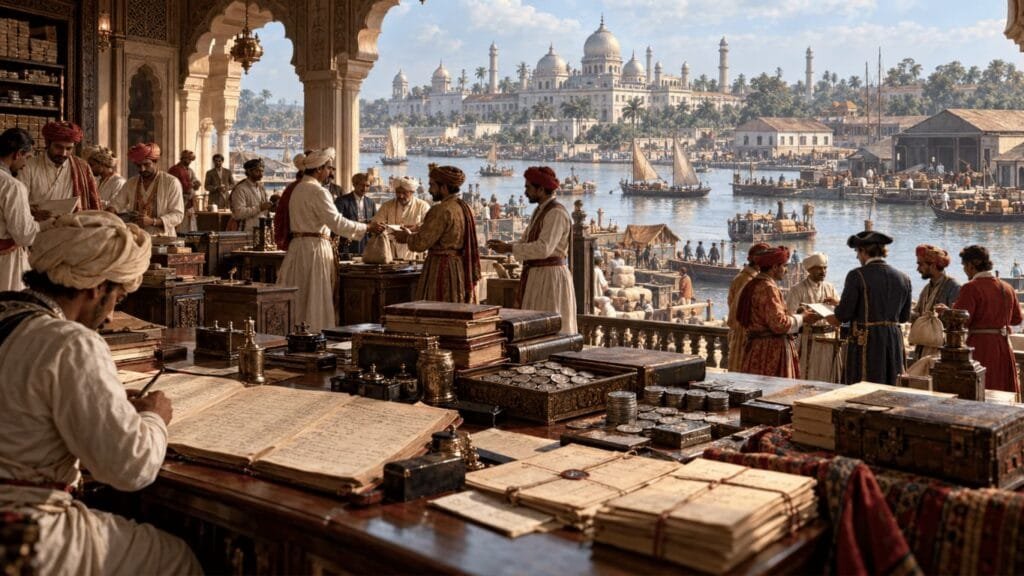
Jagat Seth was more than the name of a wealthy banker in 18th-century Bengal. It became associated with one of the most powerful banking houses in eastern India, a financial institution deeply connected to Bengal’s treasury, revenue system, credit networks and political elite.
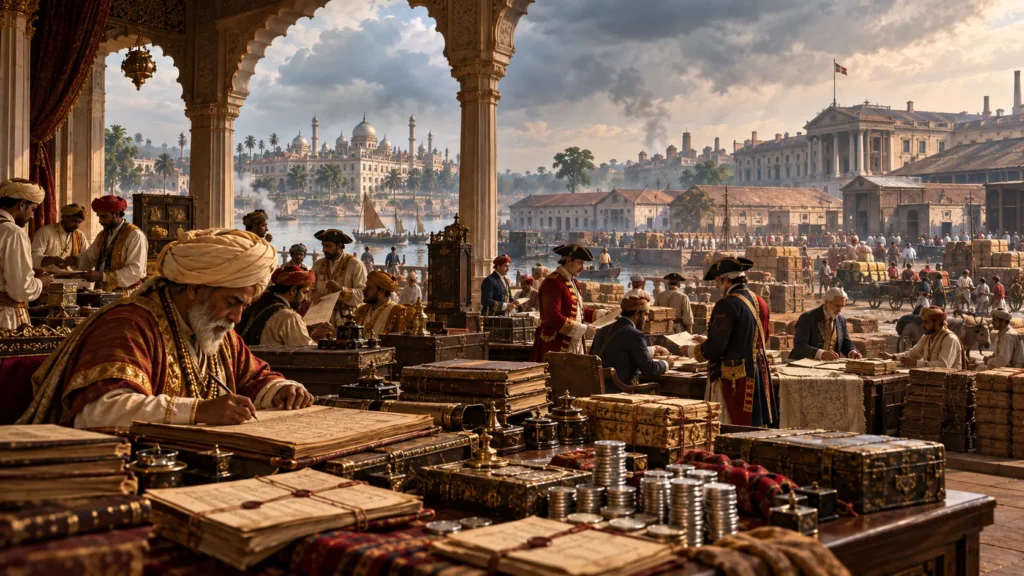
By the middle of the 18th century, the House of Jagat Seth occupied an unusual position. It dealt with rulers, zamindars, merchants and European trading companies. Its financial activities were intertwined with the movement of government revenue and the wider commercial economy of Bengal. Contemporary British records even described the Seths as a “great banking family” at Murshidabad and noted their connection with the management of the government treasury.
Then came 1757.
When the East India Company moved against Bengal’s Nawab, Siraj ud-Daulah, the Jagat Seths became involved in the political coalition that supported his replacement by Mir Jafar. On 23 June 1757, Robert Clive’s Company forces defeated Siraj’s army at the Battle of Plassey.
But the story does not end with Plassey.
In fact, the most interesting part came afterward.
The same transformation that turned the East India Company into a major political and fiscal power would eventually weaken the financial system that had made the Jagat Seths so influential.
This is the story of how money became political power—and how political power eventually changed the world of money.
By the middle of the 18th century, the House of Jagat Seth occupied an unusual position. It dealt with rulers, zamindars, merchants and European trading companies. Its financial activities were intertwined with the movement of government revenue and the wider commercial economy of Bengal. Contemporary British records even described the Seths as a “great banking family” at Murshidabad and noted their connection with the management of the government treasury.
Who Was Jagat Seth?
The first thing to understand about the Jagat Seth story is that Jagat Seth was not simply one individual.
The name became associated with the head of a powerful banking house based at Murshidabad. J. H. Little’s historical study of the family traces the succession of the house and records Fateh Chand’s receipt of the title “Jagat Seth” during the reign of Muhammad Shah. His descendants continued to hold the title, including Mahtab Rao, whose position became particularly important during the crisis of 1757.
That distinction matters.
Popular accounts sometimes present Jagat Seth as if he were an 18th-century equivalent of a single billionaire controlling Bengal from behind the scenes.
The reality was more institutional.
The House of Jagat Seth was a family banking enterprise whose importance came from its position inside Bengal’s financial system.
Research published in the Journal of Asian Studies describes the Jagat Seths as bankers to the provincial government who also supplied loans to zamindars to help them meet revenue payments. By the first half of the 18th century, bankers had become an important component of Bengal’s ruling and administrative structure.
So the key to understanding Jagat Seth is not simply wealth.
It is financial infrastructure.
The House of Jagat Seth: How a Banking Family Rose in Bengal
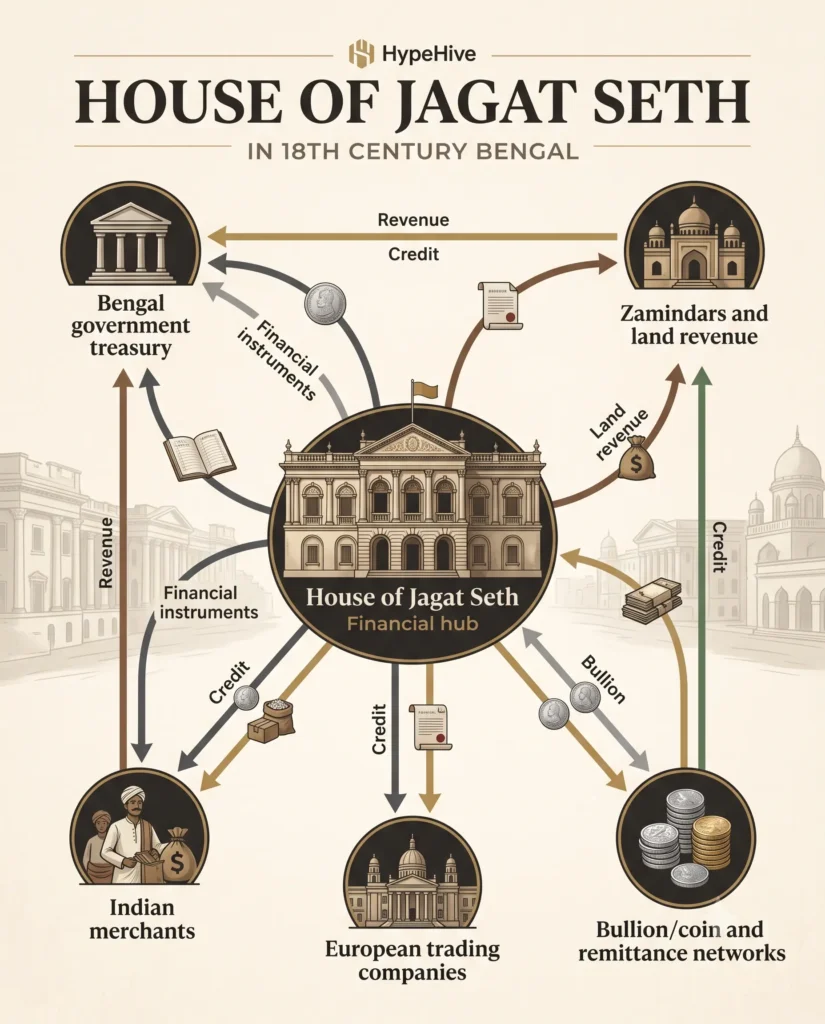
To understand why the Jagat Seths became politically important, it is necessary to understand how Bengal’s economy worked.
The Bengal government collected revenue from agriculture.
Zamindars had obligations to the state.
Merchants needed credit.
Governments needed money before revenue arrived.
Funds had to move between cities and political centres.
And different currencies and forms of payment had to be converted and transferred.
Bankers operated across these connections.
The House of Jagat Seth became particularly important because it could provide credit, handle financial transactions and connect Bengal’s government with wider commercial networks.
The British Library preserves a 17 December 1757 letter describing the Seths as a major banking family at Murshidabad. The archival description specifically notes that the letter is valuable for understanding how the government treasury was managed under the Bengal government.
This was a remarkable position.
A military commander controlled troops.
A zamindar controlled land and revenue collection.
A Nawab controlled the provincial government.
But a major banking house could help move the money that connected these different parts of the system.
That made the bankers indispensable.
It also gave them political importance.
When Money Became Political Power
The rise of the Jagat Seths illustrates a broader transformation taking place in Bengal during the 18th century.
The weakening of centralized Mughal authority did not mean that political power simply disappeared.
Instead, regional networks of military leaders, zamindars, administrators and financiers became increasingly important.
Historian Philip Calkins described bankers as an important element within Bengal’s ruling group after 1700. The Jagat Seths, in particular, became bankers to the provincial government and lenders to zamindars who needed funds to meet their revenue obligations.
The banking house therefore had access to something extremely valuable:
information.
It knew who needed money.
It knew where revenue was coming from.
It dealt with officials and merchants.
It could transfer funds.
And it operated close to the Nawab’s court.
That combination of finance and political access meant that the Seths were no longer merely private merchants.
They had become part of Bengal’s political economy.
And when Bengal’s politics entered a crisis, their financial position inevitably became political.
Why Did the Jagat Seths Oppose Siraj ud-Daulah?
By the time Siraj ud-Daulah became Nawab, Bengal’s political environment was already complicated.
The East India Company was expanding its military capabilities.
The Company was competing with the French.
Siraj was attempting to assert his authority.
Powerful members of Bengal’s political and financial elite had their own interests to protect.
The relationship between Siraj and the Jagat Seths deteriorated badly.
The National Army Museum identifies Mahtab Rai, head of the Jagat Seth banking family, as one of the figures concerned that Siraj might seize the family’s considerable wealth. It also records that the Jagat Seths and Robert Clive secretly offered Mir Jafar the Nawabship if Siraj was defeated.
This is an important point.
The conflict was not simply a straightforward confrontation between the British and Bengal.
There were competing factions within Bengal itself.
The East India Company had its own commercial and strategic objectives.
Mir Jafar had political ambitions.
The Jagat Seths had financial interests and concerns about Siraj’s government.
Other powerful figures were also dissatisfied with the Nawab.
The Company’s intervention therefore intersected with an existing political struggle.
That intersection would prove decisive.
Jagat Seth and the Battle of Plassey
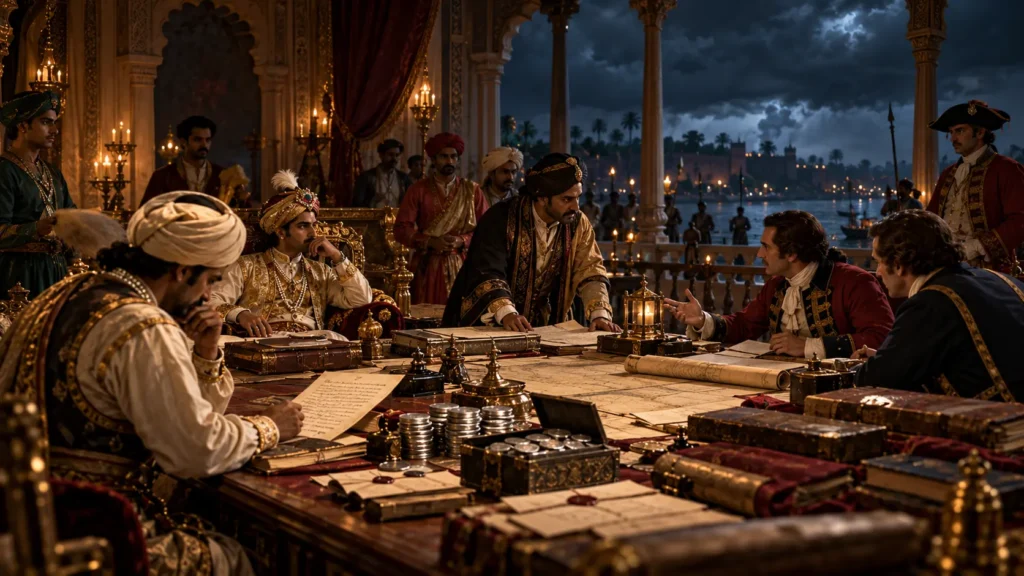
The Battle of Plassey was fought on 23 June 1757.
Robert Clive’s forces were heavily outnumbered. The National Army Museum gives Siraj’s army at roughly 50,000 men, compared with around 3,000 in Clive’s force.
Yet Plassey was not simply a battle of numbers.
The political arrangements made before the battle were crucial.
The Company had reached a secret agreement with Mir Jafar, one of Siraj’s commanders.
According to the National Army Museum, the Jagat Seths and Clive supported the plan to replace Siraj with Mir Jafar. During the battle, Mir Jafar did not commit his forces against Clive.
The battlefield outcome was therefore connected to a much larger political conspiracy and realignment.
Siraj’s forces were defeated.
Mir Jafar subsequently became Nawab.
The East India Company gained enormous political leverage in Bengal.
And the consequences extended far beyond the battlefield.
The National Army Museum describes Plassey as the beginning of a process that eventually transformed the Company into an imperial power.
But there is an important distinction.
Plassey did not instantly give Britain control of India.
It was a decisive opening in Bengal that allowed the Company to expand its political and fiscal power in the years that followed.
Did Jagat Seth Actually Finance the British Victory?

This is where the popular version of the Jagat Seth story needs to be handled carefully.
It is well documented that the Jagat Seths were major financial actors in Bengal and that they became involved in the political arrangements surrounding Mir Jafar and the East India Company.
But that does not automatically mean that “Jagat Seth financed the Battle of Plassey.”
There were substantial financial transactions associated with the political settlement.
Later records also contain large claims made by the Seth family regarding money advanced during this period.
These records have contributed to the popular description of the Jagat Seths as the financiers behind Plassey.
But the evidence supports a more precise formulation:
The House of Jagat Seth was financially connected to the political coalition surrounding Mir Jafar and the Company, and surviving records indicate substantial financial claims associated with this period.
That is different from claiming that the Seths simply paid for the British victory.
The distinction matters because Plassey was the product of several forces acting simultaneously:
- Company military intervention
- opposition to Siraj within Bengal
- Mir Jafar’s political ambitions
- financial interests of powerful banking and commercial groups
- British-French rivalry
- military decisions made during the battle itself
The Seths were one important part of this network—not the sole cause of the outcome.
Plassey Changed the Financial System Itself
This is the part of the story that is often missing.
The usual narrative goes:
Jagat Seth → Clive → Plassey → British rule.
But the historical sequence was much more complicated.
After Plassey, the East India Company became increasingly involved in Bengal’s political and financial administration.
The Company received payments and concessions from the new political arrangement.
It became increasingly dependent upon Bengal’s financial resources.
And then, in 1765, something much more significant happened.
The Company obtained the Diwani, the authority to collect revenue in Bengal, Bihar and Orissa, from Mughal emperor Shah Alam II. British Library records preserve Company papers concerning the grant of the Diwani and related arrangements.
This fundamentally changed the Company’s position.
Before Plassey, the East India Company was primarily a commercial organization operating within Indian political systems.
After Plassey, it became an increasingly powerful political actor.
After the Diwani, it possessed direct fiscal authority over major territories.
British Library records from the period include statements of Bengal and Bihar’s Diwani revenues and charges for 1765–1771, demonstrating the scale of the fiscal machinery the Company was now administering.
The transformation was enormous.
The Company was no longer merely asking powerful Indian financiers to help it operate.
It was increasingly becoming a power capable of controlling the revenue system itself.
From Financial Partners to a New Colonial Order
This is where the later history of the Jagat Seths becomes particularly revealing.
A 2026 working paper by Swapnil Bhagat examines the transformation of Bengal’s financial order between Plassey and the early years of Company Diwani. It argues that the Company continued to rely heavily on Indian bankers immediately after Plassey, before subsequent fiscal and institutional changes progressively reduced their autonomy.
That interpretation offers an important way of looking at the Jagat Seth story.
The Company did not simply replace the old financial system overnight.
Initially, it needed the very networks that had existed before its political rise.
But as the Company acquired direct rights over revenue, its relationship with indigenous financial institutions changed.
The old arrangement was gradually being replaced by a new fiscal order.
This produced an extraordinary historical irony:
The financial system that had helped make the Jagat Seths powerful was being transformed by the political power that emerged from the crisis in which they had participated.
What Happened to the Jagat Seth Family?
The family’s decline was neither immediate nor simple.
The political instability of Bengal continued after Plassey.
Mir Jafar’s rule was followed by the rise of Mir Qasim, who attempted to assert greater independence from Company influence.
The Jagat Seth family became caught in the continuing struggle.
By the 1760s, members of the family were killed during the political conflicts surrounding Mir Qasim. Recent scholarship specifically identifies the violent destruction of the Jagat Seth house under Mir Qasim as part of the broader transformation of Bengal’s financial order.
Their story therefore did not end with a peaceful loss of business to British competitors.
The family experienced political violence while the financial system around it was being fundamentally reorganized.
At the same time, the Company’s own records show that indigenous bankers continued to participate in Bengal’s financial system during the transition.
The decline of the Jagat Seths was consequently part of a larger transformation, rather than a single event.
Did the Jagat Seths Help Create British Rule?
The answer depends on what exactly is meant by “helped create.”
If the claim is that the Jagat Seths single-handedly handed Bengal to Britain, the evidence does not support such a simple explanation.
But if the claim is that the Jagat Seths were among the important Indian financial and political actors whose decisions intersected with the Company’s seizure of political power in Bengal, the evidence is much stronger.
The National Army Museum explicitly places the Jagat Seths within the political arrangement involving Clive and Mir Jafar before Plassey.
But Plassey was only the beginning of the transformation.
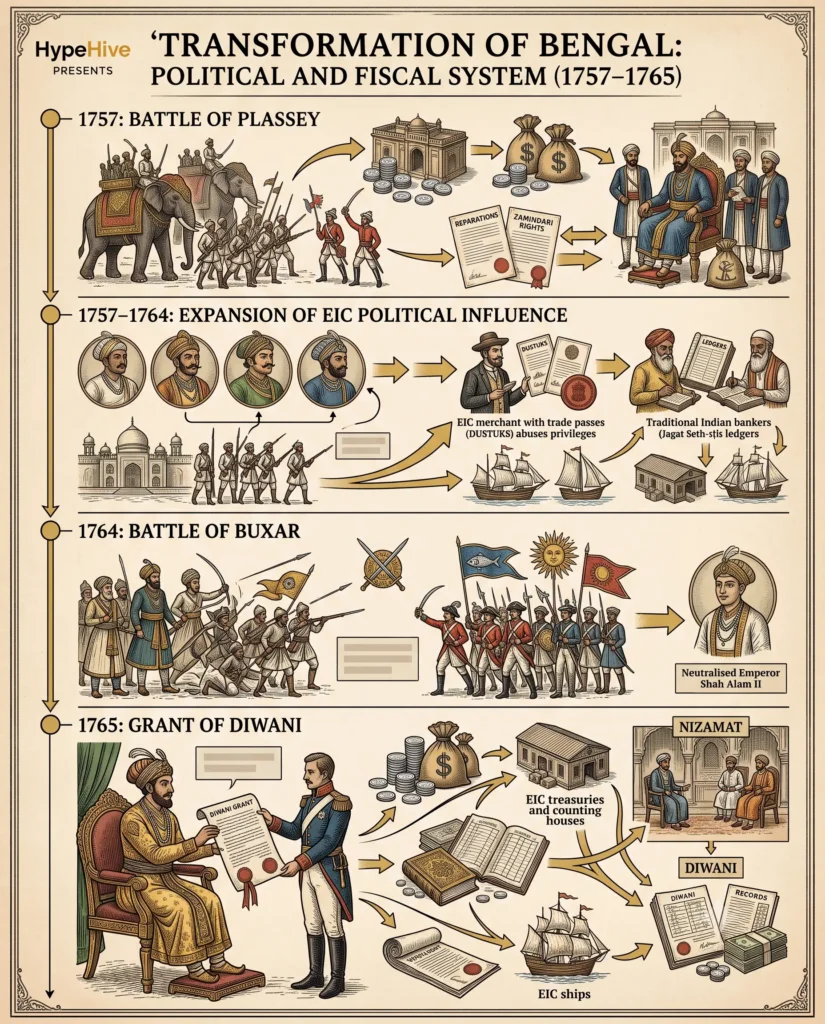
The broader sequence was:
Plassey — 1757
↓
Company political influence expands
↓
Battle of Buxar — 1764
↓
Diwani — 1765
↓
Company gains increasing control over Bengal’s revenues
↓
A new colonial fiscal system develops
British Library records from the period document the Company’s expanding revenue administration following the acquisition of the Diwani.
The Jagat Seth story therefore belongs to a much larger historical transition.
It was not simply about one banking family and one battle.
It was about the transformation of who controlled money, revenue and political authority in Bengal.
The Real Story of Jagat Seth
The House of Jagat Seth did not suddenly become important in 1757.
Its influence had been built over decades.
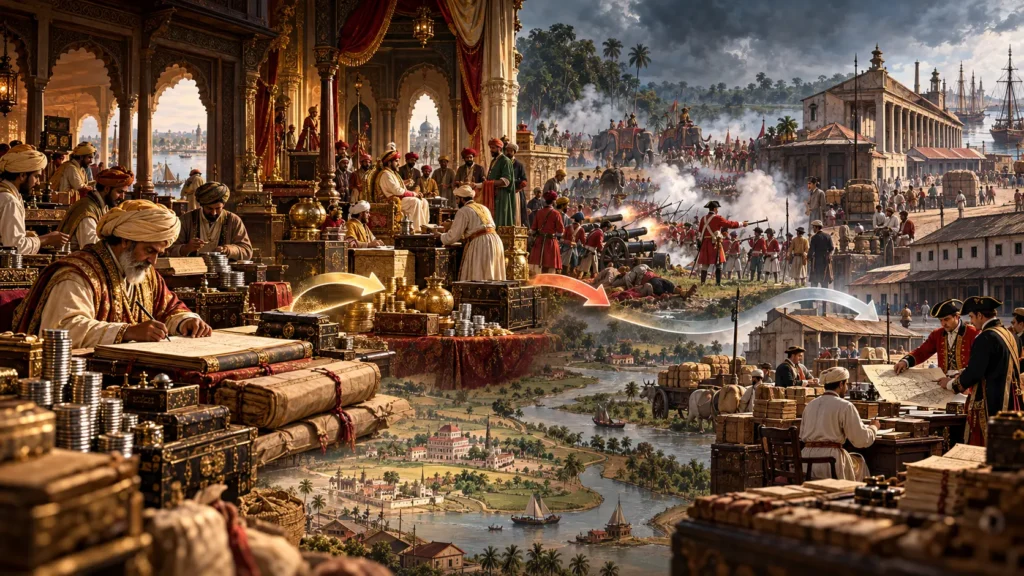
The banking house occupied a critical position within Bengal’s financial structure, connecting government revenue, credit, merchants and political elites.
That financial importance gave the Seths political influence.
When relations between Siraj ud-Daulah and powerful sections of Bengal’s elite deteriorated, the Seths became part of the coalition that supported his replacement.
At Plassey, that political realignment intersected with the East India Company’s military intervention.
The result changed Bengal.
But the irony is that the transformation did not simply make the Jagat Seths more powerful.
The Company that emerged from Plassey increasingly acquired control over the fiscal machinery of Bengal itself.
The grant of the Diwani in 1765 represented a major step in that process.
The old financial order was gradually being replaced.
And that is why the history of Jagat Seth is more interesting than the familiar story of a wealthy banker “selling Bengal.”
The deeper story is about financial infrastructure becoming political infrastructure.
The House of Jagat Seth became powerful because it stood at the centre of Bengal’s financial system.
When Bengal’s political order changed, that same financial system changed with it.
The banking house had helped operate the old order.
The East India Company was building something different.
And in the years after Plassey, the question was no longer simply who had the money.
It was increasingly who controlled the revenue that produced the money in the first place.
That was the transformation that changed Bengal—and eventually helped turn the East India Company from a trading corporation into a territorial power.