
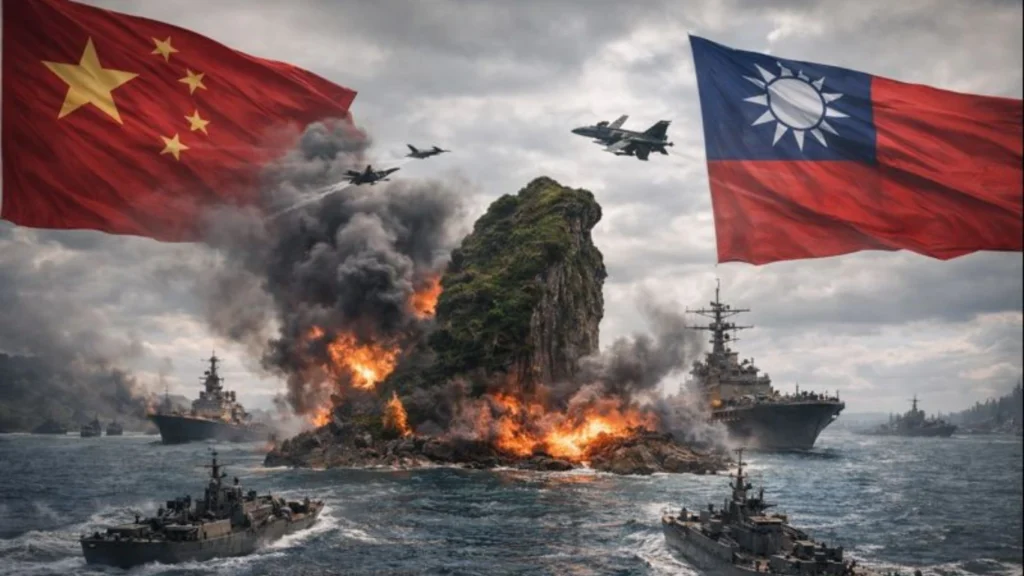
If China Taiwan conflict starts tomorrow, the impact would not stay in East Asia.
Within weeks, global semiconductor supplies would collapse. Artificial intelligence development would slow dramatically. Automotive, electronics, and defense manufacturing would stall. Financial markets would react instantly.
This is why the China–Taiwan conflict is no longer a regional dispute. It is widely considered the most dangerous geopolitical flashpoint of the 21st century.
At its core, the conflict is not about borders. It is about power, legitimacy, political systems, and control over the technologies that underpin the modern global economy. China seeks reunification as a matter of national destiny. Taiwan seeks survival as a democracy. The United States seeks to preserve stability without triggering a great-power war.
These goals are fundamentally incompatible. That is what makes the Taiwan question uniquely volatile.
Historical Roots: How Two Chinas Were Create
The Chinese Civil War and the Unfinished Break
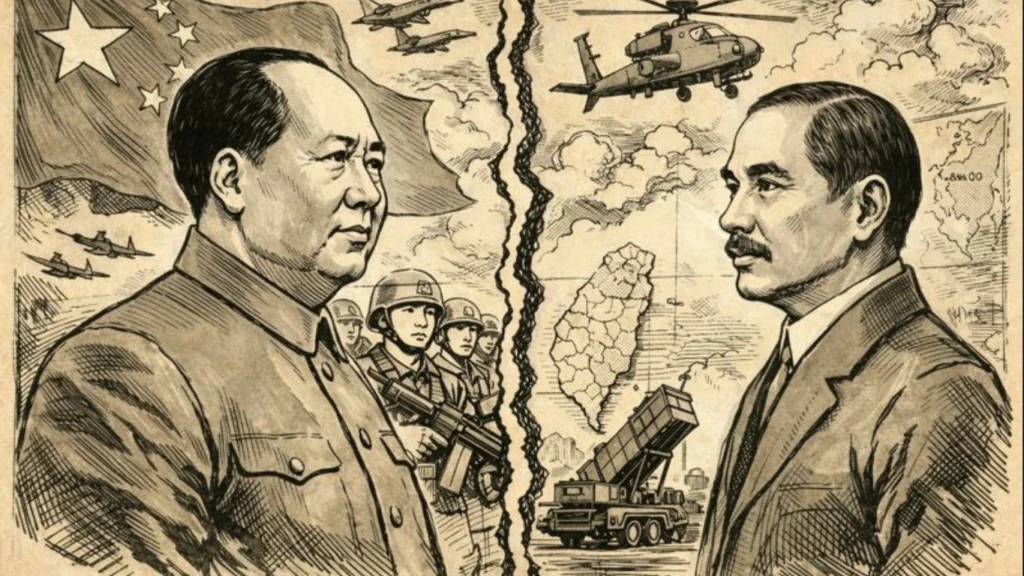
The origins of the China–Taiwan conflict trace directly to the Chinese Civil War (1927–1950), fought between the Chinese Communist Party led by Mao Zedong and the Nationalist Party (Kuomintang) led by Chiang Kai-shek.
When the Communists secured victory in 1949, Mao proclaimed the establishment of the People’s Republic of China on the mainland. The defeated Nationalist government retreated to Taiwan, maintaining the Republic of China there. No peace treaty or armistice was ever signed. The war ended militarily, but not politically.
This unresolved split created two governments claiming legitimacy over “China,” a contradiction that has never been resolved.
Taiwan’s Post-War Trauma and Identity Formation
Taiwan’s transfer from Japanese colonial rule (1895–1945) to Nationalist Chinese control was marked by repression rather than liberation. The February 28 Incident of 1947, in which thousands of civilians were killed during a crackdown on dissent, left deep scars.
Decades of martial law and the White Terror period followed. Ironically, this repression accelerated the emergence of a distinct Taiwanese identity rather than reinforcing Chinese nationalism.
The Cold War Freeze That Prevented War
The outbreak of the Korean War in 1950 transformed Taiwan into a Cold War strategic asset. The United States deployed the Seventh Fleet to the Taiwan Strait, preventing a Communist invasion and effectively freezing the conflict.
Two Taiwan Strait Crises in the 1950s demonstrated how close the situation came to open war. US involvement institutionalized deterrence, later formalized through the Taiwan Relations Act in 1979.
The conflict did not disappear. It was simply postponed.
Taiwan’s Democratic Transformation
From the late 1980s onward, Taiwan underwent one of the most successful democratic transitions in Asia.
Martial law ended in 1987. Opposition parties were legalized. Direct presidential elections began in 1996. Civil liberties expanded, and democratic institutions matured.
The rise of the Democratic Progressive Party reflected a political shift away from eventual reunification toward an emphasis on Taiwanese sovereignty, democratic governance, and self-determination. For younger generations, Taiwanese identity increasingly replaced Chinese identity.
This transformation fundamentally changed the nature of the conflict. Taiwan was no longer an authoritarian remnant of a civil war. It became a functioning liberal democracy.
China’s Ultimate Goal: Reunification as National Destiny
One Country, Two Systems and the Loss of Credibility
China’s position on Taiwan is explicit. Reunification under Communist Party sovereignty is framed as the restoration of historical territorial integrity and a prerequisite for national rejuvenation.
The proposed mechanism has long been the “One Country, Two Systems” model, first applied in Hong Kong. In theory, it promised autonomy and continuity. In practice, Hong Kong’s experience destroyed trust in this framework.
The erosion of civil liberties, judicial independence, and political pluralism after 2019 convinced most Taiwanese that reunification would mean the end of democratic self-rule.
Strategic Timelines and Political Stakes
Xi Jinping has embedded Taiwan into China’s long-term national project. Key milestones include military readiness by 2027, full modernization by 2035, and national rejuvenation by 2049.
This framing elevates Taiwan from a territorial issue to an existential question for Communist Party legitimacy. Reunification is no longer optional. Delay itself is increasingly viewed in Beijing as strategic failure.
Coercion Without War: China’s Current Strategy
China has dramatically increased pressure on Taiwan without crossing the threshold of open conflict.
Military exercises encircle the island. Airspace and maritime violations test response times. Cyber operations and disinformation campaigns target public confidence. Economic measures signal that prosperity is conditional on political alignment.
This “gray zone” strategy is designed to exhaust Taiwan psychologically while avoiding actions that would guarantee US military intervention.
Taiwan’s Goal: Preserving Democracy Without Provoking War
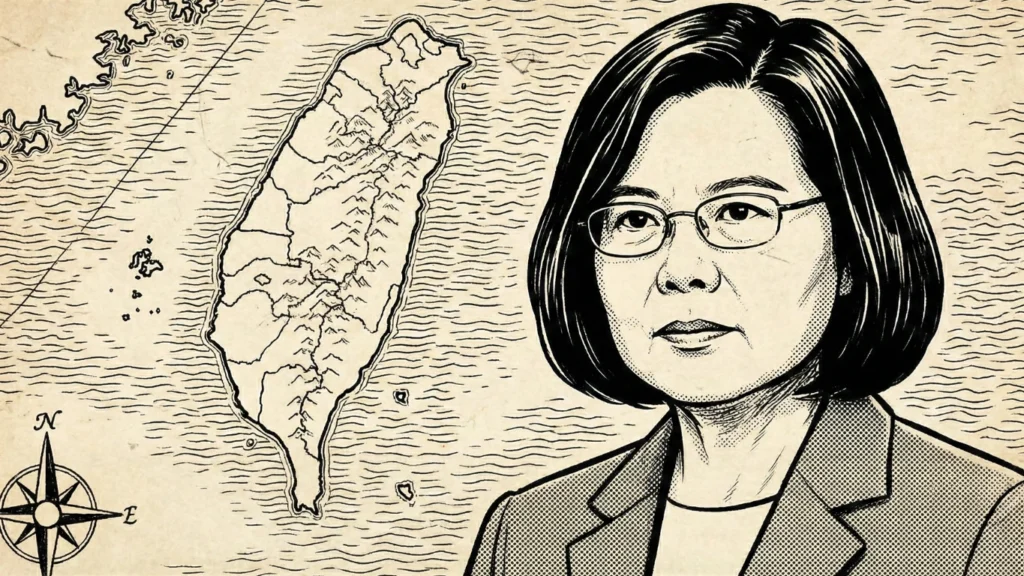
The Status Quo as a Survival Strategy
Taiwan’s strategy is often misunderstood. It is not moving toward formal independence. It is attempting to preserve de facto independence without triggering invasion.
Public opinion consistently favors maintaining the status quo. Formal independence would likely provoke war. Reunification would dismantle democratic governance. The status quo is not indecision. It is risk management.
Defensive Deterrence and Military Adaptation
Facing a far larger Chinese military, Taiwan has shifted toward asymmetric defense. Rather than matching China conventionally, it focuses on mobile missile systems, territorial resilience, and civil preparedness.
The objective is deterrence through cost imposition. Invasion must appear prohibitively expensive, slow, and uncertain.
The United States and Strategic Ambiguity
Since 1979, US policy toward Taiwan has been defined by strategic ambiguity. The United States provides defensive support but avoids explicit guarantees, deterring both Chinese aggression and Taiwanese unilateral moves.
In recent years, ambiguity has evolved rather than disappeared. US statements, alliance coordination, and regional force posture increasingly signal resolve while preserving flexibility.
This balance is fragile. Too much clarity risks escalation. Too little risks miscalculation.
Semiconductors: Why China–Taiwan conflict Is Economically Unique
Taiwan’s central role in advanced semiconductor manufacturing fundamentally changes the stakes.
Taiwan Semiconductor Manufacturing Company produces the majority of the world’s most advanced chips, essential for artificial intelligence, defense systems, telecommunications, and modern industry.
Any serious disruption would ripple through the global economy within weeks. Even a blockade without invasion could trigger shortages severe enough to cause a global recession.
Taiwan’s technological importance both deters conflict and intensifies incentives for control. This paradox makes stability precarious.
The Closing Window of Opportunity
Many analysts believe China perceives a narrowing window for achieving reunification. Taiwanese identity is solidifying. Taiwan’s defenses are improving. US alliances are tightening. China faces demographic and economic headwinds.
Perceived urgency, not military weakness, may be the greatest risk factor. History shows that wars often begin not from confidence, but from fear of lost opportunity.
AI, Technology, and the Future Balance of Power
The Taiwan conflict is inseparable from the future of artificial intelligence. Advanced AI systems depend on the chips Taiwan produces.
Control over Taiwan would reshape technological leadership, military capabilities, and economic influence for decades. This is why the conflict now sits at the intersection of geopolitics and technological supremacy.
Conclusion: Taiwan Is Not the Trigger. It Is the Test.
The China–Taiwan conflict is often described as a war waiting to happen. That framing misses the deeper reality.
This conflict is a test of whether deterrence can still function in an era of deep economic interdependence, technological concentration, and authoritarian urgency.
China does not want war, but wants reunification more than uncertainty. Taiwan does not want independence declarations, but will not surrender democracy. The United States does not want conflict, but cannot allow coercion to succeed.
The danger lies not in intent, but in miscalculation.
If war comes, it will not be because one side sought catastrophe. It will be because every side believed the other would yield first.
Taiwan was never just an island. It is the keystone holding the modern global order in place.
People Also Ask: China–Taiwan Conflict
Why does China want Taiwan?
China wants Taiwan because it considers the island part of its territory after the Chinese Civil War ended in 1949. In the China–Taiwan conflict, reunification is tied to China’s national identity, political legitimacy, and long-term goal of national rejuvenation under Communist Party rule.
Why can’t China just leave Taiwan alone?
China believes leaving Taiwan alone would permanently weaken its sovereignty claims and encourage separatism. In the China–Taiwan conflict, allowing Taiwan to exist indefinitely outside Beijing’s control is seen as a threat to China’s territorial integrity and political authority.
Why is Taiwan so important to the world?
Taiwan is important because it produces most of the world’s advanced semiconductors used in AI, electronics, and defense systems. Any escalation in the China–Taiwan conflict could disrupt global supply chains and trigger major economic consequences worldwide.
Why is 2027 important for China and Taiwan?
The year 2027 is significant because China has instructed its military to be ready for Taiwan-related operations by then. Analysts view this as a potential decision window in the China–Taiwan conflict, rather than a fixed invasion date.
Who gave Taiwan back to China?
After World War II, Japan surrendered Taiwan to the Republic of China in 1945. Taiwan was never formally transferred to the People’s Republic of China, which is a key legal ambiguity underlying the China–Taiwan conflict.
Why did Taiwan and China split?
Taiwan and China split after the Chinese Civil War when the defeated Nationalist government retreated to Taiwan in 1949. No peace treaty was signed, leaving the China–Taiwan conflict unresolved to this day.
What is the conflict between China and Taiwan?
The China–Taiwan conflict centers on Taiwan’s political status. China claims Taiwan as part of its sovereign territory, while Taiwan operates as a self-governing democracy with its own government, military, and economy.
Why does Taiwan not want to reunite with China?
Taiwan opposes reunification mainly due to fears of losing democratic freedoms. Events in Hong Kong have reinforced concerns that reunification under China would end political autonomy and civil liberties within the China–Taiwan conflict.
Does Russia recognize Taiwan as a country?
No, Russia does not recognize Taiwan as a country. Russia follows the One China policy and officially recognizes the People’s Republic of China, aligning with Beijing’s position in the China–Taiwan conflict.
How many countries recognize Taiwan?
Only a small number of countries formally recognize Taiwan. Most nations recognize China instead while maintaining unofficial relations with Taiwan due to diplomatic pressures linked to the China–Taiwan conflict.
Does India recognize Taiwan?
India does not formally recognize Taiwan as a sovereign country. However, India maintains trade, investment, and cultural ties with Taiwan while adhering to the One China policy related to the China–Taiwan conflict.
Who is more powerful, China or Taiwan?
China is significantly more powerful than Taiwan in terms of military size and economic scale. However, Taiwan’s advanced technology, strategic location, and defensive partnerships complicate the balance within the China–Taiwan conflict.
Is Taiwan a strong country?
Taiwan is considered strong economically and technologically, especially in semiconductor manufacturing. Despite its small size, these strengths play a major role in deterrence dynamics within the China–Taiwan conflict.
Does China have troops stationed in Taiwan?
No, China does not have troops stationed in Taiwan. Any Chinese military presence on the island would represent a major escalation and fundamentally change the status quo of the China–Taiwan conflict.
Which country has the strongest military in Asia?
China has the largest military force in Asia by manpower and budget. However, military strength in the region depends on technology, alliances, and geography, all of which are critical factors in the China–Taiwan conflict.
Pingback: India-EU Free Trade Agreement 2026 | Comprehensive Guide