
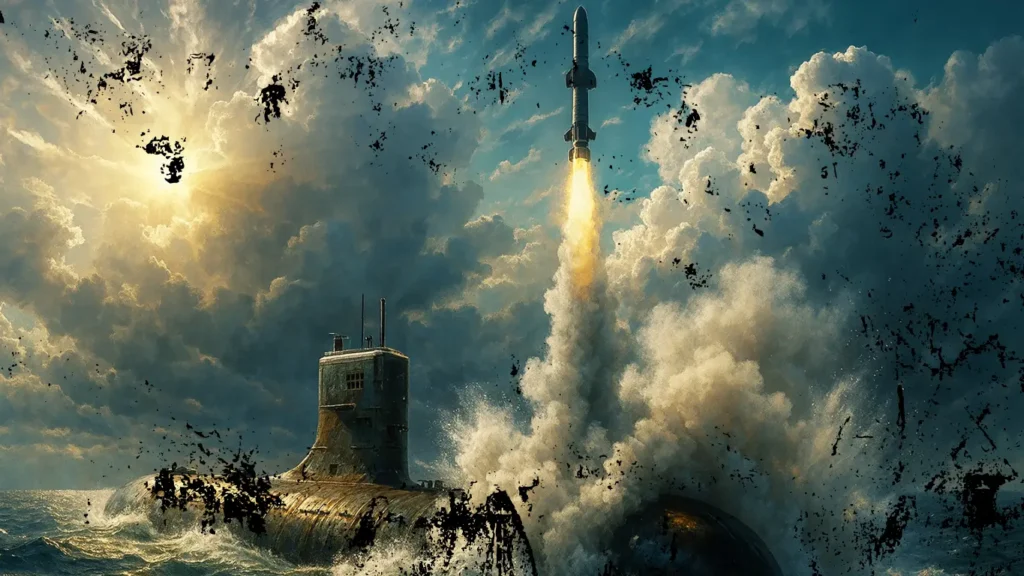
Imagine a silent submarine gliding deep beneath the Indian Ocean, its presence invisible to satellites or radar. Then imagine it launching a precision missile — not from land, not from air, but from beneath the waves. That’s the power of the drdo submarine launched cruise missile. And in late 2025, India quietly confirmed: this is no longer just a plan, but reality.
This is the story of how India built one of the most sophisticated undersea strike capabilities in the world — through decades of strategy, science, and engineering patience.
Origins: Why India Needed Submarine-Launched Cruise Capability
The Strategic Backdrop: From 1971 to Late 1990s
After the 1971 war, Indian strategists realized that terrestrial and air-based deterrence were not enough. The Indian Ocean was becoming a contested arena, with superpower submarines already patrolling deep waters. Meanwhile, regional rivals were gradually enhancing their naval and missile capabilities.
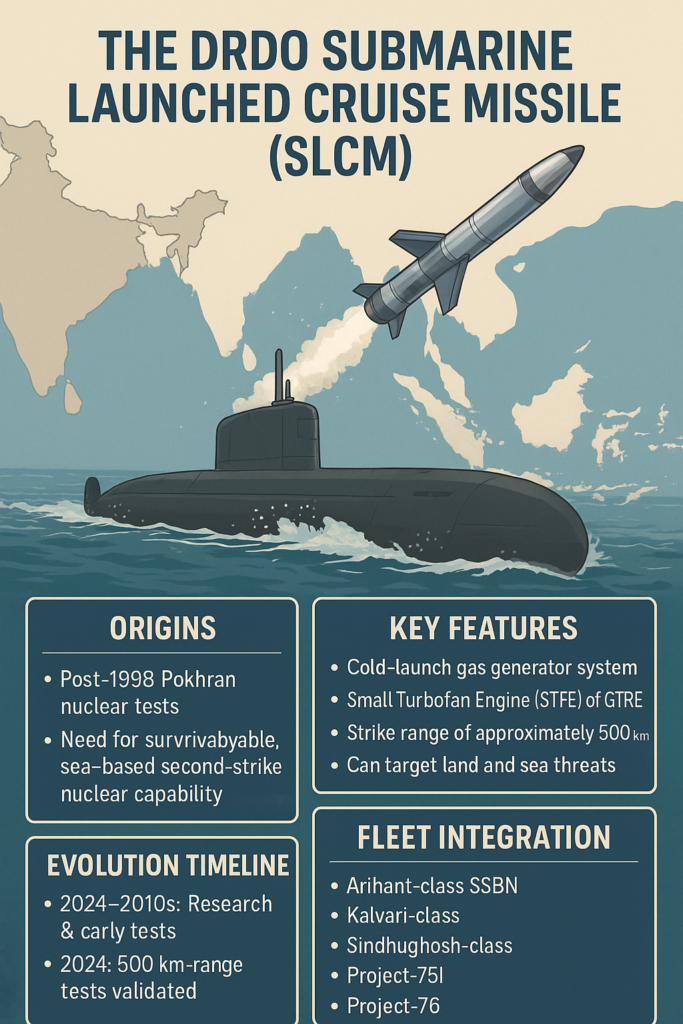
The nuclear tests at Pokhran-II in 1998 sharpened the need for a survivable, sea-based second-strike option — part of a nuclear triad involving land, air, and sea. A submarine-launched cruise missile seemed the logical addition to land-based and ballistic deterrents.
Birth of the SLCM Program
In response, the Defence Research and Development Organisation (DRDO) quietly began work on adapting its existing cruise-missile know-how (from programs like Nirbhay and other cruise missile experiments) to underwater launch conditions.
The complexity was immense: underwater ejection, capsule protection, pressure adaptation, acoustic signature reduction, followed by air-phase transition, navigation, guidance — all had to work seamlessly.
Evolution Timeline: From Concept to Verified Capability
2000s–2010s: Foundation and Early Experiments
- During the 2000s, DRDO and allied agencies researched submarine-compatible cruise missile concepts, studying waterproof canisters, ejection dynamics, and the possibility of in-flight engine ignition.
- Notably, a successful underwater launch of a different missile series — the supersonic BrahMos — in 2013 demonstrated feasibility, even though BrahMos was better suited for ship- or air-based platforms.
These early successes laid foundational confidence that an indigenous submarine-launched cruise missile (SLCM) was realistically achievable.
2023–2024: Proving the 500 km-Range SLCM
By early 2024, as per official and media reports, India prepared to test a SLCM with a 500 km strike range.
Here’s what happened:
- First Mission (Early 2024): From a classified underwater test platform simulating submarine conditions. This trial validated critical underwater ejection mechanics, buoyancy control, pressure adaptation, and acoustic signature reduction. Engineers observed perfect buoyancy-induced attitude correction and smooth capsule ejection — ensuring the missile remained stable under deep-sea pressure before surfacing.
- Second Mission (Mid-2024): Tested the surface-breakout, air-phase ignition, and full cruise trajectory. The missile transitioned from underwater launch to air-breathing flight flawlessly, executing terrain-hugging cruise, accurate waypoint navigation, and terminal guidance against simulated naval and land targets — all with zero anomalies.
The confirmed validated range was ~500 km, and the mission performance was reportedly flawless.
2025 Confirmatory Tests & Indigenous Engine Integration
- By mid-2025, further tests reportedly used the indigenous Small Turbofan Engine (STFE) developed by Gas Turbine Research Establishment (GTRE), demonstrating fully domestic propulsion and confirming four successful SLCM tests.
- On 18 November 2025, Indian media announced that the SLCM program had “validated indigenous submarine-launched cruise missile capability.” The system is now considered ready for integration with India’s submarine fleet.
According to public reports: underwater ejection, cold-launch gas generator system, air-phase flight, navigation and guidance systems — all performed reliably. This milestone marks a sea-change in India’s undersea deterrence posture.
Strategic Impact & Legacy: What This Missile Brings to India
Completing a Flexible Sea-Based Option
With the successful SLCM trials, India now has a credible, flexible, and stealthy undersea strike capability. A drdo submarine launched cruise missile allows:
- Launch from submerged vessels — keeping submarines hidden even during launch.
- Precision targeting of both land and maritime threats.
- Lower acoustic and radar signature compared to ballistic missile launches.
This significantly strengthens India’s sea-based deterrence, especially alongside its submarine-launched ballistic missiles (SLBMs) like those from the K Missile family, adding tactical flexibility beyond purely strategic nuclear strike options.
Technological Leap: From Collaboration to Indigenous Mastery
The adoption of an indigenously developed STFE (Small Turbo Fan Engine) by GTRE is critical. It marks a shift away from dependence on foreign propulsion modules. Now, DRDO, GTRE, and Indian industry partners (e.g., Bharat Dynamics Limited — BDL) are positioned to take SLCM into production and deployment.
This is not merely about missiles — it’s about mastering propulsion, underwater-launch systems, navigation, and stealth. That’s a huge strategic and technological legacy.
Modern Relevance: Fleet Integration, Submarine Expansion & Strategic Message
Where the Missile Can Be Deployed
While initial expectations often linked the SLCM only with the nuclear-powered SSBN INS Arihant (commissioned August 2016), recent plans point to broader fleet integration:
- Conventional diesel-electric submarines such as the Kalvari-class submarine
- Older platforms like the Sindhughosh-class submarine
- Future boats under procurement initiatives such as Project‑75I and possibly Project‑76
This wide integration will greatly enhance India’s undersea strike footprint. According to reports, SLCMs are being considered as a core weapon of the future Indian Navy submarine fleet.
Production & Industry Partnership
In 2025, defence-industry circles indicate that BDL and allied companies are slated for a large production order (estimated at ~₹5,000 crore) to manufacture nearly 200 SLCMs for phased induction.
This is significant not only for the navy, but also for India’s broader self-reliant defence industrial base.
Operational Timeline: From Tests to Commission
While the 2024 and 2025 trials mark technical success, official public reporting suggests that user trials with the Navy are planned over the next 2–3 years, aiming for initial operational capability around 2028.
Hence, the SLCM is not just a prototype — it is on track to become a real, deployable weapon system within this decade.
Debates, Interpretations & Challenges Ahead
No breakthrough in defence is without concerns and debate. Several debates swirl around the SLCM program:
Secrecy vs Transparency
Some analysts argue that the high secrecy around submarine-launched cruise missile programs limits academic scrutiny, independent verification, and public trust. Others counter that secrecy is essential to maintain deterrence and deny adversaries critical data.
Regional Arms Race & Strategic Stability
While the SLCM enhances India’s deterrence, there’s a view that such stealthy strike capabilities could trigger a regional undersea arms race. Critics warn this might escalate tensions among Indian Ocean littoral states.
On the flip side — and historically speaking — credible deterrence often helps avoid open warfare by raising the cost of aggression.
Technical & Integration Hurdles
- Integration across diverse submarine classes (diesel-electric, SSBNs) requires careful adaptation and rigorous checks.
- Ensuring consistent reliability across the production series is a big challenge — especially for cold-launch systems, STFE engines, guidance and navigation suites, and warhead integration.
- Maintenance, climate (salinity), depth variation and acoustic signature suppression are continuous technical challenges.
Nevertheless, recent trials demonstrate that many of these hurdles have already been overcome — at least for the initial variants.
Conclusion: Why This Milestone Matters — For India and Beyond
The story of the drdo submarine launched cruise missile is not just about missiles or military strategy. It’s a story of India’s evolution — from relying on imports or foreign collaboration, to building cutting-edge indigenous systems that combine stealth, precision, and strategic thought.
With validated 2024–2025 trials, a domestic STFE propulsion engine, and plans for mass production and fleet integration — India stands on the brink of fielding a potent undersea strike force. That changes not just naval calculations, but the geopolitical dynamics of the Indian Ocean.
This is not legacy. This is living, evolving deterrence — quietly moving beneath the waves.
If you care about India’s maritime future, this is a story worth following.
According to Wikipedia’s overview of DRDO projects, the Submarine Launched Cruise Missile (SLCM) project includes use of Small Turbofan Engines (STFEs) for propulsion. Wikipedia
FAQs
- What is DRDO’s submarine launched cruise missile (SLCM)?
The DRDO submarine launched cruise missile is an underwater-launched cruise missile, developed indigenously, designed to provide stealthy, precision strike capability — launching from submarines submerged beneath the ocean. - When were the SLCM validation trials completed?
Two full-range SLCM trials were conducted in 2024 — one early in the year (underwater ejection and buoyancy tests) and another mid-2024 (air-phase cruise and terminal guidance). A formal announcement of validation came in November 2025. - What is the confirmed range of India’s submarine-launched cruise missile?
The 2024 trials validated a strike range of ~500 kilometres for the SLCM. Future variants aim to extend this to 800 km or more. - Which engine powers the SLCM during cruise flight?
The missile uses a two-stage propulsion system: a solid rocket booster for underwater launch, followed by an indigenously developed Small Turbofan Engine (STFE) created by GTRE for sustained air-breathing cruise flight. - Which submarines are likely to carry the SLCM?
The missile is expected to integrate across several Indian Navy classes — from the nuclear-powered INS Arihant to conventional submarines like Kalvari-class and Sindhughosh-class, and future boats under Project-75I and Project-76. - When will the SLCM enter operational service?
According to publicly available reports, user trials with the Navy are planned over the next 2–3 years, with expected initial operational capability (IOC) around 2028. - Who manufactures the missiles? Are Indian firms involved?
Yes. The missile program involves indigenous production partnerships — notably with Bharat Dynamics Limited (BDL), which reportedly has a production order worth around ₹5,000 crore to manufacture about 200 missiles. - How does the cold-launch gas generator system work for SLCM?
The SLCM uses a cold-launch mechanism: a gas-generator driven ejector launches the missile capsule from underwater canister without ignition. Once at periscope depth or surface-clearance distance, the capsule separates, and the air-breathing STFE engine ignites — preserving submarine stealth during launch. - Can the missile strike both land and sea targets?
Yes. The SLCM is designed for versatility. It can engage maritime (ships, naval assets) as well as land-based strategic or tactical targets with high precision, using its onboard navigation, guidance and terminal seeker systems. - How does this missile strengthen India’s strategic deterrence?
By adding stealthy, submarine-based strike capability, the SLCM significantly enhances India’s second-strike potential. Even if land and air bases are compromised, submarines deep at sea can still deliver precision strikes — bolstering deterrence, maritime security, and strategic flexibility.