
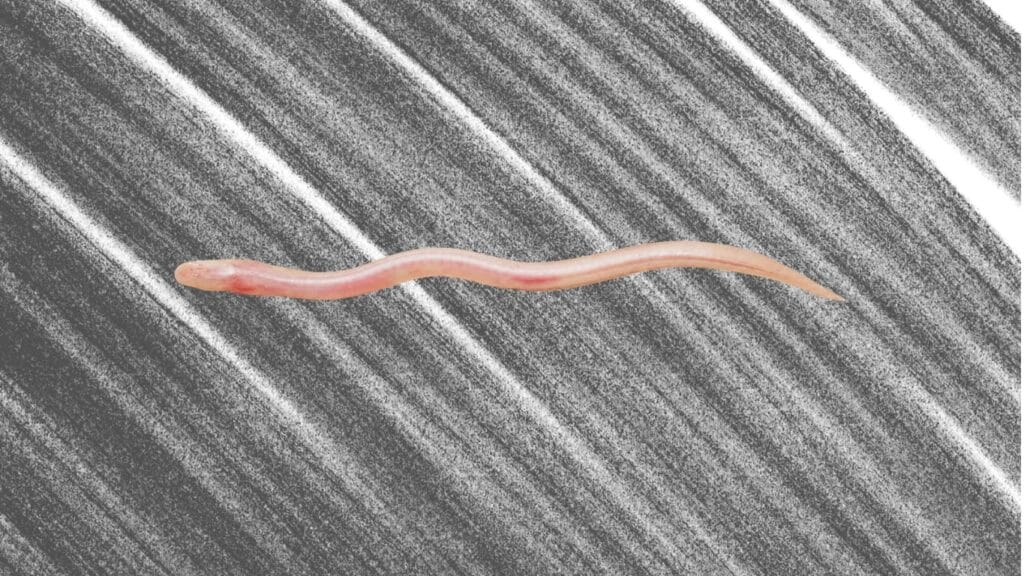
In 2024, a strange little fish appeared in a TikTok video.
It was pale, almost translucent, and seemed to have emerged from a borewell near the India–Nepal border.
It looked unusual enough to attract scientific attention.
What happened next took researchers into a world almost nobody could see.
Scientists eventually travelled to Bihar, pumped thousands of litres of groundwater from borewells and recovered specimens of the mysterious animal. They then used detailed anatomical examination, micro-CT scanning and genetic analysis to establish that they were looking at something science had never formally described.
It was not simply a new species.
It represented a new genus.
The animal was formally described in ZooKeys in August 2026 as Gangaichthys indonepalicus — a miniature subterranean earthworm eel living in the alluvial aquifers of the Indo-Gangetic Plain.
And the discovery has a much bigger story behind it.
Because beneath the fields, villages and roads of northern India may exist an entire world of life that we rarely see.
It Started With a TikTok Video
The discovery did not begin inside a laboratory.
It began on social media.
A video posted to TikTok in 2024 showed a tiny, unusual fish emerging from a borewell near the India–Nepal border. The animal appeared translucent and had eyes that seemed to be covered by skin.
For researchers familiar with subterranean animals, that was enough to raise a question.
Could this be a fish adapted to permanent life underground?
At the time, there were no known stygobitic fish recorded from the region.
Stygobitic refers to animals that live permanently in underground aquatic environments such as groundwater systems, caves and aquifers.
The researchers therefore decided that the strange fish in the video needed to be investigated rather than dismissed as an odd-looking surface species.
A social-media video had become a scientific lead.
But finding the animal again would be much harder.
Scientists Went Looking Beneath Bihar

The research team travelled to Pashchim Champaran district in Bihar, close to the India–Nepal border.
Their target was not a river or lake.
It was groundwater.
The researchers identified handpumps and borewells that could potentially provide access to the underground aquifer system where the fish appeared to live.
Then they started pumping.
And pumping.
And pumping.
The first specimen emerged only after approximately 2,000 litres of water had been extracted.
Unfortunately, the animal was damaged during the process and died.
The researchers continued.
After another 500 litres had been pumped from the same borewell, another specimen emerged.
This one was intact.
That specimen would later become the holotype — the individual specimen formally designated as the name-bearing reference for the new species.
In other words, a strange fish spotted on TikTok eventually led scientists to a borewell in Bihar where they had to extract roughly 2,500 litres of groundwater before obtaining the intact specimen that would define a new species.
That is an extraordinary route from social media to taxonomy.
Meet Gangaichthys indonepalicus
The scientists named the new animal Gangaichthys indonepalicus.
The name itself tells part of the story.
Gangaichthys refers to a fish associated with the Ganga, or Ganges.
The species name indonepalicus refers to the India–Nepal border region where the animal occurs.
The researchers proposed Indonepalese blind earthworm eel as its English common name.
The scientific name is therefore almost a geographical description:
Ganga + fish + India–Nepal region.
And the name is appropriate because this is no ordinary surface-dwelling fish.
It appears to spend its life underground.
What Exactly Is This Strange Fish?
Despite being described in headlines as a “new underground fish,” Gangaichthys indonepalicus is more specifically a miniature stygobitic earthworm eel belonging to the family Chaudhuriidae.
Earthworm eels are small, elongated freshwater fishes that can look surprisingly unlike the fish most people imagine.
But Gangaichthys goes further.
It is the first known subterranean member of the family Chaudhuriidae and the first subterranean fish formally recorded from the Gangetic Basin and Indo-Gangetic Plain.
That makes the discovery important at several levels.
Scientists did not merely add another species to a list.
They discovered an entirely new branch within a fish family that had never before been known to contain a subterranean species.
And the animal’s body provides clues about how it survived in a world without sunlight.
A Fish Built for Darkness
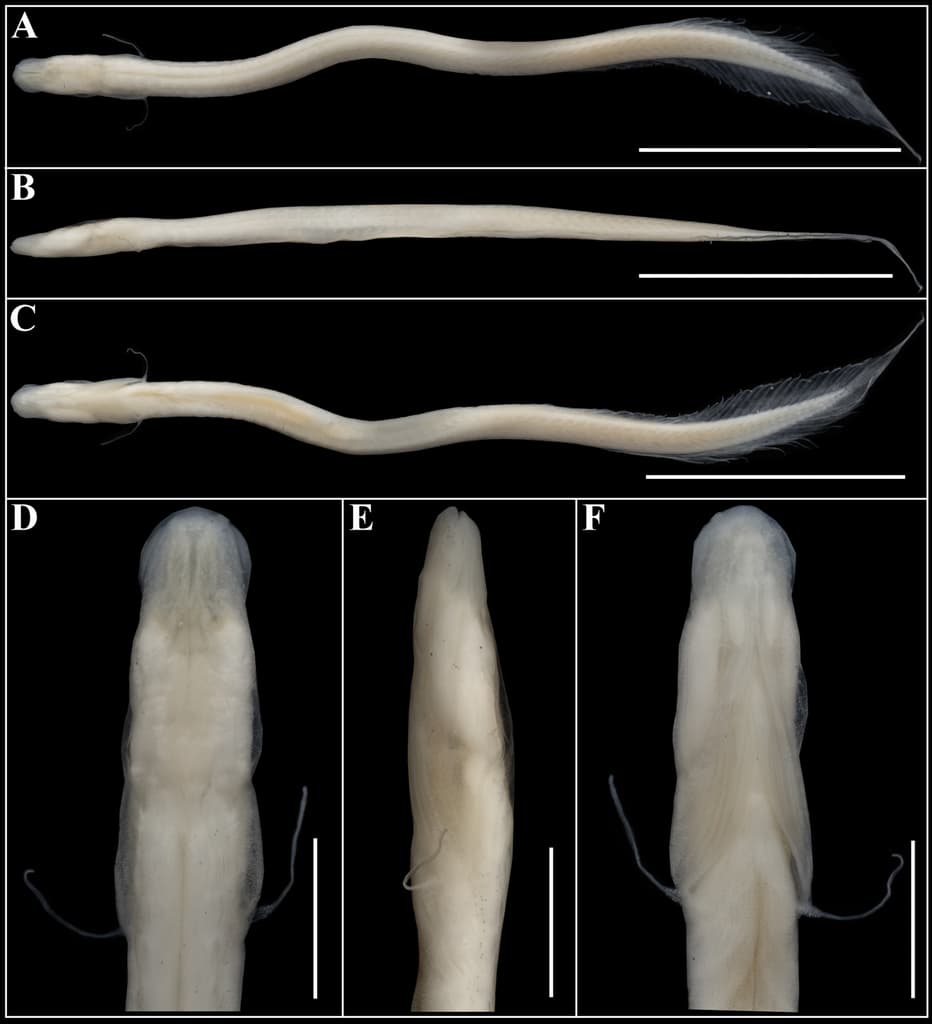
The holotype is only about 40.6 millimetres long — roughly four centimetres.
But its small body contains some remarkable adaptations.
The researchers found that Gangaichthys indonepalicus has:
- reduced eyes covered by skin
- a completely unpigmented, translucent body
- an apparent absence of ribs
- distinctive skeletal characteristics
- a body plan associated with life in subterranean water.
Think about what those characteristics mean.
A fish living in a brightly lit river benefits from seeing.
A fish living permanently underground has far less reason to maintain fully developed eyes.
A surface fish also needs pigmentation for a variety of functions.
In an environment where sunlight never reaches the animal, pigmentation becomes much less useful.
Over evolutionary time, organisms isolated in darkness can develop traits that reflect those conditions.
The new Bihar fish appears to be one such example.
It Is Not Really "Blind"
Calling the animal a completely blind fish would be an oversimplification.
Its eyes are greatly reduced and covered by skin.
That is a more interesting story anyway.
The animal has not simply “lost its eyes.”
Its anatomy appears to reflect a long evolutionary history in an environment where vision is of limited value.
This is one reason subterranean organisms are so fascinating.
Evolution does not work according to a simple rule that says:
“Dark place = no eyes.”
Instead, different lineages respond to darkness in different ways.
Some retain reduced eyes.
Some lose pigmentation.
Some alter their sensory systems.
Others develop completely different adaptations.
The tiny fish beneath Bihar is another piece of that much larger evolutionary puzzle.
How Scientists Proved It Was a New Genus and Species
Finding a strange animal is one thing.
Proving that it represents an entirely new genus and species is another.
The researchers used what is known as integrative taxonomy.
Instead of relying on one characteristic, they combined several kinds of evidence.
Morphology
Scientists examined the animal’s external anatomy and compared it with known members of the earthworm-eel family.
Skeletal anatomy
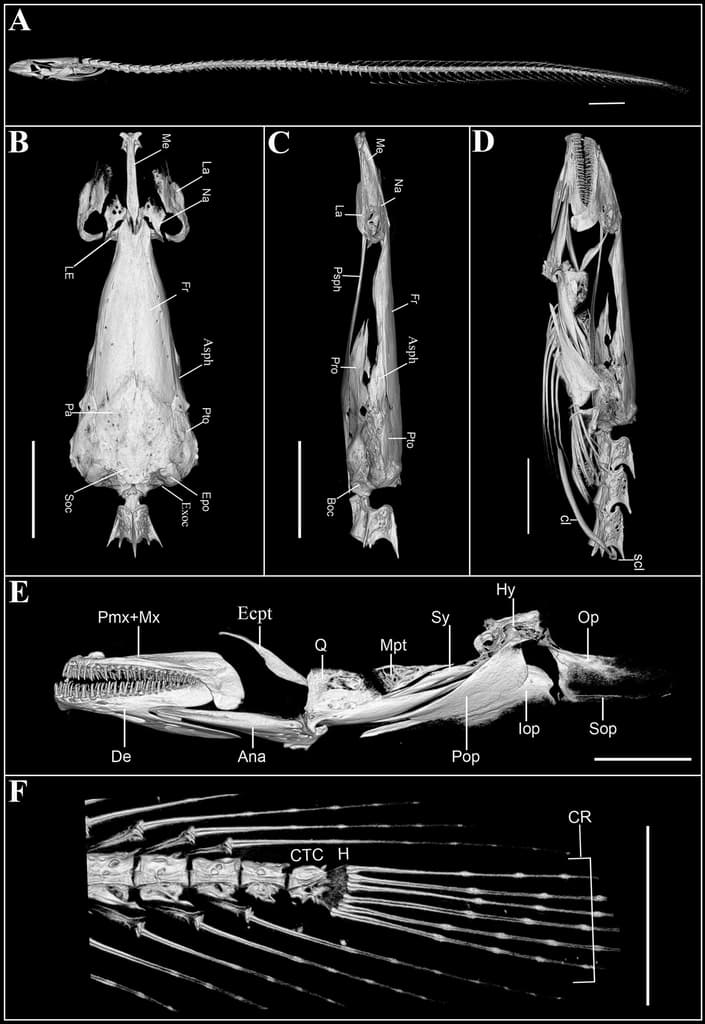
The holotype was examined using micro-computed tomography, or micro-CT.
This allowed researchers to reconstruct and study its internal skeletal structures without relying solely on conventional dissection. The resulting research figure documents the whole body and detailed skeletal anatomy of the holotype.
Genetics
The researchers also used molecular data to determine where the animal belongs in the evolutionary tree.
The genetic evidence placed Gangaichthys indonepalicus within the family Chaudhuriidae, while the authors reported that it was more than 20% divergent from two other genera for which comparable mitochondrial COI data were available.
That combination of evidence was crucial.
The scientists weren’t simply saying:
“This fish looks weird.”
They were showing that its anatomy and genetics were different enough to justify establishing a new genus and a new species.
The New Genus Is Called Gangaichthys
The discovery is especially significant because Gangaichthys itself is new.
The researchers established the genus in 2026, with Gangaichthys indonepalicus designated as its type species.
The new genus differs from other members of Chaudhuriidae in a combination of morphological and skeletal features, including its reduced eyes, lack of body pigmentation and apparent absence of ribs.
The animal also has a distinctive vertebral and fin-ray arrangement that helps separate it from known relatives.
This is why the discovery is much more important than the phrase “new fish” suggests.
A new species expands our knowledge.
A new genus can reveal that we were missing an entire evolutionary branch.
Where Does Gangaichthys indonepalicus Live?
So far, the species is known from a very small area.
Researchers recorded specimens from Balgangwa village in Pashchim Champaran district, Bihar, while photographic records indicate the animal may also occur near Triveni in Nawalparasi District, Lumbini Province, Nepal.
The known localities lie within roughly 11 kilometres of one another.
More importantly, the fish has so far been recovered only from handpumps and borewells reaching depths of up to approximately 10 metres below the surface.
Researchers also sampled nearby wells and ponds but did not find additional specimens.
That suggests something extraordinary.
The fish isn’t simply visiting groundwater occasionally.
The evidence points toward a species that may be exclusively subterranean.
Its real habitat is therefore not the pond beside the village.
It is the hidden water system beneath it.
What Is an Alluvial Aquifer?
This is where the geology becomes part of the story.
An alluvial aquifer is a groundwater system formed within layers of sediments such as sand, gravel, silt and other material deposited by rivers over long periods.
The Indo-Gangetic Plain contains enormous sedimentary deposits associated with the river systems of northern South Asia.
Water can move through interconnected spaces within these sediments.
For humans, that groundwater is an important resource.
For Gangaichthys, it may be an entire ecosystem.
The same underground environment that supplies water to wells can also provide a habitat for organisms that spend their entire lives beyond direct human view.
And that changes how we should think about the landscape above us.
A field is not necessarily just a field.
A village is not necessarily just a village.
A borewell is not simply a hole drilled into the ground.
Beneath them may be a complex aquatic world.
We Usually Think of India's Biodiversity as Something We Can See
India’s biodiversity is often imagined through its visible landscapes.
The Himalayas.
The Western Ghats.
The forests of central India.
The wetlands.
The rivers.
The mangroves.
The deserts.
But subterranean ecosystems are different.
They are difficult to access.
They are difficult to sample.
And the organisms living there may never be encountered during conventional wildlife surveys.
That makes Gangaichthys indonepalicus especially interesting.
Its discovery reinforces a point made by the researchers themselves: India has enormous biodiversity, but there are still major gaps in what scientists know about its species and their distributions. Subterranean environments are particularly difficult to study.
In other words, the map of Indian biodiversity is still incomplete.
Some of the missing pieces may be underground.
A Strange Parallel With the History of Life
There is a broader HypeHive question here.
How much of life on Earth remains unknown to us?
Scientists continue to push backward through geological time, finding evidence that changes our understanding of life’s history.
HypeHive has explored this from another direction in our article on the oldest evidence of life on Earth.
That story asks how far back we can trace life.
Gangaichthys indonepalicus asks a different question:
How much life is still hiding around us today?
One story looks backward through deep time.
The other looks beneath our feet.
Both reveal the same fundamental problem:
The known history of life is not the whole history of life.
The Fish Was Hiding in Plain Sight
There is an almost poetic element to this discovery.
The species was not found in some unreachable cave halfway across the world.
It was found through a borewell.
People were already accessing the groundwater.
The wells were already there.
The water was already being pumped.
And yet the animal living inside that hidden system had not been formally recognized by science.
That is what makes the TikTok connection so important.
The discovery did not happen because someone deliberately searched the entire Indo-Gangetic Plain for an unknown fish.
It happened because somebody happened to record something unusual.
Then somebody else paid attention.
And scientists followed the clue.
Citizen Science Can Begin With Something as Simple as a Video
There is a useful lesson here about modern scientific discovery.
You do not necessarily need a laboratory to notice something scientifically important.
You need observation.
The original TikTok video was not a scientific paper.
It did not contain genetic analysis.
It did not establish a type specimen.
It did not prove the existence of a new genus.
But it contained something scientists needed:
evidence that an unusual animal existed.
The research team then transformed that observation into formal scientific evidence through fieldwork, specimen collection, anatomy and genetics.
This is one of the more interesting changes in modern natural history.
A camera phone can now become the first step in a scientific investigation.
The technology is simple.
The investigation that follows can be extraordinarily difficult.
This Is Not the First Time the Internet Has Helped Reveal Nature
The connection between technology and natural history is becoming increasingly important.
People photograph animals they don’t recognize.
They upload them.
Researchers notice unusual records.
Scientists investigate.
And eventually, some of those observations can become formal scientific discoveries.
That doesn’t mean every viral animal video represents a new species.
Far from it.
Most do not.
But Gangaichthys indonepalicus demonstrates what can happen when an unusual observation reaches someone capable of recognizing its scientific significance.
A random video became a research question.
The research question became fieldwork.
The fieldwork produced specimens.
The specimens produced a scientific description.
And the description added a new branch to the tree of life.
The Oarfish Shows the Other Side of the Story
There is another HypeHive article that fits this discovery surprisingly well.
Our story on the oarfish and the mysteries surrounding deep-sea giants explores how an unusual real animal can become wrapped in mystery and legend.
The oarfish lives in the deep ocean.
Gangaichthys indonepalicus lives in groundwater.
One occupies a world hidden beneath kilometres of ocean.
The other occupies a world hidden beneath the ground.
Both remind us of the same thing:
Humans have explored only a fraction of the environments on Earth where life exists.
And sometimes the strangest animals are found precisely where we cannot easily look.
Why Does It Look Like This?
One of the most fascinating questions is why Gangaichthys indonepalicus evolved its unusual appearance.
The answer is not completely known.
But the researchers identify characteristics consistent with a subterranean lifestyle: reduced eyes covered by skin, complete loss of body pigmentation and other anatomical modifications.
The environment provides the obvious evolutionary context.
Imagine living in water that is almost completely isolated from sunlight.
There is little reason to maintain the same visual system as a surface fish.
There is little reason to invest energy in pigmentation.
Over generations, natural selection can favour traits that make sense in that environment.
This is called troglomorphism or, more broadly, subterranean adaptation when discussing organisms specialized for underground environments.
The Bihar fish appears to represent an especially unusual example within its family.
A Four-Centimetre Fish Has Changed What We Know About the Ganga Basin
The Ganga is one of the most important river systems in South Asia.
Its waters have supported agriculture, settlements, transport, economies and civilizations for thousands of years.
HypeHive has explored the historical importance of Indian landscapes in several different ways, from the history of ancient centres of learning to modern infrastructure and environmental change.
But Gangaichthys indonepalicus adds another layer.
The Ganga Basin is not only a visible river landscape.
Its ecological story extends beneath the surface.
The new fish is the first formally documented subterranean fish from the Gangetic Basin and Indo-Gangetic Plain.
That means our understanding of the region’s biodiversity has just expanded downward.
Literally.
The Discovery Also Raises More Questions Than It Answers
Scientists currently know very little about the species.
That is normal for a newly described organism.
We still need to know:
- How large is its population?
- How widespread is it underground?
- What does it eat?
- How does it reproduce?
- How long does it live?
- How much water can it tolerate moving through?
- Does it occur throughout the aquifer system?
- Are there other related subterranean species nearby?
- How vulnerable is it to changes in groundwater quality?
The researchers searched several nearby wells and ponds but found no additional specimens beyond the known records.
That makes future surveys particularly important.
The three known specimens are not the end of the story.
They are the beginning of one.
What Happens If the Underground Habitat Changes?
There is another reason the discovery matters.
Subterranean organisms are dependent on environments that humans often modify without seeing the biological consequences immediately.
Groundwater extraction.
Pollution.
Changes in water quality.
Agricultural chemicals.
Changes in recharge patterns.
Alterations to aquifers.
These can affect organisms living underground even when the surface landscape looks unchanged.
For a species known from such a small area, understanding its habitat becomes especially important.
At present, it would be premature to assign a conservation status without adequate population data.
But the discovery itself tells scientists that the aquifer contains biological value that was previously undocumented.
And that alone is significant.
From TikTok to the Tree of Life
There is something remarkable about the journey of this animal.
In 2024, it was a strange fish in a short social-media video.
In 2026, it became:
Gangaichthys indonepalicus
A new species.
A new genus.
A new record for subterranean fish in the Gangetic Basin.
And a new reminder that the natural world can still surprise science.
The sequence is almost unbelievable:
TikTok video
↓
Scientific curiosity
↓
Bihar fieldwork
↓
Thousands of litres of groundwater
↓
A tiny translucent fish
↓
Micro-CT imaging
↓
Genetic analysis
↓
New genus
↓
Gangaichthys indonepalicus
↓
A hidden ecosystem beneath the Indo-Gangetic Plain
That is much more than a viral animal story.
It is a story about how knowledge is created.
The Hidden World Beneath India
Perhaps the most interesting question isn’t:
“How did scientists discover this fish?”
It is:
“What else is down there?”
The Indo-Gangetic Plain is enormous.
Its aquifers stretch beneath one of the most densely populated regions on Earth.
Millions of people interact with groundwater every day without ever seeing the organisms that may inhabit it.
And yet a four-centimetre fish has shown that these underground systems can contain species previously unknown to science.
The discovery therefore changes the way we should imagine the landscape.
The visible India is only one layer.
Below it is another.
And below that, perhaps, are more stories waiting to surface.
What Gangaichthys Indonepalicus Teaches Us
The story of this fish brings together several ideas that HypeHive repeatedly explores.
Discovery can happen anywhere
The next important scientific observation does not necessarily have to come from a famous laboratory.
It can begin with a video filmed beside a village borewell.
New species are not necessarily new organisms
The fish did not suddenly evolve in 2026.
It has presumably existed for a very long time.
What changed was human knowledge.
Technology changes what we can see
A smartphone helped researchers notice the animal.
Micro-CT helped them examine its skeleton.
Genetic analysis helped place it within the evolutionary tree.
Earth still contains unknown life
Even in a densely populated region of India, scientists have now described a previously unknown genus and species.
And that is perhaps the most humbling part of the story.
From the Oldest Life to the Life We Haven't Found Yet
The history of life is often presented as a completed story.
We have dinosaurs.
We have fossils.
We have ancient rocks.
We have evolutionary trees.
But science is constantly adding new branches.
HypeHive’s story on the oldest evidence of life on Earth takes us billions of years into the past.
Gangaichthys indonepalicus brings us back to the present.
The two stories seem completely different.
One concerns ancient traces preserved in rocks.
The other concerns a tiny animal living in groundwater beneath Bihar.
But together they reveal something important:
The history of life is still being written.
Sometimes the evidence is billions of years old.
Sometimes it is four centimetres long and comes out of a borewell.
The Strange Fish Beneath Bihar
A TikTok video did not discover Gangaichthys indonepalicus by itself.
People did.
Researchers did.
Fieldwork did.
Micro-CT scanning did.
Genetic analysis did.
But the video started the chain.
That is what makes the story so compelling.
A person saw something strange.
They recorded it.
Someone else noticed.
Scientists followed the clue.
And beneath the surface of northern India, they found an animal that had been living in darkness long before anyone knew its name.
Gangaichthys indonepalicus is only about four centimetres long.
It has reduced eyes.
Its body is translucent.
It has no apparent ribs.
It lives in groundwater.
And it represents an entirely new genus and species.
It is easy to think we have already mapped the natural world.
We haven’t.
There are still forests we haven’t fully explored.
Caves we barely understand.
Deep oceans we have barely entered.
And aquifers beneath our feet that may contain life we have never seen.
The next discovery may not be waiting on a distant island.
It may be waiting in the darkness beneath the place where we live.
Final Thought
The most remarkable thing about Gangaichthys indonepalicus may not be its strange body or its scientific name.
It may be the fact that its discovery required us to look somewhere we rarely think of looking.
Down.
Beneath the surface.
The fish was not hiding in some untouched wilderness thousands of kilometres from civilization.
It was living beneath the Indo-Gangetic Plain.
And it took a TikTok video, determined researchers and thousands of litres of pumped groundwater to bring its existence into the scientific record.
That is the beauty of natural history.
Sometimes the past survives in a fossil.
Sometimes history is buried beneath a ruined city.
Sometimes a mystery sits at the bottom of the ocean.
And sometimes, a completely unknown story is swimming in the darkness beneath a Bihar borewell.
We just have to notice it.
The Research Behind the Discovery
The species was formally described by Akshay Khandekar, Tejas Thackeray, You He, Anil Mohapatra and Ishan Agarwal in ZooKeys.
Scientific name: Gangaichthys indonepalicus Khandekar, Thackeray, He, Mohapatra & Agarwal, 2026
Genus: Gangaichthys
Family: Chaudhuriidae
Type locality: Balgangwa village, Pashchim Champaran District, Bihar, India
Habitat: Alluvial aquifer systems accessed through borewells
Length of holotype: 40.6 mm standard length
Publication: ZooKeys 1289, pages 185–202
Published: 11 August 2026
The study combines morphological analysis, micro-CT imaging and molecular data to establish the new genus and species.
Read the original research: ZooKeys — Gangaichthys indonepalicus
Read the research highlight: Nature India — TikTok video leads to discovery of new underground fish species
Read the researchers’ research release: Pensoft — TikTok Video Leads to Discovery of Rare Underground Eel in India
HypeHive Further Reading
If this discovery caught your attention, these HypeHive stories explore other moments when science, nature, technology and history reveal something we did not fully understand before:
Oldest evidence of life:
Oldest Evidence of Life on Earth
Another mysterious creature from nature:
Oarfish: Unveiling the Secrets of Deep-Sea Giants
How technology has changed our ability to see the hidden world:
History of Remote Sensing: From Aerial Photography to Modern Earth Observation
Another remarkable intersection of science and extraordinary creatures:
Scientists and the Return of the Direwolf
Sources
Primary scientific paper:
Khandekar A, Thackeray T, He Y, Mohapatra A & Agarwal I. Gangaichthys indonepalicus, a new genus and species of miniature stygobitic earthworm eel from alluvial aquifers in the Indo-Gangetic Plain, Bihar, northern India. ZooKeys 1289: 185–202, 2026.
Taxonomic treatment:
The formal taxonomic record establishes Gangaichthys as a new genus and G. indonepalicus as its type species.
Research imagery:
The original study figures, including the live specimen, borewell habitat photographs and micro-CT reconstructions, are archived through Zenodo.
Independent research coverage:
Nature India independently reported the TikTok-to-discovery story and summarized the fieldwork, anatomy and genetic evidence.