
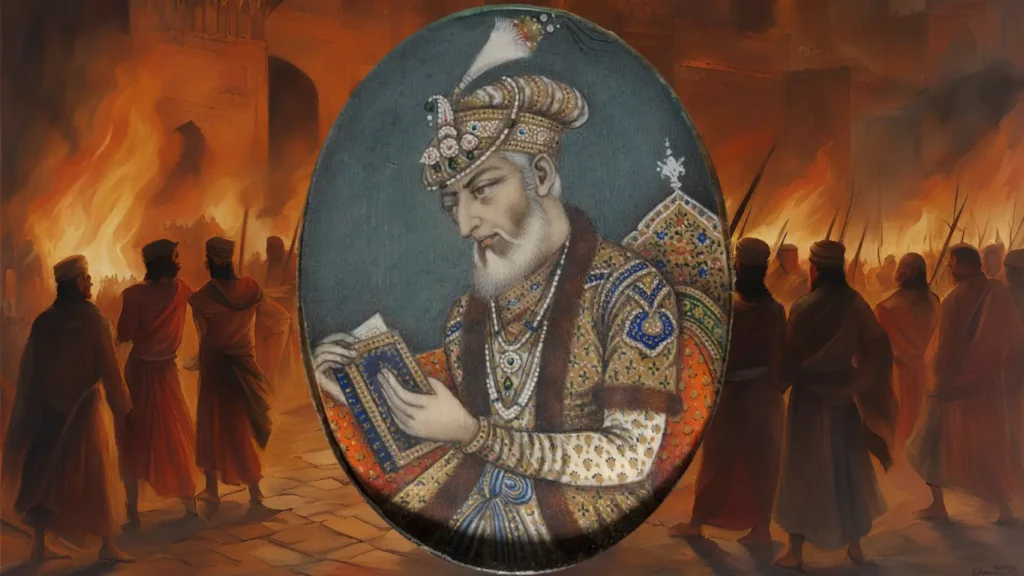
Aurangzeb, the sixth Mughal emperor, died on 3 March 1707 at his military encampment at Ahmadnagar in the Deccan, bringing to an end a reign that had lasted almost half a century. He was 88 years old.
There is no reliable historical evidence that Aurangzeb was assassinated or killed in battle. The surviving record instead places his death after a period of declining health in old age, following decades in which he had continued to direct military and administrative affairs across the Mughal Empire.
But the story of how Aurangzeb died is about more than the condition of an aging emperor. His death came at a critical moment for the Mughal Empire. A succession struggle began almost immediately, while the empire was already dealing with the consequences of prolonged warfare and the political pressures created by governing an enormous territory.
So, how did Aurangzeb die? What happened during his final years, where did he die, and why was one of India’s most powerful emperors buried in such a simple grave?
This article examines Aurangzeb’s death, his final years, burial, succession crisis, and the historical consequences of his passing.
Aurangzeb’s Life and Reign (1618–1707)
Aurangzeb was born on 3 November 1618. His full name was Abu’l Muzaffar Muhi-ud-Din Muhammad Aurangzeb Alamgir.
He became Mughal emperor in 1658 after a war of succession among the sons of Shah Jahan. His reign continued until his death in 1707, making it one of the longest reigns of any Mughal emperor.
During his rule, the Mughal Empire reached its greatest territorial extent. Aurangzeb expanded Mughal authority deep into the Deccan and spent much of the later part of his reign directing military campaigns in southern India.
His reign was also marked by:
- Expansion of Mughal territory in the Deccan
- Long conflicts with the Marathas
- Wars against the Deccan sultanates
- Administrative and fiscal pressures
- Reimposition of jizya in 1679
- Increasing military expenditure
- Growing resistance in different parts of the empire
The enormous size of the empire came with enormous costs. By the final years of Aurangzeb’s reign, prolonged warfare had placed considerable pressure on Mughal finances and administration.
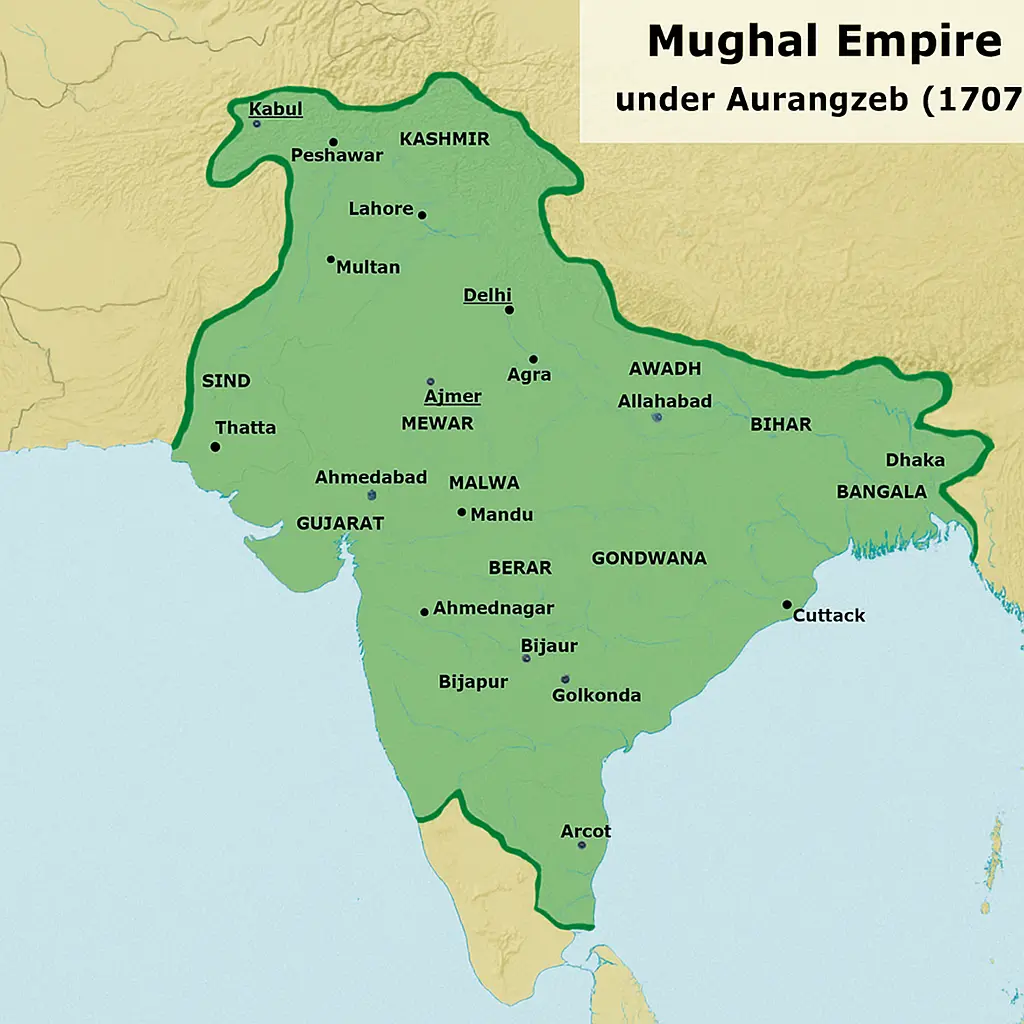
Key Facts About Aurangzeb
| Fact | Details |
|---|---|
| Full Name | Abu’l Muzaffar Muhi-ud-Din Muhammad Aurangzeb Alamgir |
| Born | 3 November 1618 |
| Reign | 1658–1707 |
| Died | 3 March 1707 |
| Age | 88 years |
| Cause of Death | Natural causes (old age, prolonged illness, exhaustion) |
| Place of Death | Ahmednagar, Maharashtra |
| Burial Place | Khuldabad, Maharashtra |
| Burial Cost | 14 rupees and 12 annas |
| Successor | Bahadur Shah I |
| Historical Impact | Beginning of Mughal decline |
How Did Aurangzeb Die?
Aurangzeb died on 3 March 1707 after a period of declining health in old age. Historical sources do not provide enough medical evidence to establish a precise modern diagnosis for the illness that preceded his death.
There is no reliable historical evidence that he was assassinated or killed in battle.
By the end of his life, Aurangzeb had spent much of his later reign in the Deccan, where Mughal armies were engaged in prolonged campaigns. The emperor continued to govern from his military encampment even as he reached advanced age and his health deteriorated.
Historical accounts place his death on 3 March 1707 at his military encampment near Ahmednagar. Cambridge’s history of the Mughal Empire records that Aurangzeb died at his encampment at Ahmadnagar on that date.
Later accounts describe his health as having deteriorated significantly during his final period.
The safest historical description is therefore that Aurangzeb died after a prolonged decline in health during old age. No reliable surviving evidence allows historians to identify a single modern medical diagnosis as the precise cause of death.
Did Aurangzeb Die in Battle?
No. Aurangzeb did not die on a battlefield. He died at his military encampment at Ahmadnagar on 3 March 1707.
He died at his military encampment at Ahmadnagar after years of campaigning in the Deccan. His death came while the Mughal Empire was still engaged in the political and military struggles of southern India.
The significance of the location is important: Aurangzeb had spent the final decades of his reign increasingly focused on the Deccan, and he died there rather than returning to the imperial capital in northern India.
Aurangzeb’s Final Years in the Deccan
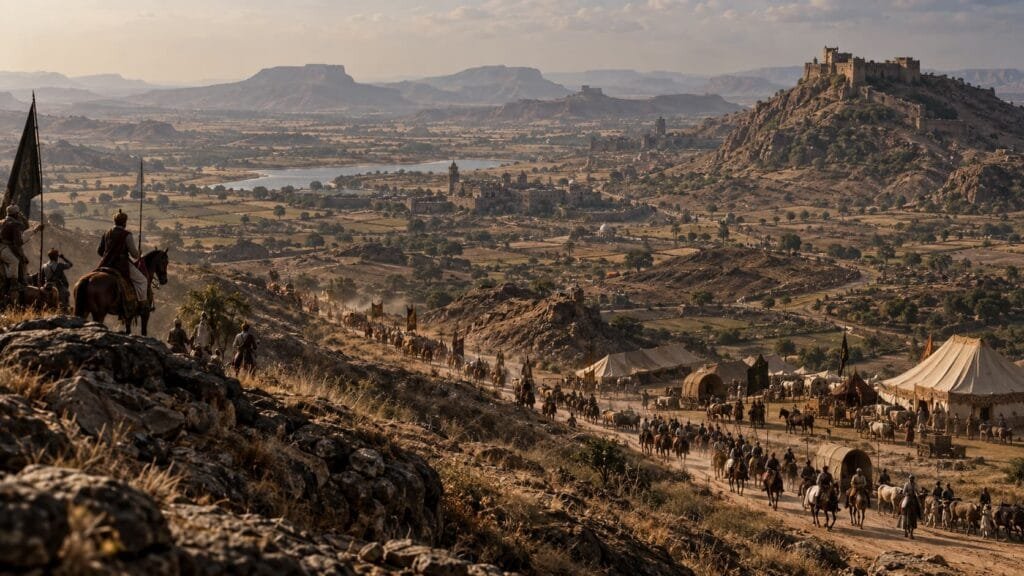
From 1681 until his death, Aurangzeb spent much of his later reign in the Deccan, directing Mughal military operations and attempting to consolidate imperial control over the region. The conflict involved the Marathas as well as the territories of the Deccan sultanates that the Mughals had conquered. The campaigns continued for years and imposed substantial military and administrative demands on the empire.
By 1705:
The treasury was exhausted
The army was overstretched
Provincial governors grew independent
Rebellions increased
In the final phase of his reign, Aurangzeb remained with the imperial encampment in the Deccan. Rather than representing a simple withdrawal from affairs of state, these years were still part of an active period of military administration and imperial decision-making. His death came while the Deccan campaigns were still unresolved.
Aurangzeb's Health Before His Death
The surviving historical record does not provide enough medical information to establish a precise modern diagnosis for Aurangzeb’s final illness. What can be established with greater confidence is that he died at an advanced age after a period of declining health. The historical record therefore supports describing his death without assigning a specific disease that cannot be reliably documented.
For that reason, claims that he died from a particular modern medical condition should be treated cautiously.
What can be established with greater confidence is that:
- He was 88 years old
- His health had deteriorated during his final years
- He had spent decades campaigning
- He died at his camp near Ahmednagar
- His death was recorded as natural rather than violent
This distinction is important because historical sources from the period were not medical records in the modern sense.
What Were Aurangzeb's Last Words?
There is no reliably authenticated historical record establishing Aurangzeb’s exact final words.
Later accounts and popular retellings attribute various emotional statements to Aurangzeb concerning his life, death, religious concerns, or regrets. However, the existence of such accounts does not establish that these statements were his literal final words.
HypeHive therefore does not present any particular quotation as Aurangzeb’s confirmed last statement unless a reliable primary or scholarly source establishes it.
This is an important distinction between a popular historical anecdote and a claim supported by reliable primary evidence.
Where Did Aurangzeb Die?
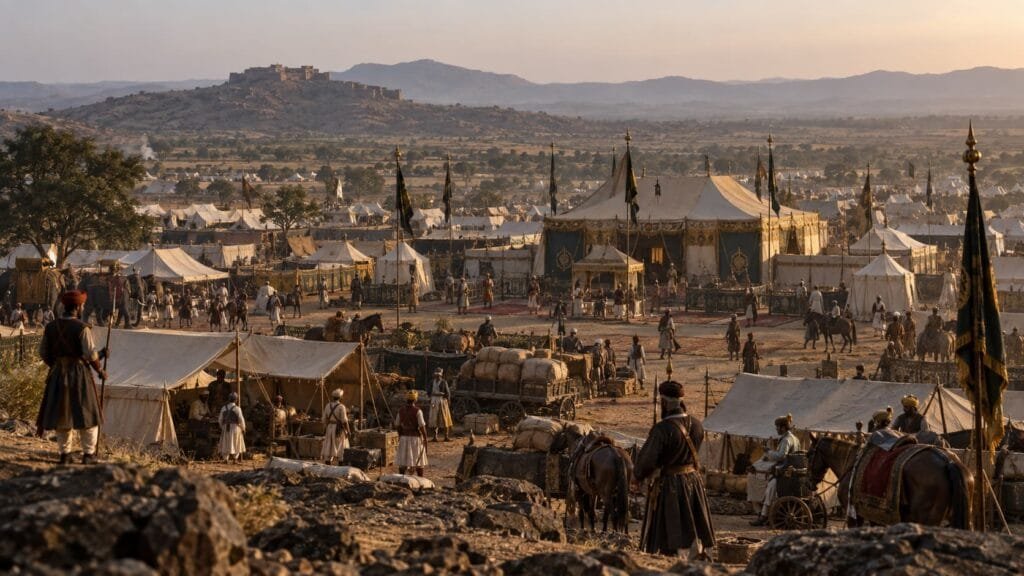
Aurangzeb died at his military encampment at Ahmadnagar in the Deccan on 3 March 1707.
Ahmadnagar was an important base for the Mughal campaigns in the Deccan, and the imperial encampment there had become closely associated with Aurangzeb’s prolonged southern campaigns.
His death there was significant because the Deccan had dominated much of the final phase of his reign. Aurangzeb did not return to Delhi before his death; the emperor who had ruled the Mughal Empire for nearly five decades died far from the imperial capital, in the region where so much of his final political and military effort had been concentrated.
John F. Richards’s history of the Mughal Empire records that Aurangzeb died at his encampment at Ahmadnagar on 3 March 1707.
The Burial of Aurangzeb at Khuldabad
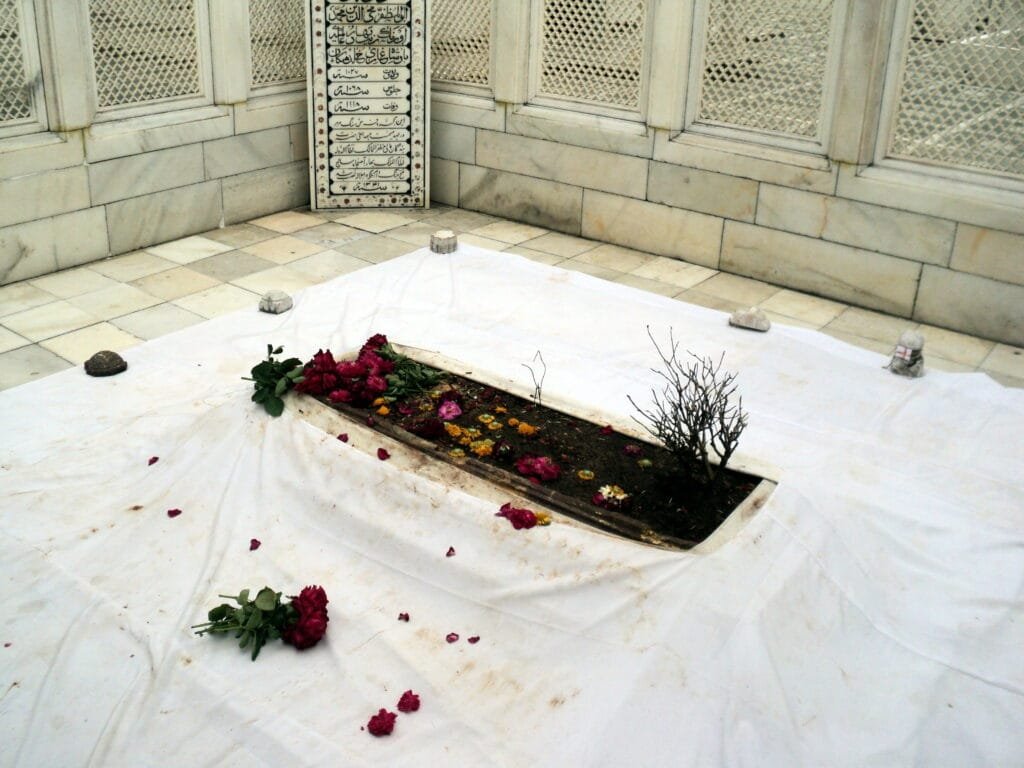
After his death, Aurangzeb was buried at Khuldabad in present-day Maharashtra, near the shrine of the Sufi saint Shaikh Zayn al-Din Shirazi. Encyclopaedia Iranica describes his grave as a simple open grave at the shrine complex.
Unlike the monumental tombs associated with several earlier Mughal rulers, Aurangzeb’s grave was remarkably modest. Contemporary and later descriptions of the site emphasize its simplicity rather than the monumental architecture normally associated with Mughal imperial burials.
He was buried near the shrine complex associated with the Sufi saint Shaikh Zainuddin.
Accounts of Aurangzeb’s burial describe a simple grave, and historical studies note that his own instructions for a modest burial are closely associated with the form of the grave at Khuldabad.
The burial became historically distinctive because the emperor who had ruled one of the largest empires of early modern India was not commemorated with a monumental imperial mausoleum. His grave remained notably simple and open to the ground at Khuldabad.
Why Is Aurangzeb's Tomb So Simple?
Aurangzeb’s burial is one of the most striking examples of simplicity among Mughal royal graves. The site contrasts sharply with the monumental architecture associated with several other members of the Mughal dynasty.
Unlike the monumental Mughal complexes associated with figures such as Humayun, Akbar, and Mumtaz Mahal, Aurangzeb’s grave at Khuldabad remained extremely modest. Its simplicity has therefore become an important part of the historical memory surrounding his death and burial.
The grave was associated with his wish to avoid an extravagant mausoleum.
Later modifications were made to the site. The present appearance should therefore not be confused entirely with the grave’s original 1707 form.
The site remains notable for its open-air character and its contrast with the monumental architecture associated with other Mughal emperors.
Did Aurangzeb Pay for His Own Burial?
A long-standing account about Aurangzeb’s burial says that he wanted the expenses of his simple grave to be met from money he had personally earned, including money traditionally said to have come from copying the Qur’an or making prayer caps.
However, this detail belongs to the wider tradition surrounding his burial and should not be presented as though every element of the story is independently established.
The frequently cited figure is 14 rupees and 12 annas.
However, this should be treated as a historical tradition rather than stated as an indisputable modern financial record.
The precise details of these earnings vary across later accounts. What is much more firmly established is the unusual simplicity of Aurangzeb’s grave at Khuldabad and the historical tradition that he wished to avoid the kind of monumental imperial tomb associated with other Mughal rulers.
The more important historical point is the contrast between Aurangzeb’s imperial position and the modest form of his final resting place. The ruler of a vast empire was ultimately buried in a simple grave rather than a monumental mausoleum.
What Happened After Aurangzeb Died?
Aurangzeb’s death did not immediately destroy the Mughal Empire. The empire continued under his successors, but his death triggered an immediate struggle over who would inherit the throne.
Instead, it exposed problems that had been developing during the later years of his reign.
One of the most immediate problems was succession.
Aurangzeb’s sons included:
- Muazzam, later known as Bahadur Shah I
- Muhammad Azam Shah
- Kam Bakhsh
A struggle for the throne followed almost immediately. Aurangzeb’s surviving sons included Muazzam, Azam Shah, and Kam Bakhsh, and the succession was ultimately decided through a military contest rather than a peaceful transfer of power.
John F. Richards records that the succession conflict began almost immediately after Aurangzeb’s death. Azam Shah adopted imperial titles and moved north toward Agra, while Muazzam, who was then in the north-west, began preparing to contest the succession. Muazzam ultimately prevailed and became emperor Bahadur Shah I.
Muazzam eventually emerged victorious and became Bahadur Shah I.
Succession Crisis After Aurangzeb’s Death
The Mughal succession did not operate according to a simple rule in which the eldest son automatically inherited the throne. Mughal princes could compete for imperial authority, making the death of a powerful emperor a potential trigger for armed succession.
Aurangzeb’s death therefore created precisely the situation that Mughal succession politics had repeatedly produced: rival princes competing for control of the empire.
In 1707, that contest began almost immediately, with Azam Shah and Muazzam moving to secure the throne. Muazzam eventually emerged as Bahadur Shah I.
The succession conflict did not by itself dismantle Mughal authority, but it opened a new phase in which imperial power faced growing political and military pressures. Over the following decades, regional powers increasingly exercised greater autonomy while the authority of the Mughal centre weakened.
The result was not an instant collapse, but it contributed to a period of increasing political instability.
Regional powers gained greater freedom, while the Mughal centre increasingly struggled to maintain the level of authority it had exercised under Aurangzeb.
Did Aurangzeb's Death Cause the Decline of the Mughal Empire?
Not by itself.
This is one of the most important distinctions to make when discussing Aurangzeb’s death: the Mughal Empire did not suddenly collapse because its emperor died.
The Mughal Empire was already facing significant pressures before 1707. The prolonged Deccan wars placed sustained demands on the imperial military and administration, while regional resistance and the unresolved problem of succession created additional challenges for the imperial system.
His death accelerated the political crisis because the empire immediately faced a succession struggle. The absence of a settled succession allowed the competing princes to turn the transition of power into a military contest.
Cambridge historian John F. Richards treats 1707–1720 as a distinct period of imperial decline and collapse and places the succession conflict immediately after Aurangzeb’s death at the beginning of this period.
Therefore, it is more accurate to say:
Aurangzeb’s death did not single-handedly cause the Mughal Empire’s decline. It exposed and accelerated weaknesses that were already present.
The Mughal Empire After 1707
After Aurangzeb’s death, Mughal political authority gradually became less effective across parts of the empire, although the imperial institution itself remained powerful and symbolically important for decades.
Regional powers became increasingly important.
The Marathas continued to expand their influence. Other regional political forces also strengthened their positions.
Over the following decades, Mughal emperors increasingly had to negotiate with powerful nobles, military commanders, and regional rulers whose autonomy grew as the authority of the imperial centre weakened.
The Mughal emperor continued to possess considerable political and symbolic importance, but the practical reach of the imperial centre diminished as regional powers became increasingly autonomous.
The later expansion of the British East India Company occurred within this much broader process of political fragmentation and regional competition. It was not an immediate consequence of Aurangzeb’s death in 1707.
Aurangzeb's Legacy
Aurangzeb remains one of the most extensively debated rulers in Indian history, with historians examining his military expansion, administration, religious policies, Deccan campaigns, and relationship with different regional powers.
Interpretations of his reign differ considerably.
Some historians and commentators emphasize:
- His administrative discipline
- His military achievements
- The enormous territorial extent of the empire under his rule
- His personal austerity
- His religious observance
Others emphasize:
- His religious policies
- The reimposition of jizya
- Destruction of or action against some temples
- His prolonged wars
- The fiscal and political consequences of his Deccan campaigns
- The growing strain placed on the Mughal state
Modern historical scholarship increasingly emphasizes the complexity of his rule rather than reducing him to a single label.
Aurangzeb governed a vast and diverse empire for nearly five decades. His historical legacy therefore extends beyond the circumstances of his death and involves questions about imperial expansion, administration, warfare, religion, regional resistance, and the political pressures inherited by his successors.
Why Aurangzeb's Death Still Matters
Aurangzeb’s death remains historically important because it marked a major transition in the history of the Mughal Empire.
He died after nearly half a century on the throne.
He left behind an empire that was territorially enormous but politically and financially under significant pressure.
His death was followed almost immediately by a succession struggle between rival Mughal princes.
In the decades that followed, Mughal political authority weakened in relative terms while regional powers became increasingly influential and autonomous.
For this reason, 3 March 1707 is an important date in Mughal history: it marks both the death of Aurangzeb and the beginning of an immediate succession crisis that shaped the empire’s next phase.
It was not the day the empire suddenly disappeared.
What followed was not an instant collapse, but a new phase in which succession struggles, regional autonomy, military pressures, and weakening central authority increasingly shaped the history of the Mughal Empire.
Frequently Asked Questions (FAQ)
1. How did Aurangzeb die?
Aurangzeb died on 3 March 1707 at his military encampment at Ahmadnagar in the Deccan after a period of declining health in old age. Historical sources do not establish a precise modern medical diagnosis for his final illness.
2. When did Aurangzeb die?
Aurangzeb died on 3 March 1707.
3. Where did Aurangzeb die?
He died at his military encampment at Ahmadnagar in the Deccan.
4. How old was Aurangzeb when he died?
Aurangzeb was 88 years old when he died.
5. Was Aurangzeb assassinated?
There is no reliable historical evidence that Aurangzeb was assassinated. The surviving historical record places his death after a period of declining health in old age.
6. Did Aurangzeb die in battle?
No. Aurangzeb did not die in battle. He died at his military encampment at Ahmadnagar on 3 March 1707.
7. Where is Aurangzeb buried?
Aurangzeb is buried at Khuldabad in Maharashtra, at a simple grave near the shrine of Shaikh Zayn al-Din Shirazi.
8. Why is Aurangzeb’s tomb so simple?
Aurangzeb’s grave at Khuldabad is notably simple and open to the ground, in keeping with the historical tradition that he wanted a modest burial rather than a monumental imperial mausoleum.
9. Did Aurangzeb’s death cause the Mughal Empire to collapse?
No. The Mughal Empire did not collapse immediately after Aurangzeb’s death. His death was followed by a succession war and a period of increasing political and military pressure, but Mughal authority continued for decades afterward.
10. What were Aurangzeb’s last words?
There is no reliably authenticated historical record establishing Aurangzeb’s exact final words. Later accounts contain statements attributed to him, but they should not automatically be treated as his literal last words.
Conclusion
How did Aurangzeb die?
Aurangzeb died on 3 March 1707 at his military encampment at Ahmadnagar in the Deccan, aged 88.
The surviving historical record does not establish a precise modern medical diagnosis for his final illness, but it places his death after a period of declining health in old age.
There is also no reliable evidence that he was assassinated or killed in battle.
His death was followed almost immediately by a struggle for succession among his sons, with Muazzam eventually emerging as Bahadur Shah I.
The Mughal Empire did not collapse in 1707, but the succession crisis marked the beginning of a new phase in which the imperial centre faced growing political, military, and regional pressures.
Aurangzeb’s final resting place at Khuldabad is equally striking. The emperor who had ruled a vast empire was buried in a remarkably simple grave near the shrine of Shaikh Zayn al-Din Shirazi.
More than three centuries later, the question “How did Aurangzeb die?” remains important because the circumstances of his death connect a personal historical event with the beginning of a major transition in Mughal political history.
