
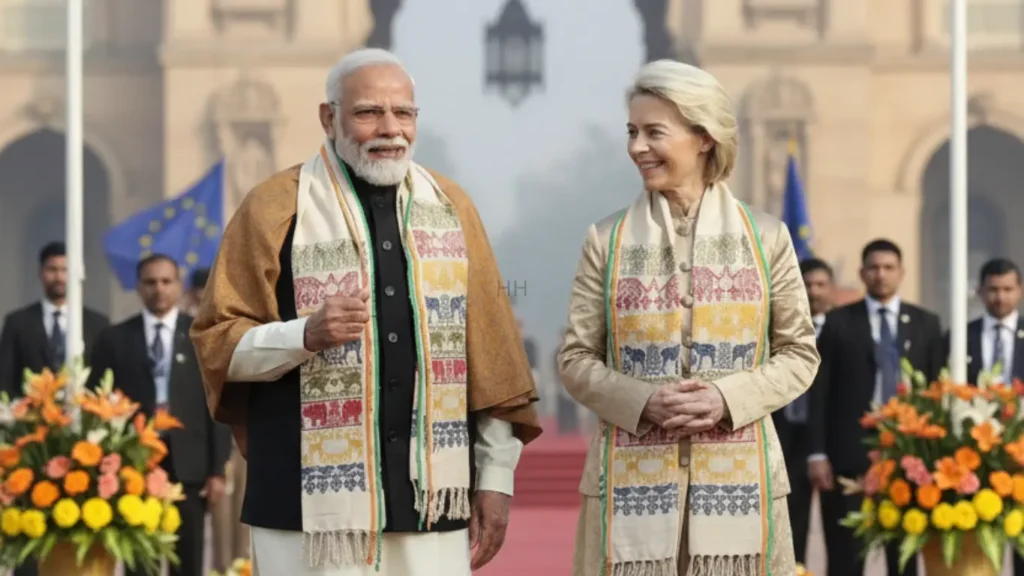
The India-EU Free Trade Agreement 2026 (FTA), dubbed the “Mother of All Deals,” has been formally concluded in January 2026 after nearly two decades of negotiations. Indian and EU leaders have described it as a transformative economic pact covering a market of nearly two billion consumers and roughly one-quarter of global GDP, with trade between the partners representing one-third of global commerce.
This agreement is not merely about tariff cuts; it signals a strategic realignment in global trade and geopolitical relations at a moment of intense international economic stress.
Why It Is Called the “Mother of All Deals”
Scale and Scope
The agreement connects the Indian economy with the economies of the 27-member European Union, collectively representing approximately 25% of global economic output and one-third of total global trade. The size and depth of market access for both sides are unprecedented for India and significant for the EU.
Duration of Negotiations
Negotiations were launched in 2007 and faced multiple pauses, most notably after 2013, before progress picked up again in the early 2020s. Over nearly two decades, negotiators worked through complex issues involving tariffs, services, regulatory standards, and investment protections.
Strategic Significance
Beyond economics, this pact underscores both India’s and the EU’s intent to diversify economic relationships and reduce strategic dependency on any single market or corridor. Scholars see the timing as closely tied to global geopolitical shifts that favour multipolar engagement over traditional reliance on any one world power.
What the India-EU FTA Covers
Tariff Reductions and Market Access
The agreement envisages substantial tariff reductions on goods and expanded access in services, though detailed coverage will be consolidated through final legal formalities. Indian exporters in textiles, leather, chemicals and other labour-intensive sectors are expected to benefit from improved access to EU markets, while European industries such as automobiles, machinery and premium goods gain stronger footholds in India.
Services and Digital Trade
The pact covers trade in services, including financial, professional and digital services, where India has significant comparative advantage. Provisions for data flows and mutual recognition of professional qualifications are likely to support service sector expansion.
Investment and Regulation
Both sides are expected to adopt measures that protect foreign direct investment and streamline regulatory cooperation, which can encourage cross-border flows of technology, capital, and talent.
Geopolitical Context
Impact of U.S. Trade Policy
Trade policy in the United States under President Donald Trump has been characterized by increased tariffs, trade tensions, and a more asymmetric approach to international commerce. In recent years, high tariffs on Indian goods — including punitive duties of 25% or more tied to geopolitical disagreements — have created frictions for global exporters and contributed to wider uncertainty in world markets.
These policies have not only affected India–U.S. economic relations but also catalysed diversification efforts by India and the EU. The India-EU FTA can be seen as part of a broader strategic movement toward building resilient trade routes that are less dependent on volatile policy swings by any single large economy.
Multipolar World Dynamics
The current global environment is increasingly defined by multipolar engagement, where emerging and established powers seek partnerships that balance economic interests and geopolitical stability. The India-EU FTA fits within this evolving landscape as both partners seek greater strategic autonomy and diversified trade linkages.
How Major Countries See the Deal
China
China views the India-EU FTA through the lens of competitive trade dynamics. As European firms diversify supply chains beyond China, the pact may accelerate a “China-plus-one” strategy among businesses seeking to reduce overreliance on any single production hub. Indian and European cooperation could bolster regional supply chains in Asia and Europe, aligning with independent economic objectives while maintaining pragmatic engagement with Chinese markets.
Russia
Russia’s strategic relationship with India, particularly in energy and defence sectors, differs from its economic engagement with the EU. While India continues to maintain economic ties with Russia, the India-EU FTA introduces a significant new axis of economic cooperation that may encourage Moscow to reconsider its broader Eurasian trade strategies. Russia’s response is likely to balance its strategic interests with India against the backdrop of shifting Western sanctions and global partnerships.
United States
While the U.S. is a key global market, its recent protectionist and tariff-focused policies have prompted partners like India and the EU to pursue alternative alliances. The India-EU deal may encourage deeper engagement with Washington on trade by highlighting the benefits of predictable and rules-based market access, even as it reflects a cautious stance toward unilateral tariff actions.
Other Major Economies
Countries such as Japan, South Korea, Australia and members of ASEAN are closely monitoring the India-EU FTA as a model for future trade architecture in a world where stable, broad-based economic agreements can reduce systemic risk and promote sustainable growth. The pact could encourage similar agreements and influence negotiations where global supply chain resilience has become paramount.
Strategic and Long-Term Implications
Global Trade Realignment
The India-EU FTA is expected to contribute to a reorientation of global trade routes and partnerships, reducing vulnerability to single-market pressures. As nations worldwide seek balance between economic openness and geopolitical resilience, this deal may serve as a benchmark for future agreements.
Rules-Based Trade and Standards
By strengthening regulatory cooperation and aligning certain market norms, India and the EU signal their commitment to a rules-based international trade order. This focus is likely to encourage reforms and technological collaborations that extend beyond traditional tariff discussions.
Supply Chain Resilience
Beyond tariffs, both parties will likely invest in developing supply chain linkages that are more predictable and less sensitive to sudden policy shifts — a priority underscored by recent global trade disruptions.
Conclusion
The India-EU Free Trade Agreement concluded in January 2026 represents a landmark moment in global economic history. It is not merely a commercial pact but a strategic instrument designed to enhance economic resilience, expand market access, and hedge against volatile trade policies emanating from large economies. By deepening economic integration and fostering geopolitical cooperation, this agreement stands as a defining milestone in the evolving architecture of 21st-century global trade.
Frequently Asked Questions (FAQs)
What is the India-EU Free Trade Agreement 2026?
The India-EU Free Trade Agreement 2026 is a comprehensive trade pact between India and the European Union aimed at reducing tariffs, expanding services trade, improving investment protection, and strengthening regulatory cooperation across goods and digital commerce.
Why is the India-EU FTA called the “Mother of All Deals”?
Leaders refer to it as the “Mother of All Deals” because it links two major economies representing nearly two billion consumers and about one-quarter of global GDP, following almost two decades of negotiations.
When will the India-EU Free Trade Agreement come into effect?
Negotiations concluded in January 2026. After legal review and ratification by EU institutions and India’s government, implementation is expected to begin in 2027 with phased tariff reductions.
Which sectors in India benefit most from the deal?
Indian sectors expected to benefit include textiles, leather goods, gems and jewellery, chemicals, pharmaceuticals, and IT-enabled services, due to improved access to European markets.
Which European industries gain from the agreement?
European automakers, machinery manufacturers, luxury goods producers, and renewable energy companies are expected to gain stronger access to India’s fast-growing consumer and industrial markets.
How does the India-EU FTA affect global supply chains?
The agreement supports supply-chain diversification by encouraging manufacturing and sourcing links between India and Europe, reducing overdependence on single-country production hubs.
What is the geopolitical significance of this deal?
The pact strengthens India-EU strategic alignment in a multipolar world, promotes rules-based trade cooperation, and reduces vulnerability to unilateral trade policies and sudden tariff actions by other major powers.
How do U.S. trade policies influence this agreement?
Recent protectionist and high-tariff trade policies by the United States have increased global trade uncertainty, encouraging India and the EU to deepen direct economic cooperation through stable long-term agreements.
How is China likely to view the India-EU trade deal?
China is expected to view the agreement as part of Europe’s and India’s broader supply-chain diversification strategy. While competition may increase in certain sectors, pragmatic trade engagement with China is likely to continue.
What could be Russia’s reaction to the India-EU FTA?
Russia maintains strong strategic ties with India. The deal may prompt Russia to recalibrate its Eurasian trade strategies while continuing cooperation with India in energy and defence sectors.
Will the agreement help Indian professionals work in Europe?
Yes. The deal includes provisions on services trade and professional mobility, potentially easing recognition of qualifications and movement of skilled Indian professionals in IT, healthcare and engineering.
Is the India-EU FTA only about trade in goods?
No. It covers goods, services, investment protection, digital trade, regulatory cooperation, and long-term economic and strategic collaboration.