
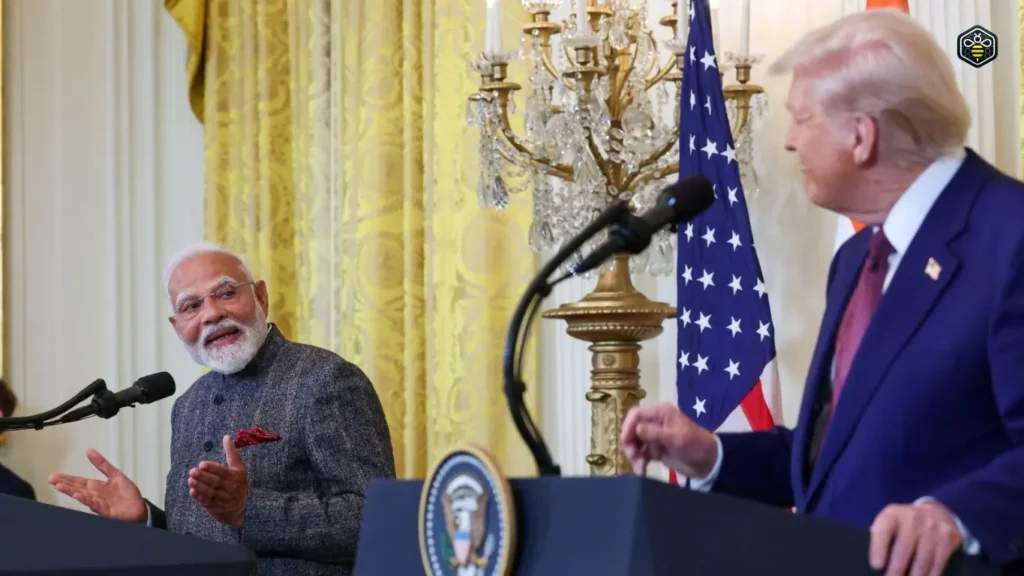
When Prime Minister Narendra Modi met U.S. President Donald Trump in Washington on February 13, 2025, the two countries presented an ambitious vision for the future.
Defence cooperation, trade, energy, artificial intelligence, critical minerals, nuclear power and advanced technology were all placed on the agenda.
More than a year later, India-US relations have entered a much more complicated phase.
The partnership has expanded in several strategic areas. India and the United States have signed a new long-term defence framework, negotiated an interim trade agreement, deepened cooperation on critical minerals and continued discussions on technology and nuclear energy.
At the same time, tariffs, Russian oil and immigration have created new friction.
The result is a relationship built around substantial cooperation but also significant disagreements.
So what has actually changed in India-US relations since the Modi-Trump meeting of February 2025?
What Happened at the Modi-Trump Meeting in February 2025?
The February 2025 summit established a broad agenda for the next phase of India-US relations.
Modi and Trump launched COMPACT — the U.S.-India initiative for Catalyzing Opportunities for Military Partnership, Accelerated Commerce and Technology.
The initiative covered defence, trade and technology while also expanding cooperation in artificial intelligence, semiconductors, quantum computing, biotechnology, energy and space.
The two governments also committed to negotiating a new 10-year framework for defence cooperation.
However, one important correction is needed in many versions of this story.
India did not agree to buy F-35 fighter jets in February 2025.
Trump discussed the possibility of making the F-35 available to India, but the February joint statement did not announce an Indian F-35 procurement agreement.
Instead, the official statement referred to expanding defence sales and co-production and identified systems including Javelin anti-tank missiles, Stryker infantry combat vehicles and additional P-8I maritime patrol aircraft for further discussion.
That distinction matters when evaluating subsequent developments in India-US relations.
1. Defence Cooperation Has Become a Long-Term Pillar
One of the clearest developments since February 2025 has been the institutionalisation of defence cooperation.
On October 31, 2025, India and the United States signed the 2025 Framework for the U.S.-India Major Defense Partnership.
The framework is designed to be renewed every ten years and covers cooperation across land, sea, air, space and cyberspace.
It also calls for greater interoperability, expanded military exercises, logistics cooperation, information sharing and defence-industrial collaboration.
This is important because the military relationship is no longer limited to India purchasing American equipment.
The broader objective is to develop deeper cooperation between the two defence establishments.
India already operates several major American-origin platforms, including:
C-17 Globemaster III
C-130J Super Hercules
P-8I Poseidon
Apache helicopters
Chinook helicopters
MH-60R Seahawks
M777 howitzers
For additional background, see HypeHive’s article on India-US defence pacts.
The growing defence relationship is therefore becoming one of the structural pillars of India-US relations.
2. Trade Became the Biggest Source of Friction
Trade was one of the most ambitious objectives announced during the February 2025 summit.
The two governments set a goal of increasing bilateral trade toward $500 billion by 2030.
But the path toward that target was far from smooth.
During 2025, Washington introduced a series of tariffs affecting Indian exports, while negotiations became increasingly connected to India’s purchases of Russian oil.
For a detailed look at the earlier tariff dispute, HypeHive has already covered Trump’s reciprocal tariffs on India.
The tariff dispute demonstrated an important feature of modern India-US relations: strategic cooperation in one area does not prevent serious economic disagreements in another.
India wanted greater access to the American market.
The United States wanted greater access to India’s large consumer market while also seeking changes to tariffs and non-tariff barriers.
That created a difficult negotiating environment.
3. The February 2026 Trade Breakthrough
A major development came in February 2026.
On February 6, the United States and India announced a framework for an Interim Agreement on reciprocal and mutually beneficial trade.
The framework was intended to provide a bridge toward a broader U.S.-India Bilateral Trade Agreement.
Under the framework, India agreed to reduce or eliminate tariffs on a wide range of American industrial, agricultural and food products.
The United States announced an 18% reciprocal tariff rate on qualifying Indian goods under the framework.
The United States also removed the additional 25% tariff that had been imposed on Indian goods in connection with India’s purchases of Russian oil.
The agreement also covered issues beyond tariffs, including:
medical devices
agricultural products
information and communication technology
automotive parts
pharmaceuticals
digital trade
rules of origin
supply-chain resilience
The framework also envisaged India purchasing $500 billion of U.S. energy products, aircraft and aircraft parts, precious metals, technology products and coking coal over five years.
However, the broader bilateral trade agreement remains a work in progress.
This means the February 2026 agreement should be understood as an interim framework rather than the final endpoint of India-US relations.
4. Russian Oil Has Changed the Conversation
Energy has become one of the most complicated issues in India-US relations.
India is one of the world’s largest oil importers and has continued to purchase Russian crude because of its energy requirements and changing global oil markets.
Washington, meanwhile, has sought to increase economic pressure on Russia.
That conflict of interests became particularly important again in September 2026.
The U.S. Congress passed legislation giving President Trump expanded authority to impose tariffs of up to 100% on countries purchasing Russian oil, potentially including India.
India responded by warning that such measures could affect bilateral ties and stating that it remained committed to protecting its energy security and economic interests.
The issue is particularly significant because Russian crude remains an important part of India’s energy mix.
But India’s purchasing pattern has already begun changing.
According to Reuters, India’s Russian oil imports fell 16.5% in August 2026 to around 2.1 million barrels per day, with preliminary September data indicating another decline to around 1.9 million barrels per day.
India has simultaneously increased purchases from other suppliers, including Iraq and countries in the Middle East.
For readers interested in the energy side of this issue, HypeHive’s explainer on what refined oil is provides useful background.
The Russian-oil dispute demonstrates why India-US relations cannot be understood purely through the lens of defence or trade.
Energy security has become part of the strategic relationship.
5. The $500 Billion Trade Target Is Still Ahead
The $500 billion target announced in 2025 remains an ambition rather than an already-achieved milestone.
The February 2026 interim framework was an important step, but negotiations over the broader bilateral trade agreement continue.
The economic relationship extends across:
information technology
pharmaceuticals
engineering goods
textiles
agriculture
energy
aviation
electronics
defence manufacturing
critical minerals
The trade relationship is also connected to India’s wider economic strategy.
For example, India is simultaneously developing major trade relationships with Europe. HypeHive has previously covered the India-EU Free Trade Agreement, which provides useful context for understanding India’s broader effort to diversify its economic partnerships.
This diversification is an important background factor in India-US relations.
6. Critical Minerals Have Become a New Strategic Priority
One of the most important developments since the original Modi-Trump meeting is the growing importance of critical minerals.
Modern industries depend on minerals and rare earth elements for:
semiconductors
electric vehicles
batteries
renewable energy
advanced electronics
defence systems
data centres
artificial intelligence infrastructure
In 2026, India and the United States established a Strategic Critical Minerals Cooperation Framework.
According to the International Energy Agency, the framework covers cooperation across mining, processing, recycling and financing of critical minerals and rare earths.
The objective is to create more diversified and resilient supply chains and reduce vulnerabilities caused by concentrated sources of supply.
This connects directly with another major HypeHive topic: rare-earth minerals and their global impact.
Critical minerals have therefore moved from being a specialist industrial issue to a strategic component of India-US relations.
They sit at the intersection of technology, defence, manufacturing and economic security.
7. Technology Cooperation Is Expanding
Technology was another major component of the February 2025 agenda.
The two countries launched the TRUST initiative — Transforming the Relationship Utilizing Strategic Technology.
The initiative covers areas including:
artificial intelligence
semiconductors
quantum computing
biotechnology
energy
space
advanced defence technology
The broader objective is to encourage cooperation between governments, companies, researchers and universities while protecting sensitive technologies.
This is particularly important because the global technology race increasingly overlaps with national security.
Artificial intelligence requires advanced computing.
Advanced computing requires semiconductor supply chains.
Semiconductors depend on complex networks involving minerals, manufacturing equipment, energy and specialised research.
That means technology cooperation increasingly overlaps with almost every other major component of India-US relations.
8. Nuclear Energy Is Returning to the Agenda
Civil nuclear cooperation also remains an important part of the relationship.
The two governments have continued discussions around implementing the U.S.-India civil nuclear framework, including cooperation involving U.S.-designed reactors and greater localisation of nuclear manufacturing.
At the same time, India is developing its own domestic Small Modular Reactor programme.
India’s Nuclear Energy Mission has allocated substantial funding toward indigenous SMR research, development and deployment.
These developments should not be confused with one another.
India’s domestic SMR programme is an indigenous initiative, while U.S.-India nuclear cooperation involves a separate bilateral framework.
Nevertheless, nuclear energy provides another potential area of cooperation within India-US relations.
9. Modi and Trump Met Again in 2026
The relationship continued at the leadership level after the February 2025 summit.
Modi and Trump met on the sidelines of the G7 Summit in France in June 2026.
Their discussions covered bilateral trade, defence, energy, strategic technology and people-to-people ties.
The meeting also provided an opportunity to review progress toward the interim trade arrangement.
This repeated high-level engagement demonstrates that the relationship continues to operate across several channels even when individual issues become contentious.
10. The Quad Adds Another Layer
India-US relations also have to be viewed through the wider Indo-Pacific framework.
India and the United States are both members of the Quad, alongside Australia and Japan.
The grouping has developed cooperation in areas including:
maritime security
critical minerals
technology
resilient supply chains
infrastructure
humanitarian assistance
Critical minerals are particularly important here.
The Quad has also developed its own critical-minerals initiative aimed at diversifying supply chains and encouraging investment and cooperation.
This gives the bilateral relationship another strategic layer.
Even when Washington and New Delhi disagree over tariffs or energy policy, cooperation can continue through broader multilateral arrangements.
11. Immigration Remains a Sensitive Economic Issue
People-to-people connections form another major part of India-US relations.
Indian students, technology professionals, researchers, entrepreneurs and the Indian-American community have created extensive social and economic links between the two countries.
However, immigration policy has also become an area of debate.
Changes to the H-1B visa system have particular significance for Indian professionals because Indian nationals have historically represented a large proportion of H-1B beneficiaries.
The issue goes beyond immigration itself.
It also affects:
technology companies
skilled-worker mobility
universities
startups
professional services
cross-border investment
As a result, immigration policy can have consequences for the broader economic relationship.
India-US Relations: What Changed Between 2025 and 2026?
The evolution can be summarised through a simple timeline:
| Period | Major development |
|---|---|
| February 2025 | Modi and Trump launch COMPACT and establish a broad strategic agenda |
| 2025 | Trade tensions intensify as U.S. tariff policy changes |
| October 2025 | New 10-year U.S.-India defence framework signed |
| February 2026 | Interim trade framework announced |
| February 2026 | U.S. reciprocal tariff rate under the framework set at 18% |
| May–July 2026 | Critical-minerals cooperation framework becomes operational |
| June 2026 | Modi and Trump meet again at the G7 Summit |
| September 2026 | New U.S. Russia-sanctions legislation creates additional tariff risks |
| September 2026 | India warns that new measures could affect bilateral ties |
| September 2026 | Indian purchases of Russian crude continue to decline |
The timeline shows why India-US relations cannot be described simply as either improving or deteriorating.
Several forms of cooperation have deepened while new disagreements have simultaneously emerged.
What Are the Main Issues in India-US Relations Now?
As of September 2026, five issues stand out.
1. Trade
The two countries are still working toward a broader bilateral trade agreement while managing tariff disagreements.
2. Russian oil
India’s energy relationship with Russia remains a major point of disagreement with Washington.
3. Defence
The countries continue to expand military interoperability, defence technology cooperation and industrial collaboration.
4. Technology
AI, semiconductors, quantum computing and critical minerals are becoming increasingly important.
5. Strategic autonomy
India continues to maintain relationships with multiple major powers rather than relying exclusively on one strategic partner.
These issues will determine the next phase of India-US relations.
The Bigger Story Behind India-US Relations
The biggest change since February 2025 is that the relationship has become broader.
It is no longer primarily about defence exercises or technology outsourcing.
It now connects:
Defence + Trade + Energy + Technology + Critical Minerals + Nuclear Power + Immigration + Indo-Pacific Security
That creates both opportunities and potential points of disagreement.
India wants access to advanced technology, investment, energy and major consumer markets.
The United States wants greater cooperation in defence, technology, supply-chain resilience, Indo-Pacific security and trade.
But the two countries do not have identical interests on every global issue.
The Russian-oil dispute is perhaps the clearest example.
India’s energy requirements can sometimes conflict with Washington’s geopolitical objectives.
That does not automatically end cooperation.
Instead, it creates a negotiation problem that both sides have to manage.
What Happens Next?
The next phase of India-US relations will likely depend heavily on three interconnected questions.
Can the two countries complete their broader trade agreement?
How will India manage its Russian energy purchases under increasing U.S. pressure?
Can defence and technology cooperation continue expanding despite economic disagreements?
The answers will determine whether the ambitious agenda established during the Modi-Trump meeting develops into a more comprehensive partnership or remains a collection of separate agreements and negotiations.
For now, the evidence points to a relationship that is becoming more interconnected, but not necessarily simpler.
The United States is becoming increasingly important to India’s defence, technology and economic ecosystem.
At the same time, India continues to protect its own interests across energy, trade and foreign policy.
That tension between strategic cooperation and strategic autonomy may become the defining feature of the next chapter of India-US relations.
Frequently Asked Questions
What did Modi and Trump agree on in February 2025?
The two leaders launched COMPACT and established an agenda covering defence, trade, technology, energy and strategic cooperation. They also committed to developing a new 10-year defence framework.
Did India agree to buy F-35 fighter jets?
No confirmed F-35 procurement agreement was announced at the February 2025 summit. The official statement discussed expanding defence sales and co-production, including Javelin missiles, Stryker vehicles and additional P-8I aircraft.
What is the India-US $500 billion trade target?
The two countries announced an ambition to increase bilateral trade toward $500 billion by 2030. The February 2026 interim framework also included India’s intention to purchase $500 billion of specified U.S. goods and energy products over five years.
What happened to the India-US trade agreement?
In February 2026, the two countries announced a framework for an interim trade agreement while continuing negotiations toward a broader bilateral trade agreement.
Why is Russian oil affecting India-US relations?
The United States has sought to increase economic pressure on Russia, while India has continued to purchase Russian crude as part of its energy-import strategy. New U.S. legislation in September 2026 expanded the potential use of tariffs against countries purchasing Russian oil.
Are India and the United States cooperating on critical minerals?
Yes. A 2026 Strategic Critical Minerals Cooperation Framework covers mining, processing, recycling and financing of critical minerals and rare earths.
Are India and the United States cooperating on nuclear energy?
Yes. Civil nuclear cooperation remains part of the bilateral agenda, while India is separately developing its own indigenous Small Modular Reactor programme.
What are the main areas of India-US relations today?
The major areas include defence, trade, energy, technology, critical minerals, nuclear cooperation, immigration and Indo-Pacific security.
Conclusion
The February 2025 Modi-Trump meeting opened an ambitious new chapter, but the developments that followed have made the relationship more complex than the original summit suggested.
Defence cooperation has become more institutionalised.
Trade negotiations have moved through a major tariff dispute into an interim framework.
Critical minerals have emerged as a strategic priority.
Technology cooperation has expanded.
Nuclear energy remains on the agenda.
And Russian oil has become one of the most difficult issues confronting the relationship.
As of September 2026, India-US relations are therefore defined by both cooperation and negotiation.
The two countries increasingly need each other in areas ranging from technology and defence to supply chains and energy.
At the same time, both continue to protect their own economic and strategic interests.
That combination — growing interdependence alongside continued strategic autonomy — is likely to shape the next chapter of the India-US relationship.