
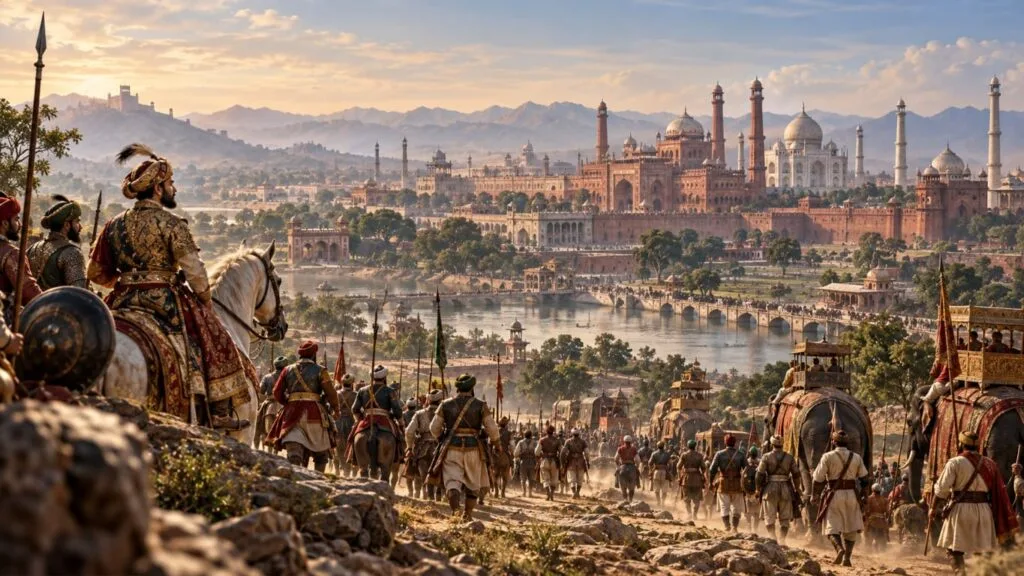
The Mughal Empire history began with Babur’s victory at Panipat in 1526 and became one of the most consequential imperial formations in South Asian history. Its story includes conquest and consolidation, succession wars, regional alliances, administrative institutions, long Deccan campaigns, extraordinary architecture and the gradual transfer of political power to regional states and, eventually, the British.
Mughal Empire History at a Glance
| Founded in India | 1526, after Babur’s victory at the First Battle of Panipat |
|---|---|
| Founder | Zahir-ud-din Muhammad Babur |
| Major imperial centres | Agra, Fatehpur Sikri, Lahore and Shahjahanabad (Delhi) |
| Major expansion | Especially under Akbar and Aurangzeb |
| Aurangzeb’s death | 1707 |
| Last Mughal emperor | Bahadur Shah II (Bahadur Shah Zafar) |
| End of Mughal sovereignty | 1858, following the Revolt of 1857 and the transfer of power to the British Crown |
What Was the Mughal Empire?
The Mughal Empire was a dynasty founded in the Indian subcontinent by Babur, a Timurid prince from Central Asia. NIOS describes the Mughal replacement of the Delhi Sultans in 1526 and notes that Mughal rule continued in a powerful form until 1707, followed by a largely nominal imperial presence until 1857. The Mughal state did not appear on an empty political landscape: north India and the Deccan already contained several regional powers when Babur entered the subcontinent.
The empire changed considerably across its long history. The political system of Babur’s first decades was not identical to the mature imperial structure associated with Akbar, and the political world of the eighteenth-century Mughal court was very different from that of Shah Jahan or Aurangzeb. For that reason, “Mughal India” should be treated as a changing historical period rather than a single uniform system.