
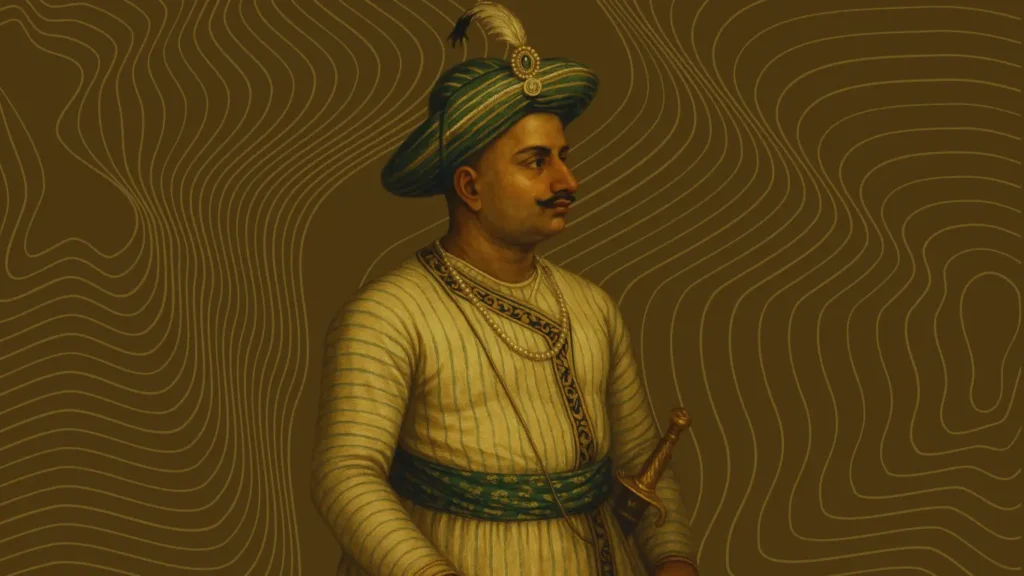
Tipu Sultan (1750/51–1799), ruler of Mysore, was the eldest son of Haidar Ali and Fakhr-un-Nisa (Fatima Begum). He married several wives, among them Sultan Begum, Ruqaya Banu Begum and Khadija Zaman Begum, and genealogies record twelve to sixteen sons and at least eight daughters. After his death in 1799 the family was held at Vellore Fort, then moved to Calcutta in 1806, where most of his known descendants still live.
Tipu Sultan’s family tree is one of the most misreported in Indian history. Popular websites routinely give him a single wife and four sons, merge different wives into one person, or invent modern “princes”. The record kept by the East India Company, which held the family for decades, is far richer and stranger than that.
This guide traces the family from Haidar Ali to the present, separating what the records show from what they do not.
The Family at a Glance
| Father | Haidar Ali (c. 1720–1782), commander who became de facto ruler of Mysore in the 1760s |
| Mother | Fakhr-un-Nisa, also called Fatima Begum, Haidar Ali’s second wife |
| Born | Devanahalli, near Bangalore. Royal Ark’s genealogy gives 20 November 1750; most references give 1 December 1751 |
| Principal wives | Sultan Begum (m. 1774), Ruqaya Banu Begum (m. 1774), Khadija Zaman Begum (m. 1795), Buranti Begum, plus many other consorts |
| Children | Twelve to sixteen sons and at least eight daughters, depending on the record |
| Died | 4 May 1799, defending Seringapatam (Srirangapatna); buried at the Gumbaz, Lalbagh |
| Family after 1799 | Vellore Fort (1799–1806), then Calcutta (from 1806) |
Origins: Haidar Ali and Fakhr-un-Nisa
Haidar Ali was not born to rule. He rose through the Mysore army under the Wodeyar kings and, by the 1760s, held real power in the state while the Wodeyars remained nominal rulers. Tipu, born to Haidar’s second wife Fakhr-un-Nisa, was trained in war and diplomacy from his teens and succeeded his father in December 1782.
Royal Ark’s genealogy, compiled by Christopher Buyers, notes that the family’s claimed descent from the Sharifs of Mecca appears in sources that contradict each other, and treats it as unreliable, probably a later invention to strengthen the dynasty’s Muslim credentials.
Tipu Sultan’s Wives
Tipu did not have one wife. The best-documented are:
- Sultan Begum, daughter of Imam Sahib Bakhshi, married at Seringapatam (now Srirangapatna) in 1774. She survived her husband by decades and died at Vellore Fort before 1835.
- Ruqaya Banu Begum, married on the same night in 1774. She was related to the family through her mother, a daughter of Tipu’s uncle. She died in February 1792, during the British attack on Seringapatam in the Third Anglo-Mysore War.
- Khadija Zaman Begum, married in 1795. She died in childbirth in 1797.
- Buranti Begum, daughter of a Delhi nobleman.
Ruqaya Banu and Khadija Zaman were two different women, married twenty years apart. Many websites merge them into one person. Beyond these wives, the Company’s lists record a large household of consorts, including two princesses of Coorg whom the British returned to their family in 1799.
Tipu Sultan’s Sons
Counts vary. Royal Ark records sixteen sons and at least eight daughters; the Company-era pension records discussed by historian Projit Mukharji refer to twelve sons in exile. Among the sons named in the records:
- Shahzada Haidar Ali (Fateh Haidar), the eldest, who commanded troops in the 1799 war
- Abdul Khaliq and Muiz-ud-din, the two boys handed over to Lord Cornwallis as hostages under the 1792 Treaty of Seringapatam and returned in 1794
- Muhi-ud-din
- Muhammad Yasin (c. 1784–1849), who died in Calcutta
- Muhammad Subhan, Shukrullah, Sarwar-ud-din, Nizam-ud-din and Jamal-ud-din
- Ghulam Muhammad (c. 1795–1872), the last surviving son, knighted (KCSI) by the British
- Ghulam Ahmad, the youngest
1799–1806: Prisoners at Vellore
After Tipu was killed at Seringapatam on 4 May 1799, Governor-General Wellesley moved the family out of Mysore. By July 1799 the four eldest sons and their households were at Vellore Fort in the Madras Presidency. Historian Denys Forrest describes an exile community of up to 3,000 people living in and around the fort: widows, princes, their own families and a large staff.
In July 1806, Indian sepoys at Vellore mutinied against their British officers. The Company blamed Tipu’s sons, above all Muiz-ud-din, and a recent study in the Journal of the Royal Asiatic Society argues that the women of Tipu’s household also played an active part. Whatever their exact role, the consequence was immediate: in August 1806 the family was shipped to Calcutta.
The Calcutta Years
In Calcutta the family settled at Russapuglah, near Tollygunge, on Company pensions that shrank as they were divided among heirs. Many of the princes died young; by 1851 only Ghulam Muhammad was alive. He became the family’s public face, built mosques in the city, including the Tipu Sultan Shahi Mosque at Dharmatala, and was knighted before his death in 1872.
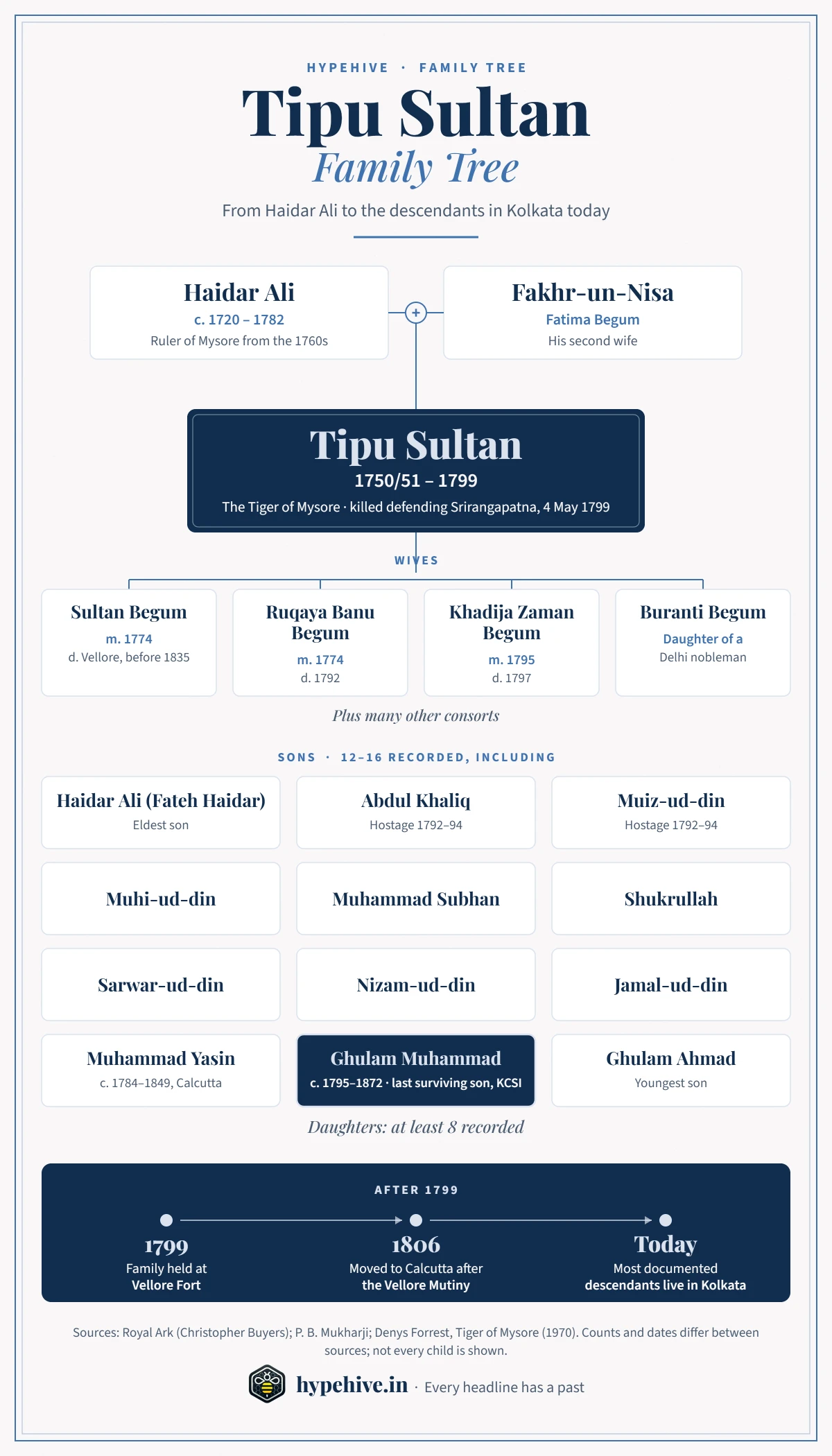
Tipu Sultan Family Tree
- Haidar Ali (c. 1720–1782) + Fakhr-un-Nisa (Fatima Begum)
- Tipu Sultan (1750/51–1799)
- Wives: Sultan Begum (m. 1774, d. Vellore before 1835); Ruqaya Banu Begum (m. 1774, d. 1792); Khadija Zaman Begum (m. 1795, d. 1797); Buranti Begum; other consorts
- Sons (12–16 recorded), including:
- Haidar Ali (Fateh Haidar) eldest
- Abdul Khaliq · Muiz-ud-din hostages 1792–94
- Muhi-ud-din · Muhammad Subhan · Shukrullah · Sarwar-ud-din · Nizam-ud-din · Jamal-ud-din
- Muhammad Yasin (c. 1784–1849, Calcutta)
- Ghulam Muhammad (c. 1795–1872, KCSI)
- Line continues in Kolkata; descendants administer the Prince Ghulam Muhammad Waqf Trust
- Ghulam Ahmad youngest
- Daughters: at least 8 recorded
- Tipu Sultan (1750/51–1799)
Compiled by HypeHive from Royal Ark (Christopher Buyers), Company-era records discussed by P. B. Mukharji, and Denys Forrest. Counts and dates differ between sources; not every child is shown.
Tipu Sultan’s Descendants Today
Most of Tipu’s documented descendants live in and around Kolkata, where the family has lived since 1806. Royal Ark lists members of the family who have served as mutawallis (trustees) of the Prince Ghulam Muhammad Waqf Trust and related family endowments, and recognises one line as the family’s representative. Indian newspapers have periodically reported on descendants living in modest circumstances, far from the wealth of the Mysore court. We cover who they are and how they live in Tipu Sultan’s descendants today.
Claims about specific living “heirs” circulate widely online. HypeHive names only individuals who appear in published genealogies or credible reporting.
Is Noor Inayat Khan related to Tipu Sultan?
Yes, through her father. Noor Inayat Khan (1914–1944), the British SOE agent posthumously awarded the George Cross, was the daughter of the Sufi musician Inayat Khan, whose family traced descent from Tipu Sultan. She is usually described as his great-great-great-granddaughter, a link repeated by her biographer Shrabani Basu, though the exact line is less fully documented than the Calcutta branches.
What the Records Show, and What They Don’t
Established: Tipu’s parents; his multiple marriages, including Sultan Begum, Ruqaya Banu and Khadija Zaman as separate wives; the 1792 hostage episode; the Vellore detention and the 1806 transfer to Calcutta; Ghulam Muhammad’s role in Calcutta.
Contested: Tipu’s exact birth date; the total number of sons and daughters; the family’s claimed descent from the Sharifs of Mecca; the princes’ role in the Vellore Mutiny.
Unverified: many online lists of “living descendants” and named modern heirs.
Frequently Asked Questions
Who were Tipu Sultan’s parents?
Haidar Ali and his second wife, Fakhr-un-Nisa (Fatima Begum).
Who were Tipu Sultan’s ancestors?
His father, Haidar Ali, rose through the Mysore army under the Wodeyar kings and held real power in the state by the 1760s. Later sources claimed the family descended from the Sharifs of Mecca, but those sources contradict each other, and the Royal Ark genealogy treats the claim as unreliable.
How many wives did Tipu Sultan have?
Several. The best-documented are Sultan Begum, Ruqaya Banu Begum, Khadija Zaman Begum and Buranti Begum, alongside many consorts.
How many sons did Tipu Sultan have?
Records give between twelve and sixteen sons, plus at least eight daughters. Not four, as many websites claim.
How many children did Tipu Sultan have in total?
At least twenty: twelve to sixteen sons and at least eight daughters, depending on which record you follow.
Which sons were taken hostage in 1792?
Abdul Khaliq and Muiz-ud-din, handed to Lord Cornwallis under the Treaty of Seringapatam and returned in 1794.
Where did Tipu Sultan’s family go after 1799?
To Vellore Fort, and after the Vellore Mutiny of 1806, to Calcutta.
Who was Tipu Sultan’s last surviving son?
Prince Ghulam Muhammad, who died in Calcutta in 1872.
Do Tipu Sultan’s descendants still live in India?
Yes. Most documented descendants live in Kolkata.
Sources and Further Reading
- Christopher Buyers, Royal Ark, “Khudadad: The Family of Tipu Sultan” (genealogy).
- Projit Bihari Mukharji, “The Disappearing Princess”, on the Mysore princes in Calcutta.
- “Tipu Sultan’s female entourage under East India Company rule”, Journal of the Royal Asiatic Society.
- Denys Forrest, Tiger of Mysore: The Life and Death of Tipu Sultan (1970).
- Mohibbul Hasan, History of Tipu Sultan (1951).
- Kate Brittlebank, Tiger: The Life of Tipu Sultan (2016).
- Shrabani Basu, Spy Princess: The Life of Noor Inayat Khan (2006).
- Britannica, “Tipu Sultan”.
Last updated October 2026. Spotted an error? Tell us.
Related: Tipu Sultan Controversy: Hero or Villain? · Khadija Zaman Begum
Quiz: Tipu Sultan's Family
5 questions. Pick your answers, then check your score. Each answer is explained.
More history quizzes: see all quizzes.
