
If you have searched for “Vande Mataram” recently, you are probably seeing the phrase everywhere.
That is not accidental.
In 2026, India is observing 150 years of Vande Mataram, and the year-long national commemoration that began on 7 November 2025 runs through 7 November 2026.
But the immediate reason for the renewed attention in August is even more specific.
On 10 August 2026, the Ministry of Defence announced that Vande Mataram will be sung from the ramparts of the Red Fort on 15 August 2026, during India's 80th Independence Day celebrations.
The Ministry described this as the first time the National Song will be sung from the Red Fort ramparts as part of the Independence Day ceremony.
So three stories have converged:
150 years of Vande Mataram
India's Independence Day
A historic Red Fort ceremony
There is another reason 2026 matters. The Government has also introduced renewed official attention to the full six-stanza composition, while Parliament has moved to extend statutory protection relating to the National Song.
That makes Vande Mataram in 2026 more than an anniversary story.
It is a story about history, nationalism, literature, constitutional symbolism and the continuing evolution of one of India's most recognizable national symbols.
But to understand why it matters today, we have to go back 150 years.
What Is Vande Mataram?
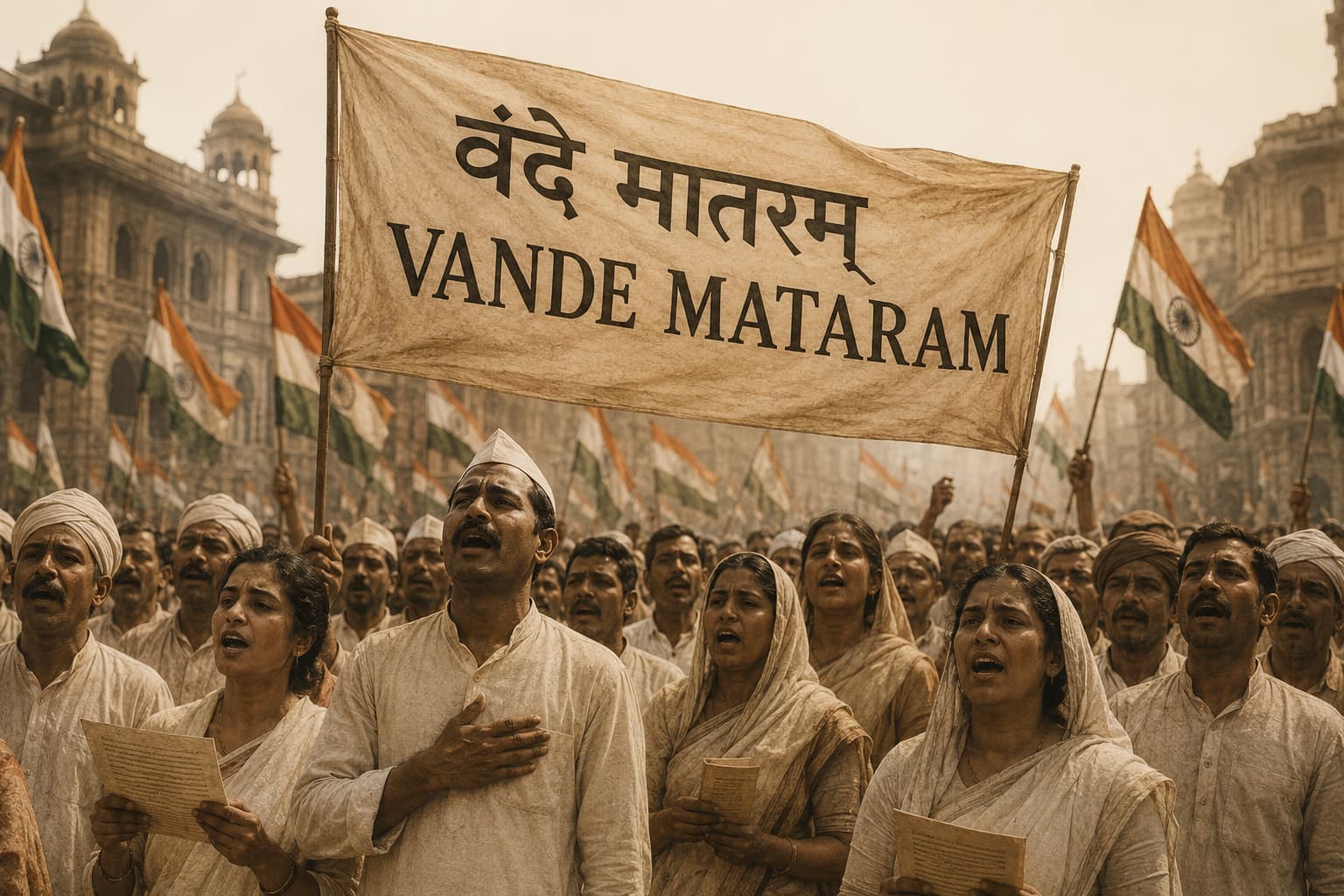
Vande Mataram is India's National Song, composed by Bankim Chandra Chatterjee.
The Government of India's 150-year historical account translates the title as “Mother, I Bow to Thee.” It describes the composition as an expression of devotion to the motherland and identifies 7 November 1875 as its first publication in Bangadarshan.
The opening imagery is not initially about political institutions or national borders.
It evokes the motherland through images of:
fertile land,
abundant water,
greenery,
breeze,
beauty, prosperity,
and the mother herself.
The official Ministry of Home Affairs document currently reproduces the National Song's text, beginning with “Vande Mataram! Sujalam suphalam…”.
This is important because the emotional foundation of the song is not simply an abstract idea of patriotism.
It is the transformation of land into mother.
The country is imagined as something that gives, nourishes and deserves reverence.
Who Wrote Vande Mataram?
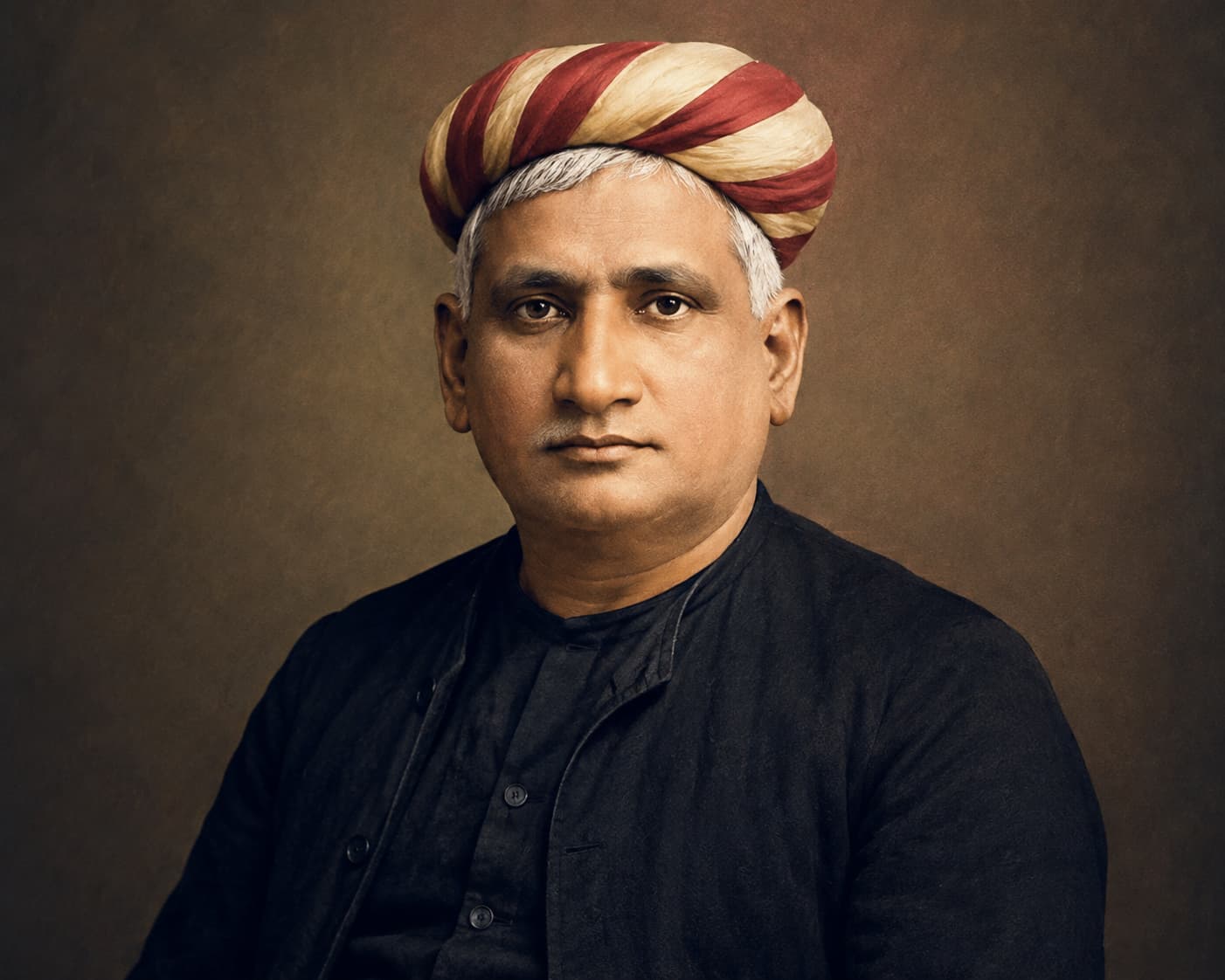
Bankim Chandra Chatterjee, one of the major literary figures of nineteenth-century Bengal, composed Vande Mataram.
The Government of India's official historical account identifies 7 November 1875 as the date of its first publication in Bangadarshan. It also notes that the song was initially composed independently and was later incorporated into Bankim's novel Anandamath, published in 1882.
This distinction matters.
A common simplified version of the story says:
Bankim wrote Vande Mataram for
Anandamath.
The official Government account gives us a more precise chronology:
Vande Mataram was composed independently → it appeared in Bangadarshan → it was later incorporated into Anandamath.
The Government's background material further notes that the song appeared as a standalone composition in the March–April 1881 issue of Bangadarshan.
So our historical timeline begins before the book publication of Anandamath.
How Did Vande Mataram Become Part of Anandamath?
The song was later incorporated into Bankim Chandra's Anandamath, which was published in 1882.
The novel provided the composition with a larger literary and historical setting. Government historical material connects Anandamath with the Sannyasi rebellion and the Bengal famine period, while describing its portrayal of the motherland through different images of the mother: the mother of the glorious past, the suffering present and the hoped-for future restoration.
This gave Vande Mataram a much larger meaning.
It was no longer simply a poetic description of a beautiful land.
The motherland could be imagined as:
a mother who had suffered,
a mother whose condition could change,
and a mother whose restoration demanded sacrifice.
That literary framework helped prepare the song for a much larger role in India's emerging nationalist movement.
How Did Vande Mataram Become a Freedom Movement Slogan?
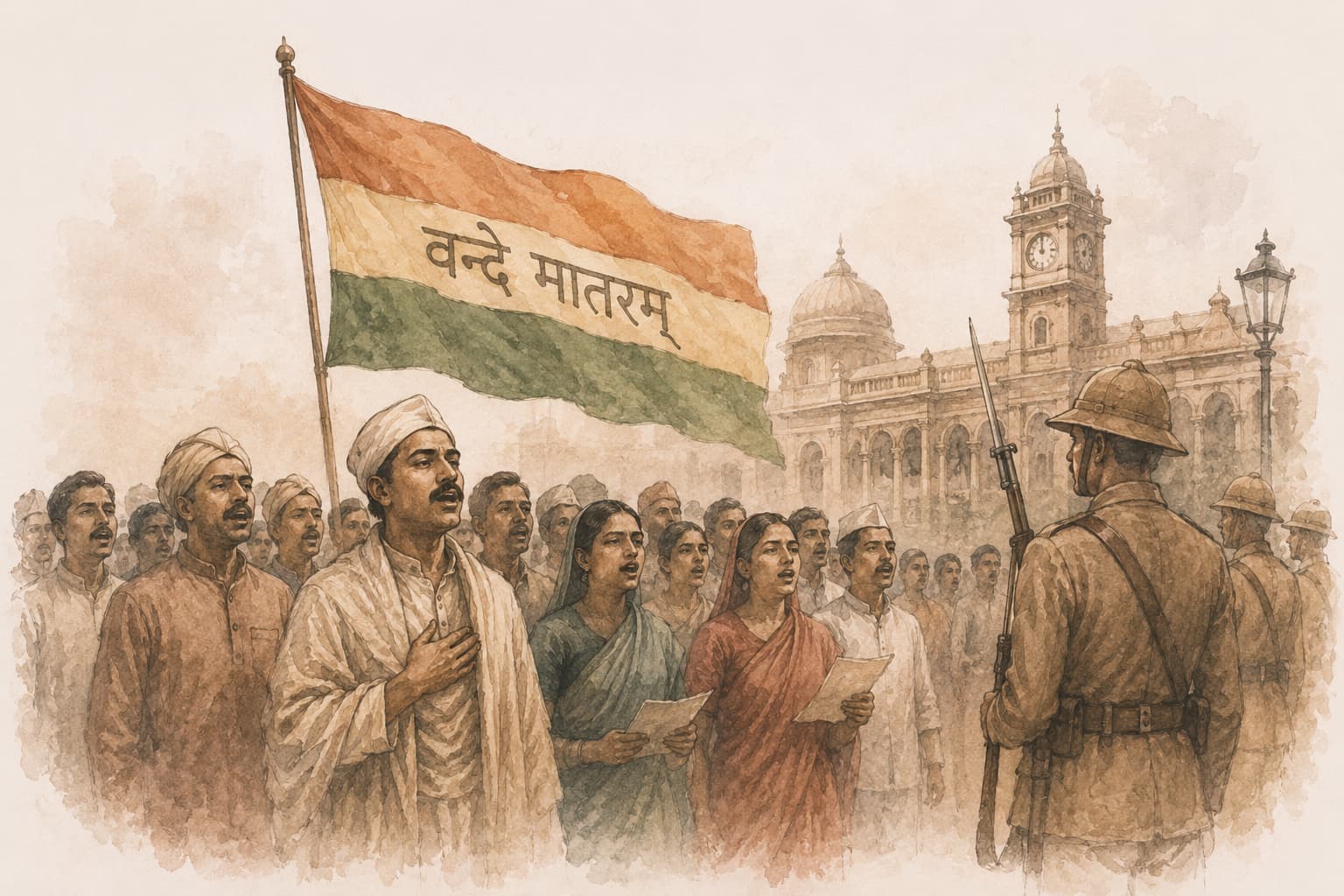
This transformation did not happen overnight.
The song gradually moved from literature into public political life.
1896: Rabindranath Tagore sings Vande Mataram
The Government of India records that Rabindranath Tagore sang Vande Mataram at the 1896 session of the Indian National Congress in Calcutta.
This was an important moment.
Bankim had created the composition.
Tagore helped bring it into a major national political gathering.
From there, its public life expanded.
The official Government historical account notes that the first two stanzas subsequently became customary at Congress meetings.
1905: Vande Mataram Becomes a Political Cry
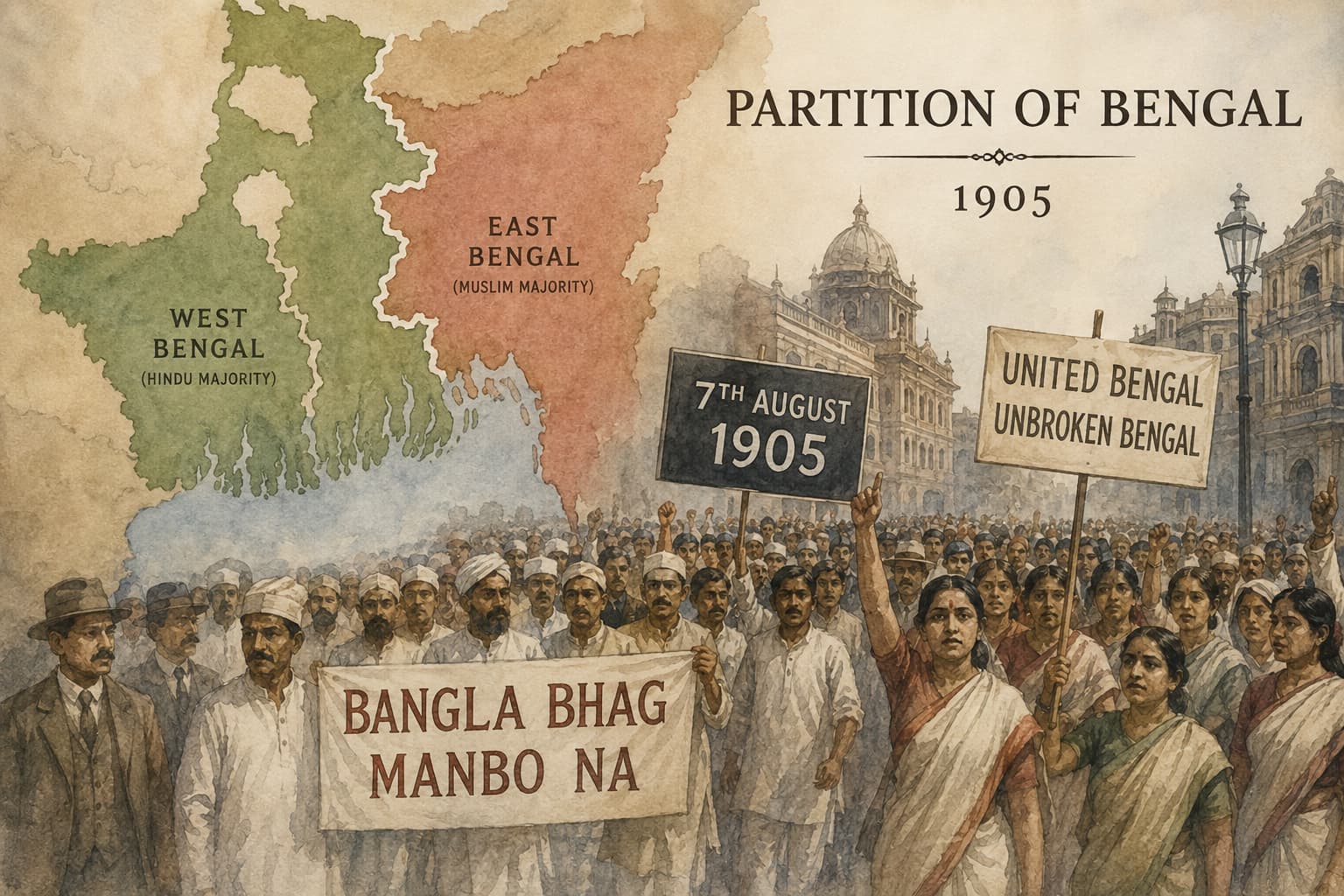
The real explosion came with the Partition of Bengal in 1905.
The Government identifies 7 August 1905 as the first use of Vande Mataram as a political slogan.
Thousands of students marched toward the Calcutta Town Hall shouting Vande Mataram as a major meeting adopted a resolution supporting the boycott of foreign goods and Swadeshi.
The song was now doing something very different.
It was no longer confined to literature or elite political gatherings.
It had entered the streets.
The official historical account describes how the appeal of both the song and the slogan became extremely powerful during the anti-Partition and Swadeshi movement.
The same Government account records that British authorities later attempted to restrict public chanting of Vande Mataram, including during the Bengal Provincial Conference at Barisal in 1906.
This is the point where the history of Vande Mataram becomes inseparable from the history of Indian nationalism.
Vande Mataram Was More Than a Song
By the early twentieth century, Vande Mataram had acquired several identities simultaneously.
It was:
a literary composition
→ a patriotic song
→ a political slogan
→ a symbol of resistance
→ a rallying cry of the freedom movement
The Government's historical material records its use in different parts of India and even beyond India's borders. It notes that Bhikaji Cama displayed the words “Vande Mataram” on the flag she raised in Stuttgart in 1907.
That tells us something important about its evolution.
The song had escaped its original literary setting.
It had become a political symbol.
Why Did Vande Mataram Become Controversial?
This is one of the most important parts of the story—and one where oversimplification can easily distort history.
The controversy became particularly significant in 1937.
Official Government material records that Muhammad Ali Jinnah objected to Vande Mataram in October 1937. Jawaharlal Nehru subsequently examined the background of Anandamath, and the Congress Working Committee reviewed the use of the song later that month.
The issue was connected to the religious imagery associated with the larger composition and its literary setting.
This distinction is important.
It is too simplistic to say:
“The first two stanzas were secular and the rest were religious.”
A more accurate description is that the opening stanzas emphasize the natural and maternal imagery of the motherland, while later portions contain more explicit religious and divine imagery.
The official Government account describes Bankim's conception of the motherland as the Mother and explains the religious dimensions of Anandamath.
The 1937 episode ultimately led to a restriction on the portion of the composition used at common national gatherings, and the first two stanzas became the customary national rendition.
There is an important research caveat here:
The exact original text of the 1937 Congress Working Committee resolution is not readily available in the official digital records we have been able to verify.
Therefore, we should distinguish between:
what the official Government historical account reports about 1937, and
what the underlying original resolution itself may have said.
That distinction matters when discussing a politically sensitive historical event.
Did the 1937 Controversy End Vande Mataram's National Role?
No.
The subsequent history shows almost the opposite.
Vande Mataram continued to carry enormous symbolic importance.
And then came 1947.
What Happened to Vande Mataram at Independence?
On 14 August 1947, the Constituent Assembly met in its historic final session before India became independent.
According to the official Parliament record, the proceedings began with the singing of the first verse of Vande Mataram, sung by Sucheta Kriplani.
The Assembly stood for the song.
That is a remarkable historical moment.
A composition that had begun as nineteenth-century literature had become part of the ceremony surrounding the birth of independent India.
The song's national significance therefore survived the political controversy of the previous decade.
Was Vande Mataram Going to Become India's National Anthem?
The answer was not settled immediately.
This is another part of the story that is often compressed into a single date.
In November 1948, Constituent Assembly member Seth Govind Das argued that Vande Mataram should be India's National Anthem.
Then, on 21 November 1949, H. V. Kamath raised the question of the National Anthem again. The matter was still unresolved at that point.
So the actual sequence was:
1947 — national ceremony
↓
1948 — active debate
↓
November 1949 — question still pending
↓
January 1950 — final arrangement
This tells us that India's national-song/anthem question was not simply settled immediately after independence.
Why Is Jana Gana Mana the National Anthem and Vande Mataram the National Song?
This question needs careful wording.
It is tempting to say:
“India rejected Vande Mataram and chose Jana Gana Mana.”
But the official record does not support that simplistic interpretation.
On 24 January 1950, Constituent Assembly President Dr. Rajendra Prasad made a statement concerning the National Anthem.
He stated that:
Jana Gana Mana would be India's National Anthem.
He simultaneously stated that:
Vande Mataram, because of its historic role in India's freedom struggle, would be honoured equally with Jana Gana Mana and would have equal status with it.
There is an important procedural detail here.
Rajendra Prasad said that the matter had once been expected to come before the Assembly as a formal resolution, but instead he would make a statement.
So the safest historical description is:
On 24 January 1950, Rajendra Prasad formally declared the respective status of Jana Gana Mana and Vande Mataram.
That is more precise than saying the Assembly passed a resolution adopting both.
So What Is the Difference Between the National Anthem and National Song?
The 1950 arrangement gave the two compositions different national roles.
Jana Gana Mana
National Anthem
Vande Mataram
National Song, with equal status and honour
The distinction is therefore not:
important song vs rejected song.
It is:
two nationally significant compositions → two different official roles.
The Government continues to refer to the 1950 arrangement in its current national-symbol framework.
What Happened to Vande Mataram After 1950?
For decades, the first two stanzas were the familiar form of Vande Mataram used at many public and institutional occasions.
The Government's 2026 material has now brought the full composition much more prominently into official discussion.
The Ministry of Home Affairs has published the National Song text and current orders concerning the National Song and National Anthem.
The Government's 2026 communications have also highlighted the full version during the 150-year commemoration.
This does not mean we should casually say that the Government “restored” the original song in 2026.
The more precise statement is:
2026 has brought renewed official attention to the full six-stanza composition and its ceremonial use.
What Changed for Vande Mataram in 2026?
This is where the historical story meets the present.
1. India is commemorating 150 years
The Government launched a year-long nationwide commemoration from 7 November 2025 to 7 November 2026.
That means 2026 is effectively the culmination of a year-long national programme.
2. The full composition has received renewed official attention
Government material in 2026 has highlighted the full version of Vande Mataram and its ceremonial treatment.
The Ministry of Home Affairs has published the current National Song documentation.
This matters because the public memory of Vande Mataram has historically been strongly associated with its shorter, familiar opening portion.
The 2026 commemoration has brought attention back to the composition as a whole.
3. Vande Mataram is coming to the Red Fort
This is probably the most immediate reason for the current August search spike.
On 10 August 2026, the Ministry of Defence announced that Vande Mataram will be sung from the ramparts of the Red Fort on 15 August 2026.
The Ministry says the song will be sung when the Prime Minister arrives at the Red Fort, before the National Flag is hoisted and the Independence Day address is delivered.
The symbolism is hard to miss.
A song that became a rallying cry against colonial rule is now being performed at the central ceremony of the independent Indian state.
4. Vande Mataram's Legal Status Also Changed in 2026
There is another significant development.
Parliament passed the Prevention of Insults to National Honour (Amendment) Bill, 2026, extending the relevant statutory protection against intentionally preventing or disrupting the singing of the National Anthem to the National Song as well. PRS India's legislative summary records that the amendment extends the existing provisions to Vande Mataram.
This development should be described carefully.
It does not mean that Vande Mataram has become the National Anthem.
It means that the law has been amended to provide the National Song with comparable statutory protection in the specified circumstances.
That distinction is crucial.
Why Does Vande Mataram Still Matter?
Perhaps the most interesting thing about Vande Mataram is that its meaning has changed with the history around it.
In the nineteenth century, it was a literary expression.
During the freedom movement, it became a rallying cry.During the Swadeshi movement, it became a political symbol.
In 1947, it appeared at the birth of independent India.
In 1950, it received equal national status alongside the National Anthem.And in 2026, it is once again at the centre of national ceremonies and public discussion.
Its history is therefore not simply a straight line.It is a story of transformation.
Vande Mataram Timeline
Vande Mataram vs Jana Gana Mana
The important point is that Vande Mataram was not replaced by Jana Gana Mana.
India's constitutional-era settlement gave the two compositions different roles.
The Bigger Story Behind Vande Mataram
If we look at Vande Mataram only as a patriotic song, we miss most of its history.
Its journey looks more like this:
Literature
↓
Motherland imagined as a mother
↓
National awakening
↓
Congress and public performance
↓
Swadeshi and anti-Partition movement
↓
Freedom struggle
↓
Political controversy
↓
Independence
↓
Constitutional settlement
↓
National Song
↓
2026 revival
That is why Vande Mataram remains historically important.
It is not merely a composition that survived 150 years.
It is a composition whose meaning and public role evolved alongside India's own political history.
What Is Happening to Vande Mataram in 2026?
The answer to our original question is now clear.
Vande Mataram is trending in 2026 because history and current events have converged.
India is observing the 150th anniversary of the composition through a year-long national commemoration.
The country is approaching its 80th Independence Day, and the Government has announced that Vande Mataram will be sung from the Red Fort ramparts during the August 15 ceremony.
The Government has also renewed attention to the full composition and its ceremonial use, while Parliament has extended statutory protection to the National Song in specified circumstances.
So the current trend is not simply nostalgia.
It is the latest chapter in a story that began with Bankim Chandra Chatterjee's composition in the nineteenth century and passed through the most important stages of India's modern history.
Final Takeaway
Vande Mataram began as a literary composition, became a powerful expression of Indian nationalism, turned into a rallying cry during the freedom movement, survived political controversy, and ultimately received equal national status alongside India's National Anthem.
In 2026, 150 years after its historical emergence, it has returned to the centre of public attention.
And on 15 August 2026, when Vande Mataram is sung from the Red Fort, the moment will carry a historical irony worth remembering:
a song that once accompanied India's struggle against colonial rule will be sung at the heart of the independent republic that emerged from that struggle.
