
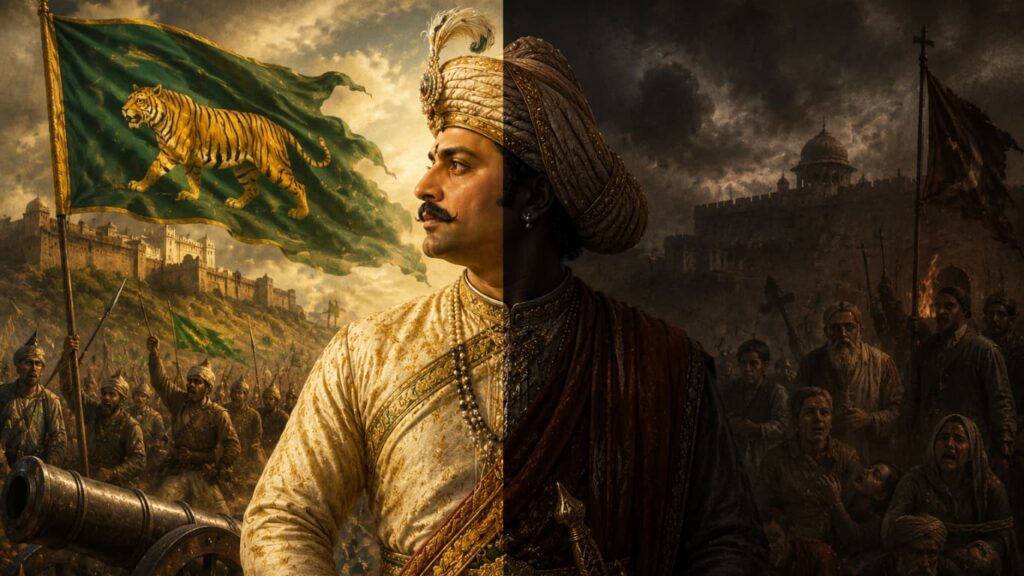
India has had many rulers who left marks on history — some celebrated, some condemned. But very few have sparked a debate as fierce and lasting as the Tipu Sultan controversy. For over two centuries, the Tiger of Mysore has been simultaneously worshipped as a national hero and criticized as a religious tyrant. The Tipu Sultan controversy is not just a history classroom argument — it is a living, breathing political and cultural flashpoint in modern India.
So who was Tipu Sultan, really? Was he the brave anti-colonial warrior who challenged the British Empire? Or was he a cruel ruler who forcibly converted Hindus and Christians? The Tipu Sultan controversy is built on both these narratives, and the truth — as always — is layered, complex, and worth exploring in full.
In this comprehensive deep-dive, we'll walk through the historical evidence on both sides, unpack why the Tipu Sultan controversy refuses to die, and help you form an informed view.
Who Was Tipu Sultan? A Brief Historical Background
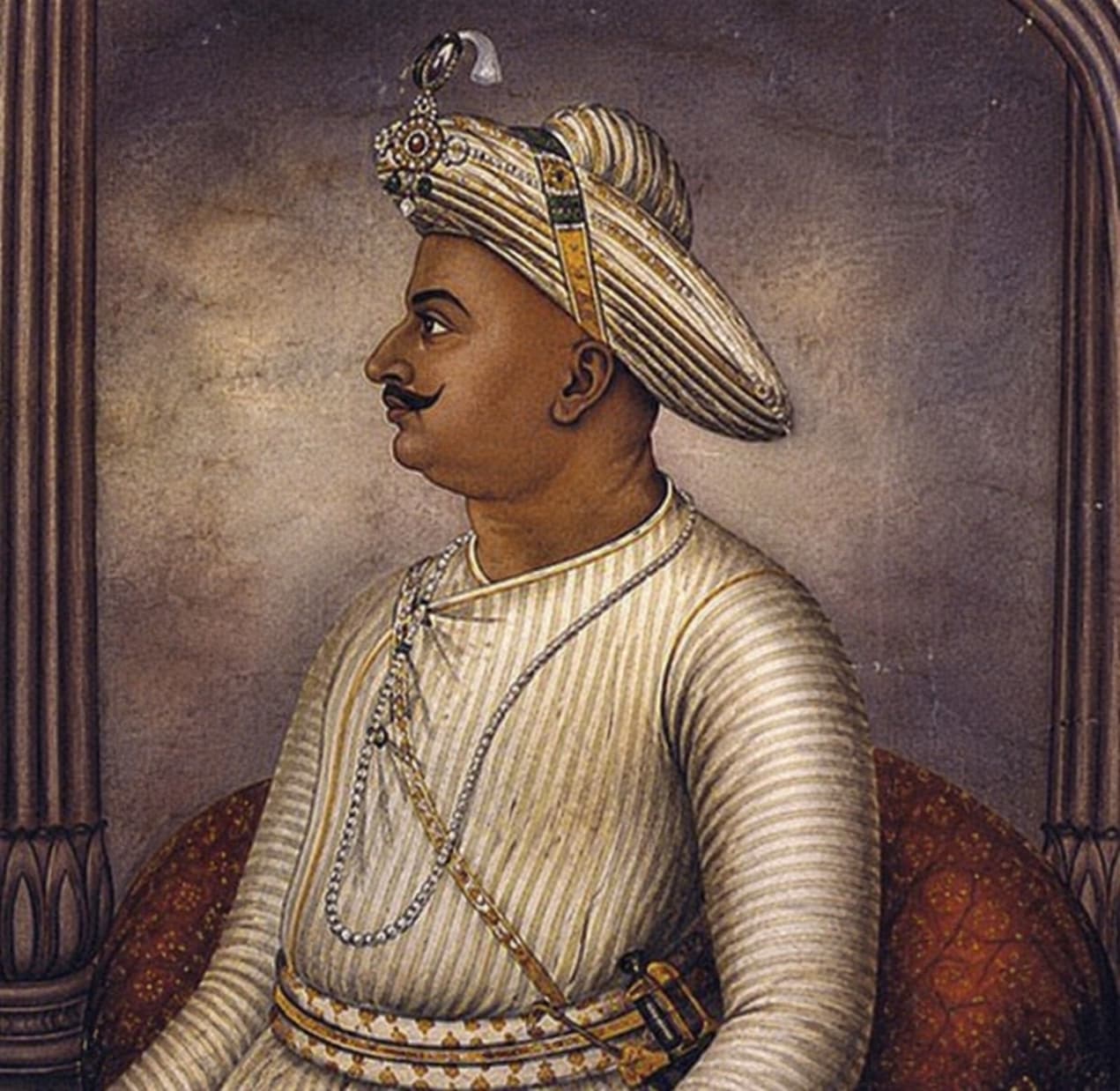
Tipu Sultan, born on November 20, 1750, in Devanahalli (near present-day Bengaluru), was the ruler of the Kingdom of Mysore from 1782 until his death in 1799. Son of Haidar Ali — the military genius who transformed Mysore into a formidable power — Tipu inherited both his father's ambitions and his boldness. He waged four major wars against the British East India Company and is widely remembered as one of the earliest rulers to seriously challenge European colonialism on Indian soil.
Tipu introduced rocket artillery in Indian warfare, pursued diplomatic alliances with France and the Ottoman Empire against the British, and modernized Mysore's economy through trade, agriculture, and industrial reforms. He died on May 4, 1799, during the Fourth Anglo-Mysore War, defending his capital Srirangapatna against a British siege.
If you want to understand his bloodline and what became of his family after 1799, our detailed blog on the Tipu Sultan family tree covers his descendants, their exile to Vellore Fort, and how the royal line survived into the modern era.
But beyond the timelines and battles, the Tipu Sultan controversy runs much deeper.
Why Does the Tipu Sultan Controversy Exist?
The Tipu Sultan controversy is rooted in a sharp divide between two schools of historical interpretation.
The first school views Tipu Sultan as a freedom fighter — a king who resisted British colonialism with everything he had, who built one of the most progressive states in 18th-century India, and who died a martyr's death fighting for his sovereignty.
The second school paints him as a religious bigot — a ruler who persecuted Hindus, Kodavas, and Syrian Christians in Kerala, who undertook forced conversions, and whose cruelty was systematically whitewashed by nationalist historians after independence.
What makes the Tipu Sultan controversy so difficult to resolve is that both sides draw from real historical evidence. Neither is entirely fabricating their claims. The debate exists in the space between documented fact and politically motivated interpretation.
The Case For Tipu Sultan: The Freedom Fighter Narrative
The most powerful argument in favor of Tipu Sultan is his unyielding resistance to British colonialism. At a time when most Indian rulers were capitulating to or allying with the British East India Company, Tipu Sultan was actively fighting them in four wars spanning nearly two decades.
His diplomatic outreach was remarkable for the era. He sent ambassadors to France, Turkey, and even Iran, seeking alliances to counter British power — making him arguably the most internationally minded Indian ruler of his time. He reportedly despised the subservience of Indian princes to foreign powers and is often quoted as saying he would rather die a lion than live as a jackal.
Tipu Sultan's administrative and economic reforms have earned him significant praise from historians. He introduced a new calendar, a new coinage system, and encouraged sericulture and trade. His Mysore was known for its silk industry and economic productivity. He built a strong navy, introduced modern rocket artillery — a technology that would later influence British and European military thinking — and created a disciplined professional army.
As a ruler fighting the very colonial force that would go on to dominate India for 150 years, Tipu Sultan stands alongside figures like Rani Lakshmibai, Bhagat Singh, and others in the broader tapestry of Indian resistance. Our blog on the freedom fighters of India places Tipu Sultan among the early leaders who challenged British power before organized nationalist movements even existed.
In many ways, the Tipu Sultan controversy began after his death — when the British, having defeated him, deliberately worked to undermine his legacy and paint him as a fanatic to justify their conquest.
The Case Against Tipu Sultan: Persecution and Forced Conversions
This is the most contested aspect of the Tipu Sultan controversy — and the one that causes the most heated public debate.
There is documented historical evidence that Tipu Sultan carried out forced conversions and persecution during certain military campaigns. The most well-known instances involve the Kodava community of Coorg, Syrian Christians in Kerala, and communities in Mangalore.
Tipu Sultan's 1784 campaign in Coorg (Kodagu) resulted in thousands of Kodavas being forcibly marched to Srirangapatna, where many were reportedly converted to Islam. Historians like James Mill and British accounts from the era documented these events, though critics argue that British writers of the time had obvious incentives to portray Tipu as a monster.
The Syrian Christian community of Kerala also recorded severe persecution. Thousands of Syrian Christians in Malabar were reportedly captured, killed, or converted during Tipu's military campaigns in the late 18th century. The Zamorin of Calicut and other Hindu rulers in Kerala faced similar treatment.
The Tipu Sultan controversy in Karnataka is particularly sharp because of the Kodava community, who continue to observe a day of mourning related to Tipu's campaigns. Several Brahmin communities in coastal Karnataka also hold deep historical grievances.
These accounts present a genuine challenge to those who seek to portray Tipu Sultan purely as a secular nationalist hero.
What Do Historians Say About the Tipu Sultan Controversy?
Serious academic historians tend to occupy nuanced ground on the Tipu Sultan controversy — and that nuance is often lost in the public shouting match.
B.A. Saletore and other Indian historians writing in the early 20th century were largely sympathetic to Tipu, viewing him through the lens of anti-colonialism. Kate Brittlebank's scholarly work on Tipu Sultan's politics emphasizes that his religious motivations were often as much political and military as they were theological — his campaigns in Coorg and Kerala were punitive measures against communities that had collaborated with the British, not purely religious crusades.
M.H. Gopal and Irfan Habib, prominent Indian historians, have emphasized Tipu's modernizing outlook and his resistance to the British as defining features of his legacy.
However, historians like Sandeep Balakrishna, writing from a more critical Hindu nationalist perspective, argue in their research that the evidence of forced conversions and violence against non-Muslim communities is substantial enough that it cannot be rationalized away by colonial context.
The Tipu Sultan controversy is also shaped by which primary sources one trusts. British documents from the period have an obvious bias. Persian chronicles from Tipu's own court were naturally flattering. Local oral traditions, temple records, and community histories fill in some gaps but also carry their own cultural biases.
The truth is that Tipu Sultan was a product of his time — a time when religion, politics, war, and statecraft were inseparable. Judging him by 21st-century secular standards is as misleading as canonizing him without acknowledging the violence his campaigns caused.
The Political Tipu Sultan Controversy in Modern India
The Tipu Sultan controversy has taken on a distinctly political character in modern India, particularly in Karnataka, where his memory is most actively contested.The Congress government in Karnataka periodically celebrated "Tipu Jayanti" — Tipu Sultan's birthday — as a state-sponsored event. These celebrations triggered significant opposition from the BJP and Hindu nationalist organizations, who viewed the commemoration as glorifying a ruler who persecuted Hindu communities.
Protests erupted across Karnataka on Tipu Jayanti dates, and in some places, violence followed. The debate moved beyond historical argument and into the domain of electoral politics, identity, and communal sentiment — all the markers of a genuinely contested public memory.
Similarly, textbooks across Indian states have had their portrayal of Tipu Sultan debated and revised multiple times. Some describe him as a freedom fighter in the preface and a religious bigot in the footnotes — a reflection of how the Tipu Sultan controversy infects even bureaucratic and academic processes.
This is not unique to India. Across the world, how nations remember their historical figures is deeply tied to present-day politics. In the case of Tipu Sultan, the controversy is sharpest because it sits at the intersection of religion, colonial history, and contemporary Hindu-Muslim relations in India.
Tipu Sultan and the British: Why Colonial History Complicates the Debate
One of the most intellectually important points in the Tipu Sultan controversy is the role of British sources in shaping how we understand him.
Much of the damning documentation about Tipu Sultan's religious persecution comes from British military and administrative records. The British East India Company and its officers had every incentive to portray the ruler they had just defeated as a tyrant — it justified their conquest, made it look like a liberation rather than an occupation, and helped neutralize any sympathy Tipu might have attracted from the Indian population.
This is not a defence of Tipu Sultan, but it is an important caveat. Colonial propaganda was real. The British manufactured or exaggerated negative portrayals of rulers they conquered, from Tipu to the Marathas. Separating genuine historical evidence from colonial manipulation is genuinely difficult.
Comparing this to how Maratha rulers are remembered offers an instructive parallel. Chhatrapati Shivaji Maharaj, whose own legacy and death we explored in our blog on how did Shivaji Maharaj died, was also a fierce anti-Mughal warrior celebrated today as a founding hero of Maharashtra. Shivaji's military campaigns also involved brutality — sacking cities, killing enemies, and warring against Muslim rulers. Yet Shivaji is almost universally celebrated as a hero with very little of the political controversy that surrounds Tipu.
This double standard — where Hindu rulers who waged religious-tinged wars are celebrated, but Muslim rulers who did the same are condemned — is itself a part of the Tipu Sultan controversy that deserves honest acknowledgement.
Tipu Sultan's Religious Identity: Pious Muslim or Fanatic?
At the heart of the Tipu Sultan controversy is a question about his relationship with religion.
Tipu was undeniably a devout Muslim who saw himself as a warrior for Islam. His private correspondence, his coins, and his use of Islamic symbols and titles (he called himself "Padshah" and used religious epithets) all point to a ruler who was deeply committed to his faith.
But devout is not the same as fanatical. Many of Tipu's closest advisors and military commanders were Hindu. His revenue minister, Purnaiya, was a Hindu Brahmin who served him loyally for years. Hindu temples in Mysore were funded and protected by his administration. He maintained amicable relations with the Sringeri Sharada Peetham, the famous Hindu institution, and even wrote to its Shankaracharya seeking blessings after enemy raids on the monastery.
This is not the profile of a single-minded religious zealot. It is the profile of a ruler who was devoutly religious himself but was capable of pragmatic, pluralistic governance when political stability required it.
The forced conversions and violence appear to have been concentrated in specific military contexts — punishing communities seen as enemies or collaborators — rather than as a systematic state policy of religious cleansing. This makes Tipu Sultan a morally complex figure, which is exactly what makes the Tipu Sultan controversy so persistent.
Tipu Sultan's Death: End of an Era, Beginning of a Legend
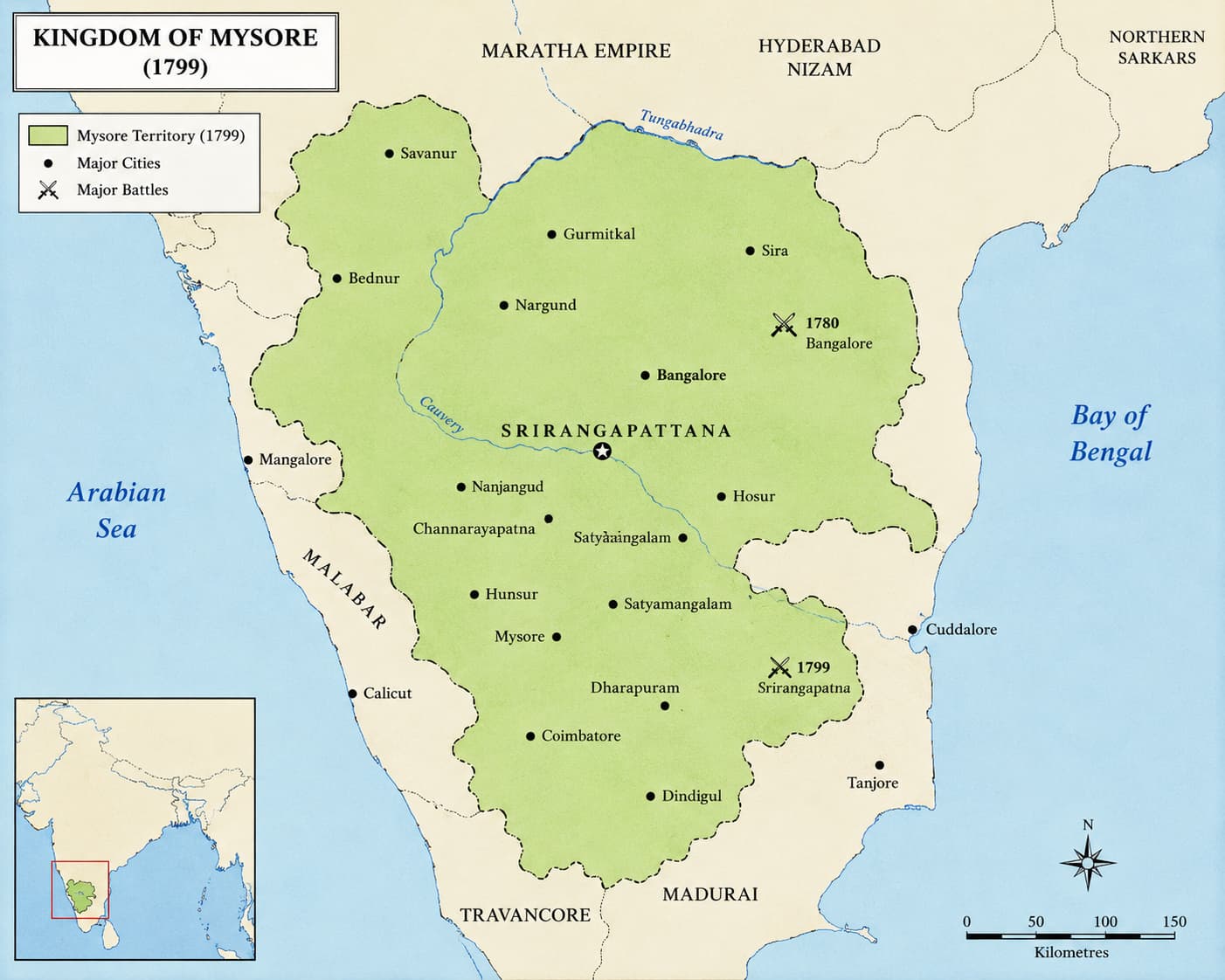
Tipu Sultan was killed on May 4, 1799, during the storming of Srirangapatna by British forces. According to historical accounts, he died fighting — his body was found with multiple gunshot wounds among the fallen defenders of the fort's water gate.
His death marked the end of an independent Mysore and the consolidation of British power in South India. The British were reportedly shocked by his fierce resistance to the very end, and some British officers expressed a grudging respect for the man they had worked so hard to defeat.
In death, Tipu Sultan became a legend that the Tipu Sultan controversy could never quite extinguish. His story has been adapted into novels, films, and television series. The famous 1990 television serial "The Sword of Tipu Sultan" based on Bhagwan S. Gidwani's novel brought Tipu's story to millions of Indian households and firmly established the nationalist, heroic version of his legacy in popular memory.
The Sword of Tipu Sultan: Symbol of the Controversy
Few objects embody the Tipu Sultan controversy as powerfully as his famous sword. When Tipu's sword was auctioned at Christie's in London in 2004 for £98,000, it sparked outrage in India and calls for the return of looted artifacts.
The sword — along with other objects like his mechanical tiger, his jewels, and his correspondence — now sits in British museums, a reminder of colonial conquest. For many Indians, Tipu Sultan's sword is not a symbol of religious persecution but of anti-colonial resistance. For others, it is a weapon of a cruel ruler best left in history.
This divide in how people interpret even a physical object captures the essence of the Tipu Sultan controversy perfectly.
Why the Tipu Sultan Controversy Matters Today
The Tipu Sultan controversy matters in 2026 not because we need to arrive at a final verdict on an 18th-century ruler, but because of what the debate reveals about us.
It reveals how India continues to struggle with the complexity of its pre-colonial history — a history that doesn't divide neatly into heroes and villains along religious lines. It reveals how colonial historiography continues to shape our understanding of our own past. It reveals how political parties use historical memory to mobilize voters. And it reveals how minority and majority communities relate to shared national history in ways that reflect present-day anxieties.
The Tipu Sultan controversy is, at its deepest level, a mirror of modern India's unresolved questions about nationalism, secularism, religious identity, and historical justice.
Reducing it to either "Tipu was a hero" or "Tipu was a villain" does a disservice to the real complexity of both history and the present.
What the Evidence Tells Us: A Balanced View
Taking all the available evidence into account, here is what we can say with reasonable confidence about Tipu Sultan:
He was a remarkably capable ruler who modernized Mysore and built a genuinely powerful, well-administered state. His resistance to British colonialism was fierce, sustained, and historically significant. He died fighting, which is more than can be said for most rulers who faced the British in that era.
He was also a devout Muslim who used religious language and identity in his politics and warfare. His military campaigns in Coorg, Kerala, and Mangalore caused real suffering for Kodava, Syrian Christian, and other communities. These events cannot be dismissed as pure British propaganda — too much independent local evidence corroborates them.
He was neither the secular saint that enthusiastic nationalists make him, nor the one-dimensional bigot that his harshest critics portray. He was a man of his time — one who combined genuine political genius with the religious and military sensibilities of a 18th-century Muslim ruler.
The Tipu Sultan controversy exists precisely because this complexity resists the simple narratives that politics demands.
Frequently Asked Questions About the Tipu Sultan Controversy
Conclusion: Living With Historical Complexity
The Tipu Sultan controversy is unlikely to be resolved anytime soon — and perhaps that is as it should be. History is rarely simple, and the most powerful historical figures are almost never simply good or evil.
What the Tipu Sultan controversy invites us to do is to hold complexity — to acknowledge a man who was simultaneously a brilliant anti-colonial warrior, a modernizing ruler, a devout Muslim, and a military commander whose campaigns caused documented suffering to specific communities. To flatten any of these truths is to distort history for political convenience.
India's historical memory is still being written, negotiated, and contested. From Tipu Sultan to the freedom fighters of India who came after him, from Shivaji Maharaj's legendary battles to the final days of Tipu at Srirangapatna — these stories are part of a much larger, messier, more human story of who we are as a nation. And the Tipu Sultan controversy, at its most productive, is an invitation to engage with that story honestly.
Understanding Tipu Sultan also means understanding how his family survived after him. If you're curious about what happened to his sons and descendants after the fall of Srirangapatna, our in-depth blog on the Tipu Sultan family tree explores their exile, dispersal, and enduring legacy across India and beyond.
The Tiger of Mysore remains one of the most fascinating, contradictory, and important figures in Indian history. The Tipu Sultan controversy is not a reason to stop studying him — it is the most compelling reason to start.
