
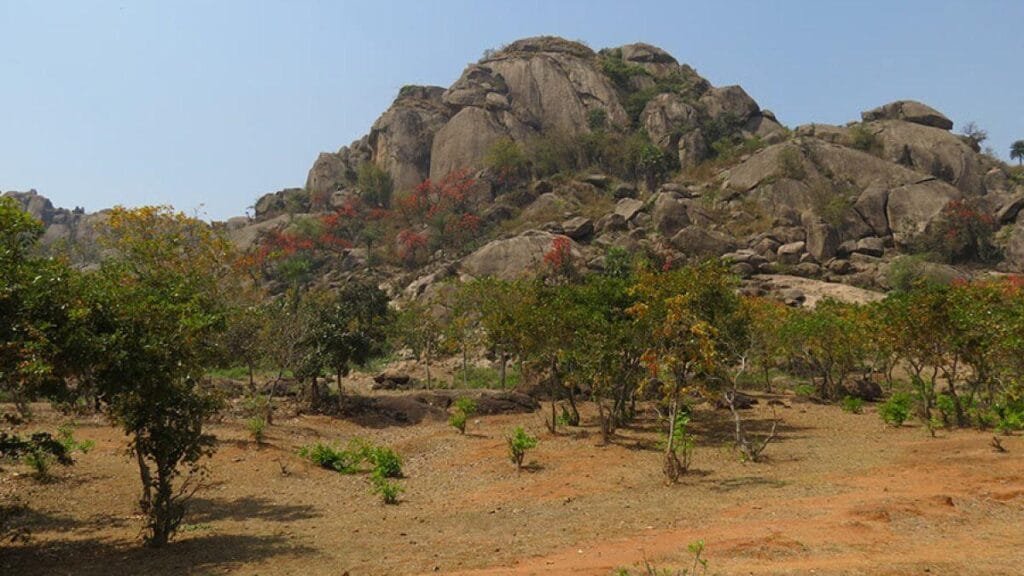
A small piece of rock from Jharkhand may be carrying a message from a world that existed long before humans, dinosaurs, trees or even an oxygen-rich atmosphere.
Near Bhitardari, around 20 kilometres south of Jamshedpur, researchers have studied a silica-rich rock known as chert that is approximately 3.497 billion years old. Inside it are dark, carbon-rich layers and structures that researchers interpret as possible remnants of ancient microbial mats.
The discovery is remarkable, but the real story is more complicated than the headline.
Scientists are not claiming to have found a fossilised bacterium preserved perfectly inside the rock. Instead, they have combined the rock's age, its carbon chemistry, its microscopic structures, molecular evidence and its geological setting to argue that the carbon may have been produced by ancient microbial life.
That makes the Bhitardari discovery potentially important in the search for the oldest evidence of life on Earth.
But how can scientists determine whether carbon trapped inside a rock billions of years old came from living organisms—or from geology?
And what was Earth actually like when this rock formed?
What Was Discovered Near Jamshedpur?
The discovery comes from Bhitardari in the Singhbhum region of Jharkhand, part of the ancient Singhbhum Craton.
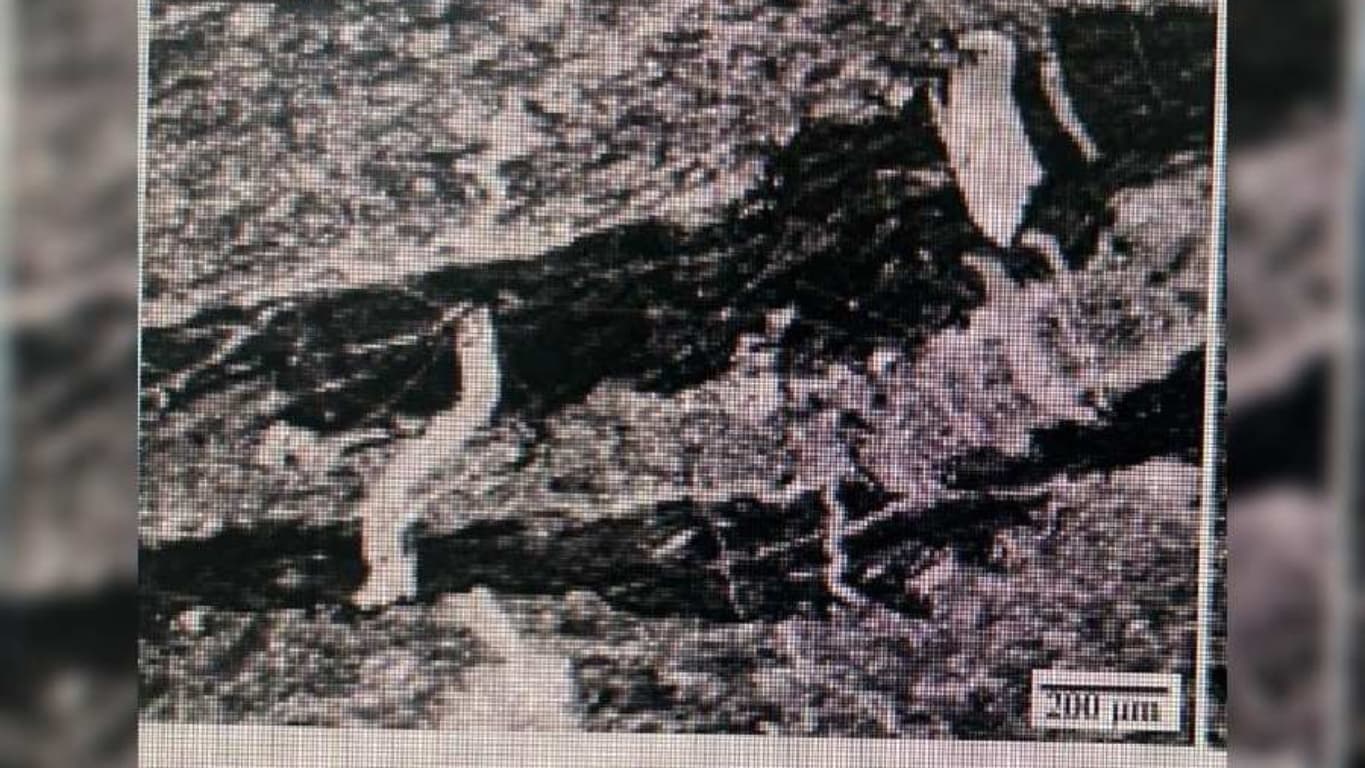
Researchers examined a chert containing alternating light and dark bands. The darker layers are rich in carbon and have structures that are interpreted as being compatible with ancient microbial mats.
According to the reported study, the chert is approximately 3.497 billion years old. The significance is not simply that the rock is extremely old. Rocks of similar antiquity are known from several parts of the world.
The important question is whether the carbonaceous material preserved inside the rock is evidence of biological activity.
The researchers' argument combines several different kinds of evidence rather than relying on the appearance of the rock alone. The reported evidence includes carbon chemistry, structural characteristics, molecular analysis and an age constraint for the geological material.
You can read [the original Telegraph India report] as a useful account of the discovery and the researchers involved. original Telegraph India report
Why Is 3.497 Billion Years So Important?
Earth is approximately 4.6 billion years old.
That means this rock formed only around 1.1 billion years after the planet itself came into existence.
Put another way, the Bhitardari chert comes from a period when Earth was still in the early part of its geological history.
There were no humans.
There were no dinosaurs.
There were no forests or flowering plants.
There were no animals walking across continents.
The atmosphere and oceans were also dramatically different from those of the modern Earth.
Yet, if the researchers' interpretation is correct, microbial communities were already living and interacting with their environment.
That is what makes the discovery so interesting.
It potentially pushes our understanding of how early life became established on Earth.
What Is a Microbial Mat?
The phrase microbial mat might sound like a fossilised organism, but that is not what it means.
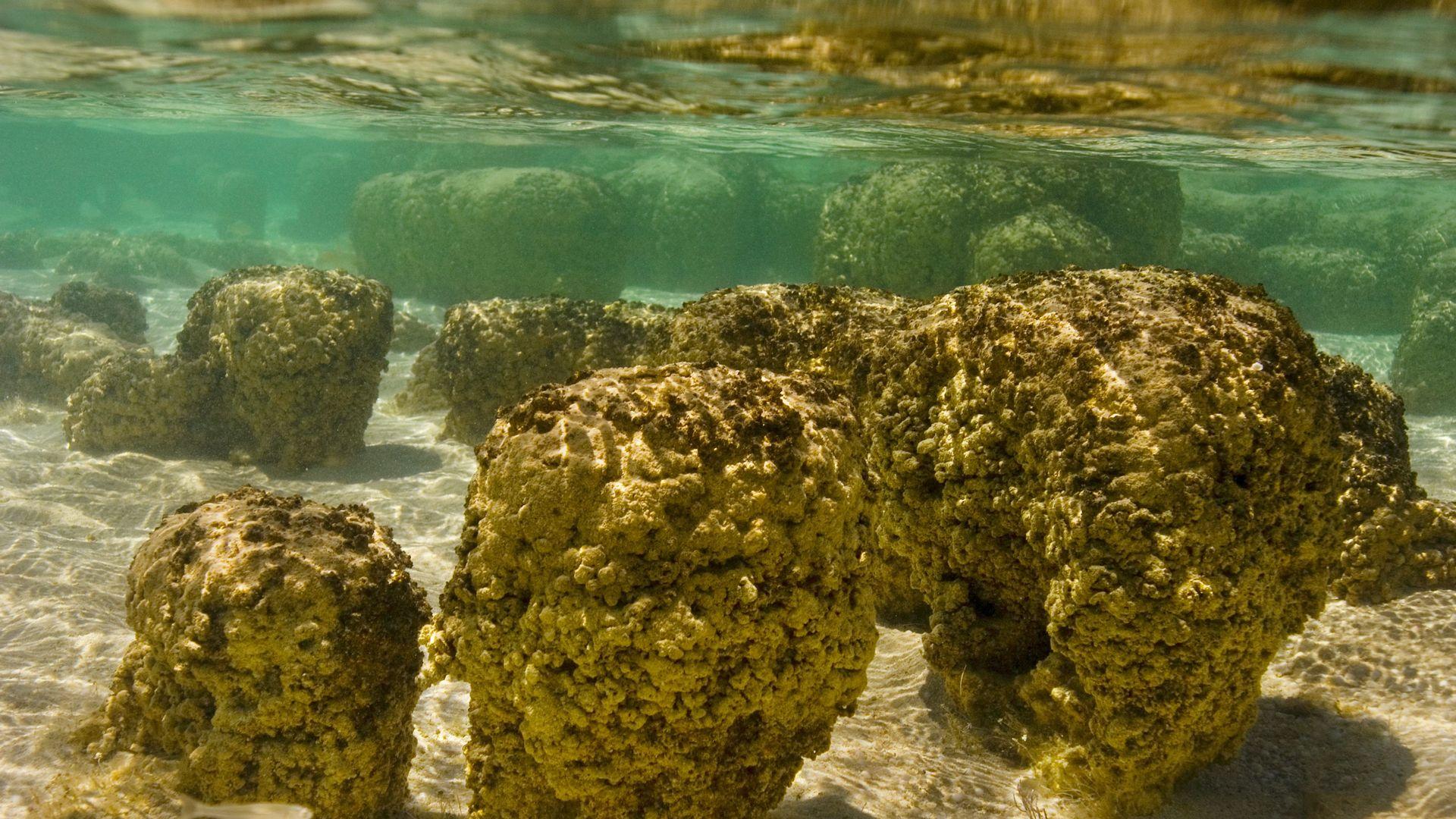
A microbial mat is more like a living biological carpet.
It consists of communities of microscopic organisms growing together across a surface. Modern microbial mats can develop in environments such as shallow marine areas, tidal flats, hypersaline lakes and some hot springs.
Microorganisms within these communities interact with minerals, water, sediment and one another.
Over time, they can create layered structures.
If such a community becomes buried and preserved under the right geological conditions, some of its chemical and structural characteristics can survive for enormous periods of time.
The proposed Bhitardari structures are therefore more comparable to the imprint of an ancient microbial ecosystem than to a conventional fossil such as a dinosaur bone.
That distinction is crucial.
Scientists are not looking for a recognisable ancient bacterium sitting inside the chert.
They are looking for a combination of structures and chemical signatures that would make sense if microorganisms had once occupied the environment.
How Can a Rock Reveal Ancient Life?
This is the central scientific problem.
Finding something that looks biological is not enough.A rock can develop strange patterns through:
heat
pressure
mineral growth
volcanic activity
hydrothermal fluids
chemical reactions
metamorphism
Some of those geological processes can produce structures that resemble biological material.
The older the rock, the more difficult the problem becomes.A 3.5-billion-year-old rock has experienced an enormous amount of geological history since its original formation.
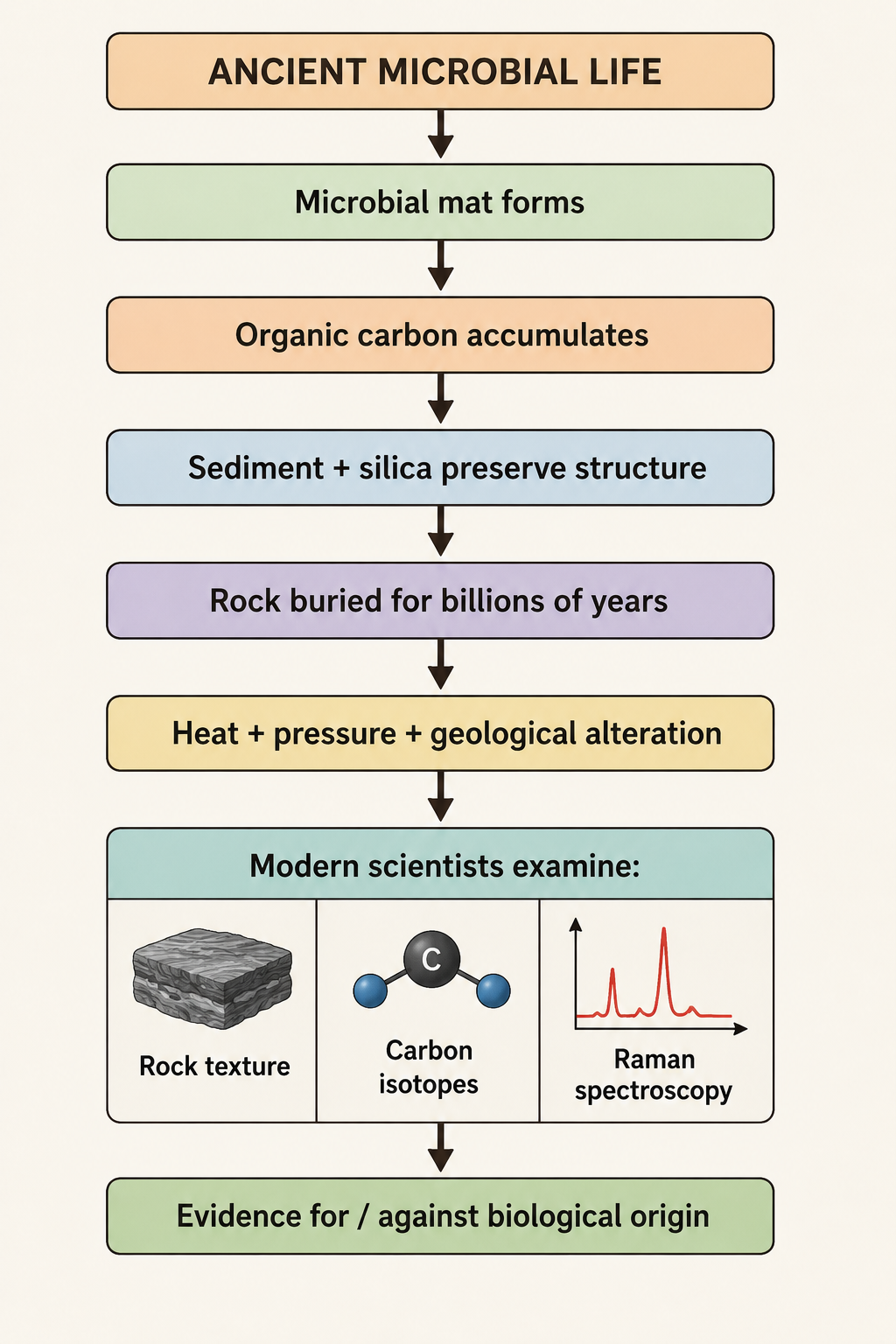
That is why scientists investigating ancient life look for multiple independent clues.
In the Bhitardari case, the reported argument involves the rock's age, its carbon-rich layers, isotope chemistry, molecular characteristics and geological environment.
The evidence becomes more persuasive when those different observations point toward the same explanation.
Carbon May Hold the Biological Fingerprint
One of the clues comes from carbon.
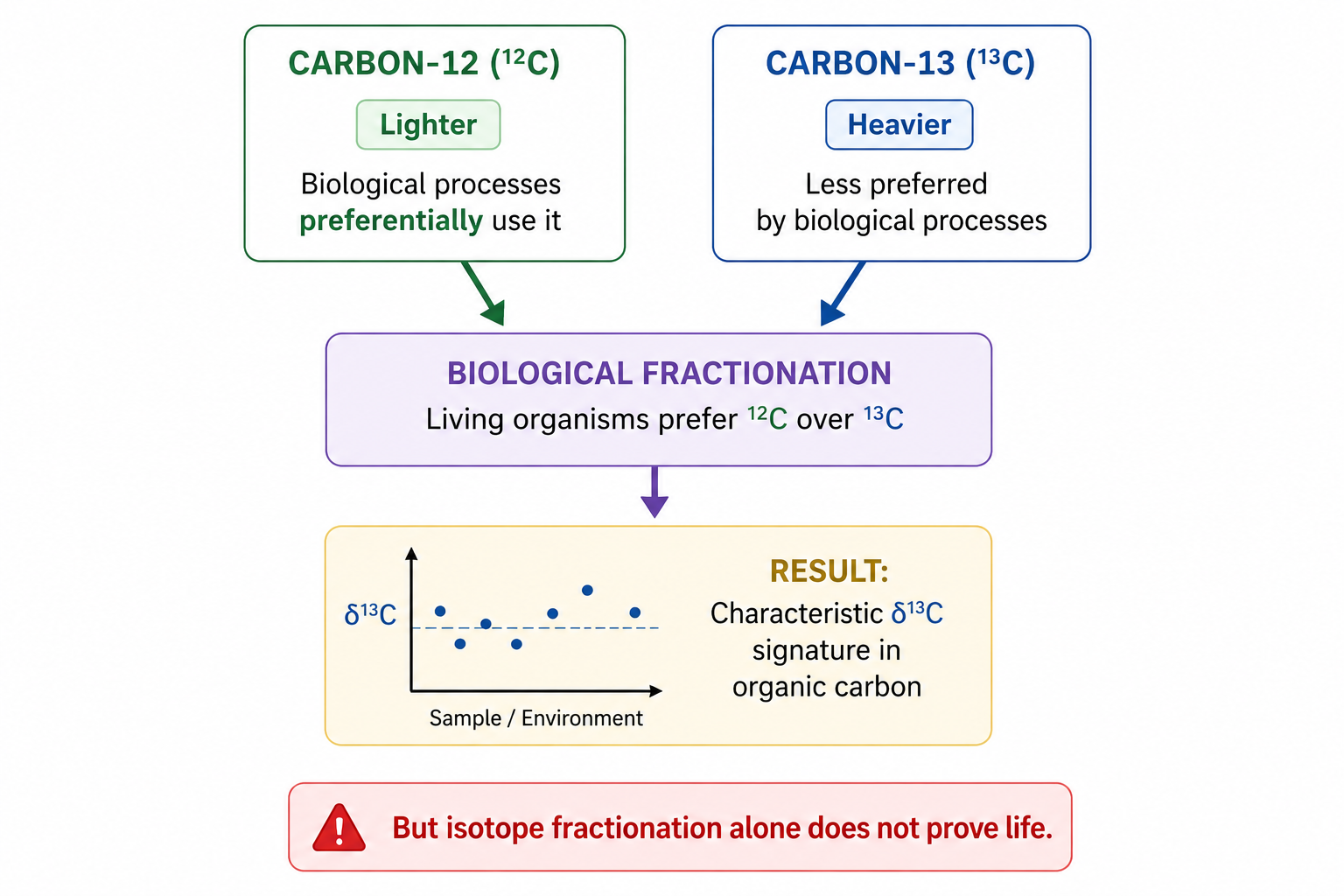
Life uses carbon extensively, and biological reactions can preferentially use different carbon isotopes.
Carbon has several isotopes, including carbon-12 and carbon-13. Biological carbon-fixation processes can favour the lighter carbon-12 isotope, potentially leaving a characteristic isotopic signature behind.
This is known as carbon-isotope fractionation.
However, there is an important scientific warning here:
A carbon-isotope signature is not automatically proof of life.
Abiotic geological processes can also produce carbon and isotope fractionation.
Therefore, scientists need to ask several questions:
Was the carbon present when the rock formed?
Does it occur in structures consistent with biological activity?
Does its chemistry match what would be expected from biological processes?
Could the same signature have been produced without life?
The Bhitardari interpretation becomes interesting precisely because researchers did not rely on carbon isotopes alone.
What Did Raman Spectroscopy Reveal?
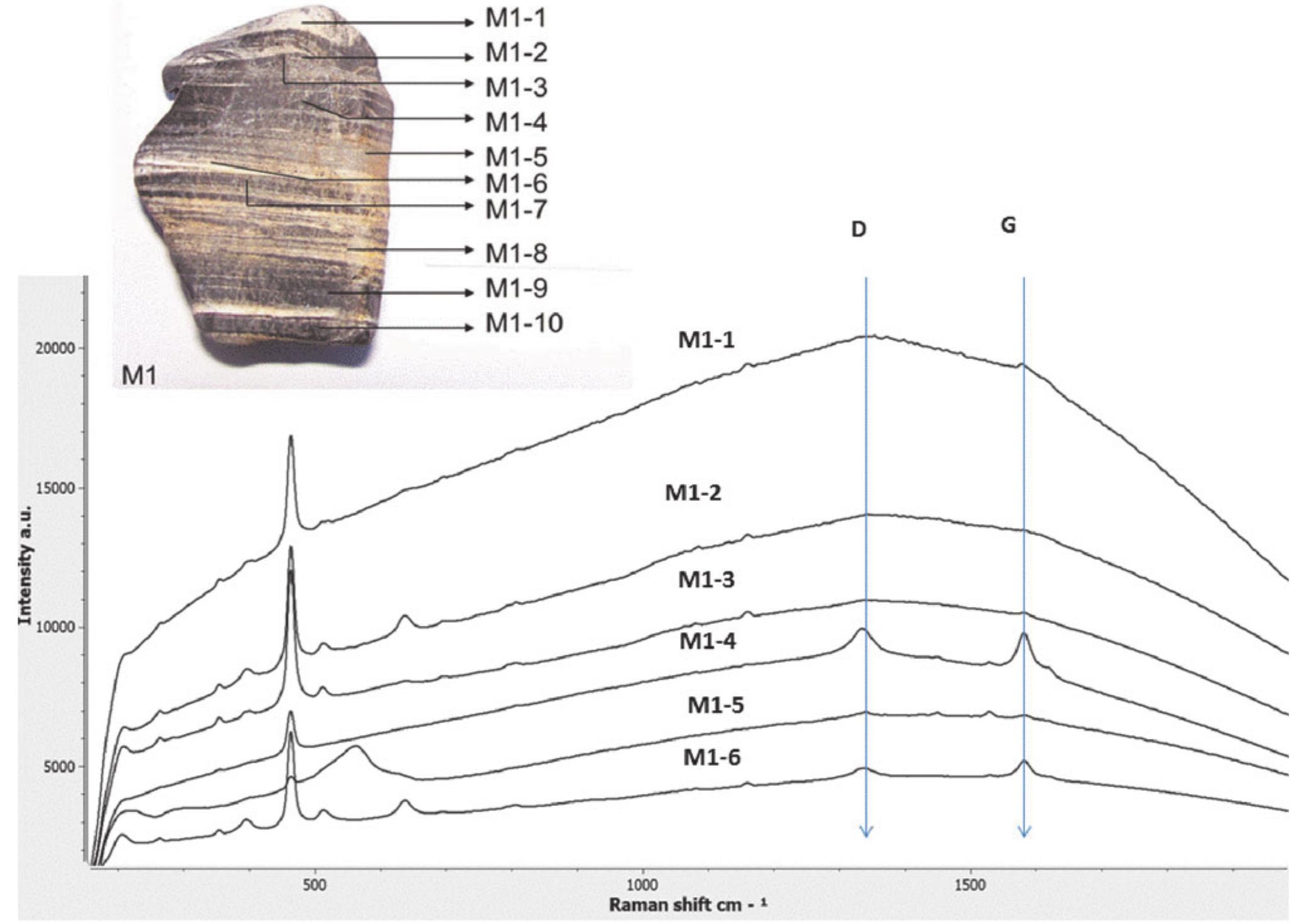
Another piece of the investigation involved Laser Raman Spectroscopy.
Raman spectroscopy uses laser light to study how a material interacts with that light at the molecular level.
Carbonaceous materials can produce characteristic Raman signals, commonly associated with the so-called D and G bands.
The relationship between these signals can provide information about the structure and history of carbon.
This is particularly useful for ancient rocks because carbon can be altered by heat and pressure over geological time.
The reported research compared carbon preserved within the ancient layers with younger graphite associated with quartz veins.
The difference between these carbon populations helps researchers investigate whether the carbonaceous material was part of the original geological system or introduced during a later event.
Again, Raman spectroscopy is not a magical “life detector.”
It is one component of a larger scientific argument.
That distinction is important when discussing the oldest evidence of life on Earth.
How Was the Rock Dated?
This is one of the most important parts of the discovery.
When scientists say the rock is around 3.497 billion years old, they need a reliable method for establishing that age.
The reported study uses zircon associated with the geological material.
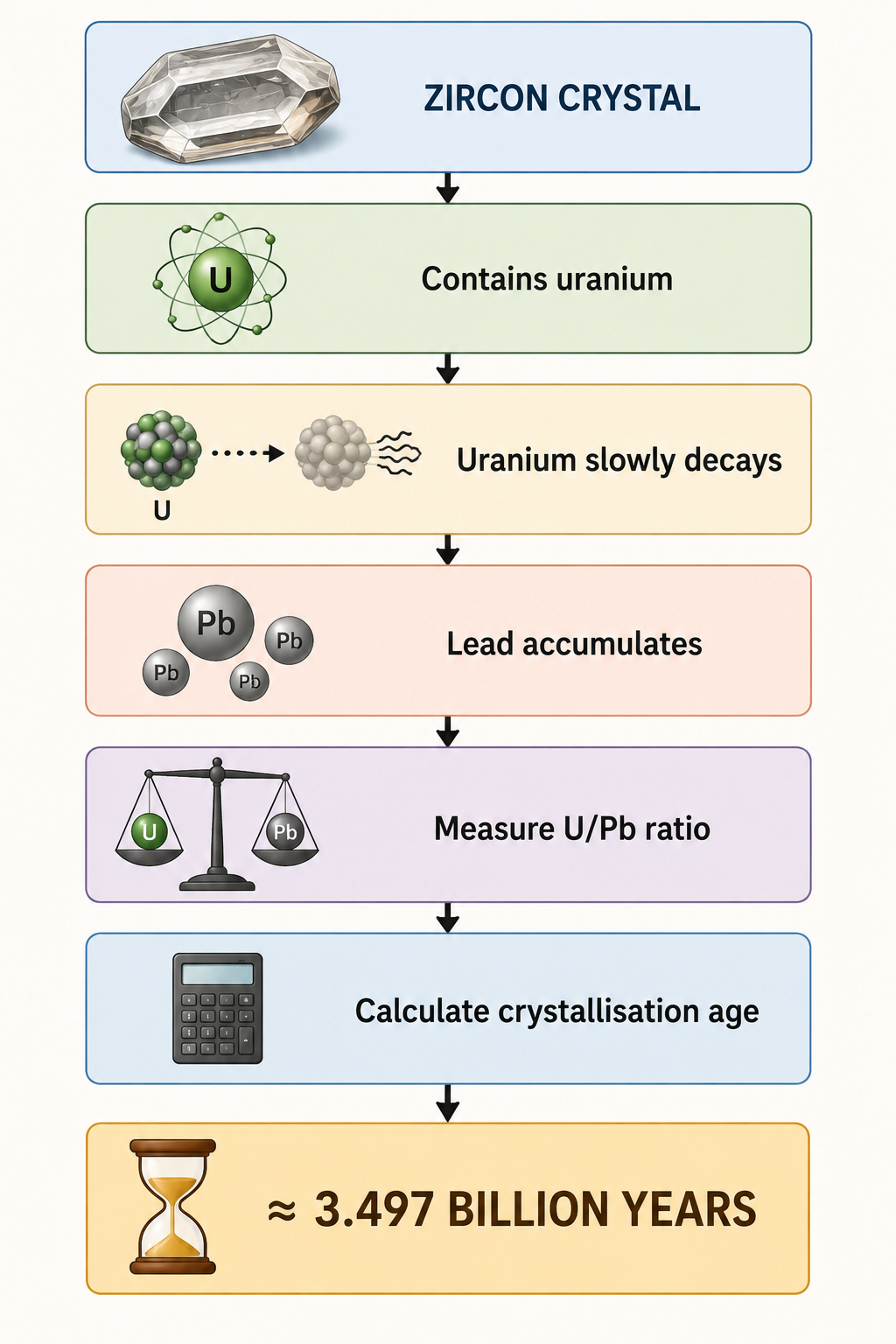
Zircon is one of the most valuable minerals in geochronology because it can incorporate uranium into its crystal structure when it forms while generally excluding lead.
Over immense periods of time, radioactive uranium isotopes decay into lead.
By measuring the uranium and lead isotopes inside zircon, scientists can calculate when the mineral crystallised.
This is known as uranium-lead dating.
But there is a critical distinction.
Scientists are not simply putting the biological carbon into a machine and receiving the number “3.497 billion years.”
The dating provides an age constraint for the geological material. The researchers then have to establish that the dated minerals are genuinely connected to the formation of the rock containing the suspected biosignatures.
That is why questions about whether zircon grains were inherited from older rocks, whether later geological processes altered the sample, and whether the carbon formed at the same time as the chert are so important.
The uploaded research notes this distinction explicitly: the importance of the dating depends on establishing that the dated zircon formed with the relevant geological event and that the carbonaceous structures are primary rather than later additions.
The Singhbhum Craton: A Geological Time Capsule
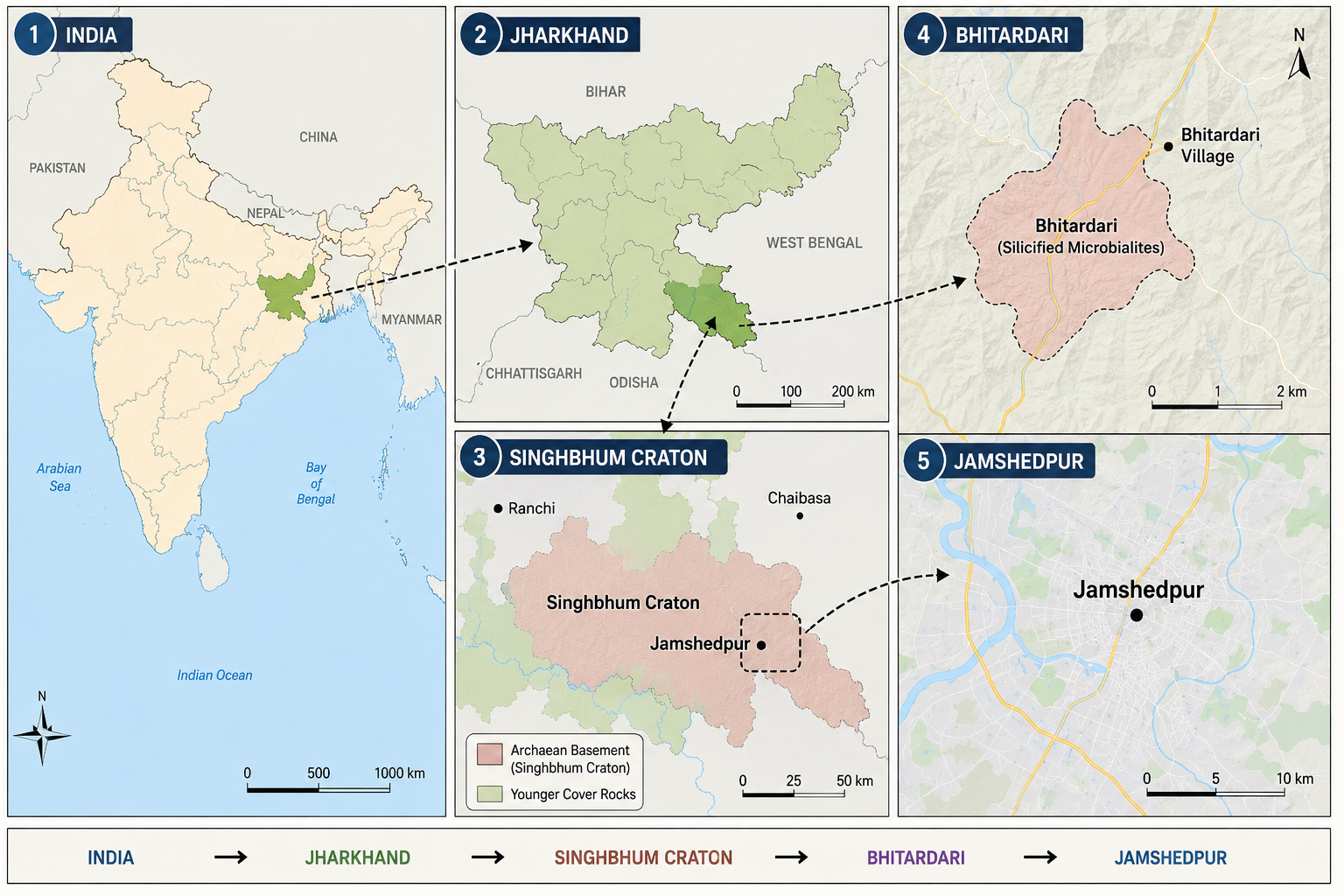
The discovery becomes even more interesting when we look at its location.
Bhitardari lies within the Singhbhum Craton, one of India's ancient continental blocks.
A craton is a relatively stable portion of continental crust that can preserve geological records for billions of years.
The Singhbhum region contains ancient:
volcanic rocks
greenstone belts
granitic and tonalitic rocks
sedimentary and chemical rocks
silica-rich formations
Previous geological research has already established that the region preserves rocks dating to approximately 3.5 billion years.
That makes the Singhbhum Craton much more than the location of a single unusual rock.
It is a geological archive of the early Earth.
Researchers have previously studied carbonaceous rocks and ancient volcanic environments within the region, making the new Bhitardari interpretation part of a much larger scientific effort to understand early Earth.
You can explore [earlier geological research on the Singhbhum Craton] for additional context. earlier geological research on the Singhbhum Craton
What Was Earth Like 3.5 Billion Years Ago?
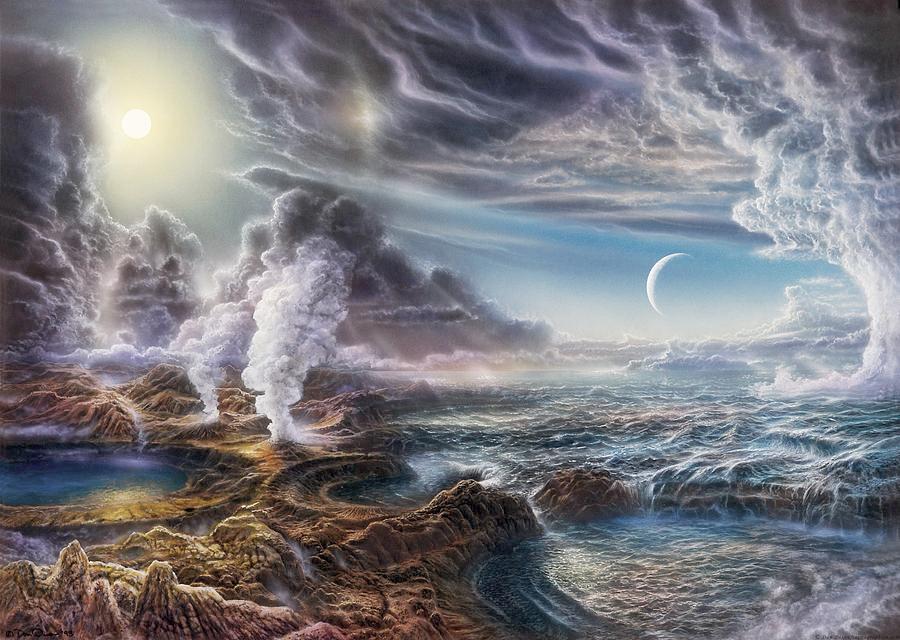
To appreciate the discovery, it helps to imagine Earth around 3.5 billion years ago.
It would be almost unrecognisable.
Volcanic activity was widespread.
The atmosphere contained very little free oxygen compared with today.
The continents were smaller and were still undergoing major geological development.
Large portions of the early Earth's environment were dominated by oceans and volcanic systems.
The seafloor could interact with chemically rich fluids emerging from Earth's interior.
Iron, sulphur, silica and other minerals circulated through these environments.
For primitive microorganisms, such chemical gradients could potentially provide sources of energy.
This is one reason why ancient volcanic and marine environments are so important in research into the emergence of life.
But the Bhitardari discovery does not prove that life originated inside a hydrothermal vent.
It tells us something more limited and scientifically defensible:
The geological environment appears to have been compatible with conditions that could have supported early microbial life.
Were the Microbes Photosynthetic?
Not necessarily.
This is another place where a headline can easily go too far.
If the carbon was produced biologically, the evidence does not automatically tell us exactly what kind of organism produced it.
We cannot confidently identify the organism as a particular species.
We also cannot simply conclude that it performed modern oxygen-producing photosynthesis.
Early microorganisms could have obtained energy through metabolic pathways very different from those familiar today.
The reported carbon signatures may be compatible with carbon-fixation processes, but the exact metabolic pathway cannot be established solely from the information available in the news report.
So we should describe the organisms as ancient microbial communities rather than inventing a precise biological identity.
Is This Really the Oldest Evidence of Life on Earth?
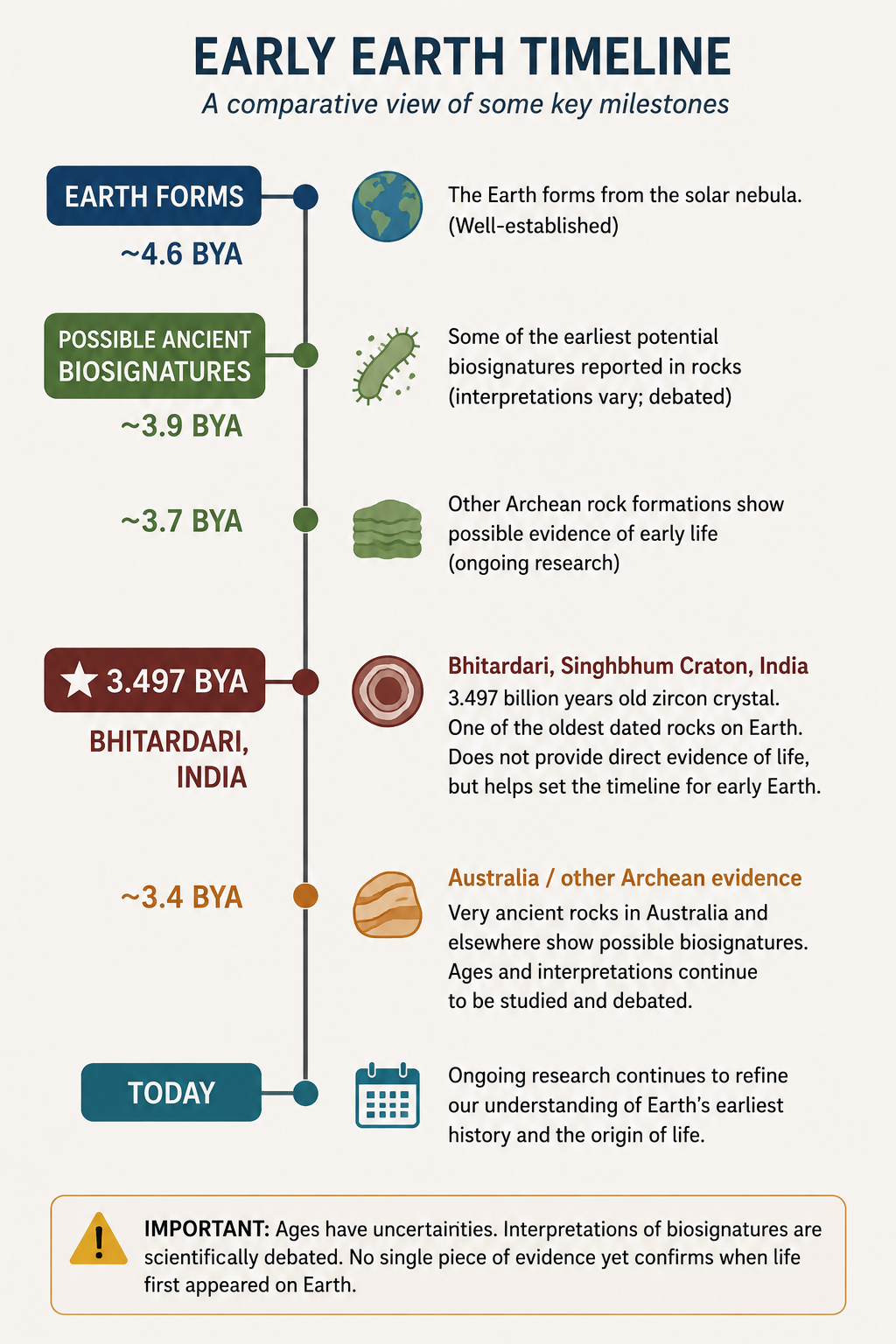
This is where the story becomes scientifically fascinating.
The phrase “oldest evidence of life on Earth” sounds definitive, but scientists have been debating ancient-life claims for decades.
There are proposed biological signatures older than 3.497 billion years.
Claims have included evidence from rocks in places such as Quebec and Greenland that may be older than the Bhitardari material.
However, some of those interpretations remain controversial.The difficulty is always the same:
Was the structure or chemical signature really created by life?
Or could geology have produced it?
The broader scientific literature identifies approximately 3.4–3.5-billion-year-old rocks in the Pilbara Craton of Australia as containing some of the earliest commonly discussed microbial structures, while also noting that the interpretation of particular carbonaceous signatures has been debated.
This is why the Bhitardari claim is best understood as a potentially important evidentiary advance, rather than a final declaration that scientists have solved the question of the first life on Earth.
The distinction is simple:
Older evidence may exist.
But if that evidence is more difficult to authenticate, a slightly younger discovery with stronger age constraints and multiple independent lines of evidence can still be scientifically significant.
What Makes the Bhitardari Evidence Interesting?
The strength of the reported study lies in the combination of evidence.
Researchers are essentially asking whether all these observations can reasonably be explained by one story:
The rock formed approximately 3.497 billion years ago.
↓
Carbon-rich layers occur inside it.
↓
The layers have structures compatible with microbial mats.
↓
The carbon has chemical characteristics compatible with biological carbon.
↓
Raman spectroscopy provides additional information about the carbon's molecular structure.
↓
The geological environment was capable of supporting microbial activity.
If those observations are genuinely linked to the same original geological event, the biological interpretation becomes considerably stronger than a claim based solely on a fossil-like shape.
The uploaded research describes this convergence of geological age, carbon chemistry, molecular spectroscopy, textures and environmental context as the central strength of the discovery.
But What Does the Discovery NOT Prove?
This may be the most important section of the entire article.
The discovery does not prove that:
Bhitardari contains the oldest individual fossil cell ever found.
Life originated in Jharkhand.
The organisms were definitely photosynthetic.
The organisms belonged to a particular modern biological lineage.
Complex life existed 3.5 billion years ago.
Life originated inside a hydrothermal vent.
Every alternative geological explanation has been eliminated.
Life exists elsewhere in the universe.
The scientific conclusion is much narrower.
The reported evidence suggests that carbonaceous structures preserved in an approximately 3.497-billion-year-old Singhbhum chert may record ancient biological activity.
That is already extraordinary.
We do not need to make the claim bigger than the evidence.
Why Proving Ancient Life Is So Difficult
Imagine trying to identify a footprint after billions of years of geological change.
Now imagine that the footprint is microscopic.
Then imagine that heat, pressure, fluids and minerals have repeatedly altered the surrounding rock.
That is essentially the challenge faced by researchers studying the earliest evidence of life.
Ancient rocks can undergo:
metamorphism
deformation
mineral replacement
hydrothermal alteration
chemical recrystallisation
carbon mobilisation
Any of these processes can destroy original biological structures—or create structures that look biological.
That is why the concept of biogenicity is so important.
Biogenicity asks:
Was this feature actually produced by life?
For a convincing ancient-life claim, researchers want evidence that is difficult to explain through abiotic processes.
The more independent evidence points toward biology, the stronger the argument becomes.
How Does This Compare With Other Ancient-Life Claims?
The history of early-life research contains several famous examples.
Some proposed evidence from rocks more than 3.5 billion years old has generated intense debate.
In other cases, structures initially interpreted as fossils were later argued to be products of geological processes.
This is not a failure of science.It is how science works.
A remarkable claim is proposed.Other scientists test it.
Alternative explanations are investigated.
New analytical techniques are applied.The interpretation may become stronger—or it may change.
That is exactly why the Bhitardari discovery should be followed as a developing scientific story rather than treated as the final answer to the origin of life.
Why This Discovery Matters for India
For India, the significance goes beyond the age of one rock.
The Singhbhum Craton is already an important geological region, but discoveries like this place Indian rocks directly into the international discussion about Earth's earliest biological history.
It also highlights something often overlooked:
India's scientific heritage is not limited to monuments, manuscripts and archaeological sites.
Some of India's most important historical records are written in stone.
And some of those records are billions of years older than human civilisation.
A rock near Jamshedpur can therefore tell us something about a chapter of Earth's history that predates every human culture.
That is an extraordinary scientific heritage.
From a Rock in Jharkhand to the History of Life
The most fascinating part of the discovery may be how little the original organisms left behind.
There is no skeleton.
No tooth.
No shell.
No recognisable body.
There may simply be carbon and structures locked inside ancient silica.
Yet those traces may preserve evidence of organisms that lived at a time when Earth itself was still young.
If the researchers' interpretation survives further testing, the Bhitardari chert could become an important piece of evidence in reconstructing how early life became established on Earth.
And even if future research modifies the interpretation, the rock will remain scientifically valuable.
It records a geological environment from almost 3.5 billion years ago.
The Bigger Question: When Did Life Actually Begin?
This discovery does not answer that question.
Instead, it pushes us toward an even more fascinating possibility.
Earth formed around 4.6 billion years ago.
The Bhitardari evidence, if biological, would place established microbial communities at approximately 3.497 billion years ago.
That leaves roughly a billion years between the formation of Earth and the evidence we currently have for life in this particular record.
Somewhere inside that enormous interval, chemistry became biology.
We do not yet know exactly how.
Perhaps life emerged in oceans.
Perhaps volcanic environments played a role.
Perhaps several environments contributed.
Perhaps the transition was gradual rather than a single event.
The Bhitardari rock cannot answer all of those questions.
But it may give scientists another remarkably old piece of the puzzle.
A 3.5-Billion-Year Message From India
A piece of chert from Bhitardari does not look like much.
To an untrained eye, it is simply an old piece of rock.
But inside its dark layers may be a record of microorganisms that lived almost 3.5 billion years ago.
The researchers' interpretation still needs to be evaluated against the full scientific evidence and competing abiotic explanations. That caution matters, especially when discussing claims about the earliest life on Earth.
But that uncertainty does not make the discovery unimportant.
It makes it fascinating.
Because the real scientific question is not simply:
“Did scientists find the oldest life on Earth?”
It is:
“How do we recognise life when the only thing it has left behind is a chemical and structural fingerprint preserved for almost 3.5 billion years?”
That is the mystery locked inside the ancient rocks of Jharkhand.
And if the biological interpretation holds, a small piece of India's geological past may help us understand one of the biggest questions in science:
How early did life begin on Earth?
Sources and further reading
For readers who want to go deeper, start with [the original Telegraph India report] for the current discovery and researcher comments. Telegraph India report
For broader scientific context, see [research on Archean microbial biosignatures] and the difficulties involved in distinguishing biological signatures from abiotic geological processes. Archean microbial biosignatures review
For geological background, readers can also explore [research on the ancient Singhbhum Craton]. Singhbhum Craton geological research