
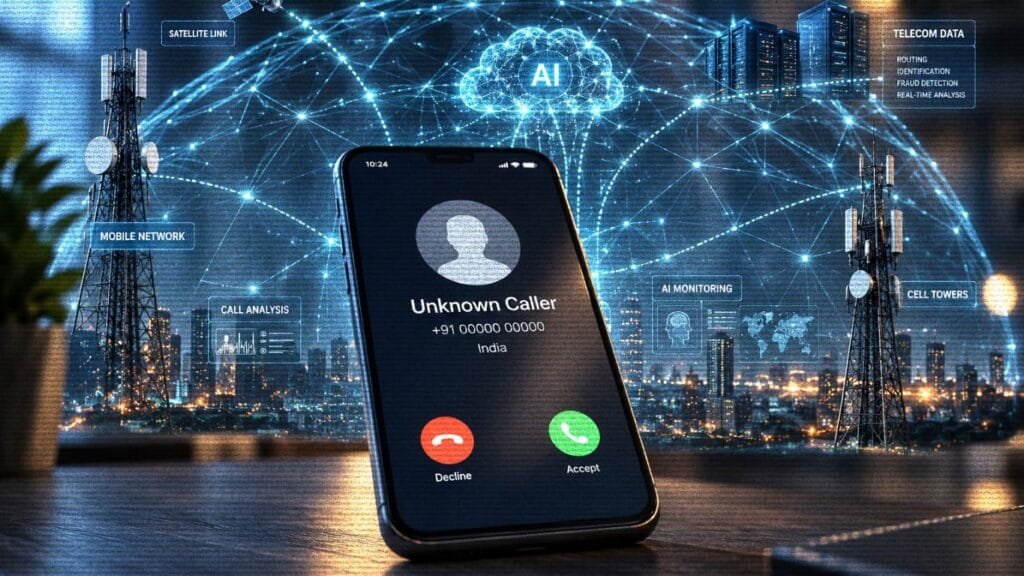
For years, the first line of defence against a spam call in India was you.
You received it. You recognized it. You rejected it. You reported it.
That is changing.
AI spam detection in India is moving part of that responsibility inside the telecom network itself. Telecom operators are already using AI and machine learning systems to identify suspicious communication patterns, while TRAI is building a framework for sharing those signals across operators and connecting suspicious telecom resources to their underlying senders.
But this is not simply a story about AI blocking annoying calls.
It is the latest chapter in a nearly 20-year experiment.
India first tried Do Not Call lists. Then it built consumer preference systems. Then it introduced a blockchain-like distributed ledger for commercial communication. Then telecom networks began learning behavioural patterns. Now those networks are being connected so that suspicious activity detected on one network can become intelligence for another.
And alongside the fight against suspicious calls, India is creating new ways to identify legitimate service calls.
The deeper story is this:
India is slowly turning the telephone network into a machine-readable trust system.
Your phone may not be the first thing judging that call
Your phone rings.
An unfamiliar number appears.
You decide whether to answer.
But before you make that decision, the telecom network may already have something to say about the communication.
TRAI says several access providers have deployed network-level AI/ML-based UCC detection systems capable of analysing behavioural signatures such as call and message volume, velocity, diversity, duration and temporal patterns. These systems can flag suspected unsolicited commercial communication in near real time.
That is an important change in the way spam is understood.
A human sees:
One phone number.
A network can see:
A pattern.
A number that suddenly makes huge volumes of calls, contacts unusually diverse recipients, exhibits particular timing behaviour or operates alongside several related numbers may look very different when viewed through the network’s larger data set.
This is where artificial intelligence becomes useful.
If you want to understand the broader technology behind AI systems like these, HypeHive’s guide to the domains of AI provides the wider context.
The interesting question, however, is not simply how AI detects spam.
It is why India needed AI in the first place.
To understand that, we have to go back to 2007.
Before AI, India gave consumers a “Do Not Call” button
India’s modern fight against unwanted commercial communication began with a much simpler idea:
Let people say no.
In 2007, TRAI created the framework for the National Do Not Call Registry, designed to maintain a database of subscribers who did not want unsolicited commercial communication. The Telecom Unsolicited Commercial Communications Regulations, 2007 were notified on 5 June 2007.
The registry became operational on 12 October 2007.
Telemarketers were required to register and could submit their calling lists for scrubbing against the database. Numbers belonging to subscribers who had opted out could then be removed from those lists.
It was a logical first-generation solution.
The consumer tells the system:
Don’t call me.
The system tries to enforce that preference.
But spam has an inconvenient characteristic.
It adapts.
New numbers appear.
Calling strategies change.
Businesses and telemarketers use different communication methods.
And illegal operators have little incentive to obey a database designed for legitimate participants.
The problem was becoming less about knowing who doesn’t want calls and more about knowing who is behaving suspiciously.
That required a different kind of system.
The first big transformation: India stopped treating spam as just a phone number
The next phase was not artificial intelligence.
It was identity.
By the late 2010s, India was moving toward a system in which commercial communication could be connected to registered entities, headers, templates, consent and other digital records.
In 2018, TRAI adopted a framework built around Distributed Ledger Technology, commonly associated with blockchain-style architectures.
The idea was not to put a cryptocurrency on the telephone network.
It was to create a shared, permissioned digital infrastructure through which participants could maintain and verify records associated with commercial communications. TRAI’s framework specifically described DLT as a way to improve registration, consent management, data sharing and regulatory compliance.
That distinction matters.
India was beginning to move from:
“Which number called me?”
toward:
“Which registered entity is responsible for this communication?”
That is a much more powerful question.
The system also created a machine-readable record of commercial messaging.
Who is sending it?
What identity is associated with the sender?
What header is being used?
What template has been approved?
Has the communication passed the relevant checks?
The network was slowly gaining something it had never really possessed before:
institutional memory.
You can explore TRAI’s own material on the subject through its Unsolicited Commercial Communication framework, including its resources on DLT, consumer preferences and spam reporting.
Then the network learned that spam has fingerprints
This is where the story becomes much more interesting.
Imagine two phone numbers.
Number A makes 20 calls during the day.
Number B makes thousands.
Number A mostly communicates with a relatively predictable set of recipients.
Number B contacts enormous numbers of different people.
Number A’s calling behaviour looks ordinary.
Number B’s behaviour may look unusual.
A human looking at either number may not know what is happening.
A network can compare behaviour across enormous volumes of communication.
That is the logic behind behavioural detection.
India’s regulatory framework has progressively introduced signals such as call and SMS volume, recipient diversity, average call duration, ratios between incoming and outgoing communication, multiple mobile numbers associated with a device and other indicators.
In other words, spam can leave a behavioural fingerprint.
The network does not necessarily need to know that a caller is suspicious because a human has already labelled the number.
It can begin looking at what the number does.
That is a fundamental change.
2023: AI officially entered the anti-spam architecture
The shift became explicit in 2023.
TRAI issued directions on implementing UCC_Detect systems in June and July 2023. The June direction required access providers to deploy AI/ML-based UCC detection capable of evolving as new signatures, patterns and techniques used by unregistered telemarketers emerged.
That word — evolving — is important.
A static blacklist has a weakness.
Once a number is identified, the operator can simply change the number.
An adaptive system attempts to identify the pattern rather than only the identifier.
That is why the modern fight against spam looks increasingly like cybersecurity.
The system is not merely maintaining a list of bad numbers.
It is attempting to recognize behaviour that resembles a known problem — and adapt when the behaviour changes.
2026: the networks started sharing what they learned
This is where India’s latest development becomes particularly significant.
On 27 February 2026, TRAI issued a direction concerning the institutionalisation of AI/ML-based UCC_Detect intelligence for inter-operator sharing and regulatory action against UCC senders.
The key phrase is:
inter-operator sharing.
Suppose a suspicious sender uses multiple telecom networks.
If every operator sees only its own data, the overall picture can remain fragmented.
One network sees one number.
Another sees another.
A third sees a different communication pattern.
But if relevant intelligence can move between networks, those fragments can potentially become one picture.
TRAI’s framework says that when a terminating access provider’s UCC_Detect system flags a Calling Line Identification as a “Suspected UCC CLI,” that information is to be shared with the originating access provider through the DLT ecosystem. The direction sets a two-hour timeframe for that sharing.
That is a very different architecture from the old complaint-driven model.
The question is no longer only:
“Did someone report this number?”
It becomes:
“What does the network know about the behaviour behind this number?”
The really clever part: the system follows the sender
A spammer can change phone numbers.
That has always been one of the basic weaknesses of number-based enforcement.
So India’s newer approach attempts to look beneath the number.
TRAI’s February 2026 direction provides for identifying the KYC identifiers associated with flagged senders and using that information across access providers to identify telecom resources connected with the same sender. The framework looks back over a 10-day period.
If five or more CLIs associated with the same sender are flagged as suspected UCC within those ten days, graduated action can begin.
The first occurrence can trigger KYC re-verification.
A subsequent occurrence can lead to physical verification and, where misuse or mismatch is established, stronger restrictions on outgoing services.
This changes the economics of evasion.
Changing a phone number is easy.
Changing the identity and infrastructure connected to a pattern of suspicious activity is much harder.
The system is therefore moving from number-level reputation toward sender-level reputation.
That may be one of the most important changes hidden inside the technical language of the regulation.
India isn't just blocking spam. It is building a memory of it.
There is another fascinating part of the system: honeypots.
A honeypot is essentially a controlled target designed to attract suspicious activity so that the activity can be studied.
Under India’s anti-UCC framework, access providers are required to deploy honeypots in their licensed service areas according to complaint volumes, with a minimum number specified in the framework. These honeypots can log spam messages and record voice calls, allowing providers to analyse the captured communication and identify suspected senders.
Think about what that means.
Instead of waiting for a million ordinary consumers to receive spam and complain, the network can create controlled observation points where suspicious communication can reveal itself.
The philosophy has changed again.
Old system:
Consumer receives spam → consumer complains → regulator acts.
Newer system:
Network observes behaviour → AI identifies a pattern → intelligence is shared → sender is investigated → enforcement can follow.
The consumer is no longer the only sensor.
The network itself is becoming one.
But AI has a dangerous weakness: it can be wrong
This is where the story needs a reality check.
A system designed to identify suspicious behaviour can also encounter legitimate behaviour that looks suspicious.
A food-delivery platform may make huge numbers of calls.
A logistics company may contact thousands of customers.
A financial institution may have large outbound calling operations.
An automated customer-service platform can produce patterns that look very different from an ordinary human making a phone call.
Industry stakeholders have raised concerns about false positives and the possibility that legitimate high-volume communication could be affected by aggressive thresholds or automated detection.
This creates the central balancing problem:
If the system is too weak, spam survives.
If the system is too aggressive, legitimate communication gets caught.
That is why AI-based regulation cannot simply be about accuracy.
It also needs:
- verification,
- proportional enforcement,
- appeal mechanisms,
- accountability,
- data security,
- and safeguards for legitimate businesses.
The goal cannot be:
“Block everything suspicious.”
It has to be:
“Identify suspicious behaviour while preserving legitimate communication.”
The hidden number most people haven't noticed: 1601
There is another piece of India’s telecom strategy that rarely gets discussed alongside AI spam detection.
It is the 1601 numbering series.
In August 2026, TRAI issued a direction for the allocation and operationalisation of the 1601 series for service and transactional voice calls by entities in sectors outside the already covered BFSI and government categories.
This matters because fighting bad communication is only half the problem.
What happens when consumers stop trusting unfamiliar calls altogether?
A legitimate courier company could look like a spammer.
A utility provider could look like a telemarketer.
A genuine service call could be ignored simply because consumers have learned that unknown numbers are dangerous.
So the network needs a positive identity layer too.
The 1601 initiative moves in that direction.
The broader architecture begins to look like this:
Suspicious communication
AI detects unusual behaviour → sender can be investigated.
Legitimate communication
Recognizable numbering → consumer gets a stronger identity signal.
The future of telecom trust may therefore depend on both.
Knowing what to distrust.
And knowing what to trust.
The story connects to India's wider digital trust experiment
This is not happening in isolation.
India has spent the last decade building systems where identity, transactions and risk can move between institutions.
The same broader philosophy can be seen in India’s digital payments ecosystem.
For example, HypeHive’s explainer on how UPI works in India looks at another transformation where digital infrastructure had to make enormous volumes of transactions possible while maintaining identity, authentication and trust.
Telecom is now facing a related challenge.
Instead of asking:
“Can this transaction be trusted?”
the network increasingly needs to ask:
“Can this communication be trusted?”
That is a much bigger idea than spam blocking.
AI spam detection in India already has another layer: Sanchar Saathi
The fight against suspicious communication also extends beyond the operator’s internal systems.
The Department of Telecommunications’ Sanchar Saathi initiative gives citizens tools to report suspected fraud communications, check mobile connections issued in their name and access other telecom-security services. Its Chakshu facility specifically allows users to report suspected fraudulent communications.
This creates an interesting feedback loop.
Network intelligence → detection
Citizen reports → additional intelligence
KYC and telecom records → identity
Cross-operator information → wider picture
Enforcement → consequences
The consumer hasn’t disappeared from the system.
Instead, the consumer is becoming one of several sources of intelligence.
You can access the Department of Telecommunications’ current citizen services through the official telecom e-services portal, which includes facilities for reporting suspected fraud and unsolicited commercial communication.
India's anti-spam story is really a 20-year technology timeline
Put everything together and the evolution becomes much clearer.
2007 — The consumer speaks
India creates the National Do Not Call framework.
The basic instruction is:
“I don’t want commercial calls.”
2010s — Preferences become more sophisticated
Consumer preferences, telemarketer registration and enforcement mechanisms evolve.
2018–19 — Communication gets a digital identity
DLT becomes part of the commercial communication framework.
The system starts connecting entities, consent, headers and templates.
2021–22 — Compliance becomes increasingly machine-readable
Commercial communication can be checked against registered information and templates.
2023 — The network starts learning behaviour
AI/ML-based UCC detection enters the operational architecture.
2025 — Detection becomes more structured
TRAI’s amended framework specifies behavioural signals, honeypots, detection of robotic and automated calling patterns and AI/ML-based proactive detection.
2026 — Intelligence begins crossing network boundaries
AI-generated UCC intelligence can be shared between operators, connected to KYC identities and used for regulatory action.
2026 — Legitimate callers get a stronger identity signal
The 1601 numbering series begins its phase-wise implementation for service and transactional calls in additional sectors.
That is not a minor regulatory update.
It is an evolution in what the telephone network itself is capable of knowing.
The next problem may not be human spam at all
And this is where the story gets much bigger.
Traditional spam assumed that a person, somewhere, was making calls.
But modern communication is increasingly automated.
Autodialers already exist.
Robocalls already exist.
Pre-recorded calls already exist.
And AI voice systems are making machine-generated conversations increasingly sophisticated.
That creates a future regulatory problem:
What happens when the spammer is no longer a person with a phone, but software capable of making thousands of convincing conversations?
The problem becomes much harder.
A legitimate company might deploy AI voice agents for customer service.
A scammer could deploy similar technology for fraud.
Both could generate enormous call volumes.
Both could sound human.
Both could adapt their behaviour.
The network may therefore need to judge not only who is calling, but also what kind of communication system is generating the call and whether it has a legitimate identity and purpose.
The battle against spam could quietly become one of the first major tests of AI governance at the infrastructure level.
And then there is the internet
There is one obvious escape route.
Traditional telecom networks are not the entire communication universe.
Internet calling, messaging platforms and application-based communication create other routes through which unwanted or fraudulent communication can travel.
That means better telecom-level detection does not automatically solve the larger communication problem.
It may simply move the battlefield.
The challenge for regulators will increasingly be to protect consumers across a communication ecosystem where the distinction between:
phone call, app call, automated call and AI conversation
becomes increasingly blurred.
The technology is changing faster than the old definition of a “phone call.”
The real story isn't about spam calls
That is why the headline “TRAI introduces AI spam rules” would undersell what is happening.
The deeper story is about the transformation of the network itself.
In 2007, India largely asked:
Who doesn’t want to be called?
Then it asked:
Who is authorized to send commercial communication?
Then:
What are they authorized to send?
Then:
Does their communication behave suspiciously?
Now:
Does this suspicious behaviour connect across networks to the same underlying sender?
And alongside that:
Can legitimate service communication be given a recognizable identity?
The telephone network is becoming less like a passive pipe and more like an intelligent infrastructure layer.
It is learning.
It is remembering.
It is comparing.
It is sharing.
And increasingly, it is acting.
From “Do Not Call” to “Should This Machine Be Allowed to Speak?”
There is something almost poetic about the evolution.
India began with a very human request:
Do not call me.
The network could not understand much more than that.
Then came databases.
Then registration.
Then distributed ledgers.
Then digital consent.
Then behavioural signatures.
Then AI.
Now the system is beginning to connect suspicious numbers to underlying identities and share intelligence across networks.
The next generation of the problem may involve machines talking to humans at a scale that humans cannot manually supervise.
At that point, the central question changes.
It will no longer simply be:
“Is this number spam?”
It may become:
“Who is behind this communication, what is it trying to do, and should this machine be allowed to speak to me at all?”
That is the future hiding inside today’s spam call.
India’s fight against unwanted communication started with a list of people who wanted silence.
Nearly two decades later, the country is building something far more ambitious:
a telecom network capable of developing its own understanding of trust.
And the strange thing is that most of us may never notice it happening.
We will simply answer fewer suspicious calls.
And perhaps, one day, stop asking why.
