
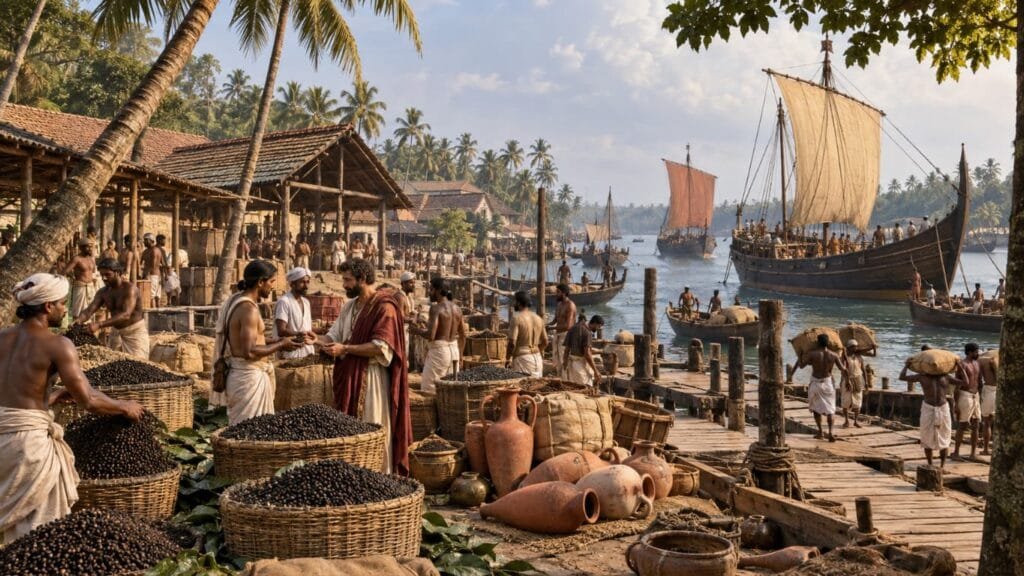
Nearly 2,000 years ago, ships crossed the Arabian Sea toward the southwest coast of India carrying merchants, financiers and cargoes from the Red Sea world. Their destination was a trading region known to ancient writers as Muziris.
What they wanted was not gold, silk or some mythical treasure.
One of the commodities that drew them was black pepper.
But the story of Muziris is much bigger than the familiar image of Roman merchants arriving in India to buy spices. Archaeological discoveries at Pattanam, ancient Greek and Roman writings, commercial documents and recent environmental research together reveal something more complicated: a South Indian trading network connected to the Arabian Sea, Red Sea and Mediterranean economies.
And there is still a mystery at its centre.
Where exactly was Muziris?
What Was Muziris?
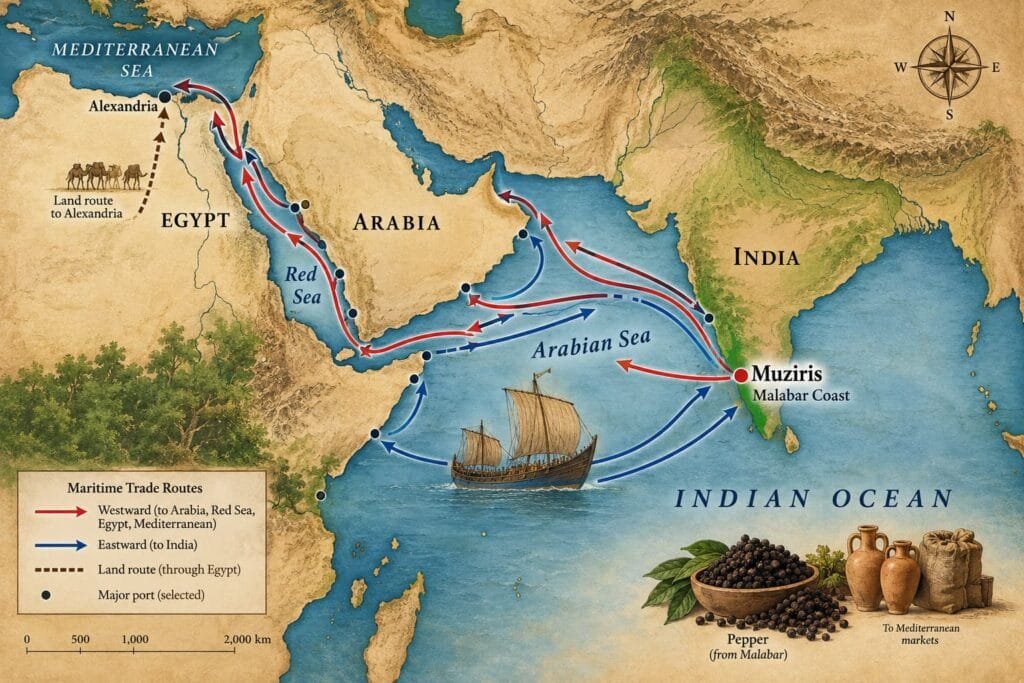
Muziris was an important ancient trading centre on the Malabar Coast of southwestern India, associated with the Chera political world. Ancient sources including the Periplus of the Erythraean Sea, Pliny and Ptolemy describe ports and commercial connections along the South Indian coast, while early Tamil literature also preserves references relevant to the region.
The evidence shows that this was not an isolated coastal settlement.
Muziris belonged to a maritime system in which goods, merchants and information moved between South India and ports around the Indian Ocean and the Red Sea.
The importance of the place becomes clearer when we stop looking at it as simply an ancient “Roman port.”
It was an Indian port participating in an international commercial system.
And its most valuable connection may have begun far inland.
Why Did Rome Want India's Pepper?
Pepper grows particularly well in the humid landscapes of India’s southwest, where the Western Ghats create conditions suited to the crop.
For Mediterranean consumers, however, the pepper-growing regions of South India were separated from their markets by thousands of kilometres of land and sea.
That distance created an enormous commercial opportunity.
Pepper and other Indian commodities could move from production areas toward the Malabar coast, enter maritime trade through ports such as Muziris, cross the Arabian Sea and eventually reach the Red Sea.
From there, goods could continue through Egypt toward the Mediterranean.
The Muziris trade therefore was not simply:
India → Rome.
It was a chain:
South Indian production → coastal trading centre → Arabian Sea → Red Sea → Egypt → Mediterranean markets
That distinction matters.
The port was only one part of the system.
The Monsoon Turned the Ocean Into a Highway
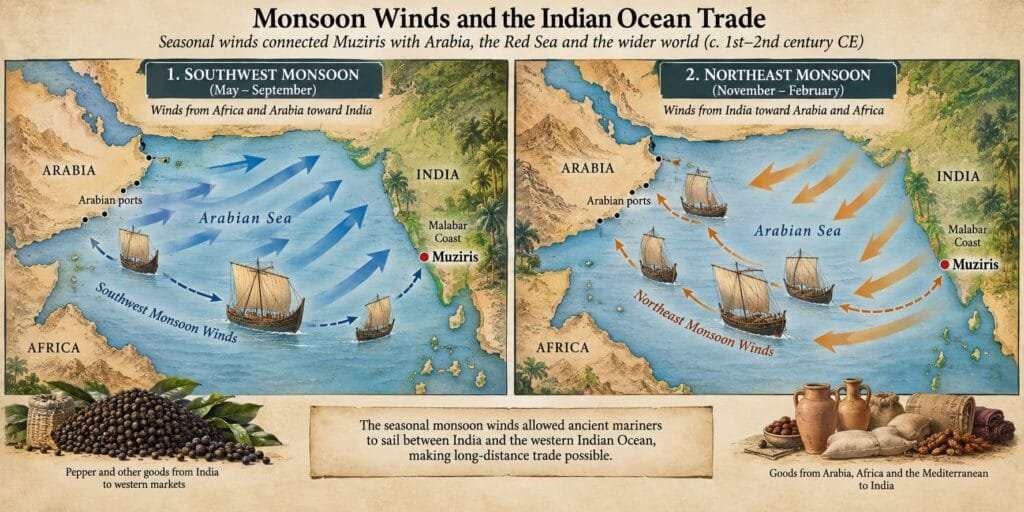
The Arabian Sea was not an easy body of water to cross.
Ancient sailors had to understand seasonal winds and plan voyages accordingly.
The monsoon system provided a remarkable natural transportation mechanism. Once sailors understood the seasonal wind patterns, voyages between the Red Sea and the Indian coast could become much more predictable than a simple eastward or westward journey might suggest.
This helps explain why South India’s ports could become deeply connected with distant markets.
The sea was not merely a barrier.
Under the right conditions, it was the route.
Research on the Muziris Papyrus and related ancient sources has been used to reconstruct sailing schedules, ship sizes, commodities and commercial practices associated with the South India–Red Sea trade.
That means the ancient pepper trade was not just an exchange of goods.
It required knowledge of winds, ships, ports, financing, taxation and long-distance logistics.
What Was Traded Through Muziris?
Pepper was important, but it was not alone.
Ancient evidence associates South Indian maritime commerce with commodities including pepper, ivory, pearls, gemstones and other valuable products.
The Periplus also mentions products such as malabathrum in connection with the South Indian trade.
The return journey brought foreign goods into South India.
Archaeology at Pattanam provides some of the physical evidence for this exchange.
Researchers have found imported pottery and other objects associated with regions far beyond Kerala, including Roman, West Asian and other Indian Ocean connections.
That is important because the objects tell a story that is broader than a simple India-Rome relationship.
Pattanam’s archaeological record points toward a settlement participating in a much wider maritime world.
The Muziris Papyrus: An Ancient Business Document
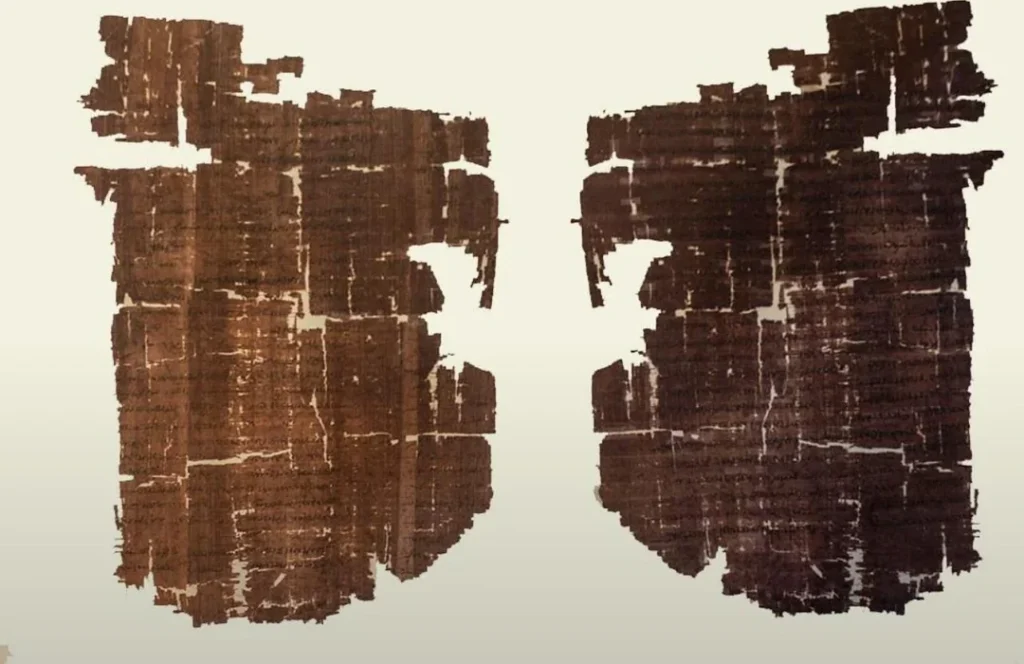
One of the most extraordinary pieces of evidence connected with Muziris is not a monument.
It is a damaged papyrus.
Known as the Muziris Papyrus, the document dates to the middle decades of the second century CE. It contains parts of commercial texts concerning trade between Roman Egypt and Muziris.
Its importance lies in the detail.
The papyrus provides evidence about the financial and organizational machinery behind long-distance commerce.
A merchant could obtain financing for a voyage to Muziris. The cargo then had to move through a chain of transportation and taxation after reaching the Red Sea.
The surviving text refers to transporting goods by camel across Egypt’s eastern desert, then moving them onward by river toward Alexandria.
At Alexandria, customs obligations became part of the calculation.
In other words, the pepper trade required something that sounds surprisingly modern:
finance, logistics, transport contracts, taxation and risk management.
The document gives historians a rare glimpse into the commercial infrastructure behind ancient Indian Ocean trade.
It also changes how we should imagine the merchants involved.
These were not simply sailors filling ships with spices.
They operated within sophisticated commercial networks.
Pattanam: The Archaeological Clues
For centuries, Muziris survived largely through texts.
Then archaeologists began finding something much more tangible.
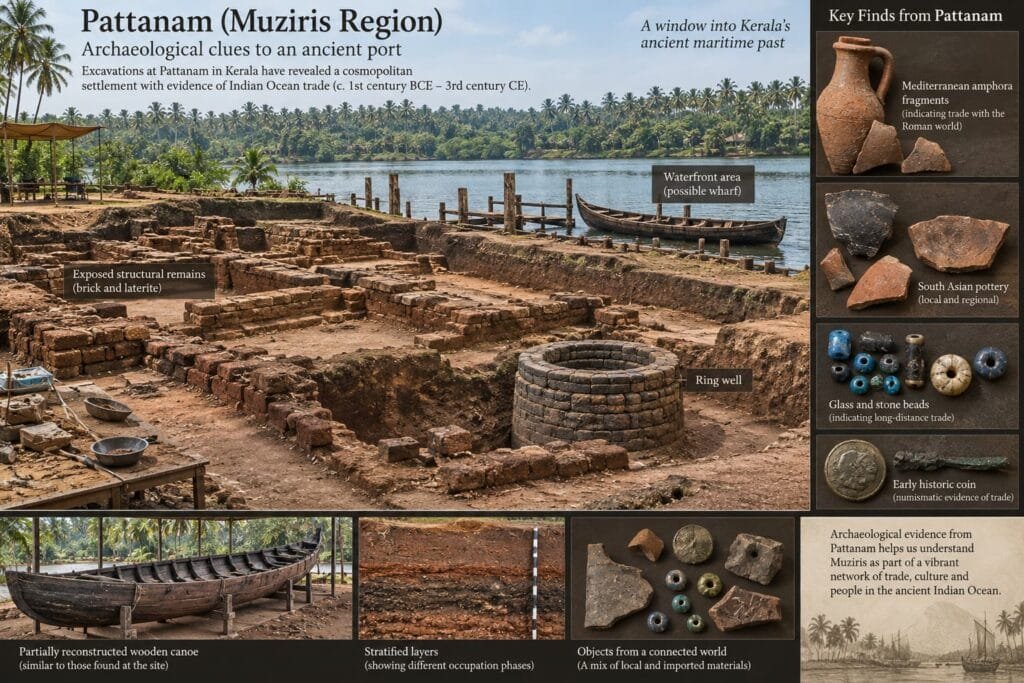
Excavations at Pattanam in Kerala have revealed evidence of a substantial early historic settlement and extensive maritime connections.
According to Kerala’s Muziris Heritage Project, excavations beginning in 2007 uncovered brick architecture, burnt clay floors, ring wells, storage features, a wharf with bollards and a wooden canoe found alongside it.
The site has also produced large quantities of pottery and other artefacts, including Roman amphora fragments, terra sigillata, West Asian pottery, beads and early Chera coins.
The settlement evidence extends across a long period, with material indicating occupation from around the second century BCE to the tenth century CE.
The most intriguing discovery is the combination of these objects.
Imagine the archaeological picture:
A South Indian settlement.
Roman containers.
West Asian ceramics.
Indian pottery.
Chera coins.
A waterfront structure.
A wooden boat.
And evidence of connections extending across the Indian Ocean.
Individually, each object tells only part of the story.
Together, they reveal a place deeply connected to maritime exchange.
So, Is Pattanam Actually Muziris?

This is where the story becomes more complicated.
It is tempting to say that archaeologists have simply “found Muziris.”
But the evidence does not justify such a simple statement.
Pattanam has produced compelling evidence for an important early historic maritime settlement, and researchers have made a strong case connecting it with the ancient Muziris described in historical sources.
Kerala’s own Muziris Heritage Project describes the findings as suggesting the possibility that Pattanam was ancient Muziris.
Academic research has likewise argued for the identification while emphasizing that continuing archaeological investigation is needed.
That distinction matters.
Pattanam is archaeological evidence. “Pattanam was Muziris” is an interpretation of that evidence.
Those two statements should not be treated as identical.
Earlier research had generally placed Muziris somewhere around the Kodungallur region near the mouth of the Periyar River. Archaeologists have therefore been trying to reconcile several different kinds of evidence:
- ancient written descriptions
- geography
- archaeological remains
- imported ceramics
- local material culture
- river systems
- maritime infrastructure
The challenge is that an ancient port does not necessarily leave behind a modern sign saying:
“Muziris — main entrance.”
Ports move.
Rivers change course.
Coastlines evolve.
Settlements expand and disappear.
And later construction can cover earlier landscapes.
What the Archaeological Objects Actually Tell Us
The finds from Pattanam become more interesting when treated as evidence rather than simply listed as artefacts.
Roman amphorae
Amphora fragments are containers associated with Mediterranean trade. Their presence provides physical evidence of contact with the western Indian Ocean trade system.
Terra sigillata
Fragments of fine Roman tableware provide another indication of connections with the Mediterranean world.
West Asian pottery
These finds broaden the picture beyond Rome and show that the settlement participated in wider networks.
Chera coins
Local coinage provides evidence of the regional political and economic environment in which the settlement operated.
Wharf and bollards
These are particularly important because they point toward maritime infrastructure rather than merely imported objects.
Wooden canoe
The discovery of a substantial wooden watercraft adds another physical dimension to the settlement’s relationship with waterways and transport.
The archaeological story therefore isn’t simply:
“Roman things were found in India.”
It is:
“A South Indian settlement possessed the infrastructure and material connections expected of a major node in an international trading system.”
Muziris Was Connected to More Than Rome
The Roman connection is undoubtedly one of the most fascinating parts of the story.
But it can also distort our understanding.
Research on Pattanam’s ceramics has identified connections involving the Red Sea, South Arabia, the Persian Gulf and India’s eastern coast.
Some pottery types found at Pattanam can be compared with material from important Red Sea ports such as Myos Hormos and Berenike.
This changes the mental map.
Muziris was not sitting at one end of a narrow India-Rome trade route.
It was part of an interconnected Indian Ocean world.
Goods could move between different ports and regions, while merchants operated across cultural and political boundaries.
The Malabar Coast was therefore not a peripheral corner of the ancient world.
It was one of the places where different commercial worlds met.
The Periyar and the Geography of a Lost Port
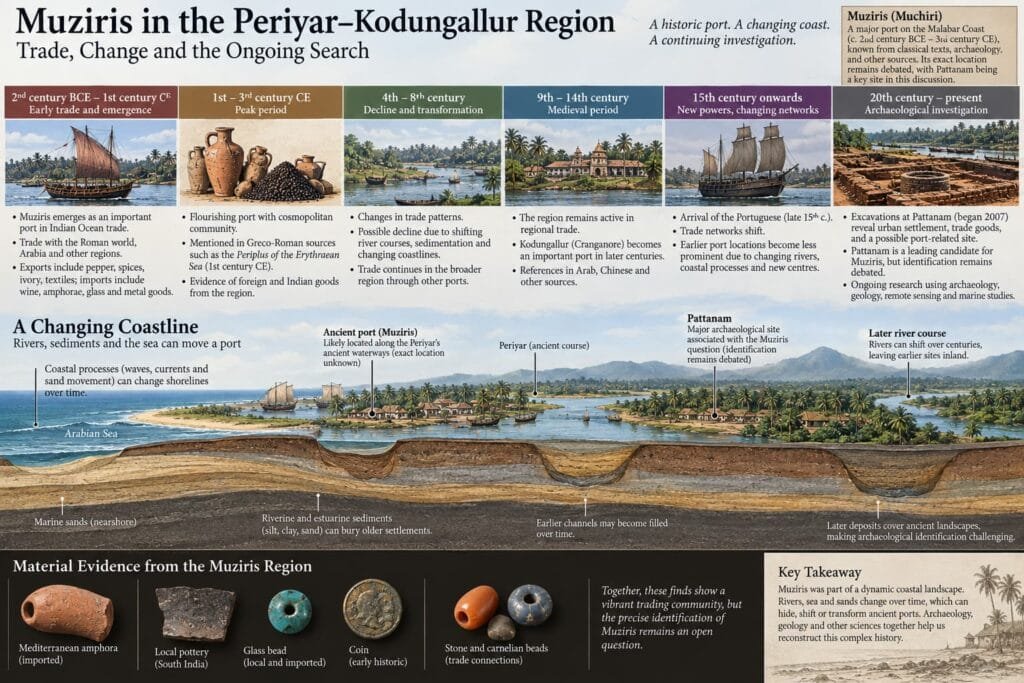
Muziris is traditionally associated with the region around the Periyar River and Kodungallur.
That geography may help explain both its rise and its disappearance.
A port needs access to water, transport routes and hinterlands.
The Periyar connects the interior of Kerala with the coast. Beyond the immediate river system were the productive landscapes of the Western Ghats and the wider South Indian hinterland.
That created a natural combination:
mountains and plantations → river routes → coastal settlement → Arabian Sea
But the same landscape is constantly changing.
Rivers deposit sediment.
Coastlines shift.
Sea levels change.
Storms and floods alter channels.
Human settlements also move.
Recent research published in Quaternary Science Advances used sedimentary, geochemical, mineralogical, palynological and chronological evidence to investigate the long-term evolution of the Central Kerala coast around the Muziris region.
The study identifies major environmental changes over thousands of years and argues that coastal evolution and climate variability played an important role in shaping the landscape.
Importantly, the researchers conclude that the exact location of the ancient port remains unresolved while suggesting that Pattanam may have functioned as a satellite settlement within the wider Muziris port area.
That is a much more cautious picture than the popular claim that a single catastrophic event simply “destroyed Muziris.”
What Happened to Muziris?
There is no single, universally established answer.
The disappearance of an ancient port does not necessarily mean that its population vanished overnight.
A maritime centre can decline because its river channel changes, its harbour becomes less accessible, commercial routes shift, political conditions change, competing ports become more important or environmental conditions alter the landscape.
For Muziris, researchers are investigating exactly these kinds of processes.
The archaeological evidence suggests long-term occupation at Pattanam rather than a simple moment when everything stopped.
The landscape around the Periyar also underwent substantial environmental change.
So instead of imagining:
Muziris → disaster → abandoned city
it may be more accurate to think in terms of:
changing landscape + changing waterways + changing trade networks + changing settlements
The ancient port may have disappeared from the historical map without disappearing in a single dramatic moment.
What We Know — and What We Still Don't
| What the evidence supports | What remains uncertain |
|---|---|
| Muziris was an important South Indian maritime centre | Its exact archaeological location |
| The region participated in long-distance trade | Whether Pattanam itself was the principal Muziris settlement |
| South India had substantial trade with the Roman world | The precise physical layout of Muziris |
| Pepper was an important commodity | Exactly how the port declined |
| Pattanam was a significant early historic settlement | How every archaeological feature relates to ancient Muziris |
| Pattanam had connections across the Indian Ocean and beyond | The exact relationship between Pattanam and the wider port complex |
| The Periyar region underwent major environmental changes | How much each environmental event contributed to the port’s transformation |
This uncertainty doesn’t make the story weaker.
It makes the archaeological investigation more interesting.
Muziris Was More Than a Port
The easiest way to remember Muziris is as an ancient port where Roman merchants came looking for pepper.
But that description misses the larger story.
Muziris was a meeting point between landscapes and economies.
Pepper grew in South India’s humid environment.
Merchants moved commodities toward the coast.
Ships crossed the Arabian Sea using seasonal winds.
Goods entered the Red Sea.
Egyptian infrastructure moved them toward the Mediterranean.
Financial arrangements allowed merchants to undertake enormous voyages.
Governments collected taxes.
And distant consumers created demand for products grown thousands of kilometres away.
The surviving Muziris Papyrus makes this especially clear.
It shows that ancient long-distance trade was not simply an exchange between two places. It involved contracts, loans, agents, cargo valuation, taxation and transportation.
That is why Muziris deserves to be understood as a network, not merely a dot on an ancient map.
The Ancient Port We Still Can't Fully See
Today, the most fascinating thing about Muziris may be the gap between what we know and what remains hidden.
We know that a major maritime trading system operated along the Malabar Coast.
We know that South Indian commodities reached the wider Mediterranean world.
We know that Pattanam contains remarkable archaeological evidence of long-distance exchange.
We know that ancient documents preserve details of commercial activity involving Muziris.
And we know that the landscape itself has changed dramatically over thousands of years.
But archaeologists are still working to reconstruct exactly where the ancient port stood and how its different settlements and waterways fitted together.
That makes Muziris different from many famous ancient cities.
We can visit the ruins of some ancient capitals and see their streets, walls and monuments.
Muziris is harder to see.
Its story survives in fragments:
A broken amphora.
A coin.
A piece of pottery.
A wooden boat.
A buried wharf.
A line in an ancient text.
A damaged business document.
A changing river.
Put those fragments together, and a remarkable picture begins to emerge.
Nearly 2,000 years ago, something grown in the forests and hills of South India could begin a journey that crossed the Arabian Sea, passed through the Red Sea and eventually reached the Mediterranean world.
The real story of Muziris, then, is not simply that Rome came looking for pepper.
It is that India was already part of a sophisticated intercontinental trading system—and Muziris was one of the places where that system became visible.