
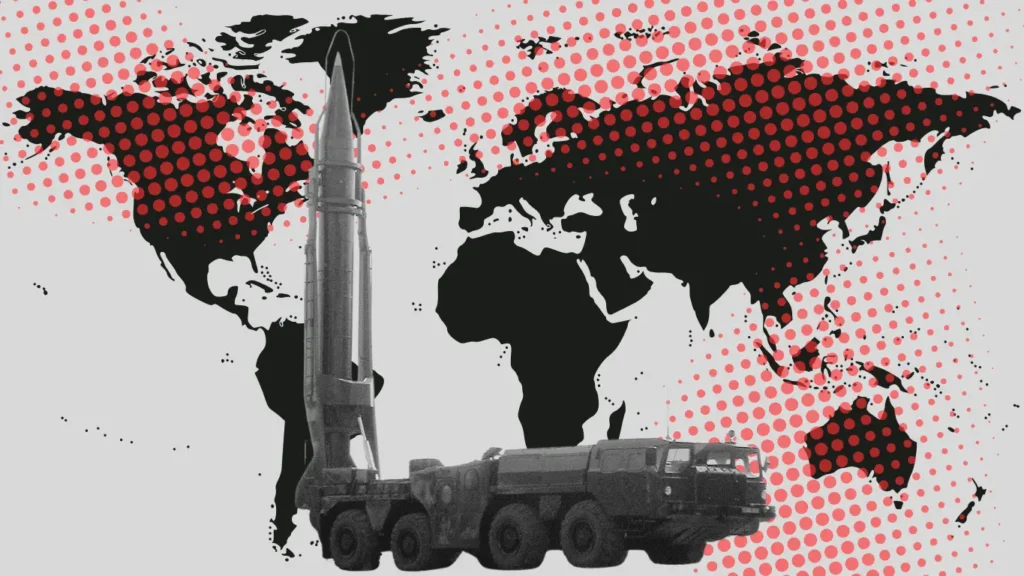
A Scud missile is a Soviet-designed, liquid-fuelled short-range ballistic missile, first flown in 1953 as the R-11 and exported worldwide as the R-17 Scud-B, with a range of about 300 km. “Scud” is its NATO reporting name. Copies and derivatives are still built in North Korea and Iran and fired by Yemen’s Houthis.
The Scud missile has been fired at Tel Aviv, Tehran, Dhahran and Riyadh, yet its family tree begins in a Nazi weapons programme, and not with the V-2 rocket that most histories credit.
On 10 October 2026, an attack on King Khalid International Airport in Riyadh killed 12 people and injured 309, according to figures from Saudi Arabia’s General Authority of Civil Aviation reported by Khaleej Times. It was the third attack on the airport that week. The Saudi-led coalition blamed the Houthis. As of 13 October, the weapon used had not been publicly confirmed.
Most coverage has stayed with the casualties, the threats of retaliation and the role of Iran. Far fewer stories ask a simpler question: where did the Houthis’ ballistic missiles come from in the first place?
The answer runs through a Baltic research station, an underground slave-labour factory, a single night in October 1946, a Soviet design bureau, Cairo, Pyongyang and Tehran. It also overturns one of the most repeated “facts” in military history.
What Is a Scud Missile?
A Scud missile is a short-range ballistic missile developed in the Soviet Union in the early 1950s. It is fired from a mobile launcher, climbs on a rocket engine and falls on its target along a ballistic arc. Its warhead stays attached to the missile body rather than separating in flight.
The family has two main Soviet members. The first, the R-11, is known in the West as the Scud-A. The second, the R-17 or Scud-B, became the workhorse. It was built in large numbers, exported across the Middle East and Asia, and copied by countries that never signed a licence.
That is why “Scud” now means two things. Strictly, it names a handful of Soviet missiles. Loosely, it covers a whole lineage of copies and upgrades: Iraqi, North Korean, Iranian and Yemeni weapons that still carry the original’s DNA.
Why Is It Called a Scud?
“Scud” was never a Soviet name. It is a NATO reporting name, a code word Western intelligence services gave Soviet weapons so they could be discussed without knowing the official designation. Moscow called the missiles the R-11 and R-17; the Federation of American Scientists lists the Scud-B’s industrial index as 8K14.
No documented explanation exists for why this particular word was chosen, and stories claiming one should be treated with caution. The label simply stuck. It stuck so well that Iraq’s Al-Hussein and Iran’s Shahab missiles were routinely called “Scuds” decades later.
Where the Story Begins: Peenemünde and the V-2 Rocket
The V-2 rocket was the world’s first long-range guided ballistic missile. It was developed by Wernher von Braun’s team at Peenemünde on Germany’s Baltic coast and first fired in combat in September 1944. It was a technological leap. It was also, by any measure, a weapon built on atrocity.
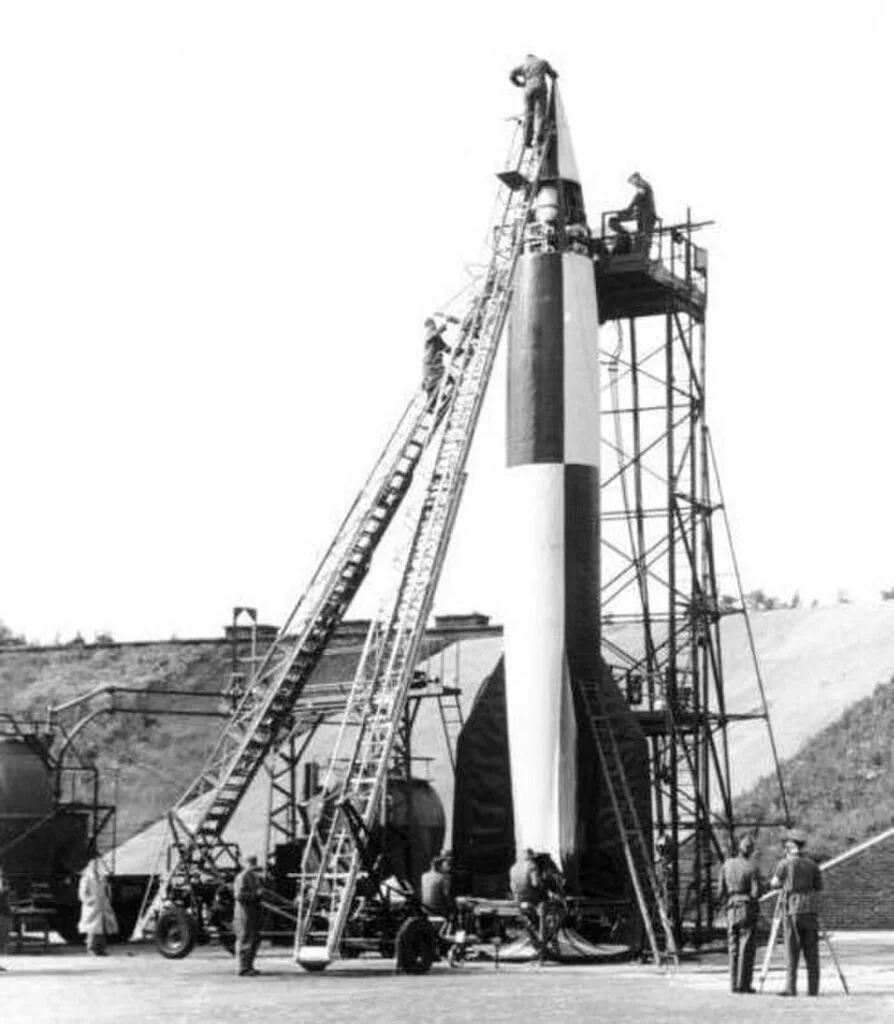
Michael J. Neufeld, a senior curator at the Smithsonian’s National Air and Space Museum, estimates that V-2 attacks killed a little over 5,000 people, mainly in London and Antwerp. At least 10,000 concentration-camp prisoners died building the rockets at Mittelbau-Dora, the underground factory complex in central Germany. The V-2 killed roughly twice as many of the people forced to make it as the people it was fired at.
Peenemünde produced more than the V-2. Von Braun’s engineers worked on a range of designs, including a radio-guided anti-aircraft rocket called the Wasserfall (“waterfall”). That second rocket matters more to the Scud’s story than almost any reference book admits.
When Germany collapsed in 1945, the rocket programme became a prize. In other hands, its science would go on to seed space programmes as well as missile arsenals. But first, the victors had to divide the engineers.
The Night Stalin Took Germany’s Rocket Engineers
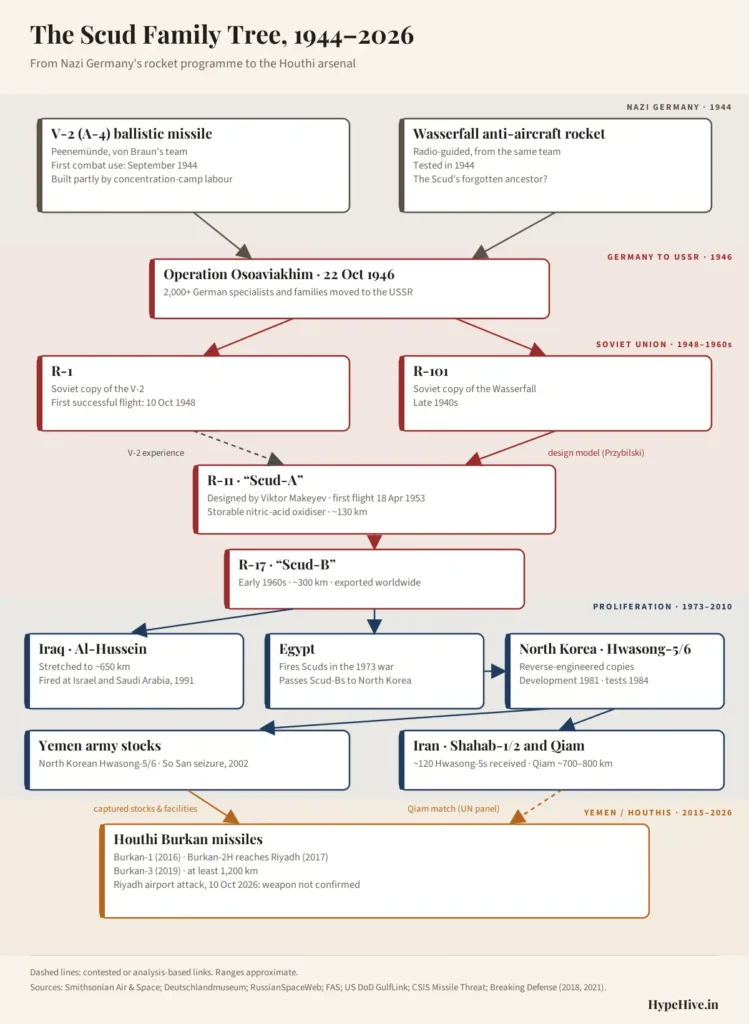
On 22 October 1946, Soviet authorities carried out Operation Osoaviakhim (also spelled Ossawakim). In one surprise action, they moved more than 2,000 German specialists and their families from the Soviet occupation zone to the USSR.
According to Germany’s Deutschlandmuseum, armed soldiers arrived at the specialists’ homes and told them they were leaving. Entire factory inventories were dismantled and loaded onto goods trains. The deportees included experts in aerospace, nuclear research, chemistry and optics. Most stayed between four and eight years, and many did not return home until 1958.
The rocket specialists were led by Helmut Gröttrup, a former Peenemünde engineer. Records compiled by RussianSpaceWeb show he protested the deportation and went on strike in April 1947. The Germans were gradually moved to Gorodomlya, an island on Lake Seliger north-west of Moscow; by 1 January 1948, 96 German specialists lived there. Their main proposal, an improved rocket called the G-1, was approved in principle but never built. The Soviets increasingly restricted them to consulting and training.
Soviet engineers under Sergei Korolev, meanwhile, built the R-1, which RussianSpaceWeb describes as the Soviet copy of the German A-4, the V-2’s official name. After a failed first attempt in September 1948, the first successful R-1 flew from Kapustin Yar on 10 October 1948. That was 78 years to the day before the attack on Riyadh’s airport, a coincidence of the calendar, but a reminder of how long this lineage runs.
Operation Paperclip’s Soviet Mirror
The United States ran its own, better-known programme. Under Operation Paperclip, Wernher von Braun and many of his senior colleagues were brought to America, where they went on to build US missiles and space rockets. Osoaviakhim was the Soviet answer: less famous, more coercive, and aimed as much at factories and production know-how as at star scientists.
Both superpowers built their early rocket forces on German foundations. The difference is where the hardware ended up. American rocketry led to the Moon. The Soviet line led, among other places, to the Scud.
The Forgotten Ancestor: Wasserfall, Not the V-2
Most reference sources describe the Scud as a descendant of the V-2. Research by Olaf Przybilski of the Technical University of Dresden, reported by the Smithsonian’s Air & Space magazine, points instead to the Wasserfall anti-aircraft rocket.
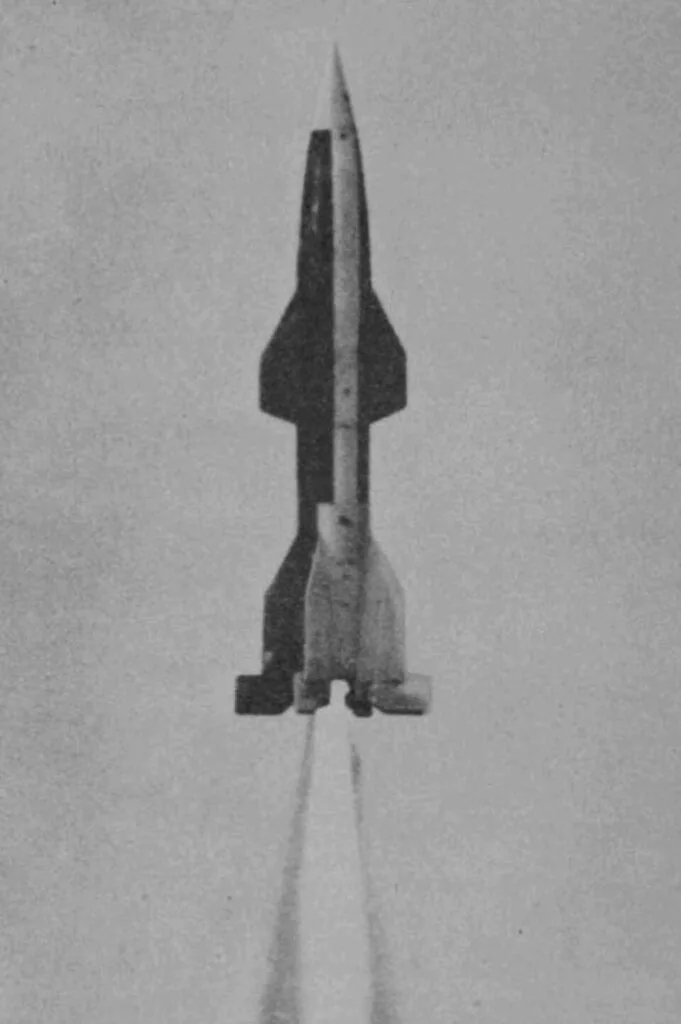
Przybilski based his conclusion on interviews with the German engineers the Soviets had conscripted after the war. In his account, the Soviet air defence force copied the Wasserfall in the late 1940s as the R-101, and engineers later drew on that design to build the R-11, the first Scud. Wikipedia’s entry on the R-11, citing defence historian Steven Zaloga and Jane’s, likewise names the Wasserfall as the design’s model.
The other side of the record is real too. The Federation of American Scientists says the Scud was derived from the V-2. The US Department of Defense’s Gulf War history calls it a direct descendant.
Both views contain truth. Soviet engineers learned the craft of large rockets by copying the V-2, and that experience shaped everything that followed. But one design decision made the Scud a practical battlefield weapon. When designing the R-11, Viktor Makeyev chose a storable nitric-acid oxidiser; his superior, Korolev, preferred the V-2’s liquid oxygen.
That choice fits the anti-aircraft lineage. An air-defence rocket has to be ready to fire at short notice, while a V-2 burning liquid oxygen had to be fuelled shortly before launch. A missile that can sit fuelled on a truck is the core of what the Scud became.
The fair conclusion: the Scud’s ancestry is contested, and the familiar “V-2 copy” story is too simple. Its most important inheritance may come from Hitler’s forgotten anti-aircraft rocket.
From Scud-A to Scud-B: The Missile Moscow Sold to the World
The R-11 first flew on 18 April 1953 and was formally accepted into Soviet service in 1955. Its successor, the R-17 Scud-B, appeared in the early 1960s and became the family’s most widely exported member, with a range of about 300 km, according to the Federation of American Scientists.
The Scud-B was built for the Cold War battlefield, able to carry either a conventional or a nuclear warhead. Its range also placed it below the line of later arms control. The 1987 INF Treaty eliminated ground-launched missiles with ranges between 500 and 5,500 km, so 300-km Scud-Bs fell outside it. (For how that treaty reshaped the arms race, see our explainer on Cold War missile arms control.)
The Soviet Union exported the missile widely to client states. Its first combat use came in the 1973 Yom Kippur War, and it was fired again in large numbers during the Iran–Iraq War of the 1980s, when the two countries traded missile strikes on each other’s cities.
Scud Missiles in the Gulf War
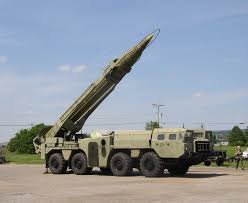
During the 1991 Gulf War, Iraq fired dozens of Scud-type missiles at Israel and Saudi Arabia. Counts differ by source: figures compiled on Wikipedia give 88 launches, 46 into Saudi Arabia and 42 into Israel. Analyst Kyle Mizokami, writing in The National Interest, puts the number at about 93.
Most of these were not original Soviet Scuds. The Iraqi Al-Hussein stretched the missile’s reach to about 650 km by cutting the warhead to 250 kg and adding around 15 per cent more fuel, according to the US Defense Department’s GulfLink history.
The deadliest single strike came on 25 February 1991. A Scud hit a barracks in Dhahran, Saudi Arabia, killing 28 US soldiers and wounding 99, according to the US Army. Thirteen of the dead belonged to the 14th Quartermaster Detachment, an Army Reserve water-purification unit from Greensburg, Pennsylvania.
How a Soviet Missile Reached Pyongyang and Tehran
North Korea obtained Soviet-built Scud-B missiles from Egypt and reverse-engineered them. According to the Center for Strategic and International Studies’ Missile Threat project, development of the North Korean copy, the Hwasong-5, began in 1981, and flight tests started in 1984.
North Korea then became a seller. CSIS estimates that Iran received around 120 Hwasong-5 missiles plus mobile launchers, and that a manufacturing facility was set up in Iran. Iran fielded the North Korean Scud copies as the Shahab-1 and Shahab-2, according to a 2018 analysis in Breaking Defense, and developed its own Scud-derived missiles from there.
Yemen bought from the same source. Before its civil war, the Yemeni military held North Korean Hwasong-5 and Hwasong-6 missiles. In 2002, 15 Scuds bound for Yemen were seized aboard the North Korean ship So San.
The pattern is a relay. Each buyer learned enough to become a builder, and each builder became a supplier.
How Did the Houthis Get Ballistic Missiles?
The Houthis’ ballistic arsenal has two roots. One is the Yemeni army’s pre-war Scud stockpile and production facilities. The other is a newer family of Burkan missiles that analysts and UN investigators link to Iran’s Scud-derived Qiam.
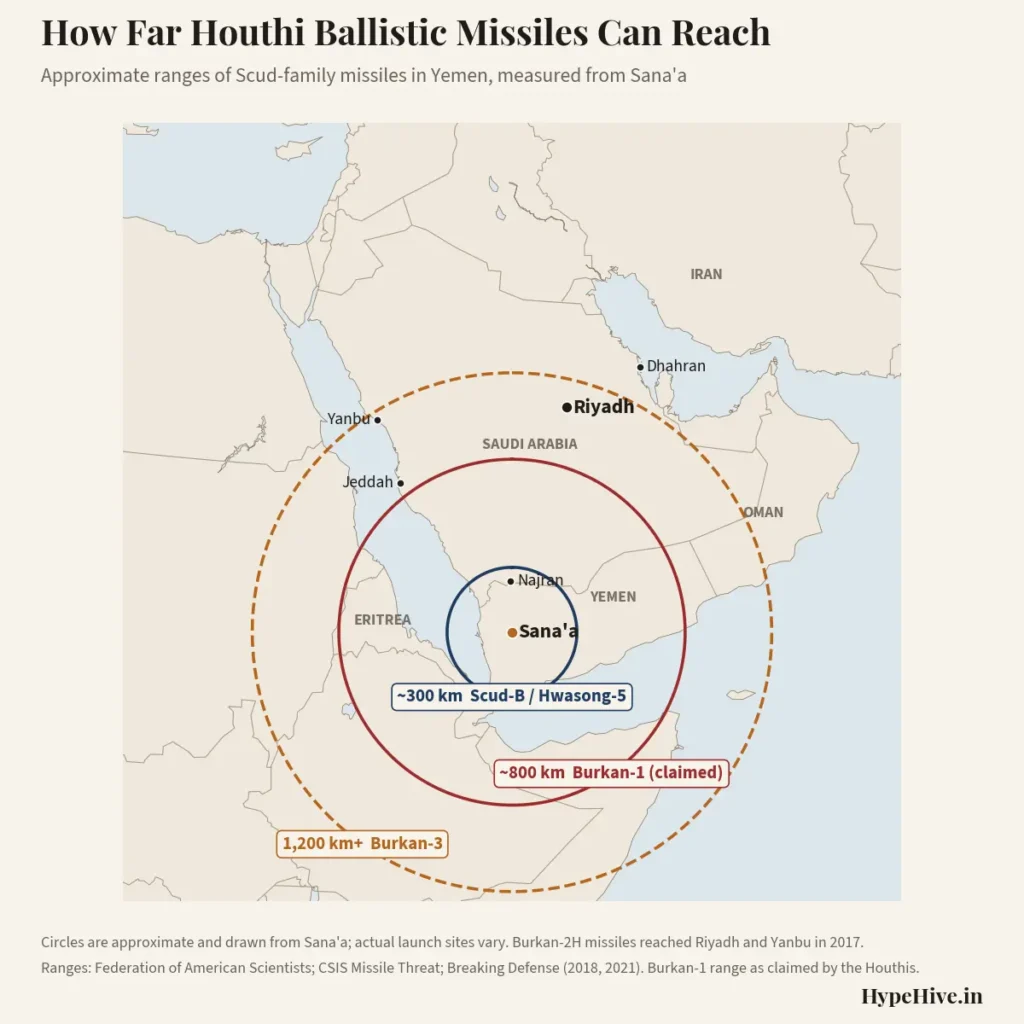
When the civil war engulfed Yemen, the army’s Scud facilities in Sana’a came under Houthi control, according to defence analyst Ralph Savelsberg of the Netherlands Defence Academy, writing in Breaking Defense in 2021. The Houthis unveiled the Burkan-1 in 2016, claiming a range of 800 km. Burkan-2H missiles reached Yanbu and Riyadh in 2017.
The UN Panel of Experts found the Burkan-2H matches the Iranian Qiam, writing that the two were “almost certainly produced by the same manufacturer.” Savelsberg’s trajectory analysis concluded the later Burkan-3, unveiled in August 2019, is most likely an Iranian Qiam variant with a range of at least 1,200 km, enough to reach most of Saudi Arabia.
These conclusions rest on wreckage examination and trajectory modelling, not official admissions. Iran’s wider network of military operations in Yemen has drawn US attention for years; our profile of Iran’s Quds Force commander Abdul Reza Shahlai traces part of that story.
What this means for October 2026 is limited but important. The specific weapon used against King Khalid International Airport has not been confirmed. What is established is that Houthi forces have fired Scud-derived ballistic missiles at Riyadh since at least 2017, the latest link in a chain that began in German laboratories more than 80 years ago.
Scud Missile Range: How the Family Grew
Scud missile range has grown from about 130 km for the original Scud-A to at least 1,200 km for the Houthis’ Burkan-3, as each generation traded warhead weight for fuel and reach.
| Missile | Origin | Approximate range | Source |
|---|---|---|---|
| R-11 (Scud-A) | USSR, 1950s | ~130 km | Federation of American Scientists |
| R-17 (Scud-B) | USSR, 1960s | ~300 km | Federation of American Scientists |
| Hwasong-5 | North Korea | ~300 km | CSIS Missile Threat |
| Scud-C / Hwasong-6 | USSR design / North Korea | ~575–600 km | Federation of American Scientists |
| Al-Hussein | Iraq | ~650 km | US DoD GulfLink |
| Scud-D | USSR | ~700 km | Federation of American Scientists |
| Qiam | Iran | ~700–800 km | Breaking Defense (2021) |
| Burkan-3 | Houthis (Iranian Qiam variant, per analysis) | at least 1,200 km | Breaking Defense (2021) |
What the Evidence Shows, and What We Still Don’t Know
Established:
- The V-2 was developed at Peenemünde and built partly with concentration-camp labour.
- The Soviet Union moved thousands of German specialists east in October 1946.
- The R-1 copied the V-2.
- The R-11 and R-17 became the Scud family.
- North Korea copied Scud-Bs obtained from Egypt and sold them on to Iran and Yemen.
Contested:
- Whether the Scud is best described as a V-2 descendant or as a Wasserfall descendant. Reputable sources disagree, and the honest answer involves both.
- How many Scuds Iraq fired in 1991. Published counts range from 88 to about 93.
Unknown or unconfirmed:
- The weapon used in the 10 October 2026 Riyadh attack.
- The exact date Egypt passed Scud-Bs to North Korea, usually placed around 1979–81.
- The full extent of Iran’s role in each Houthi missile, which rests on analysis rather than admissions.
Are Scud Missiles Still Used?
Yes. Original Soviet-built Scuds are now largely obsolete, but their derivatives remain in service and in combat, from North Korea’s arsenals to Iran’s missile forces and the Burkan missiles fired from Yemen.
That longevity is unusual. Most weapons of the early Cold War are museum pieces. The Scud survived because it is simple, mobile and easy to copy, and because each copy became a new starting point. Newer systems, such as Russia’s latest ballistic missiles and hypersonic projects like India’s Project Vishnu, show where missile technology is heading. The Scud shows how long old technology can keep killing.
Trace the line back, and the missiles over the Gulf in 2026 connect to a rocket station on the Baltic. On one side are the prisoners who died building its weapons. On the other is a night in 1946 when soldiers knocked on the doors of German engineers. None of those engineers could have imagined where their work would land. Weapons outlive the governments that commission them, and the Scud’s family tree shows how far they can travel.
Quiz: The Scud Missile's Family Tree
5 questions. Pick your answers, then check your score. Each answer is explained.
More history quizzes: see all quizzes.
