
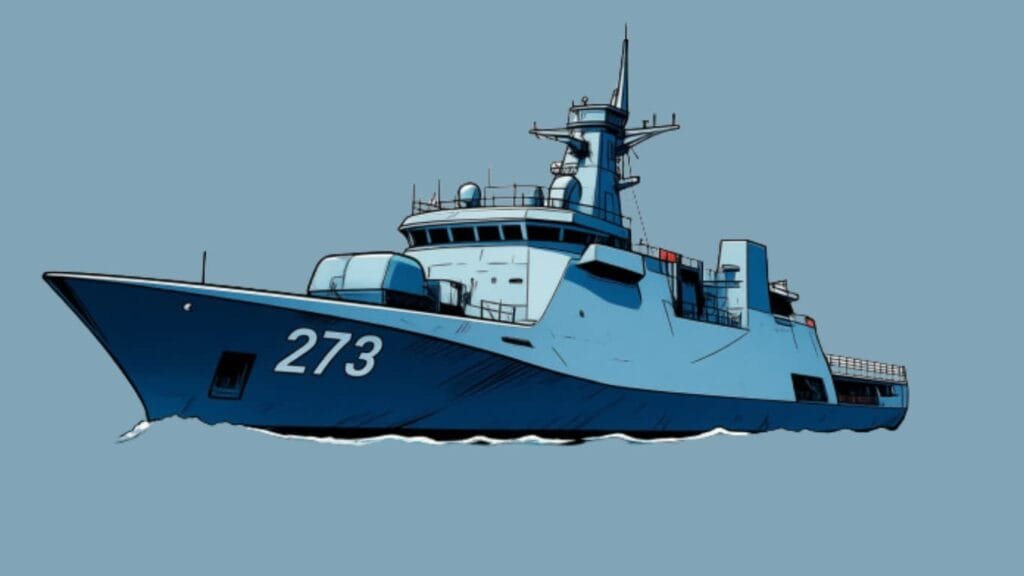
A Pakistani naval vessel has suddenly become the centre of attention in India after a collision with an Indian Navy warship in the North Arabian Sea.
The Pakistani vessel was PNS Hunain (F-273), a Yarmook-class offshore patrol vessel. According to Indian reporting, the collision occurred on September 15, 2026, in international waters roughly 120 nautical miles from the Gulf of Oman. India said the Pakistani vessel approached its warship at high speed and manoeuvred unsafely before the collision. Pakistan disputed India’s account and said the incident occurred within its Exclusive Economic Zone during a naval exercise, accusing the Indian vessel of dangerous manoeuvring.
The two countries therefore disagree about what happened at sea.
But there is another question hiding behind the headline:
Why is the Pakistani warship called PNS Hunain?
The answer takes us back nearly 1,400 years, to a battle fought in Arabia in 630 CE.
And PNS Hunain is not alone.
Its sister ships carry the names Yarmook, Tabuk and Yamama—names connected to episodes from the early Islamic period.
That means a modern warship appearing in the news in 2026 carries a name rooted in a history that existed more than a millennium before Pakistan itself was created.
This is the story behind that name.
What Happened Between PNS Hunain and the Indian Navy?
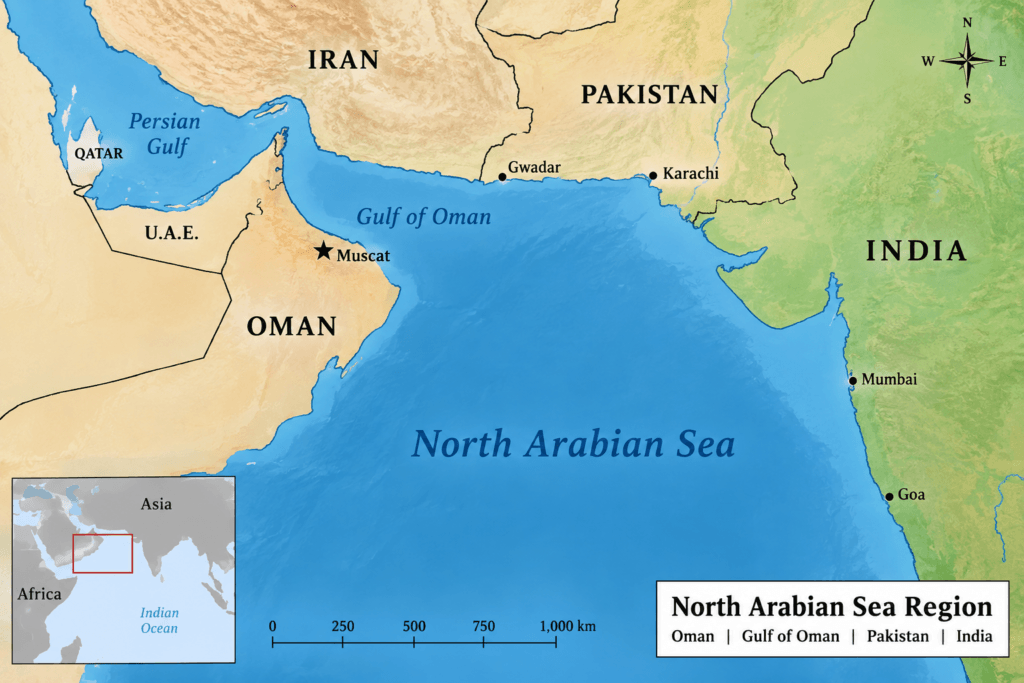
On September 15, 2026, PNS Hunain was involved in a collision with an Indian Navy frontline warship in the North Arabian Sea.
Indian officials said the Indian warship was carrying out a surveillance mission when the Pakistani vessel approached at high speed and manoeuvred before the two ships came into contact.
Indian reporting said the Indian vessel remained operational while PNS Hunain sustained damage and returned toward port.
India subsequently summoned Pakistan’s Charge d’Affaires in New Delhi and lodged a formal protest, describing the conduct of the Pakistani naval units as unacceptable and unprofessional.
India also referred to Article 10 of the 1991 India-Pakistan Agreement on Advance Notice on Military Exercises, Manoeuvres and Troop Movements. The provision addresses the separation of naval vessels and submarines belonging to the two countries while operating in international waters.
Pakistan gave a different account.
International reporting said Pakistan maintained that the incident occurred inside its Exclusive Economic Zone during a naval exercise and accused the Indian vessel of aggressive and dangerous manoeuvring.
So the circumstances of the collision remain contested.
What is not disputed, however, is the identity of the Pakistani ship involved:
PNS Hunain.
And that name has a history of its own.
Why Is the Pakistani Ship Called Hunain?
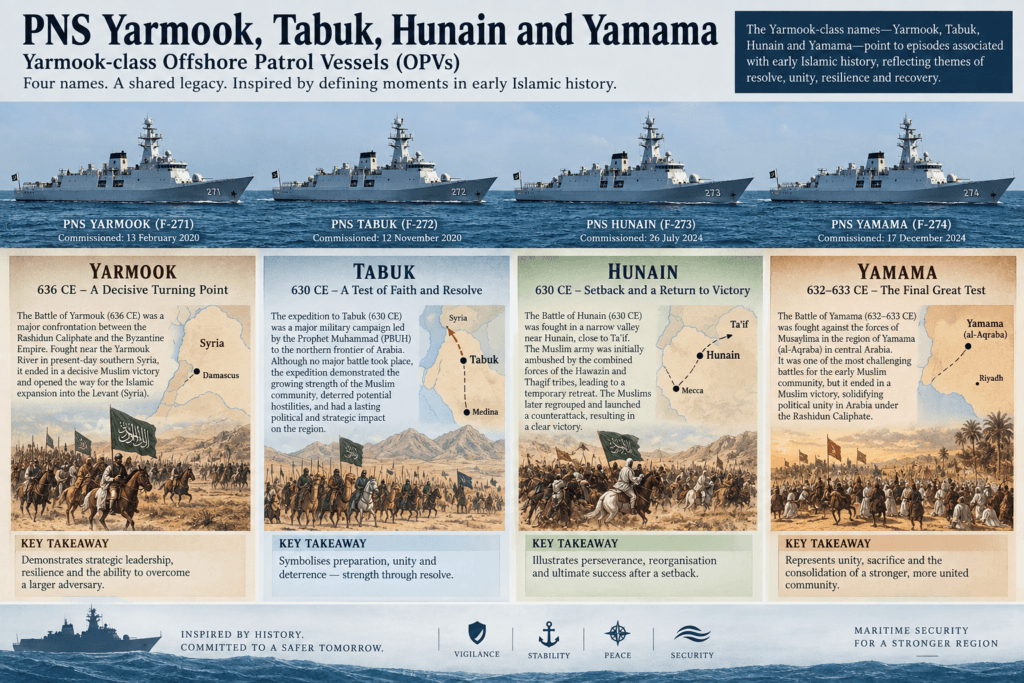
PNS Hunain is part of the Yarmook-class group of Pakistani naval vessels.
The four ships are:
| Ship | Historical reference |
|---|---|
| PNS Yarmook | Battle of Yarmuk |
| PNS Tabuk | Expedition of Tabuk |
| PNS Hunain | Battle of Hunayn |
| PNS Yamama | Battle of Yamama |
The names therefore point toward episodes associated with the early history of Islam.
The name Hunain refers to Hunayn, a valley between Mecca and Ta’if and the site of the Battle of Hunayn in 630 CE.
The battle took place shortly after the conquest of Mecca and involved the forces of Muhammad against a coalition associated with the Hawazin and Thaqif.
For a modern reader, the important point is simple:
PNS Hunain takes its name from an event in seventh-century Arabian history.
The ship itself is a twenty-first-century vessel.
The name is nearly fourteen centuries older.
The Battle of Hunayn: The Seventh-Century History Behind the Name
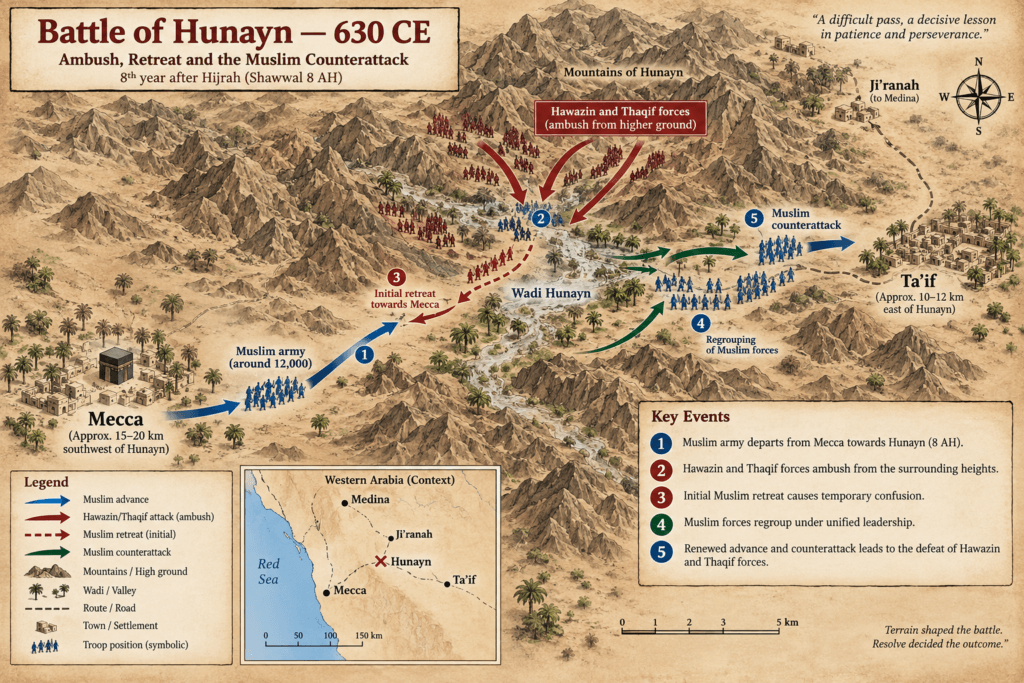
To understand the name, we have to leave the North Arabian Sea of 2026 and travel back to Arabia in 630 CE.
The political landscape of western Arabia was changing rapidly.
Mecca had recently come under Muhammad’s control, and several tribes in the region were confronting a dramatically altered balance of power.
The Hawazin and their allies, including the Thaqif, prepared for confrontation.
The resulting Battle of Hunayn took place in the valley of Hunayn, on the route between Mecca and Ta’if.
Early historical accounts describe an initial period of confusion for Muhammad’s army after entering the valley, followed by a regrouping and eventual victory.
The battle subsequently became an important episode in early Islamic history and is also referenced by name in the Quran.
Modern scholarship also treats Hunayn as one of the major military episodes in accounts of Muhammad’s campaigns, while noting that the surviving traditions require careful historical analysis. Oxford Academic’s treatment of Muhammad’s military expeditions, for example, specifically discusses the Battle of Hunayn and the traditions surrounding it.
This is the historical memory that sits behind the word Hunain on the hull of a modern Pakistani naval vessel.
The name did not originate with the Pakistan Navy.
It came from a battlefield almost fourteen centuries earlier.
PNS Hunain Is Not Alone: The Yarmook-Class Naming Pattern
The most interesting part of the story is that Hunain is only one piece of a larger naming pattern.
Consider the other ships in the class.
PNS Yarmook
The name Yarmook refers to the Battle of Yarmuk, fought in 636 CE between forces of the Rashidun Caliphate and the Byzantine Empire.
The battle took place near the Yarmuk River and became a major turning point in the struggle for control of the Levant.
Modern historical scholarship also cautions that reconstructing the battle in precise detail is difficult because contemporary sources are limited and many surviving accounts were written later.
That makes Yarmuk an interesting example of how a historical event can become much larger in collective memory than the surviving evidence allows us to reconstruct in every detail.
PNS Tabuk
Then there is PNS Tabuk.
This name refers to Tabuk, associated with the Expedition of Tabuk in 630 CE.
There is an important historical distinction here.
It is more accurate to call it the Expedition of Tabuk, rather than simply the “Battle of Tabuk.”
A Muslim army travelled north toward the Byzantine frontier, but no major pitched battle ultimately took place at Tabuk itself.
That distinction matters.
Military history can easily become distorted when every campaign or expedition is described as a battle.
PNS Hunain
PNS Hunain takes its name from the Battle of Hunayn, fought in 630 CE.
The battle followed the conquest of Mecca and became an important episode in the early Islamic historical tradition.
PNS Yamama
The fourth name is Yamama.
The Battle of Yamama occurred in 632 CE during the Ridda Wars, shortly after Muhammad’s death.
The battle was fought in the al-Yamama region of central Arabia and became one of the major confrontations of the early Rashidun period.
Together, the four names create a striking sequence of historical references:
Yarmook. Tabuk. Hunain. Yamama.
Modern vessels.
Ancient names.
Why Does Pakistan's Navy Use Historical Names?
This is where the story becomes broader than one ship.
Military institutions frequently use names to preserve historical memory.
A warship can be named after a person, place, battle, campaign, geographical feature or cultural symbol.
The choice does not necessarily have one single interpretation.
In Pakistan’s naval naming tradition, Islamic history is one important source of historical references, particularly visible in the Yarmook class.
But it would be too simplistic to say that every Pakistani warship is named after an Islamic battle.
Pakistan’s naval fleet contains a mixture of names connected to historical figures, places, battles and other cultural references.
The Yarmook class is simply a particularly clear example of a group of ships carrying names associated with the early Islamic period.
That distinction matters.
A ship’s name can tell us what historical reference was selected by an institution.
It cannot, by itself, tell us what every sailor, officer or citizen thinks about that history.
Pakistan Navy Ship Names: More Than Just Battles
Look beyond the Yarmook class and the picture becomes more complicated.
Names such as Khaibar, Babur, Khalid and Zulfiqar show that Pakistan’s naval naming tradition extends beyond one historical period or one type of reference.
Some names evoke historical figures.
Some recall places.
Some are connected with military history.
Some carry religious or cultural associations.
This is common in military institutions around the world.
India itself has used a wide range of historical references for naval vessels, including names associated with rulers, regions, rivers, cities and earlier Indian maritime traditions.
So the interesting question is not simply:
“Why does Pakistan name ships after battles?”
A better question is:
“Which parts of history does a modern state choose to carry into its military institutions?”
That is a much more revealing historical question.
And it brings us back to India.
The Indian Connection: PNS Khaibar and the 1971 War
One of the most striking examples is the name Khaibar.
The historical name refers to Khaybar, an oasis and region in the Arabian Peninsula associated with an important episode in early Islamic history.
But in India, the name acquired another layer of meaning in the twentieth century.
During the 1971 India-Pakistan War, the Pakistani naval vessel PNS Khaibar was sunk during India’s Operation Trident.
On the night of December 4–5, 1971, Indian Navy missile boats attacked Pakistani naval targets near Karachi.
Indian government material describing Operation Trident records the Indian Navy’s decisive role in the operation, which is commemorated through Indian Navy Day on December 4.
The sinking of PNS Khaibar became one of the most notable episodes associated with the Indian Navy’s operations during the 1971 war.
That creates an unusual historical chain.
The name Khaibar originated in a much older history.
Centuries later, the same name appeared on a Pakistani warship.
And that warship eventually became part of the naval history of India’s 1971 war.
Names survive.
Their meanings can change.
And different countries can attach entirely different memories to the same historical word.
From Hunayn to Khaibar: How History Travels Into Modern Military Institutions
This is perhaps the most fascinating part of the PNS Hunain story.
A modern military vessel is a technological object.
Its radar, propulsion system, weapons, communications equipment and navigation systems belong to the present.
But its name can come from the distant past.
That creates two timelines at once.
The first is technological:
ship → radar → engines → weapons → surveillance → maritime security
The second is historical:
name → battle → memory → identity → historical interpretation
PNS Hunain sits at the intersection of both.
Its physical existence belongs to the twenty-first century.
Its name reaches back to 630 CE.
And when the vessel appears in a modern India-Pakistan dispute, that old name suddenly becomes visible to a completely new audience.
This is exactly how forgotten history sometimes returns.
It does not always return through a history textbook.
Sometimes it returns through the name painted on the side of a ship.
What Does the Name "Hunain" Actually Tell Us?
It is tempting to attach a larger political meaning to the name PNS Hunain, especially when the ship becomes involved in a tense India-Pakistan incident.
But history requires a distinction between what the evidence shows and what we might infer from it.
The evidence allows us to say that Hunain refers to the Battle of Hunayn.
The Yarmook class also contains names associated with other events from early Islamic history.
That tells us something about the historical references selected for these vessels.
But the name alone does not explain the circumstances of the 2026 collision.
Those are separate questions.
The collision is a contemporary maritime incident.
The name is a historical reference.
Connecting the two too directly would turn historical interpretation into speculation.
The more interesting observation is simpler:
A modern state can preserve an ancient historical memory inside a modern military institution.
The 1991 Agreement and the Modern India-Pakistan Maritime Relationship
There is another historical layer much closer to our own time.
In 1991, India and Pakistan concluded an agreement concerning advance notification of military exercises, manoeuvres and troop movements.
One provision specifically addresses naval vessels and submarines operating in international waters.
Article 10 says naval ships and submarines belonging to the two countries are not to come within three nautical miles of each other while operating in international waters, specifically to avoid accidents.
India referred to this provision following the September 2026 collision.
The importance of such a provision is straightforward.
A naval confrontation does not necessarily begin with weapons being fired.
Two military ships operating near one another can create serious risks through speed, course changes, close manoeuvring or misunderstandings.
That is why confidence-building arrangements exist between militaries.
The 2026 incident therefore sits within a much longer history of attempts to manage military encounters between India and Pakistan.
PNS Hunain: A Modern Ship With an Ancient Name
There is a strange symmetry to the entire story.
In 630 CE, armies fought in the valley of Hunayn.
In 2024, a modern Pakistani naval vessel carrying that name entered service.
In 2026, the same vessel became part of a diplomatic dispute after a collision with an Indian Navy warship.
Three completely different moments.
One name connects them.
That is why the PNS Hunain story is more interesting than the collision alone.
The immediate incident will eventually disappear from the daily news cycle.
The ship’s name will remain.
And so will the history behind it.
Frequently Asked Questions
Why is the Pakistani ship called PNS Hunain?
PNS Hunain is named after Hunayn, the site of the Battle of Hunayn in 630 CE, an important episode in early Islamic history.
What is PNS Hunain?
PNS Hunain (F-273) is a Yarmook-class offshore patrol vessel of the Pakistan Navy. It was commissioned in July 2024 and was built by Damen in Romania.
Is PNS Hunain named after a battle?
Yes. The name refers to the Battle of Hunayn, fought in 630 CE.
What was the Battle of Hunayn?
The Battle of Hunayn was fought in 630 CE in the Hunayn valley between Mecca and Ta’if. It involved Muhammad’s forces and a coalition associated with the Hawazin and Thaqif.
What are the Yarmook-class ships?
The four ships are PNS Yarmook, PNS Tabuk, PNS Hunain and PNS Yamama.
Are all Yarmook-class ships named after battles?
Not exactly. Yarmook refers to the Battle of Yarmuk, Hunain to the Battle of Hunayn and Yamama to the Battle of Yamama. Tabuk refers to the Expedition of Tabuk, during which no major pitched battle occurred at Tabuk itself.
What happened to PNS Hunain in September 2026?
PNS Hunain was involved in a collision with an Indian Navy warship in the North Arabian Sea on September 15, 2026. India and Pakistan gave different accounts of the circumstances surrounding the incident.
Was PNS Khaibar sunk by India?
Yes. PNS Khaibar was sunk during India’s Operation Trident in the 1971 India-Pakistan War.
Why is December 4 important to the Indian Navy?
December 4 is celebrated as Indian Navy Day and commemorates the Indian Navy’s role in Operation Trident during the 1971 war.
Conclusion
The next time the name PNS Hunain appears in the news, there is an older story hiding behind it.
Hunain is not simply the name of a modern Pakistani warship.
It points back to a battle fought in Arabia around 630 CE.
Its sister ships take the story further: Yarmook, Tabuk and Yamama all carry historical references connected to the early Islamic period.
Then there is Khaibar, another ancient name that later became attached to a Pakistani warship and entered the naval history of India’s 1971 war.
The 2026 collision is a modern event, and India and Pakistan have presented competing accounts of what happened.
But the history behind the name Hunain is much older.
A warship may be built from steel, engines, electronics and weapons.
But its name can carry centuries of memory.
One modern ship. One ancient battle. Nearly 1,400 years of history between them.
Related Articles
- Hidden Historical Events That Changed the World → HypeHive — Hidden Historical Events
- India-Pakistan Cricket Rivalry → HypeHive — India-Pakistan Cricket Rivalry