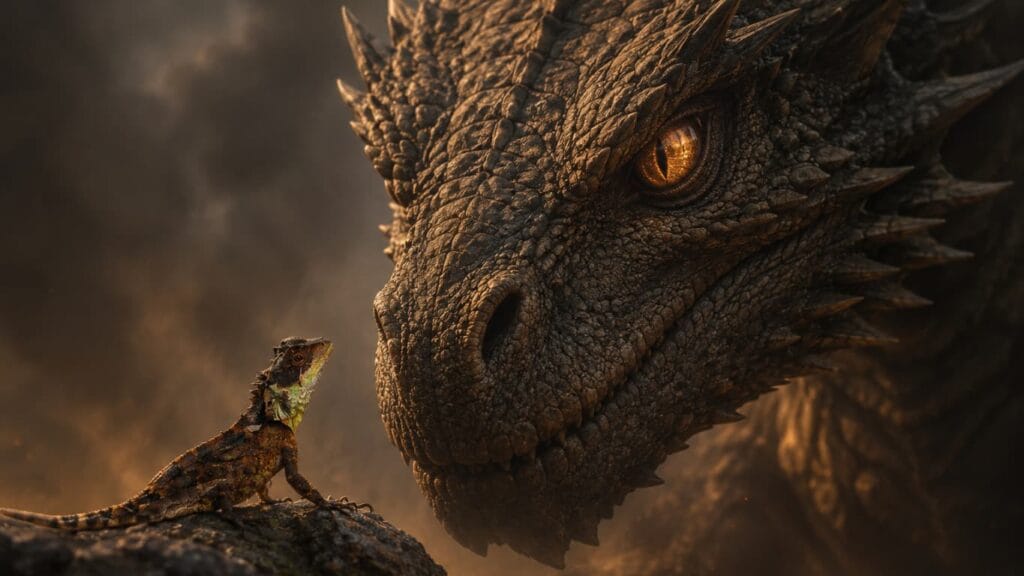
Acanthosaura Syrax: The Real Dragon Named After Syrax from House of the Dragon

Acanthosaura syrax lizard facing a fictional dragon inspired by House of the Dragon

A dragon has just entered the scientific record.

Not a fire-breathing dragon from Westeros. Not a creature with wings large enough to carry a Targaryen queen.

This one is real.

Scientists have formally described a new species of mountain horned lizard from the high-elevation forests of western Thailand and named it Acanthosaura syrax — after Syrax, the dragon ridden by Queen Rhaenyra Targaryen in House of the Dragon.

The discovery was formally published in the open-access journal ZooKeys on 31 July 2026.

At first, the story sounds like little more than a clever pop-culture reference.

But look closer and something much more interesting appears.

This tiny lizard connects modern science, DNA, taxonomy, conservation, mythology and the long human history of dragons.

For thousands of years, humans have imagined dragons.

In 2026, scientists gave one of those dragon names to a real animal.

And that is where the story gets fascinating.

A New Dragon Was Found in Thailand
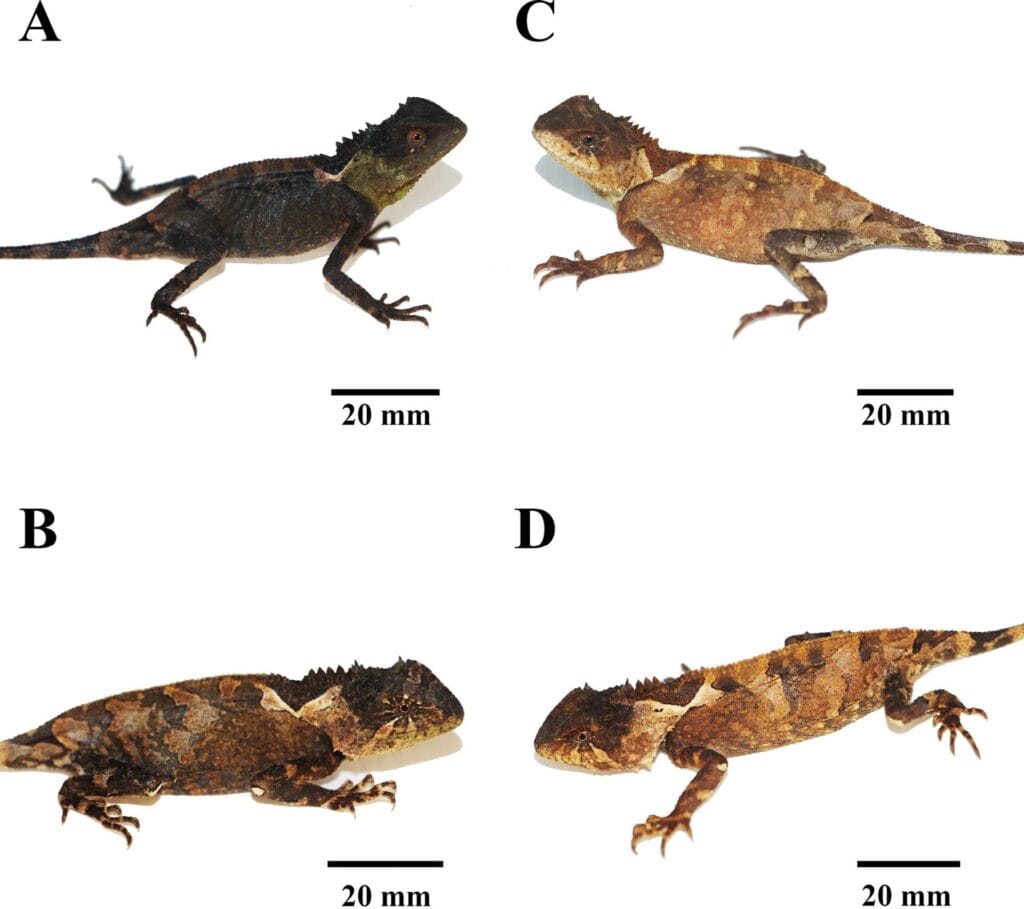
Adult male Acanthosaura syrax holotype from Mae Wong Thailand

The newly described species, Acanthosaura syrax, belongs to a group of reptiles commonly known as mountain horned dragons.

These are real agamid lizards found across parts of Southeast Asia. Their name comes from the distinctive spiny structures and crests that run along their heads, necks and backs.

The new species was found in the high-elevation evergreen forests of Mae Wong National Park in western Thailand, in the Tak–Kamphaeng Phet region.

Researchers recorded the animals at elevations above approximately 1,300 metres, where the species appears to occupy a relatively restricted mountain environment.

The animals themselves were encountered during fieldwork in 2025.

But finding an unfamiliar animal and officially recognizing it as a new species are two very different things.

The scientists needed to demonstrate that these lizards were genuinely different from the other known members of their genus.

That required careful measurements, comparisons and genetic analysis.

How Scientists Knew Acanthosaura Syrax Was a New Species

A new species cannot be established simply because an animal looks unusual.

Taxonomists have to demonstrate that it can be distinguished from related species.

For Acanthosaura syrax, researchers compared a large number of physical characteristics and examined specimens collected from the population.

One particularly striking feature is the size of its crest.

The species has the smallest nuchal and dorsal scales recorded within the genus Acanthosaura. It also differs from related species in body proportions, coloration, crest structure and other morphological characteristics.

The researchers compared it particularly closely with related mountain horned dragons, including Acanthosaura lepidogaster.

But physical appearance was only part of the evidence.

The researchers also turned to DNA.

DNA Confirmed the Dragon Was Different

The research team analyzed two mitochondrial genes, ND2 and COI, to investigate the evolutionary relationship between the new lizard and other Acanthosaura species.

The genetic analysis supported Acanthosaura syrax as a distinct evolutionary lineage.

The researchers reported strong support for the new species in their phylogenetic analyses, while genetic distances between A. syrax and other members of the genus were substantially greater than the variation observed within the new species itself.

That matters because the discovery is not simply:

"Scientists found a lizard that looks different."

It is:

"Scientists found a population that is morphologically and genetically distinct enough to be recognized as its own species."

With this discovery, the number of recognized species in the genus Acanthosaura rises to 23.

The dragon name may have created the headlines.

The science is what made the name official.

What Does Acanthosaura Syrax Look Like?
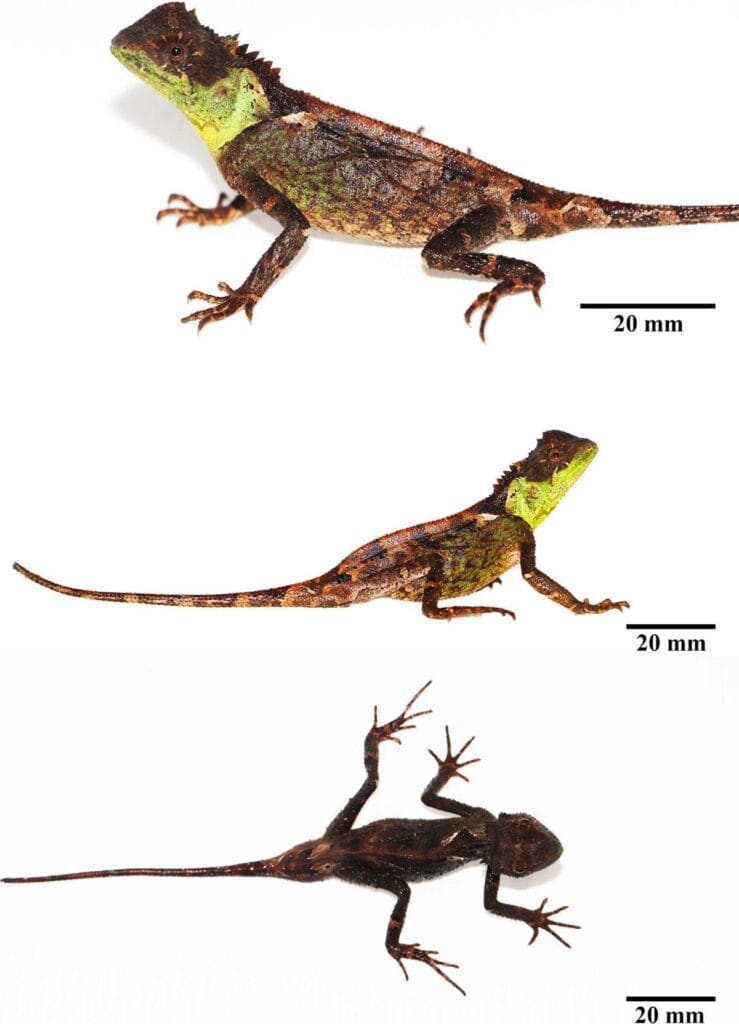
Acanthosaura syrax paratype specimens showing body coloration and crest

The real Syrax is considerably smaller than the dragons of Westeros.

It is a mountain lizard with a compact body and prominent but relatively small crests.

The researchers noted its distinctive coloration and several physical characteristics that separate it from related species.

Its body can display dark brown and yellowish or greenish tones, while some individuals show distinctive markings around the head and neck. The species also lacks the dark eye patch found in several related Acanthosaura species.

Its small size is particularly interesting.

The researchers specifically mentioned its relatively diminutive body size as one of the characteristics reflected in the choice of the name Syrax.

But there was another reason.

Its reproduction.

Why Was the Lizard Named Syrax?

The scientific name is not accidental.

The authors explicitly state that the specific epithet syrax refers to Syrax, the dragon associated with Queen Rhaenyra Targaryen in George R. R. Martin’s fictional universe.

The researchers connected the name with three characteristics of the newly described lizard:

  • its yellow-hued coloration
  • its relatively small size
  • its significant reproductive output

The last point is particularly interesting.

Females were observed producing relatively large clutches, with reported clutch sizes ranging from six to 16 eggs.

The researchers proposed “Syrax mountain horned dragon” as the English common name.

So the connection to House of the Dragon is not merely an internet nickname.

The fictional dragon has become part of the animal’s formal scientific identity:

Acanthosaura syrax

A fantasy name attached to a real evolutionary lineage.

Can Scientists Really Name Animals After Fictional Characters?

Yes.

And this is not as strange as it initially sounds.

Scientific names exist to provide a stable system for identifying organisms. Zoological nomenclature is governed internationally by the International Code of Zoological Nomenclature.

Scientists have historically drawn species names from many sources.

They can refer to:

  • physical characteristics
  • geographical locations
  • people
  • mythology
  • languages
  • historical figures
  • cultural references
  • and, sometimes, fictional characters

The name does not make the species fictional.

The animal has to be scientifically described according to the rules of zoological nomenclature.

In this case, the evidence comes from morphology and genetics.

The researchers then chose syrax as the species epithet.

That distinction is important.

The science established the species. Pop culture inspired the name.

But Dragons Were Here Long Before Westeros

This is where the story moves beyond zoology.

Because House of the Dragon did not invent the dragon.

Humans were talking about dragons thousands of years before Westeros existed.

Ancient cultures across Eurasia developed stories about enormous serpentine or reptilian creatures. In the classical Greek world, the word drakōn was associated with large serpentine creatures and eventually became part of the linguistic history behind the modern English word “dragon.”

Over centuries, dragons changed.

Some became enormous serpents.

Others became winged creatures.

Medieval European traditions increasingly associated dragons with powerful, dangerous beasts.

Asian dragon traditions developed along very different cultural paths, often giving dragons associations with water, weather, rivers, power or good fortune.

The dragon was never one single creature.

It was a changing idea.

And that idea has survived into modern culture.

From Mythology to Science

Here is the fascinating part.

Humans did not just create imaginary dragons.

They also began using dragon-related names for real animals.

The genus Draco contains real gliding lizards of Southeast Asia.

And Acanthosaura already carries the common name mountain horned dragons.

In other words, the boundary between dragons and zoology has existed for much longer than House of the Dragon.

Scientists have repeatedly borrowed language from mythology to describe the natural world.

That makes Acanthosaura syrax part of a much older tradition.

But this particular name adds a modern twist.

Instead of borrowing its name from an ancient mythological dragon, scientists borrowed it from a modern fictional dragon.

And that creates a remarkable loop.

Ancient mythology inspired the idea of dragons.

Modern fantasy reinvented dragons.

Modern science named a real animal after one of those fictional dragons.

Real Animals Have Always Inspired Myths

There is another side to this story.

Sometimes humans look at real animals and create myths around them.

Unusual creatures, enormous animals and animals living in environments people rarely visited could easily become the source of extraordinary stories.

A striking example is the oarfish.

These enormous deep-sea fish have historically been associated with sea-serpent stories because of their extraordinary length and unusual appearance.

HypeHive has explored the mystery surrounding these deep-sea giants in the history of the oarfish and the legends surrounding it.

The pattern is fascinating:

Nature creates something strange.

Humans encounter it.

Stories develop around it.

Science eventually investigates it.

And sometimes the relationship works in the opposite direction.

A fictional creature gives its name to something real.

That is exactly what happened with Acanthosaura syrax.

A New Species Does Not Mean a New Animal

There is an important distinction that often gets lost in headlines.

When scientists announce a “new species,” it does not mean that the species suddenly appeared in 2026.

Acanthosaura syrax has presumably existed in the forests of Thailand for a very long time.

What changed in 2026 was human knowledge.

Scientists formally described and recognized the population as a distinct species.

That difference is fundamental to understanding biodiversity.

There may be organisms living in forests, caves, mountains and oceans today that science has not yet formally described.

The discovery of Acanthosaura syrax is therefore not only a story about one unusual lizard.

It is also a reminder that the natural world remains incompletely documented.

And that brings us to the most important part of the story.

The Real Dragon's Home May Be More Important Than Its Name

The House of the Dragon connection makes the story easy to share.

But the animal’s habitat is what makes the discovery scientifically and environmentally important.

Acanthosaura syrax has so far been associated with a relatively restricted band of high-elevation evergreen forest in Mae Wong National Park.

The researchers believe its known distribution is limited and that its populations may be naturally fragmented by the rugged mountain landscape.

That creates a conservation concern.

Species with restricted distributions can be particularly vulnerable when their habitats are damaged or fragmented.

The researchers therefore called for stronger protection of the high-elevation forests where the species lives.

They also suggested that the new lizard could become a flagship species for conservation in the region, alongside other rare wildlife found in the area.

The irony is striking.

A fictional dragon became famous because it was powerful enough to dominate kingdoms.

The real Syrax may matter because it is small enough to disappear unnoticed.

Why Finding One New Lizard Matters

A newly described species gives scientists a starting point.

Now researchers can ask questions that were previously difficult to frame:

How large is its population?

Is it found beyond Mae Wong National Park?

Are there additional populations in nearby mountain ranges?

How genetically connected are those populations?

What does the species need to survive?

How might habitat changes affect it?

The authors specifically highlight the need for further surveys in neighboring mountain ranges because the species’ known distribution may not represent its complete range.

This is one of the most overlooked aspects of species discovery.

The first scientific paper is often not the end of the story.

It is the beginning.

The Science Behind the Name

The research was conducted by Poramad Trivalairat, Krittiya Trivalairat, Nawee Moungkhaek, Simon Caponov and Benchapol Lorsunyaluck.

Their paper, published in ZooKeys, is titled:

Acanthosaura syrax sp. nov., a new species of mountain horned dragon from high-elevation habitats of western Thailand (Squamata, Agamidae).

The study combines traditional morphological taxonomy with mitochondrial DNA analysis.

The authors examined physical characteristics, compared the new specimens with related species and analyzed ND2 and COI genetic sequences.

The resulting evidence supported the recognition of Acanthosaura syrax as a distinct species.

The complete research paper is available as an open-access publication.

Acanthosaura Syrax Is More Than a Pop-Culture Easter Egg

It would be easy to reduce the entire story to:

“Scientists named a lizard after a House of the Dragon character.”

That headline is true.

But it misses almost everything interesting.

The real story contains:

A new species

DNA evidence

taxonomy

Thailand’s mountain forests

biodiversity

conservation

dragon mythology

modern fantasy

human fascination with unusual animals

the continuing discovery of life on Earth

That is why Acanthosaura syrax is such an unusual historical story.

It begins in the present.

Then it takes us backward.

And finally, it brings us back to the present again.

From Ancient Dragons to Syrax

For thousands of years, humans have imagined creatures that never existed.

Dragons became symbols of fear, power, wisdom, destruction, protection and mystery.

Different civilizations imagined them differently.

Then literature transformed them.

Modern fantasy transformed them again.

George R. R. Martin created an enormous fictional world filled with dragons, dynasties and ancient history.

House of the Dragon brought that world to television.

And in 2026, one of its dragons crossed an unexpected boundary.

Its name entered zoological nomenclature.

Not because scientists believe Syrax existed.

Not because the new lizard resembles a giant fire-breathing reptile.

But because a real animal inspired researchers to make a cultural connection.

That is what makes the story so memorable.

The Strange Circle Between Nature and Imagination

There is something almost poetic about Acanthosaura syrax.

The lizard existed before the name.

The dragon existed before the lizard’s scientific name.

But the fictional dragon existed because humans had been imagining dragons for thousands of years.

Now the chain looks like this:

Nature → mythology → fantasy → science → nature

That is an extraordinary journey for a name.

And it shows how closely human imagination and the natural world have always been connected.

We observe nature.

We give it meaning.

We create stories.

Those stories influence culture.

And sometimes, centuries later, culture finds its way back into science.

The Real Syrax Is Waiting in Thailand

The dragons of Westeros can fly across continents.

The real Syrax cannot.

It lives in a much smaller world — the high mountain forests of western Thailand.

It has no wings.

It does not breathe fire.

It will never carry a queen into battle.

But it has something the dragons of fantasy never had.

It is real.

It is part of an ecosystem.

It has an evolutionary history.

It has a genetic identity.

And now it has an official scientific name.

Acanthosaura syrax.

A small mountain horned dragon from Thailand.

Named after a fictional dragon.

Discovered by science.

And potentially important enough to help protect the forest it calls home.

Final Thought

The discovery of Acanthosaura syrax reminds us that the natural world does not need mythology to be extraordinary.

Sometimes reality is already strange enough.

A tiny lizard living more than a kilometre above sea level in a Thai mountain forest has now become connected to one of television’s most recognizable fictional dragons.

But perhaps the most fascinating part is not that science borrowed a name from fantasy.

It is that the natural world continues to give us reasons to look closer.

There may be no fire-breathing dragons hiding in Thailand’s forests.

But there are still species waiting to be discovered.

And sometimes, one of them comes with a name worthy of Westeros.

The Original Research

The species was formally described by Poramad Trivalairat, Krittiya Trivalairat, Nawee Moungkhaek, Simon Caponov and Benchapol Lorsunyaluck in ZooKeys, Volume 1287, pages 47–76.

Published: 31 July 2026

Species: Acanthosaura syrax sp. nov.

Location: Mae Wong National Park, western Thailand

Genus: Acanthosaura

Common name proposed by researchers: Syrax mountain horned dragon

Primary research: Read the original ZooKeys paper

The research is open access and licensed under Creative Commons Attribution 4.0.

Further Reading

Sources

Primary Research:
Trivalairat P, Trivalairat K, Moungkhaek N, Caponov S & Lorsunyaluck B. Acanthosaura syrax sp. nov., a new species of mountain horned dragon from high-elevation habitats of western Thailand. ZooKeys 1287: 47–76, 2026.

Research Release:
Pensoft Publishers’ release on the discovery and conservation significance of Acanthosaura syrax.

Scientific Data:
The research figures and supplementary material are archived through Zenodo.

Scientific Naming:
International Code of Zoological Nomenclature.

Editorial Note

This article was written from the perspective of History From Present: starting with a current scientific discovery and following its connections backward through taxonomy, mythology, popular culture and the history of human understanding of the natural world.

Scroll to Top