
Why are the Houthis attacking Saudi Arabia? The Houthis say their missile and drone strikes on Saudi Arabia retaliate for Saudi-led air strikes in Yemen, where Riyadh has backed their opponents since 2015. Beneath that war lies an older dispute: the Saudi Arabia–Yemen border, drawn after a 1934 war that gave Saudi Arabia Asir, Jizan and Najran, provinces many Yemenis long claimed.
The Saudi Arabia Yemen border that Houthi missiles crossed on 10 October 2026 was drawn after a war in 1934, and it became “definitive and permanent” only in June 2000.
That Saturday, a missile struck King Khalid International Airport in Riyadh, killing 12 people and wounding 309, according to Saudi figures. It was the third strike on the airport in a week. Saudi Arabia blamed Yemen’s Houthi movement, which claimed responsibility the next day. On 11 October, Saudi Arabia’s civil aviation authority said the Riyadh airport and King Fahd International Airport in Dammam had both been attacked again. As of 14 October, the type of missile used on 10 October had not been publicly confirmed.
Most coverage asks what the Houthis want now, and whether the United States will join Saudi strikes. Fewer ask why this frontier has been fought over, negotiated and fenced for almost a century. The answer runs through a short desert war, a treaty written to expire and a 2000 agreement that finally called the line permanent. It explains a good deal about today’s war, though not everything.
Why are the Houthis attacking Saudi Arabia?
The Houthis, a Zaydi Shia armed movement also called Ansar Allah, have fought a Saudi-led coalition since 2015. Their current wave of strikes on Saudi Arabia grew out of the 2026 US–Israel war on Iran and a collapsed de-escalation between Riyadh and the group.
The escalation has a clear sequence. On 13 July 2026, Yemen’s Saudi-backed government attacked Sanaa airport to stop an aircraft it linked to Iran’s Revolutionary Guard; the Houthis answered with missiles at Saudi Arabia and declared the “de-escalation phase” over. On 20 July, Al Jazeera reported, the Houthis imposed a maritime blockade on Saudi Arabia and struck Saudi Aramco facilities in Jizan and Yanbu.
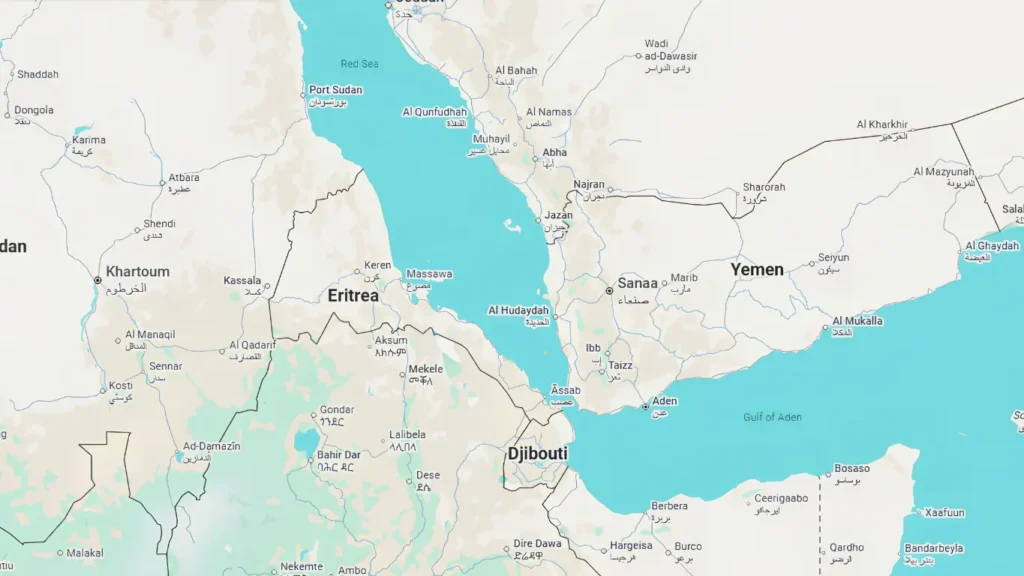
By September, the group had pushed down Yemen’s Red Sea coast. ThePrint’s consulting editor Swasti Rao wrote that Houthi forces reportedly took Mocha and islands at the mouth of the Bab el-Mandeb strait, though not full control of the waterway itself. After the deadly October strike, the Houthis warned airlines and travellers away from every Saudi airport except those serving Mecca and Medina, CNN reported.
The weapons have their own lineage, traced in our history of the Scud-derived missiles the Houthis fire at Riyadh. This article follows the line on the map those missiles cross.
The Saudi Arabia–Yemen border at a glance
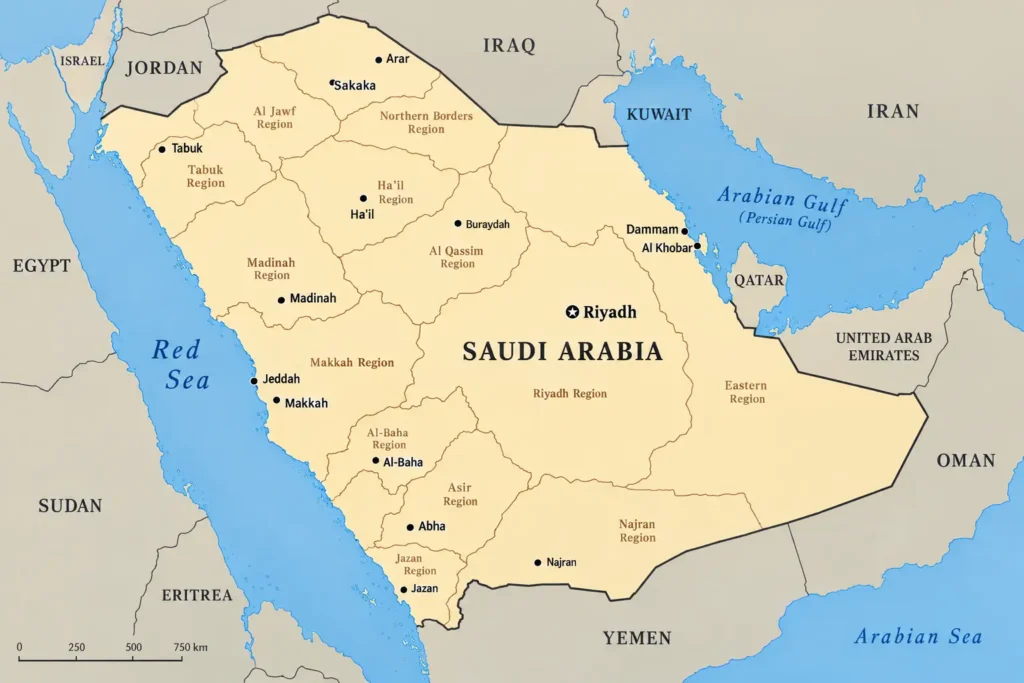
The Saudi Arabia–Yemen border is about 1,307 kilometres long, running from the Red Sea coast in the west to a tripoint with Oman in the east, according to CIA World Factbook figures compiled on Wikipedia. Its western end crosses coastal plain and the Sarawat mountains; its eastern stretch cuts across the Rub’ al-Khali, the Empty Quarter.
Three Saudi provinces sit along the western half of the line: Jizan (also spelt Jazan) on the Red Sea, Asir in the mountains, and Najran further inland. Directly across from all three lies Saada (Sa’dah), the northern Yemeni province where the Houthi movement was born. The Carnegie Endowment’s Eleonora Ardemagni describes this as a militarised borderland of farmland, harsh mountains and desert, where tribes on both sides share family and trade links.
Before the border: Asir and two rival kings

Before the 1930s, no agreed frontier separated the Saudi state from Yemen. The land between them belonged, in practice, to whoever controlled the tribes, the towns and the coast.
Two rulers were expanding into that space. In the north, Abdulaziz Al Saud, known as Ibn Saud, was building the state he would proclaim as the Kingdom of Saudi Arabia in 1932. In the south, Imam Yahya Hamid al-Din (also written Hamid ed-Din) ruled the Mutawakkilite Kingdom of Yemen from Sanaa as head of the Zaydi imamate.
Between them sat the Idrisid Emirate of Asir, a small coastal state on the Red Sea. Richard Schofield, then director of the Geopolitics and International Boundaries Research Centre at SOAS in London, records that a Saudi–Idrisi agreement in 1926 placed Idrisi territory under Saudi protection, and that Ibn Saud formally annexed it in 1930. Imam Yahya had meanwhile pushed up the Tihama coast north of Hodeidah, squeezing the Idrisis from the south.
Asir, Jizan and Najran: “Greater Yemen”
Yemen was never part of the Saudi state. The claim ran the other way. Yemeni rulers regarded Asir, Jizan and Najran as part of a “Greater Yemen”, and the young Saudi kingdom held or claimed the same ground.
Najran, an oasis town on the edge of the desert, was the sharpest point of friction. Schofield’s research shows something easy to miss: the line eventually agreed in 1934 essentially matched the de facto line of control as it stood in 1927. The war that followed did not invent the border. It fixed in place a boundary that force had already sketched.
Who started the war between Yemen and Saudi Arabia?
Both sides moved to war over the winter of 1933–34. Yemen’s forces advanced on Najran in November 1933, and Saudi Arabia formally declared war on Yemen on 20 March 1934, according to the chronology compiled from 1934 press reports and histories on Wikipedia’s account of the Saudi–Yemeni war.
The Saudi campaign moved fast. Ibn Saud sent his son, Crown Prince Saud, to retake highland townships in the Tihama that the Imam had seized. Contemporary reports put the fall of Najran on 21 April 1934 and of the Red Sea port of Hodeidah (Hudaydah) on 4 May.
The advance then stopped short of the Yemeni capital. Asher Orkaby, a historian of modern Yemen, writes for the Washington Institute that the Saudi army could not navigate the mountainous terrain of the north and halted its offensive on Sanaa. Peace talks opened on 12 May 1934. Saudi Arabia dropped an early demand that the Imam abdicate, and the last Saudi troops left Yemen on 7 July.
Saudi Arabia won the war in the sense that mattered most: it kept Asir, Jizan and Najran. Yemen kept its independence, its capital and its coast.
The India connection: Aden in 1934
The war unfolded on the doorstep of British India. Aden, at the southern tip of Yemen, had been a dependency of the Bombay Presidency since 1839. From 1932 it was a Chief Commissioner’s Province under the Viceroy of India, and it left British India only on 1 April 1937, when it became a Crown Colony.
That made the Saudi–Yemeni war partly a British Indian concern. In February 1934, as fighting loomed, Britain and the Imam signed a “treaty of friendship” in which the Imam agreed to stop attacking Aden. When Saudi forces neared Hodeidah in May, the British sloop Penzance evacuated British and Indian residents, along with about 300 other foreigners, to Kamaran Island. Colonial-era boundary questions like this one still shape South Asia too, as India’s own unfinished border lines show.
What the Treaty of Taif actually said
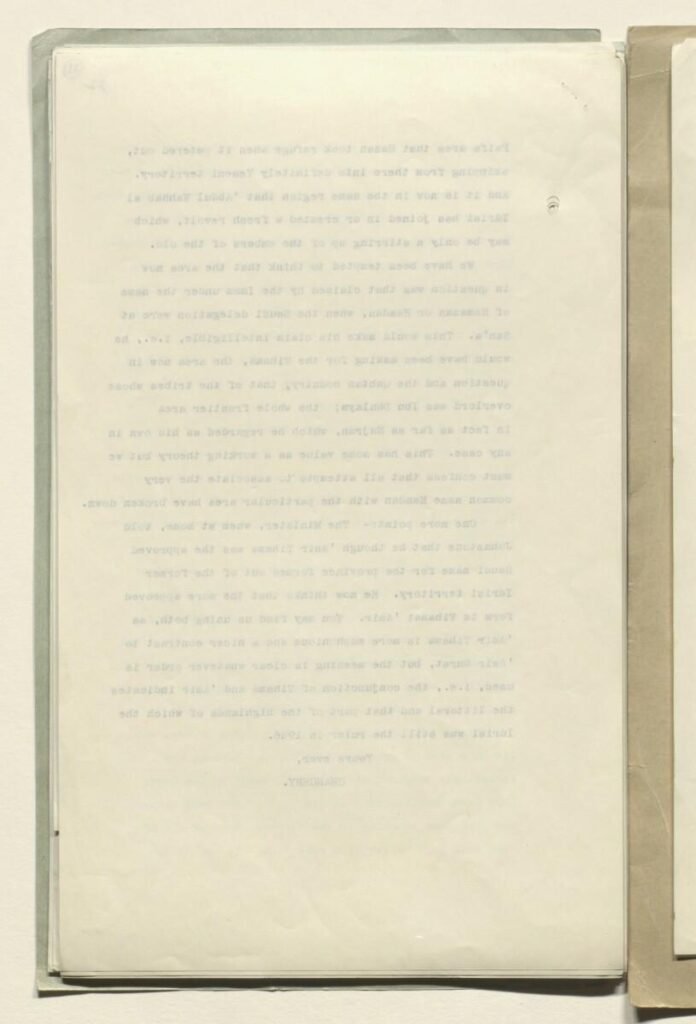
The Treaty of Taif ended the war and fixed the western stretch of the frontier. British diplomatic files now held by the British Library record that it was concluded on 6 Safar 1353 in the Islamic calendar, equivalent to 20 May 1934.
Some sources give 12 May, the day peace talks began, or a June date taken from newspaper reports. The 20 May date comes from the British Legation’s own correspondence from Jeddah.
The English text of the treaty, published by the Yemen-focused site al-Bab, contains 23 articles. Four matter most for the border:
- Article 2: each ruler gave up claims beyond the agreed frontier. Imam Yahya abandoned any right he claimed “in the name of Yemeni unity or otherwise” to the lands formerly held by the Idrisis, to Najran and to the Yam country.
- Article 4: it described the frontier from a point on the Red Sea coast through the mountains, assigned tribes and places to each side, and set up a joint committee to mark the line.
- Article 5: neither side could build fortifications within five kilometres of the frontier.
- Article 22: the treaty was to run for twenty complete lunar years, and could be renewed or amended in the six months before it expired.
Article 22 is the clause most accounts skip, and it explains the next six decades. Twenty lunar years is roughly 19.4 solar years, which put the treaty’s renewal points around 1953 and 1973. A border fixed in a treaty with an expiry clause was, to many Yemenis, a border that could expire.
The “lease” myth
A popular claim holds that Yemen merely leased Asir, Jizan and Najran to Saudi Arabia, and that the provinces were due to return. Schofield calls that reading mistaken: the treaty’s territorial article contains no lease.
Other respected accounts describe Saudi rule over the three provinces as “temporary sovereignty”, renewable every twenty years. Historian Marieke Brandt, cited in Wikipedia’s border article, adds that border tribes received the right to cross without a visa, a concession meant to secure their loyalty to the Saudi state.
The text supports a narrower conclusion than either side of the myth. Article 2 renounced the claims without a time limit, while Article 22 put a time limit on the treaty as a whole. That gap between a permanent renunciation and a temporary treaty is exactly where later Yemeni arguments lived.
Why Yemen never fully accepted the line
Yemen’s governments after 1962 did not formally accept the 1934 border, and the one attempt to settle it in the 1970s was never ratified. The dispute stayed open for most of the century.
In 1962, army officers overthrew the imamate and declared a republic in the north. Orkaby writes that the new republic’s founders declared the Treaty of Taif invalid and vowed to reclaim the three provinces. The PA-X peace agreements database at the University of Edinburgh notes that none of the regimes of the Yemen Arab Republic, as North Yemen became, recognised the treaty.
The nearest thing to a settlement came on 17 March 1973. During a visit to Saudi Arabia, Yemeni Prime Minister Abdullah al-Hajri agreed a joint communique describing the Taif line as “permanent and final”, Schofield records. No Yemeni leader afterwards confirmed or ratified it. A later analysis by John Roberts for Durham University’s International Boundaries Research Unit (IBRU) describes the Yemeni argument that followed: that the Treaty of Taif had lapsed because no second formal extension was secured in 1974.
Two events in 1990 sharpened the issue. North and South Yemen unified in May, reviving nationalist calls to pursue the old claims, and oil exploration pushed companies into land both states considered theirs. Then Yemen opposed the UN resolution authorising force against Iraq, and Saudi Arabia expelled Yemeni workers in large numbers. Orkaby puts the figure at hundreds of thousands; the PA-X database says over one million.
Formal boundary talks began in 1992. They stalled during Yemen’s 1994 civil war, when border skirmishes broke out along the Taif line. On 26 February 1995, the two governments signed a memorandum of understanding in Mecca that, in Schofield’s words, made the Taif treaty fully operative again and committed both sides to demarcation.
The Treaty of Jeddah 2000: the border becomes permanent
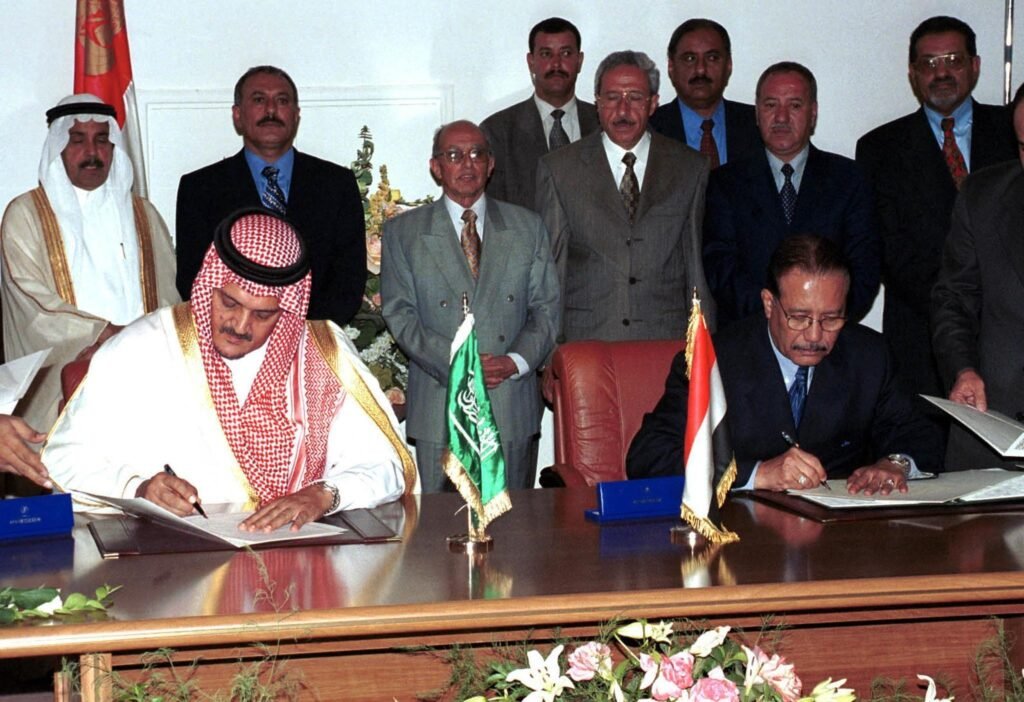
The Treaty of Jeddah, signed on 12 June 2000, closed the legal question. Its first article declares the Treaty of Taif and its annexes “binding and valid”, and its second calls the agreed western line “definitive and permanent”, according to the text held by the United Nations.
The treaty split the frontier into three sections: the old Taif line from the Red Sea to Jabal al-Tha’r, a land stretch east to the Oman tripoint, and a maritime boundary. It also restated the 1934 ban on military positions within five kilometres of the line.
Yemen’s parliament approved the treaty on 24 June 2000. Roberts’s IBRU analysis notes that Yemen did well in the east, where Yemeni newspapers spoke of 35,000 square kilometres “regained”, while Saudi Arabia gained mainly in the west and at sea. More important, by making the Taif line permanently binding, the treaty ended the argument that Yemen’s 1934 cession of Asir and Najran had lapsed. Not everyone accepted it: leaders of the Wa’ila tribe, whose lands straddle the eastern frontier, publicly opposed the border articles.
From Saada to Riyadh: how the border became a front line
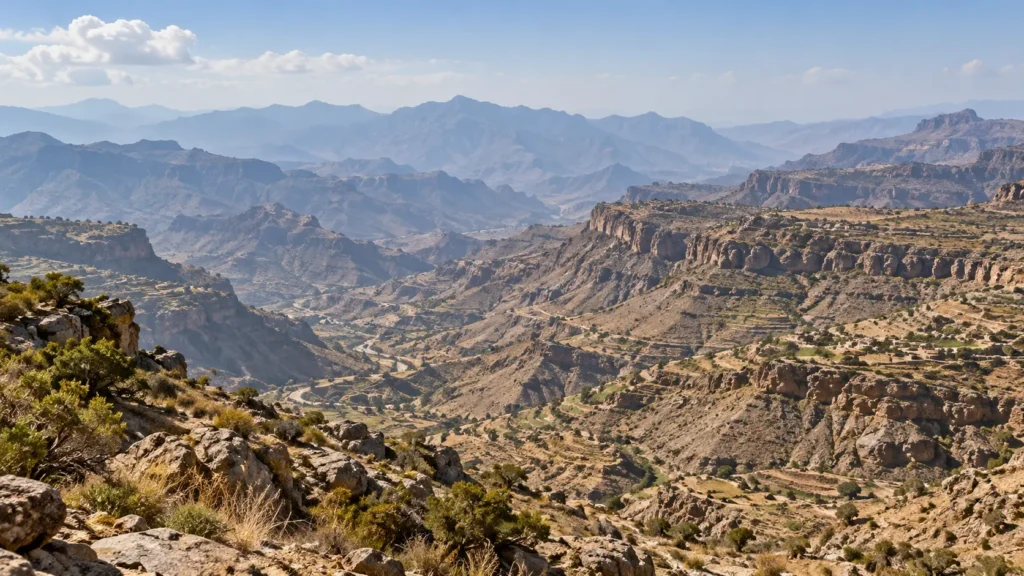
The Houthi movement grew up on the Yemeni side of the Taif line, and the border became its front line long before the 2015 Saudi attack on Yemen. Saada, the movement’s heartland, faces Najran, Asir and Jizan directly.
The movement emerged from a Zaydi religious revival in Saada in the 1990s. Swasti Rao writes that it fought six wars with President Ali Abdullah Saleh’s government between 2004 and 2010. Orkaby lists Saleh’s concessions on the border, and growing Saudi influence over Yemeni politics, among the movement’s key grievances.
Saudi Arabia also began to fortify the line. In September 2003 it started building a barrier along the frontier, citing infiltration and terrorism. Yemen objected that the barrier breached the 2000 treaty, and Saudi Arabia halted construction in February 2004 before resuming work in 2008, according to reports from the BBC and AFP compiled on Wikipedia.
In November 2009 the Houthi wars crossed the border. After Houthi fighters took positions inside Saudi territory, Saudi Arabia bombed them on 4 November and entered the conflict. By 22 December 2009, Saudi authorities reported 73 soldiers killed and 26 missing, according to a tracker kept by the American Enterprise Institute’s Critical Threats project. Orkaby gives a higher figure of more than 130 Saudi personnel killed.
The Houthis seized Sanaa in September 2014. Saudi Arabia led a coalition into Yemen in 2015, and the campaign ran until a truce in 2022. In 2026, the US–Israel war on Iran, and the energy shock it brought to the other chokepoint squeezed by the Iran war, pulled the two sides back into open conflict.
Why can’t Saudi Arabia defeat the Houthis?
No single answer is settled, but geography is part of every serious account. The terrain that, in Orkaby’s account, stopped Saudi troops short of Sanaa in 1934 is the same mountain country the Houthis hold today.
Analysts differ on the rest. Saudi Arabia and the United States accuse Iran of supplying the Houthis with missiles and expertise, a link examined in our profile of Iran’s Quds Force operations in Yemen. Rao argues that Iran did not create the movement and that the “proxy” label overstates Tehran’s control. Both points can hold at once: outside support has extended the Houthis’ reach, while their base remains local.
What the 1934 border explains about 2026, and what it doesn't
The 1934 border explains why this conflict keeps returning to the same provinces, the same mountains and the same grievances. It does not explain the timing or the targets of the 2026 strikes, which follow the Iran war and the collapse of a Saudi–Houthi truce.
The evidence sorts into three groups.
Established by documents: the Treaty of Taif was concluded on 20 May 1934; its Article 2 renounced Yemeni claims to Najran and the former Idrisi lands; its Article 22 limited the treaty to twenty lunar years; and the Treaty of Jeddah of 12 June 2000 declared the Taif treaty binding and the line permanent.
Contested or reported: whether Saudi rule in 1934 amounted to “temporary sovereignty” or outright cession; how many Yemeni workers were expelled in 1990; how many Saudi soldiers died in 2009; how much of the Bab el-Mandeb coast the Houthis now hold; and how far Iran directs Houthi strategy.
Unknown: the missile used on 10 October 2026, and whether the border itself will feature in any future Saudi–Houthi settlement.
Most explainers start this story in 2014 or 2015. Read the 1934 treaty itself, follow it through the 1973 communique, the 1974 “lapse” argument and the 2000 settlement, and the Saudi Arabia–Yemen border looks less like a fixed line than a 66-year negotiation, settled only four years before the Houthi movement’s first war. Borders confirmed on paper can still be contested by people who never signed them, as another colonial-era border that turned violent shows.
Frequently asked questions
Is Yemen still at war with Saudi Arabia?
Yes, in the sense that Saudi Arabia and the Houthis, who control Yemen’s capital and much of the north, have been exchanging strikes since July 2026. Saudi Arabia backs Yemen’s internationally recognised government, which opposes the Houthis.
How long is the Saudi Arabia–Yemen border?
About 1,307 kilometres, from the Red Sea coast to the tripoint with Oman, according to CIA World Factbook figures. Some sources give about 1,800 kilometres.
Is there a wall on the Saudi–Yemen border?
Partly. Saudi Arabia began building a barrier in September 2003, halted it in February 2004 after Yemen objected, and resumed work in 2008.
Who won the 1934 Saudi–Yemeni war?
Saudi Arabia. It captured Najran and Hodeidah, kept Asir, Jizan and Najran under the Treaty of Taif, and withdrew from Hodeidah by July 1934.
Did Yemen used to be part of Saudi Arabia?
No. Yemen was never part of the Saudi state. The dispute ran the other way: Yemeni rulers claimed Asir, Jizan and Najran, which became Saudi territory after the 1934 war.
