
An ordinary summer job turned into an extraordinary historical mystery when an 18-year-old student working on a sewer project in
Dendermonde, Belgium, uncovered a hidden hoard of gold estimated at around €9 million.
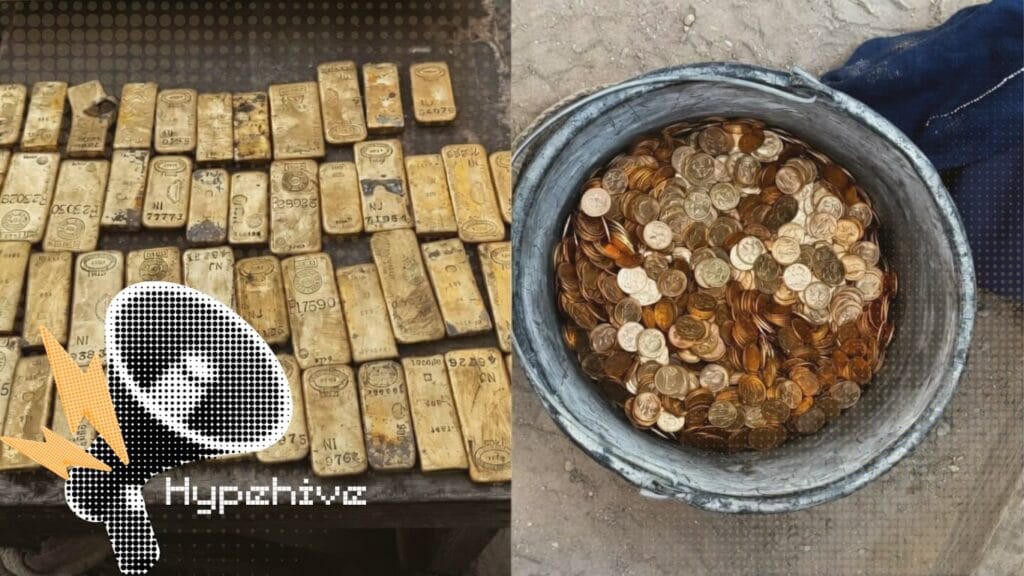
The Belgium gold discovery included gold coins, nuggets and bullion bars concealed inside the cellar area of a former brewery property. The young worker, identified in reports as Kobe, initially thought some of the objects were ordinary €1 coins. Only after finding a gold bar did the scale of the discovery become clear. The treasure was subsequently secured while Belgian authorities began investigating its origin and ownership.
At first glance, this sounds like a spectacular modern treasure story.
But the deeper you look, the more interesting it becomes.
The building was once connected to the Van Assche brewing family, the property dates to around the beginning of the 20th century, and Dendermonde itself has lived through wars, economic upheaval and enormous social change.
So the biggest question is no longer simply how much the gold is worth.
It is:
Who hid it, when was it hidden, and why did nobody find it for decades?
What happened in the Belgium gold discovery?
The discovery took place in Sint-Gillis-Dendermonde, in East Flanders, during construction work connected with a sewer system.
According to reports, workers encountered a concealed section of the former brewery property's cellar and discovered a collection of gold that had apparently been deliberately hidden. The hoard reportedly contained coins, nuggets and numbered bullion bars, with its total value estimated at approximately €9 million.
The discovery was immediately reported rather than taken home.
That decision became important because the legal ownership of the treasure is still unresolved.
Authorities are investigating whether the gold belonged to the former owners of the property, whether it came from another source, and whether there are any criminal or inheritance issues connected with it. The treasure has been moved to secure storage while those questions are examined.
That means the Belgium gold discovery is still, in a very real sense, an unfinished story.
We know where the treasure was found.
We have a strong historical connection to who once owned the property.
But we do not yet know with certainty who put the gold there.
The house behind the mystery
This is where the story moves from breaking news into history.
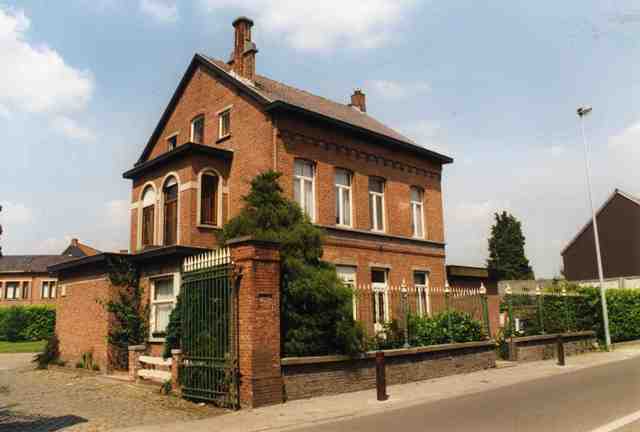
Belgium's official heritage inventory identifies the building at Van Langenhovestraat 20 in Dendermonde as a former brewer's residence, or brouwerswoning.
The heritage record says the house was probably constructed around 1900 or in the early 20th century, before the First World War. It was associated with brewer Theophilus Van Assche, who established his own brewery on the newly laid Van Langenhovestraat in 1899.
Belgium's official heritage record for the Van Assche brewer's house
That detail changes the character of the story.This was not simply an old building.
It was the home of a brewing family whose history was connected to the economic development of the area around the turn of the 20th century.
The cellar where the treasure was discovered therefore sits inside a building that already had a historical identity before anyone knew about the gold.
Who were the Van Assches?
The Van Assche name is central to understanding the mystery, although it is important to distinguish documented history from speculation about the treasure.
The family was associated with brewing in Dendermonde, and the brewery connected with Theophilus Van Assche operated for decades.
Contemporary reporting about the discovery has pointed to the Van Assche family as a possible historical owner of the hoard, while descendants and other potential claimants may have legal interests in the treasure. However, investigators have not established that the family definitely hid the gold.
That distinction matters.
It is tempting to write:
The Van Assche family hid €9 million in gold.
But that is not yet proven.
The historically responsible version is:
The treasure was found in a former Van Assche property, making the family one of the most obvious historical leads in the investigation.
And that leaves us with a fascinating question.
What kind of life could have produced a fortune large enough to hide millions of euros in gold?
Dendermonde was already a city shaped by history
The treasure did not emerge from an ordinary location.
Dendermonde has a long history, but the early 20th century was particularly turbulent.
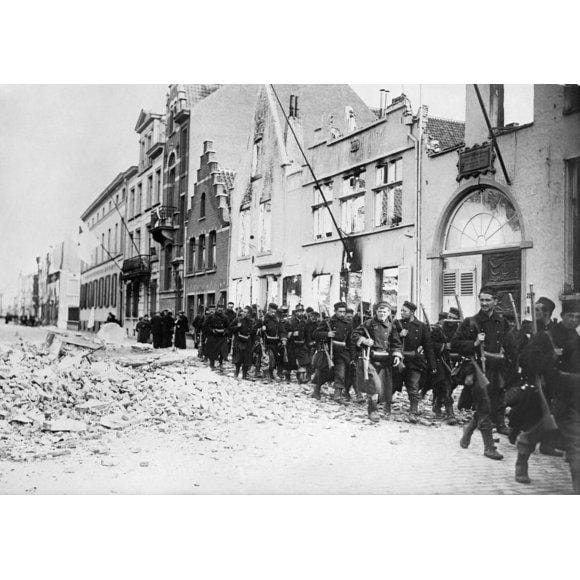
In 1914, during the First World War, Dendermonde suffered severe destruction. The city is officially remembered as one of Belgium's Martyr Cities, because of shelling, fighting and systematic destruction during the German occupation.
The city's own historical records describe how the City Hall was destroyed on September 17, 1914, with only its outer walls surviving. Its belfry spire and 40-carillon bells collapsed, while the city's old archives were destroyed in the fire. The building was later reconstructed between 1920 and 1924.
Dendermonde's official military heritage history
This gives the Belgium gold discovery an important historical backdrop.
A wealthy family had a property in a region that experienced:
industrial growth,
the First World War,
economic disruption,
the interwar period,
the Second World War,
post-war reconstruction,
and decades of social and economic change.
But that does not mean the gold was hidden during either world war.
In fact, newer reporting makes that theory considerably less certain.
Was the gold hidden during a war?
This is one of the most tempting theories surrounding the Belgium gold discovery.
It is also one of the theories we should treat most carefully.
At first, the idea seems logical.
Gold is portable, valuable and relatively easy to conceal. During wars, occupations and financial crises, wealthy people have historically hidden assets rather than keeping everything in banks or publicly visible property.
Belgium itself provides an extraordinary example.
During the Second World War, the National Bank of Belgium evacuated banknotes and reserves abroad, while the Belgian government in exile was partly financed by gold from the National Bank.
National Bank of Belgium — history of the Belgian franc during the wars
The National Bank's own historical material explains how Belgium's monetary system was badly disrupted during both world wars and how gold and financial reserves became strategically important.
So the historical context is real.
But the specific treasure is another matter.
The dates on the gold may change the entire story
One of the most important developments in the investigation is that some of the gold reportedly carries dates from 1957 and 1960.
If those dates are confirmed as dates of manufacture or issue for significant parts of the hoard, they would make it difficult to explain the entire treasure as something hidden during the First or Second World War.
That doesn't solve the mystery.
It simply moves the possible timeline forward.
The treasure could have been accumulated after the Second World War.
It could have belonged to a wealthy individual or family.
It could have been stored for investment.
It could have been deliberately concealed for personal reasons.
Or different parts of the hoard could have been assembled at different times.
At this stage, the evidence does not justify choosing one explanation.
And that uncertainty is precisely what makes the Belgium gold discovery worth following.
Why would someone hide millions in gold?
To understand the mystery, it helps to understand why gold has historically been treated differently from ordinary money.
A banknote represents a claim on a monetary system.
Gold is a physical asset.
It can be stored privately, transported and preserved for generations.
For centuries, families have treated precious metals as a form of wealth that could survive political instability, currency changes and financial crises.
Belgium's own monetary history demonstrates how dramatically ordinary money could change during periods of upheaval.
The National Bank of Belgium notes that during the First World War, convertibility of banknotes into gold or silver was suspended. People began keeping coins at home, while new emergency forms of money appeared. During the Second World War, the German mark was imposed alongside the Belgian franc and the economy was subjected to severe disruption.
That historical reality helps explain why physical gold could be attractive.
But it still doesn't answer the central question:
Why hide it inside a wall?
The cellar may be more important than the gold
The most fascinating part of the Belgium gold discovery may ultimately be the architecture.
The treasure was found inside a property whose history can be traced to the Van Assche brewery.
The official heritage record identifies the building as a brewer's residence dating from around 1900 or the beginning of the 20th century.
A hidden compartment in such a building raises several possibilities.
Perhaps the space was deliberately constructed as a hiding place.
Perhaps an existing cellar was modified later.
Perhaps the treasure was placed there by a member of the family.
Perhaps a later owner discovered the opportunity and used it.
Or perhaps someone who had no obvious connection with the brewery chose the building because they believed the location was secure.
Until investigators establish when the hiding place was created and when the gold entered it, all of these remain possibilities.
The brewery connection gives us another historical clue
The Van Assche brewery reportedly remained active until 1970, meaning the site was associated with brewing for roughly seven decades after its establishment in 1899.
That is an unusually long period for one property to remain connected to a single family business.
Imagine the number of people who could have entered those buildings over that time:
Brewers.
Workers.
Family members.
Suppliers.
Tradespeople.
Customers.
Household staff.
Contractors.
Successive owners.
Yet the gold remained hidden.
That raises another possibility that is easy to overlook.
Perhaps the person who hid the treasure did not expect anyone to find it again.
Could the treasure have been forgotten?
This is perhaps the simplest explanation.
History contains countless examples of money, jewellery and valuables being hidden and later forgotten.
The reasons can be mundane.
A person may die without telling anyone.
A family may become divided.
Property may change hands.
A hiding place may disappear behind renovations.
A generation may know that something exists without knowing exactly where.
Eventually, the people who knew the secret disappear.
The object remains.
The Belgium gold discovery could therefore represent something more ordinary — and in some ways more fascinating — than a wartime conspiracy.
It could simply be wealth that lost its story.
The treasure is not necessarily “€9 million in cash”
Another important distinction is the valuation itself.
The widely reported figure of around €9 million is an estimated value of the discovered gold, rather than €9 million in modern currency notes.
The hoard reportedly contains different forms of gold, including coins, nuggets and bullion bars.
That matters because the individual pieces may contain their own clues.
Coins can sometimes reveal:
approximate dates,
issuing countries,
political rulers,
monetary systems,
circulation patterns,
and periods when they were produced.
Bullion can potentially reveal:
refiner marks,
serial numbers,
manufacturing dates,
purity,
ownership records,
or links to financial institutions.
In other words, the gold itself may become historical evidence.
The investigators don't simply need to know what the treasure is worth.
They need to know where each piece came from.
What happens to the gold now?
The legal question may become almost as complicated as the historical one.
The treasure was handed over to authorities rather than being treated as a private find. Reports say the ownership process could involve the present property owner, potential descendants of former owners and the people who discovered the hoard.
The exact legal outcome will depend on Belgian law and the findings of the investigation.
That means the story is not finished.
If investigators identify a legitimate historical owner, the Belgium gold discovery could eventually become an inheritance story.
If nobody can establish ownership, the legal consequences could be very different.
And if investigators discover evidence that the gold came from another source, the story could take an entirely new direction.
What we know — and what we don't
At this point, the evidence allows us to separate the mystery into two columns.
What we know
An 18-year-old student discovered a large quantity of gold while working on sewer-related construction in Sint-Gillis-Dendermonde.
The hoard has been valued at roughly €9 million.
It reportedly contains coins, nuggets and bullion bars.
The treasure was found inside a former brewery property.
The property is historically associated with brewer Theophilus Van Assche.
The house itself dates to around 1900 or the early 20th century.
Authorities are investigating the treasure's origin and ownership.
Some reported pieces of the gold date to 1957 and 1960, complicating theories that the entire hoard was hidden during the world wars.
What we don't know
Who actually hid the gold?
Exactly when was it hidden?
Was the entire hoard assembled at the same time?
Why was it concealed?
Was it connected to the Van Assche family?
Was any of it stolen?
Why was it never recovered?
Who will legally own it?
Those unanswered questions are the heart of the story
The bigger history behind one hidden fortune
The most fascinating lesson from the Belgium gold discovery is that treasure does not exist outside history.
A gold bar can look like a simple object.
But behind it may be a family.
Behind that family may be a business.
Behind that business may be a town.
And behind that town may be wars, economic crises, changing currencies and generations of people whose lives have disappeared from living memory.
The gold found beneath the former brewery is therefore more than a €9 million curiosity.
It is a physical clue to a past that may have been deliberately hidden.
And Dendermonde is an especially fitting place for such a mystery.
The city still carries visible evidence of the destruction it suffered in 1914. Its archives were destroyed, its historic buildings were damaged and its streets were transformed by war.
Yet the Van Assche house survived.
And somewhere beneath that surviving structure, a fortune remained hidden long after the people who may have known about it were gone.
The Belgium gold discovery may be only the beginning
For now, the €9 million treasure remains an unresolved historical mystery.
The most exciting evidence may still be waiting to emerge from the objects themselves.
A coin may reveal a date.
A bullion bar may reveal a serial number.
A family document may reveal an inheritance.
An old photograph may identify a hiding place.
Or investigators may discover that the treasure has a completely different origin from the one historians currently suspect.
That is why this story deserves to be followed beyond the initial headlines.
The young worker who found the gold may have uncovered something far more valuable than a fortune.
He may have opened a forgotten chapter in the history of a Belgian family, a brewery and a city that has already survived more than a century of dramatic change.
For now, the central mystery remains:
Who hid millions in gold beneath an old Belgian brewery — and why did history forget where it was?
A discovery that connects the present to the past
The strangest thing about historical discoveries is that they rarely arrive looking like history.
Sometimes history is found in an ancient ruin.
Sometimes it appears in a battlefield.
And sometimes, as the Belgium gold discovery has shown, it is found when an 18-year-old student is simply doing a summer job and digging a trench for a sewer.
The gold may eventually find a legal owner.
Its historical owner may eventually be identified.
But until that happens, the treasure remains something even more interesting than money:
a mystery buried inside a building with a history of its own.
Related HypeHive stories
If you're interested in discoveries and forgotten chapters of history, explore:
1.Top 10 Hidden Historical Events That Changed the World
2.Oldest Evidence of Life on Earth
3.Oil Fields in India: Balia Discovery 2025
4.History of the Russia-Ukraine War
1.The Guardian — Belgian student discovers €9 million gold hoard
2.National Bank of Belgium — Belgian monetary history during the world wars
3.Belgian Heritage Inventory — Van Assche brewer's house
4.Visit Dendermonde — Military heritage and the First World War
Editorial note: The treasure's origin and ownership remain under investigation. Claims connecting the hoard specifically to the Van Assche family or to either world war should therefore be treated as possibilities, not established facts.