
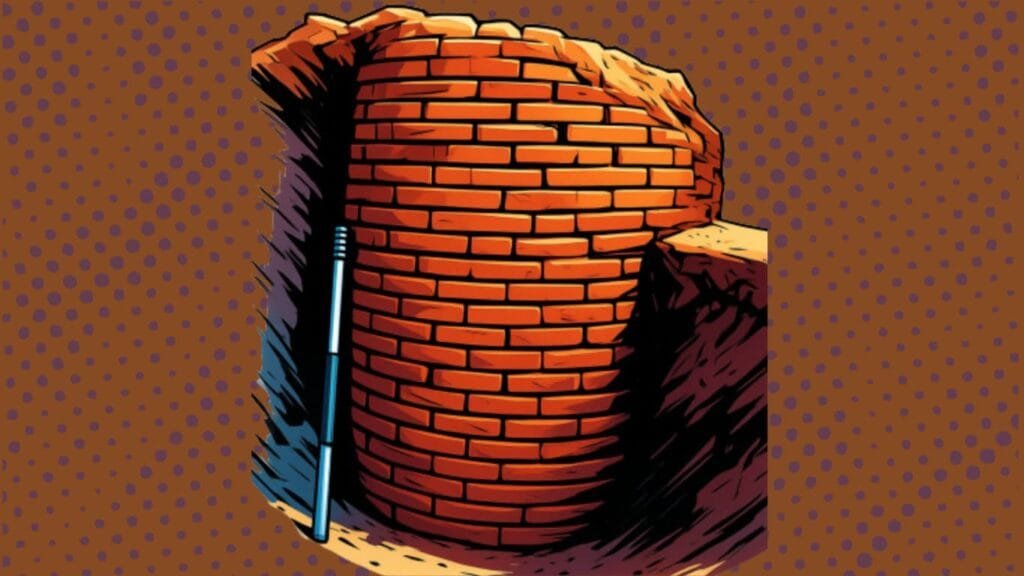
A strange circular brick structure has appeared beneath the soil at Govishan Mound in Kashipur, Uttarakhand.
At first glance, it sounds like another archaeological discovery from India’s Gupta period. But the more interesting story is not the possible well-like structure itself.
It is what may be underneath it.
Archaeologists have been digging at the site again since July 2026, and the latest excavation has exposed brick structures along with a circular formation that resembles a well. Archaeologists have deliberately avoided assigning it a definite date because no recovered object has yet conclusively tied the structure to a particular period. Further excavation and analysis of soil layers, construction techniques, pottery, coins or inscriptions will be needed.
That caution matters.
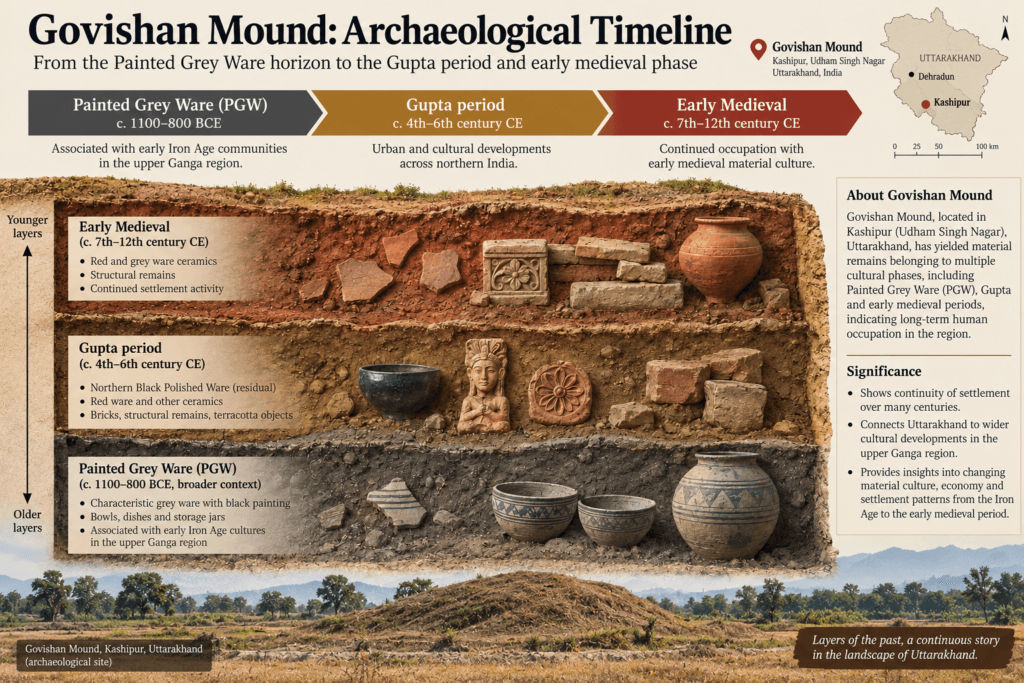
Because Govishan Mound may not represent one ancient city from one period at all. Earlier archaeological work suggests that the site preserves evidence stretching from the Painted Grey Ware period to the early medieval period.
In other words, beneath modern Kashipur may be a much longer story than the Gupta-era remains currently making headlines.
What archaeologists just found at Govishan Mound
The Archaeological Survey of India began the latest excavation at Govishan Mound on 16 July 2026.
The excavation has exposed sections of ancient brick construction and a circular structure that appears similar to a well. Reports based on preliminary observations have suggested a possible Kushan or Gupta-period date, but the archaeologists themselves have stressed that this is not yet a confirmed dating.
That distinction is important.
A structure can look Gupta because of its bricks, masonry technique or construction style. But archaeologists normally need a wider body of evidence before attaching a firm date to it.
As ASI Dehradun’s superintending archaeologist M.C. Joshi explained in the current reporting, the material recovered so far does not include a specific artefact that conclusively connects the exposed structures to a particular era. Future pottery, coins, inscriptions, construction analysis and stratigraphy could change that picture.
The excavation has also been temporarily affected by the monsoon. According to the latest report, work is expected to resume around October, weather permitting.
So the most responsible description right now is simple:
Govishan Mound has produced promising structures, but archaeologists have not yet solved their date or function.
And that uncertainty is exactly what makes the site interesting.
The mound is older than the Gupta-period story
The biggest clue comes not from the excavation happening today, but from excavations carried out decades ago.
The Kashipur Master Plan 2041, a government planning document, records the archaeological history of Govishana Mound at Drona Sagar.
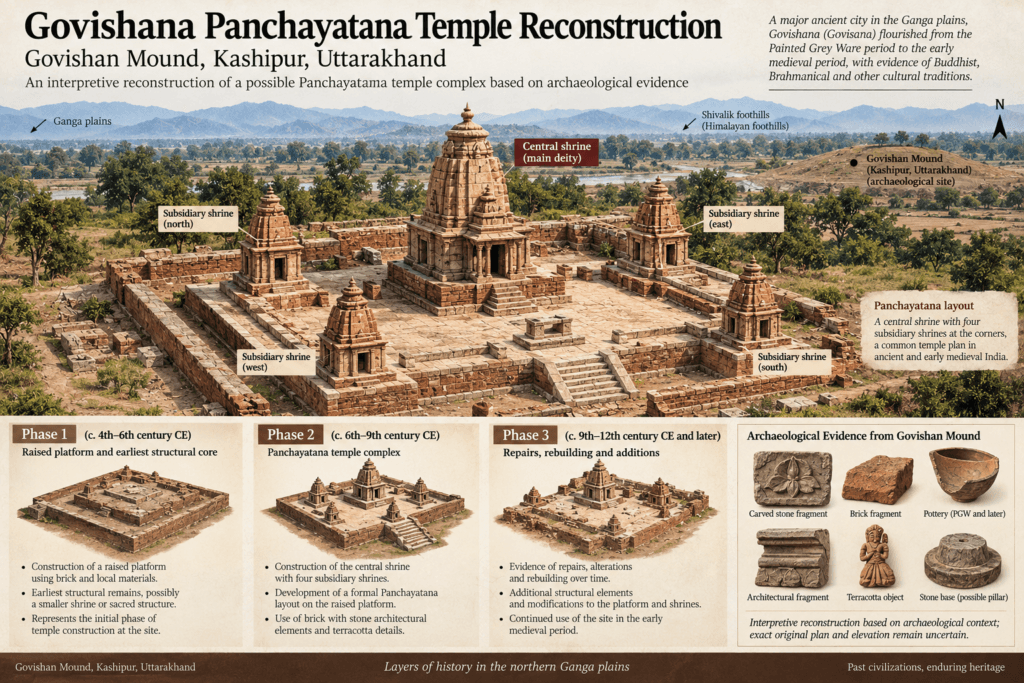
It says earlier excavation revealed a substantial temple complex built in several phases. The earliest structure appears to have been a high brick platform, possibly supporting a sanctum, associated with the Gupta period.
Later, two encircling walls were added, probably during the sixth or seventh centuries CE, eventually creating an extensive Panchayatana complex.
But here is the detail that changes the story.
The earlier excavation was primarily intended to understand the temple’s architectural plan.
It was not designed to expose the complete cultural sequence of the site.
Yet the pottery collected from the mound indicated occupation from the Painted Grey Ware period through the early medieval period. The excavation debris also contained copper coins, copper and glass bangles, copper rings, terracotta objects, stone beads, nails and chisels belonging to different periods.
That means the Gupta temple may have been only one chapter.
The mound itself appears to have had a much longer archaeological life.
What is Painted Grey Ware doing at Kashipur?
Painted Grey Ware, usually abbreviated as PGW, is one of the important archaeological ceramic traditions of northern India.
Its presence at Govishan Mound is significant because it pushes the site’s archaeological story substantially further back than the Gupta period.
It does not, by itself, prove that the entire settlement was continuously occupied in exactly the same form for centuries.
Archaeology rarely works that neatly.
A mound can contain layers representing different communities, structures and periods, separated by changes in settlement intensity, architecture and material culture.
But the PGW evidence tells us something important:
the history buried at Govishan Mound did not begin with the Gupta temple.
The Gupta-period structures may simply be the part of the ancient settlement that earlier archaeologists were able to expose most clearly.
This is one reason the 2026 excavation matters.
If archaeologists can reach deeper, undisturbed layers, they may be able to build the cultural sequence that earlier excavations deliberately did not attempt to recover.
That would transform Govishan from a temple-site story into a much broader settlement history.
Why did an ancient settlement rise here?
Modern Kashipur sits in the Uttarakhand plains, close to the transition between the Himalayan foothills and the northern Indian plains.
That geography matters.
Ancient settlements did not appear randomly. Access to water, agricultural land, movement corridors and connections between different ecological zones could all influence where communities grew.
Xuanzang’s seventh-century account gives us an intriguing glimpse of Govishana’s landscape.
But first we need to understand how we know that Govishana and the archaeological remains around Kashipur are connected.
The Kashipur government planning document records the identification made by Alexander Cunningham between the ancient name Govishana and the place associated with Kashipur. Cunningham linked the remains at Bhim-Gaja with the ancient city described in Xuanzang’s account.
The identification is therefore not simply a modern nickname invented for the mound.
It comes from a long history of archaeological and historical interpretation.
Xuanzang saw Govishana when it was still alive

This is where the story becomes much more remarkable.
The Chinese Buddhist monk Xuanzang, who travelled through India during the seventh century, recorded a country called Kiu-pi-shwang-na, identified in the translation as Govishana.
His account describes a substantial kingdom with a capital surrounded by a landscape of groves and ponds.
He also describes religious diversity.
According to the translated account, Govishana had two Buddhist monasteries with about 100 monks, as well as around 30 temples associated with different sectarian traditions. Near the chief town he describes an older monastery containing a stupa attributed to King Ashoka.
These details should be treated as a historical travel account, not as an archaeological inventory.
Xuanzang was describing what he saw and what he was told in the seventh century. Archaeology, meanwhile, deals with physical remains.
But when the two kinds of evidence are placed beside each other, something interesting happens.
The archaeological mound contains evidence of substantial religious architecture.
Xuanzang describes a landscape containing monasteries and numerous temples.
The two sources are separated by centuries and operate differently, but together they help explain why Govishana was more than an isolated temple.
Xuanzang’s account of Govishana — translated Buddhist Records of the Western World
Govishan was not just a temple
The archaeological remains at Govishan Mound are particularly interesting because of their architectural development.
According to the government master plan, the earliest identified temple phase involved a raised brick platform that may have supported a sanctum.
The complex was later expanded with additional walls, eventually becoming a Panchayatana temple complex.
A Panchayatana arrangement is a temple plan in which a principal shrine is accompanied by four subsidiary shrines.
That architectural development suggests that the site was not static.
It changed.
It was rebuilt, expanded and monumentalised.
And that is exactly the kind of evidence that can tell historians more than a single artefact ever could.
A coin can tell you something about circulation.
A pottery fragment can tell you about chronology and material culture.
But architecture can reveal how people reorganised sacred space over time.
The Govishan mound contains evidence of precisely that kind of transformation.
A forgotten city surrounded by ponds?
Xuanzang’s description of Govishana is striking for another reason.
He describes flowers, groves and lakes or ponds appearing around the settlement.
That does not prove that every water body visible today corresponds to Xuanzang’s description.
But it does give us a useful historical image of the landscape around the ancient settlement.
The archaeological evidence also suggests that Govishan was not simply an isolated religious monument.
The material recovered from the temple debris included coins, ornaments, beads, terracotta objects and tools.
These objects represent ordinary archaeological traces of activity around monumental architecture.
They are small clues, but together they can help reconstruct the people who lived around the monument rather than just the monument itself.
That distinction matters.
Ancient history is often told through kings and temples.
Archaeology can sometimes tell a different story — one involving people who made pottery, wore bangles, handled coins, used tools and lived around the structures that survive today only as buried walls.
Was Govishan the city of the Kunindas?
This is where caution becomes especially important.
Modern descriptions of Govishan sometimes connect the site strongly with the Kuninda kingdom and describe it as a major Kuninda centre.
That possibility is worth investigating, but it should not be presented as settled archaeological fact without stronger evidence directly tying the mound to a specific Kuninda political centre.
The archaeological evidence currently gives us something safer:
There was occupation over a long period.
There were later monumental structures.
There was a significant settlement associated with the name Govishana in the historical record.
And the exact political identities of every phase remain a subject for further research.
That is actually more interesting than forcing the mound into a single dynasty.
The 2026 excavation may eventually provide evidence that changes the chronology.
Drona's Fort: archaeology or legend?
Walk around the history of Kashipur and another name quickly appears:
Drona.
The mound is locally associated with Drona Sagar and is sometimes described as the remains of Drona’s fort from the Mahabharata tradition.
This is an important part of the cultural history of the region.
But it is not the same thing as archaeological proof.
There is currently no archaeological basis for stating that the exposed brick structures are definitively the fort of Dronacharya described in the Mahabharata.
This distinction is worth preserving because the site is already fascinating without turning legend into evidence.
The archaeological record gives us ancient occupation, brick structures, temple architecture, pottery and artefacts.
The literary and local traditions provide another layer of memory.
They should be placed side by side — not confused with one another.
That is one of the biggest opportunities for a better Govishan story.
What happened to ancient Govishana?
This may be the biggest unanswered question.
We know that the archaeological record extends into the early medieval period.
We know Xuanzang encountered Govishana as an established settlement in the seventh century.
We know that substantial religious architecture developed there.
But there is no simple, securely documented explanation that tells us:
“This is the exact event that caused Govishana to disappear.”
There is no need to invent one.
There may have been changes in political power, settlement patterns, religious importance, environmental conditions, economic networks or the location of later habitation.
But the evidence currently available does not justify choosing one explanation as fact.
And this is precisely the kind of question that deeper stratigraphic excavation can help answer.
Why the 2026 excavation could change the story
The most important thing about the current excavation may not be the circular structure.
It may be the possibility of reconstructing the layers beneath it.
Previous archaeological work concentrated heavily on revealing the temple’s architectural plan. The government master plan explicitly notes that the complete cultural sequence was not exposed during those excavations.
The new excavation therefore has an opportunity to ask a different question:
What existed here before, between and after the monumental structures we already know about?
If deeper layers contain securely datable pottery, coins, inscriptions or other diagnostic material, archaeologists could potentially establish a much clearer sequence.
The current circular structure is therefore interesting not because it has already solved Govishan’s history.
It has done the opposite.
It has opened another question.
What could archaeologists find next?
When excavation resumes, several discoveries would be particularly important.
1. Diagnostic pottery
Pottery can help establish chronological layers and identify changes in occupation.
2. Coins
Coins can provide evidence for chronology, economic activity and political connections, although a coin’s presence does not automatically prove that the issuing ruler controlled the site.
3. Inscriptions
An inscription would potentially be among the most valuable discoveries because it could provide names, titles, religious affiliations, donations or dates.
4. Earlier architectural layers
The biggest discovery may be something much less spectacular than a treasure: an earlier wall beneath the known structures.
That could help archaeologists understand how the settlement developed.
5. Undisturbed stratigraphy
This may be the most important of all.
A sequence of archaeological layers preserved in context can tell a story that individual artefacts cannot.
And that is what Govishan has been missing from its popular narrative.
Govishan Mound is not a buried Gupta secret
The easiest version of this story is:
“Gupta-era well discovered in Kashipur.”
It is also the least interesting version.
The deeper story is that Govishan Mound appears to preserve a long archaeological sequence, from Painted Grey Ware occupation through later monumental architecture and into the historical Govishana encountered by Xuanzang.
The Gupta-period temple is one chapter.
Xuanzang’s Govishana is another.
The local Drona tradition is another.
And the 2026 excavation is opening a new chapter in the archaeological investigation.
That makes Govishan part of a much larger pattern visible across India: settlements disappear from everyday memory while their physical layers remain underground.
A similar process can be seen at other archaeological sites featured by HypeHive, including the story of Lakkundi — the forgotten city rediscovered through archaeology and Poompuhar — the ancient port whose story lies beneath the landscape and sea.
Govishan is different.
It is not simply a city that vanished.
It is a site where different periods appear to have accumulated on top of one another.
And archaeologists are now beginning to dig through those layers again.
The real mystery is still underground
For now, the circular brick structure remains exactly that: a structure whose purpose and date have not been conclusively established.
It may prove to be a well.
It may reveal something about water management.
It may belong to the Gupta or Kushan period.
Or future excavation may complicate the picture.
That uncertainty should not weaken the story.
It is the story.
Because the most fascinating question at Govishan Mound is no longer simply “What did archaeologists find?”
It is:
How many different Govishanas are buried beneath the same mound?
The answer may require going much deeper than the Gupta walls already exposed.
And when excavation resumes, Kashipur may discover that the ancient city beneath it has a much longer memory than anyone expected.
Frequently Asked Questions
What is Govishan Mound?
Govishan Mound is an archaeological site at Drona Sagar near Kashipur, Uttarakhand, associated by archaeological and historical scholarship with ancient Govishana. Earlier excavations revealed substantial temple remains and evidence of occupation extending from the Painted Grey Ware period to the early medieval period.
Where is ancient Govishana located?
Ancient Govishana has been identified with the archaeological remains around the present-day Kashipur area, particularly the Govishana Mound near Drona Sagar. This identification is associated with Alexander Cunningham’s interpretation of Xuanzang’s description.
What did Xuanzang say about Govishana?
Xuanzang described Govishana as a substantial kingdom with a capital, ponds and groves, two Buddhist monasteries and around 30 temples associated with different sectarian traditions. His account also mentions a large stupa attributed to Ashoka.
What was found at Govishan Mound?
Earlier excavations uncovered temple structures, pottery, copper coins, bangles, rings, beads, terracotta objects and metal tools. The 2026 excavation has exposed additional brick structures and a circular structure resembling a well, although its date and exact function remain unconfirmed.
Is Govishan Mound connected to the Mahabharata?
The site is associated in local tradition with Drona and Drona Sagar, but the archaeological evidence does not establish that the mound is definitively the fort of Dronacharya. The Mahabharata connection should therefore be treated as tradition rather than established archaeological fact.