
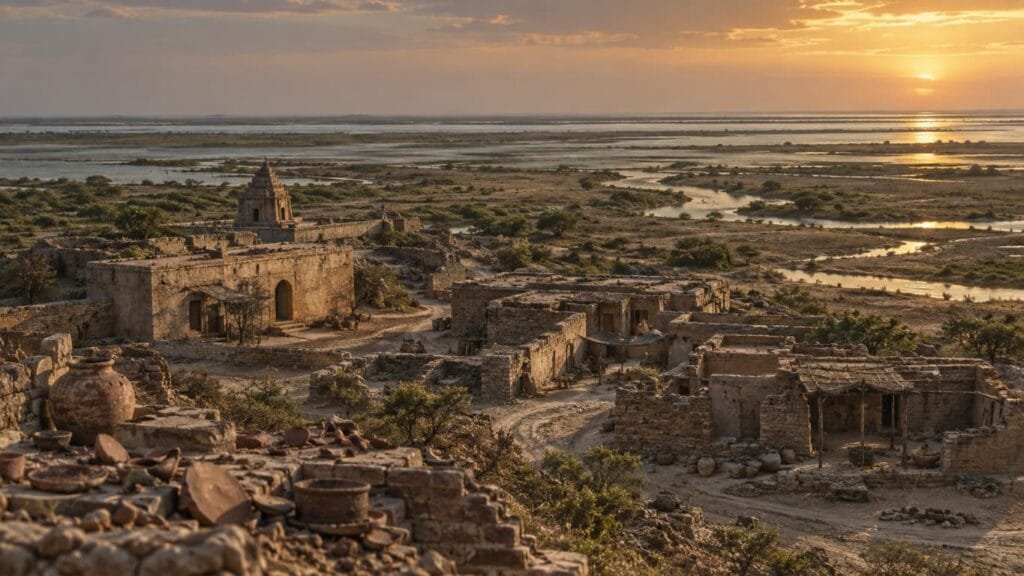
A remote patch of western Kutch, once dismissed as a deserted landscape, is now raising a much bigger question: what was Barbadgaon, and what happened to the settlement that once stood here?
The place has no confirmed ancient name.
Its archaeological chronology is still provisional.
Researchers have found human skeletons, brick structures, pottery and objects associated with rice processing.
And beneath the mystery is an even more intriguing possibility: the landscape around Sir Creek may have looked very different when this settlement was alive.
The site is provisionally called Barbadgaon, meaning roughly “ruined village.” Before archaeologists began investigating it, BSF personnel who encountered the remains during patrols in 2023–24 reportedly referred to the location as “Ujadagaon” — a deserted village.
But that name may be only the beginning.
Because nobody has yet established what the settlement was originally called.
And nobody has yet fully explained why it disappeared.
A settlement hidden in the salt desert
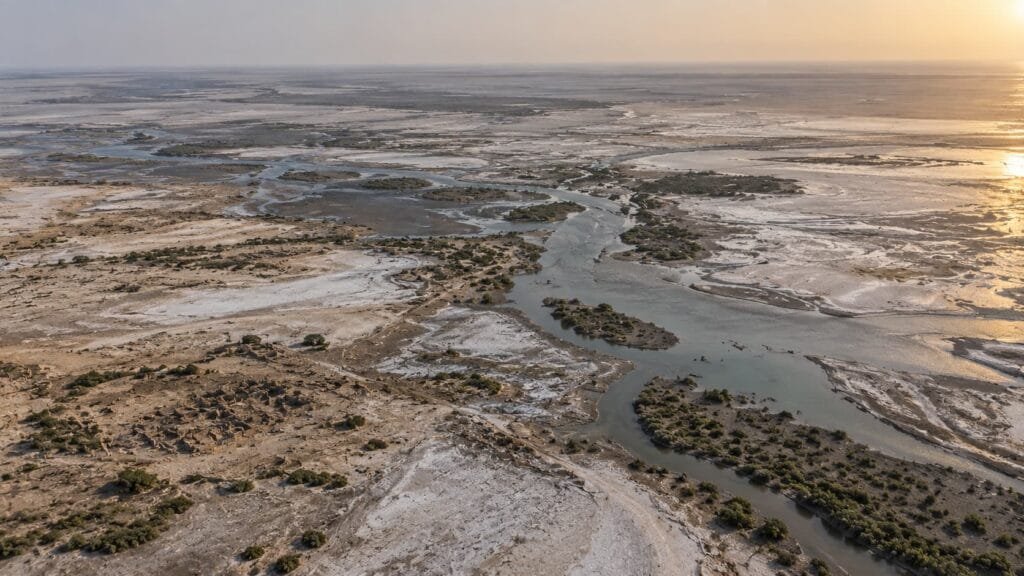
Barbadgaon lies near Sir Creek in western Kutch, close to the present India-Pakistan frontier.
Today, the surrounding landscape is difficult to imagine as the setting for a substantial settlement.
The Great Rann of Kachchh is famous for its salt flats, seasonal inundation and extreme aridity.
Yet archaeological work at Barbadgaon has identified the remains of what appears to have been a settled community.
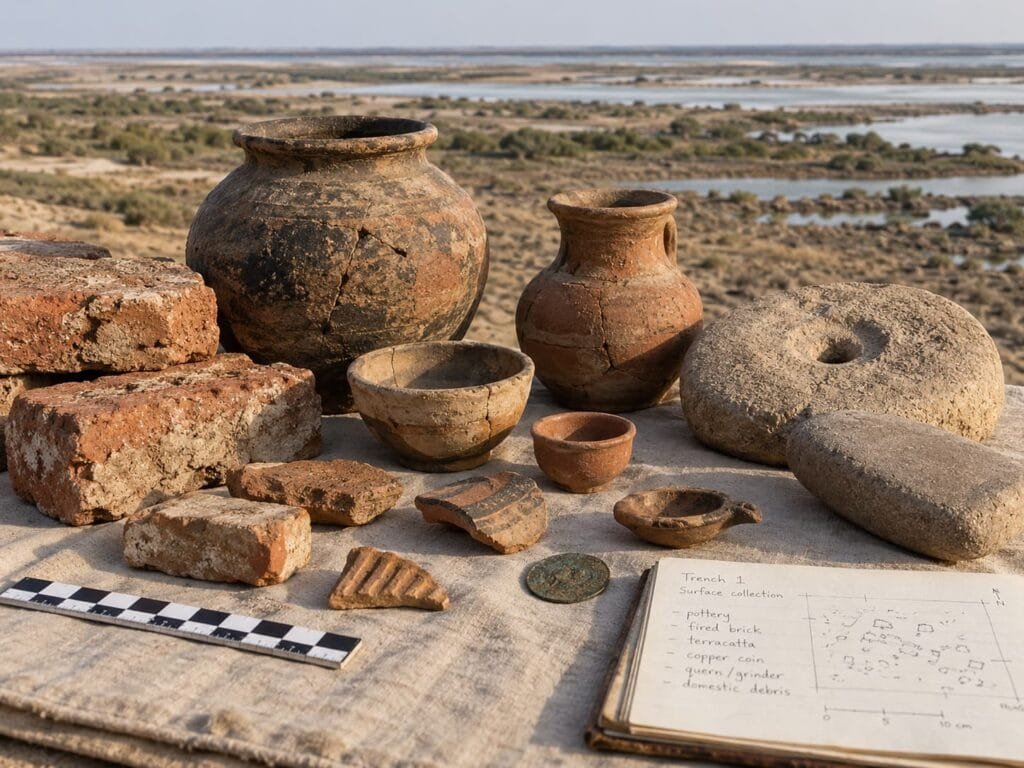
Current reporting describes brick enclosures and structures, paved surfaces, pottery, lamps, domestic ceramics, a copper coin and terracotta objects associated with rice processing. Around 100 human skeletons have also been reported from the site.
Researchers currently place the settlement broadly in the 11th–13th centuries CE, with the Times of India reporting a somewhat wider preliminary range of the 11th–14th centuries. The association with the Soomra period is also provisional.
That uncertainty matters.
Barbadgaon has not yet been given an absolute, definitive date through a complete archaeological excavation.
Its original historical identity is also unknown.
So the story is not:
Archaeologists have discovered a completely understood medieval city.
The more interesting story is:
Archaeologists may have found a settlement whose identity, economy and disappearance are still waiting to be reconstructed.
The first mystery: what was Barbadgaon actually called?
One of the strangest things about the discovery is that the settlement’s modern archaeological name is not its ancient name.
“Barbadgaon” is provisional.
“Ujadagaon” was an informal name used by BSF personnel who encountered the remains.
Neither tells us what the people who lived there called their home.
That may sound like a small detail.
It isn’t.
Ancient settlements can sometimes be connected to historical texts through inscriptions, coins, manuscripts, inscriptions from nearby regions or later traditions.
At Barbadgaon, that connection has not yet been established.
Which leaves open one of the most tantalising questions:
Are we looking at a settlement whose name has completely disappeared from the historical record?
Or could future excavation uncover something that allows archaeologists to identify it?
A coin.
An inscription.
A distinctive ceramic sequence.
A seal.
A text.
Perhaps something has survived beneath the layers of the settlement that has not yet been found.
Until then, Barbadgaon remains a modern archaeological label attached to an ancient place whose original identity is unknown.
The rice puzzle
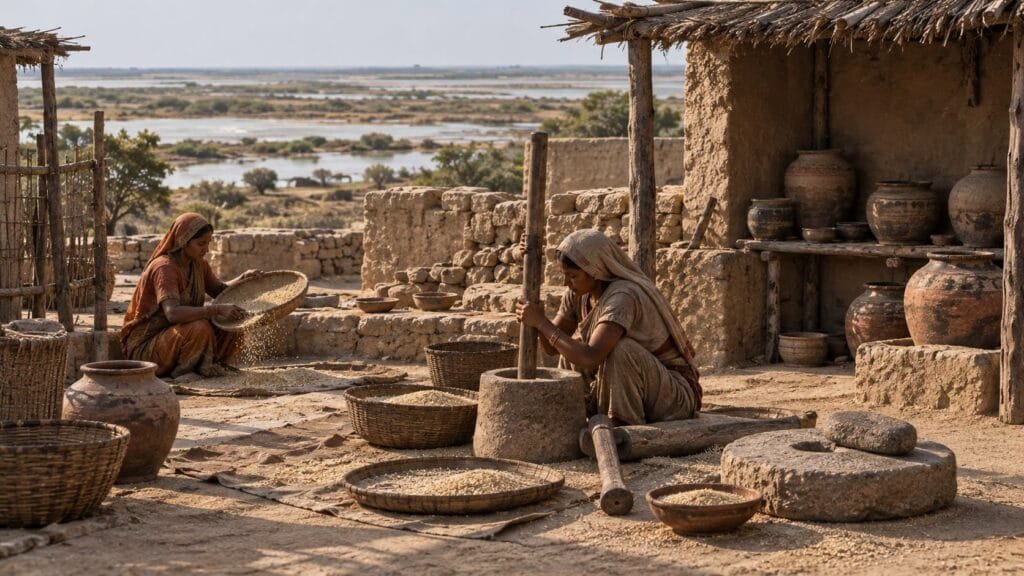
Among the most intriguing discoveries are terracotta implements interpreted as rice-processing or rice-husking equipment.
At first glance, that sounds straightforward.
People processed rice.
Therefore, people grew rice.
But archaeology rarely allows such a simple leap.
The objects provide evidence that rice was being processed at the settlement.
They do not, by themselves, establish where that rice was cultivated.
It could have been grown locally.
It could have arrived from another agricultural zone.
It could have moved through regional trade networks.
The archaeological evidence currently does not allow us to choose confidently between those possibilities.
And that makes the rice evidence more interesting, not less.
Because if Barbadgaon really occupied a settlement zone close to changing waterways and maritime routes, rice could provide a clue about how people obtained food and how goods moved through the region.
The important question is therefore not simply:
“Did Barbadgaon grow rice?”
It is:
“Where did the rice processed at Barbadgaon come from?”
That question may eventually be answered through archaeobotanical research, residue analysis, environmental reconstruction and further excavation.
For now, the safest conclusion is simply that rice processing appears to have been part of life at the settlement.
Then there are the skeletons
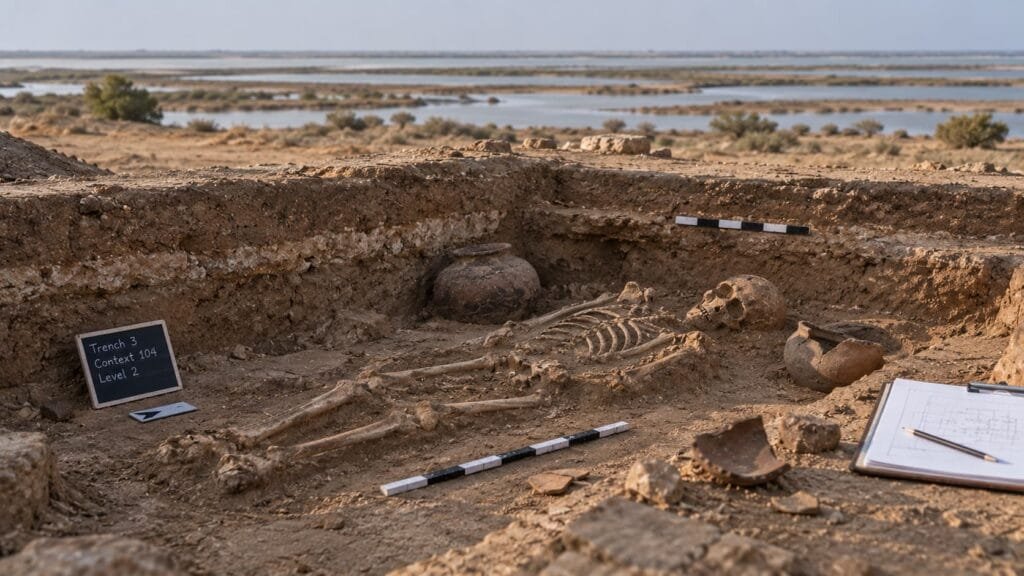
Perhaps the most visually striking part of the discovery is also the easiest to misunderstand.
Reports describe approximately 100 human skeletons at the site. The Times of India also reported that the heads of the skeletons were oriented towards the west.
But the existence of numerous skeletons does not automatically tell us why those people died.
There is currently no established evidence allowing us to say that they died in an earthquake, epidemic, massacre, sudden flood or some other single event.
Nor should the skeletons automatically be interpreted as evidence of a mass death episode.
Their dates, demographic characteristics, burial practices and relationship to the settlement require specialist study.
That means the skeletons are not the answer to Barbadgaon’s mystery.
They are another question.
Who were these people, when did they live, and why were their remains left here?
Future osteological, archaeological and chronological work may provide some of those answers.
A landscape that was not always the landscape we see today
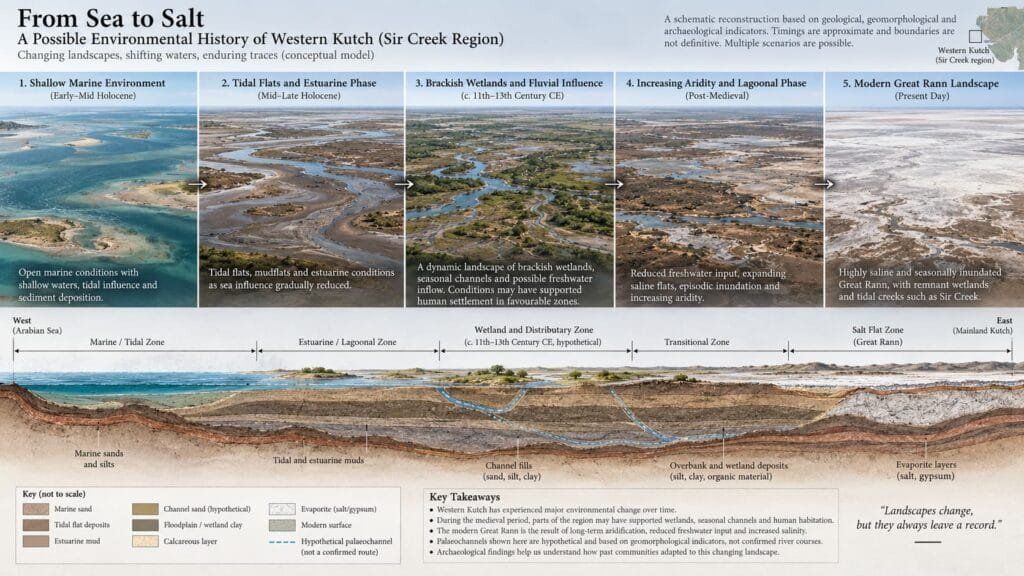
This is where Barbadgaon becomes much more than a story about one archaeological site.
The western Great Rann has undergone major environmental and geomorphological changes over thousands of years.
A 2012 study in Geomorphology reconstructed the evolution of the western Great Rann using field stratigraphy, sedimentology, geochemistry, optical dating and radiocarbon dating. It found that tidal-flat processes dominated large parts of the studied area between roughly 5,500 and 2,000 years ago, while fluvial contributions were more limited. The study also found evidence that Indus-derived sediment contributed substantially to western Rann sedimentation during the mid-Holocene.
That does not mean an Indus channel ran directly through Barbadgaon.
It does not prove that Barbadgaon was an Indus port.
And it certainly does not establish a specific river route for the medieval settlement.
Instead, it tells us something more fundamental:
the physical environment around western Kutch has changed repeatedly.
That matters when trying to understand an ancient settlement sitting beside what is now a salt-marsh landscape.
The Nara River leaves another clue
There is also a much more recent environmental record.
Researchers studying sediments from the relict Nara River channel investigated environmental changes during approximately the last 1,400 years.
Their study found evidence that the present relict Nara course was active after about 2,200 years BP. Between roughly 2,200 and 1,000 years BP, both marine and continental processes influenced sedimentation. After around 1,000 years BP, both marine and fluvial processes diminished, suggesting a reduction in hydrological conditions and a withdrawal of marine influence.
This is important context for Barbadgaon.
But it is not a direct map of the settlement’s water supply.
The Nara River evidence comes from a specific palaeochannel and sediment sequence. Barbadgaon is a separate archaeological site.
Connecting the two requires additional field evidence.
That distinction is crucial because the history of the Great Rann contains many proposed ancient river routes, and not every proposed channel can automatically be connected to every archaeological settlement.
Was there once another waterway near Sir Creek?
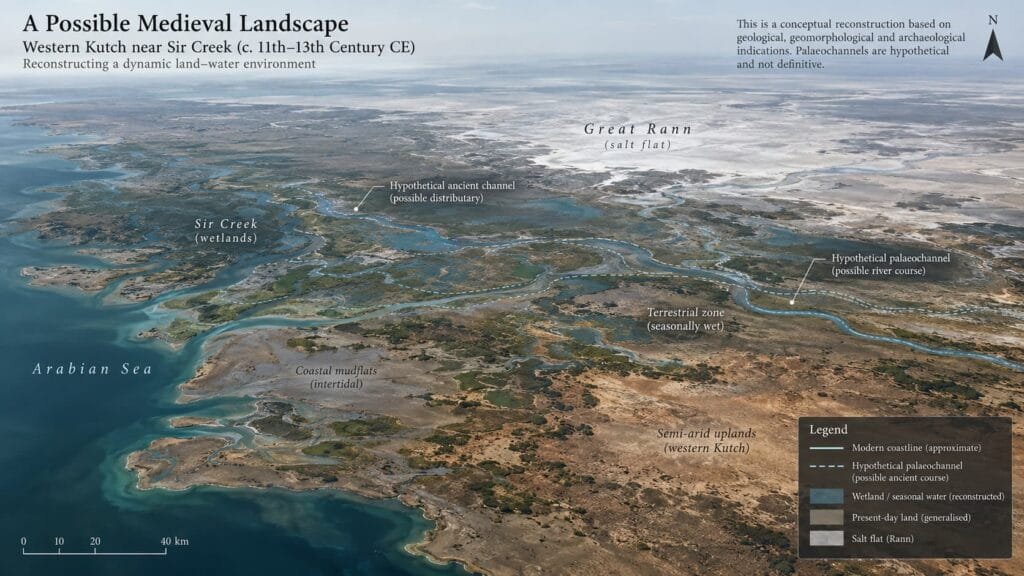
This may be the most exciting hypothesis surrounding Barbadgaon.
Researchers are investigating whether ancient distributaries of the lower Indus system may once have extended towards the Sir Creek region, potentially creating waterways that connected inland areas with the Arabian Sea.
The idea is plausible enough to investigate.
But it is not yet established as the history of Barbadgaon.
In other words, it would be premature to write:
“The Indus flowed through Barbadgaon.”
The available evidence does not establish that.
A more interesting question is:
Could palaeochannels around Sir Creek eventually reveal a water network that explains why people settled here?
That is something future research may be able to test.
Researchers can compare archaeological locations with buried channels, sediment sequences, palaeochannels, geophysical data and environmental evidence.
If those datasets converge, the landscape around Barbadgaon could become much easier to reconstruct.
If they do not, the river theory may have to be revised.
Either result would tell us something important.
The Soomra connection
The provisional dating of Barbadgaon to approximately the 11th–13th centuries CE, sometimes reported more broadly as the 11th–14th centuries, has led to its association with the Soomra period.
But a chronological or cultural association is not the same thing as proof that the Soomras founded the settlement, directly governed it or built every structure found there.
Those questions require more evidence.
The Soomra period is nevertheless important because it places Barbadgaon within a medieval landscape in which settlements, trade routes, agricultural zones and coastal environments were changing.
The settlement may eventually prove to have been part of a wider network.
Or it may turn out to have had a more local role.
At present, the archaeology has not closed that question.
What happened to Barbadgaon?
This is where the evidence becomes especially frustrating.
We know the settlement existed.
We have evidence of structures.
We have domestic material.
We have rice-processing equipment.
We have human remains.
We have a provisional chronology.
And we have a landscape whose rivers, coastlines and hydrological conditions changed repeatedly.
But we do not yet have a securely demonstrated explanation for the settlement’s disappearance.
That leaves several possibilities open.
Environmental change could have altered the habitability or economic value of the location.
Changing waterways could have affected movement and trade.
Political or economic shifts could have changed regional settlement patterns.
Or the settlement may have declined through a combination of factors.
But choosing one explanation now would go beyond the evidence.
And perhaps that is the most important thing about Barbadgaon.
The archaeological mystery is still alive.
Could the Rann itself have hidden the answer?
The western Great Rann has a complicated geological history.
Researchers have shown that marine, tidal, fluvial and tectonic processes have repeatedly interacted across the region. The 1819 Allah Bund earthquake also significantly altered the geomorphology of the Rann, leaving a landscape very different from what earlier communities experienced.
But the 1819 earthquake should not be casually presented as the reason Barbadgaon was abandoned.
The medieval settlement predates that event by centuries.
What the earthquake demonstrates is something broader:
the landscape is capable of changing dramatically.
That matters because archaeologists studying Barbadgaon are not simply excavating a settlement.
They are trying to reconstruct the environment around it.
Where was the water?
Where were the channels?
How far was the sea?
What could people grow?
What could they trade?
How did people move?
And perhaps most importantly:
what did this landscape look like before the Rann became the landscape we recognise today?
Barbadgaon may change how we see western Kutch
Barbadgaon is not yet another neatly solved ancient city.
There is no confirmed ancient name.
There is no final archaeological chronology.
There is no proven Indus channel running through the settlement.
There is no established explanation for the skeletons.
And there is no confirmed cause of abandonment.
But those gaps are precisely what make the site important.
The story of ancient western India is often told through famous cities, ports and archaeological monuments.
Barbadgaon is different.
It begins with a place that looked almost empty.
Then came brick structures.
Pottery.
A copper coin.
Rice-processing equipment.
Human remains.
And eventually a much bigger question about how people lived in a landscape whose rivers and coastlines did not always resemble those of today.
That makes Barbadgaon part of a wider archaeological pattern in India: places can disappear from historical memory while the physical evidence of their existence remains beneath the ground.
HypeHive has explored similar questions through Govishan Mound, where modern excavation is reopening questions about the long archaeological sequence beneath Kashipur, and Poompuhar, where the changing relationship between a settlement, a river and the sea has become central to understanding the ancient port.
Barbadgaon adds another variation to the same mystery.
Except here, the landscape itself may be one of the missing pieces.
The real mystery is still buried
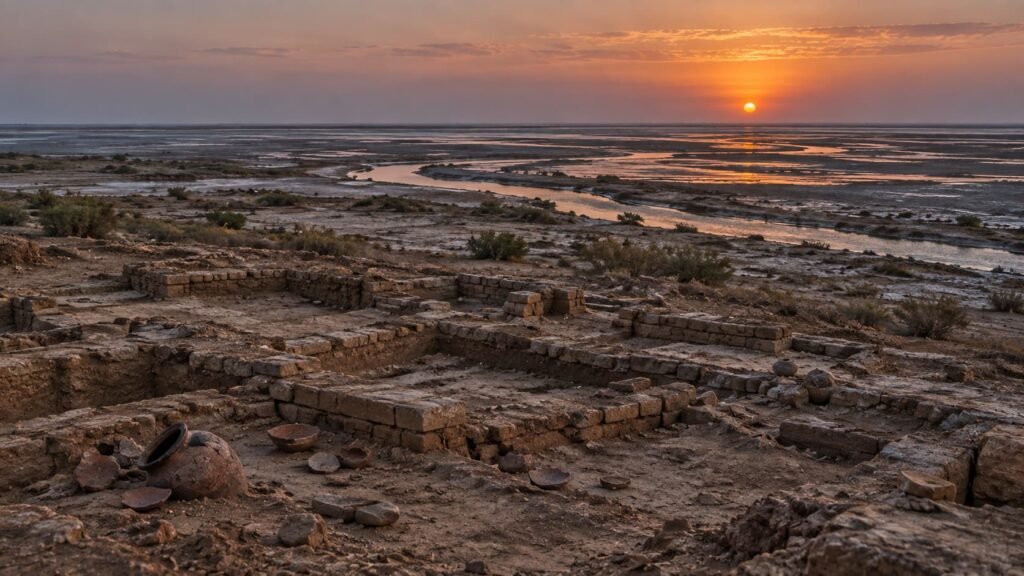
For now, Barbadgaon is a provisional name for a settlement whose original identity remains unknown.
Its ruins suggest medieval occupation.
Its artefacts provide glimpses of everyday life.
Its rice-processing tools hint at connections with agricultural production and food movement.
Its skeletons raise questions about the people who lived and died there.
And the surrounding Great Rann preserves evidence of environmental changes that may help reconstruct the world those people inhabited.
But the biggest discovery may still be waiting.
A future excavation could reveal an inscription.
A scientific date could narrow the settlement’s chronology.
Palaeochannel mapping could show whether an ancient waterway once approached the site.
Human remains could reveal more about the community.
Archaeobotanical evidence could tell us where its food came from.
Or the evidence could overturn some of today’s hypotheses entirely.
That is the exciting part.
Barbadgaon has not given archaeologists its final story yet.
Right now, we know what is buried there.
The mystery is understanding why it was there in the first place — and what happened to the people who left it behind.
And somewhere beneath the ruins of this forgotten settlement, that answer may still be waiting.