

A Georgian queen died in Safavid Persia in the 17th century. Centuries later, an arm bone was discovered beneath the ruins of a Portuguese-era church in Goa.
The archaeological location matched historical descriptions of a lost relic. Ancient DNA then provided another clue: the bone carried a mitochondrial lineage associated with Georgia and surrounding regions.
But the discovery came with an important qualification.
Scientists did not produce a direct DNA match proving beyond doubt that the bone belonged to Queen Ketevan. Their conclusion was more careful: the archaeological, literary and genetic evidence made it likely that the relic was hers.
That distinction is what makes the story of Ketevan the Martyr so fascinating.
It is not simply the story of a queen who became a saint.
It is a 400-year-old trail connecting Georgia, Safavid Persia and Goa, reconstructed through historical documents, archaeology and genetics.
Who Was Ketevan the Martyr?
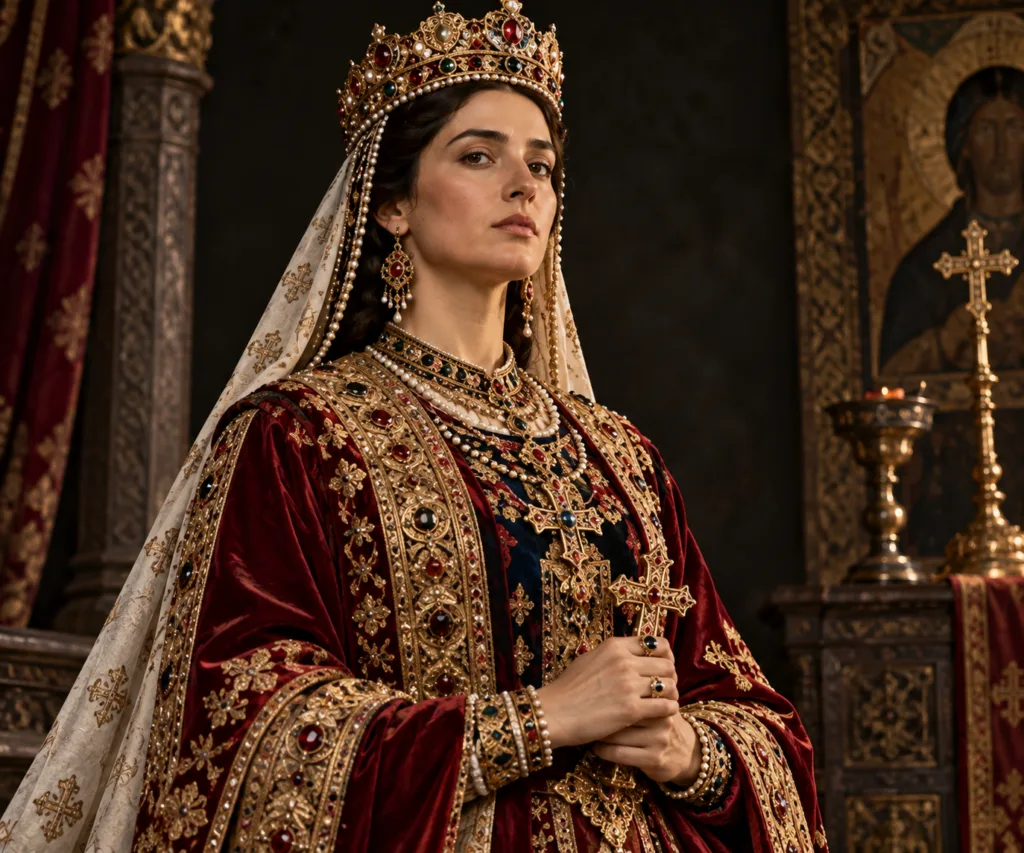
Ketevan the Martyr was the wife of David I, king of Kakheti in eastern Georgia, and the mother of Teimuraz I.
When the young Teimuraz became ruler of Kakheti in 1606, Ketevan effectively governed the kingdom. According to the Georgian Encyclopedia, she later became a hostage in the political struggles surrounding Shah Abbas I of Safavid Iran. She was eventually transferred to Shiraz around 1620.
The historical context matters.
Ketevan was not simply a religious figure waiting to become a martyr. She was a political figure caught between the interests of the Georgian kingdom and the expanding power of Safavid Iran.
Her son Teimuraz later became one of the important literary voices preserving her memory. His poem The Martyrdom of Queen Ketevan described his mother’s sacrifice and became part of the Georgian literary tradition surrounding her death.
The Georgian Encyclopedia records her death in September 1624 and identifies her as a figure who became a symbol of Christian resistance and martyrdom in Georgian memory.
Why Was Queen Ketevan Taken to Shiraz?
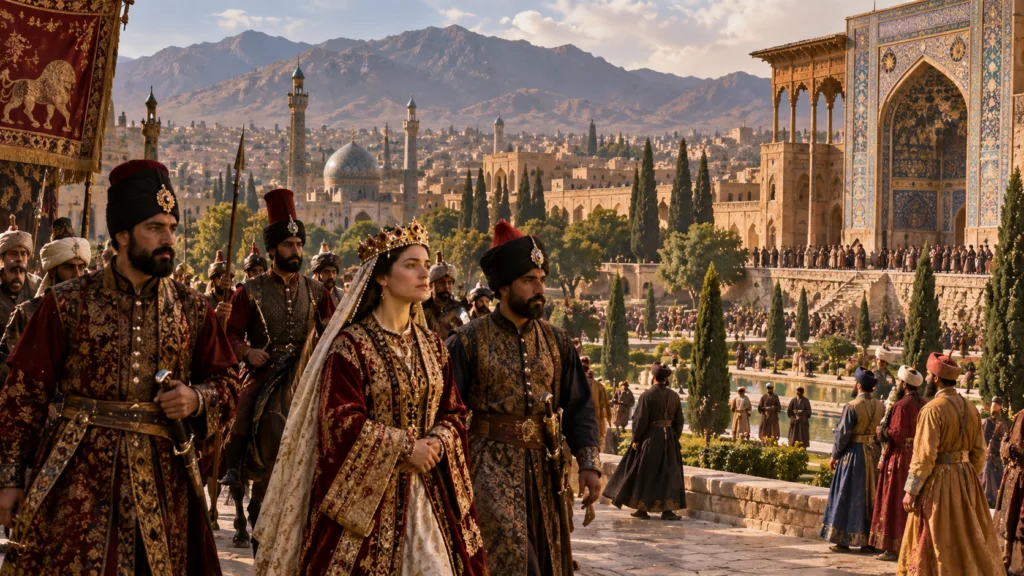
The story begins with the expansion of Shah Abbas I’s power into Georgia.
The scientific study that later examined Ketevan’s relic says that Shah Abbas I’s campaign against the Georgian kingdom resulted in Ketevan being taken prisoner. It places her captivity in Shiraz from roughly 1614 to 1624.
The Georgian Encyclopedia gives a somewhat different chronology, stating that Ketevan was first sent to Ganja as a hostage and later transferred through Ashraf before being sent to Shiraz in 1620.
That difference is worth preserving rather than smoothing away.
Historical reconstruction often depends on sources written at different times, by people with different access to information.
Research into the letters of Italian traveller Pietro Della Valle has added another layer. Historian Eldari Mamistvalishvili examined references to Ketevan scattered through Della Valle’s surviving correspondence and identified material concerning her captivity in Persia and Shiraz.
So Ketevan’s story is not preserved in a single narrative.
It survives through Georgian literary traditions, European travellers, missionary accounts and later historical research.
How Did Ketevan Die?

Ketevan died in Shiraz in 1624.
The broad historical tradition is that she was pressured to abandon Christianity and refused.
The precise details of her death belong to a mixture of historical documentation and later religious tradition, so they should not all be presented as equally documented facts.
The scientific study records that Ketevan was tortured and killed on 22 September 1624.
However, the Georgian Encyclopedia gives 12 September 1624.
Why Do Sources Give Different Dates?
This is one of the questions HypeHive should leave visible rather than pretending the disagreement does not exist.
The difference may relate to historical dating and transmission between Georgian, European and other sources, but the available references we have identified do not by themselves justify declaring one date definitively correct.
For that reason, this article uses 1624 as the secure year and identifies the exact date as a source discrepancy.
That is a small detail, but it illustrates an important rule in historical research:
A repeated date is not automatically a verified date.
How Did Ketevan's Relics Reach Goa?
This is where the story takes its unexpected turn.
After Ketevan’s death, Augustinian friars associated with her are reported to have recovered her remains.
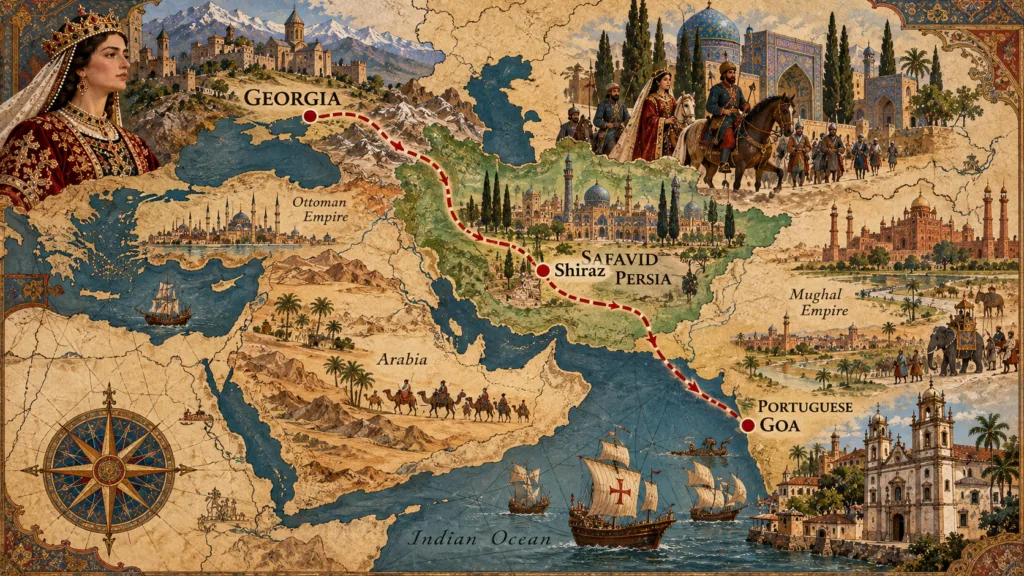
The scientific study says two Augustinian friars had arrived in Shiraz before Ketevan’s death, gained her trust and became her confessors. After her execution, they recovered and concealed her remains. In 1627, part of those remains — identified in the historical account as the right arm — was brought to Goa.
The Indian government’s later agreement with Georgia records the same broad historical tradition: some of Ketevan’s remains were brought to India in 1627 and interred in the St Augustine Church complex in Goa.
This is the crucial geographical connection:
Ketevan → Shiraz → Augustinian network → Goa
The destination was therefore not random.
The Augustinian presence connected the Persian mission environment with Portuguese India.
The Georgian Encyclopedia also records the role of Augustinian missionaries in preserving and transporting Ketevan’s remains.
Where Were Queen Ketevan's Relics Lost?

The destination was the Augustinian complex in Old Goa.
Today, the surviving ruins are officially described by the Goa Tourism Development Corporation as the Ruins of the Church of St. Augustine. The complex was built by the Augustinian order and included the church, convent and other associated structures.
The site eventually deteriorated.
Goa Tourism records that the Augustinians were expelled from Goa in 1835, after which the church was abandoned and its structures deteriorated.
The scientific paper provides more detail: the church underwent partial demolition in the 19th century and its main vault collapsed, turning the complex into ruins. Valuable objects associated with the complex were subsequently lost or removed.
And somewhere in those ruins, researchers believed Ketevan’s relic had disappeared.
The 400-Year-Old Clue That Led Archaeologists to the Bone
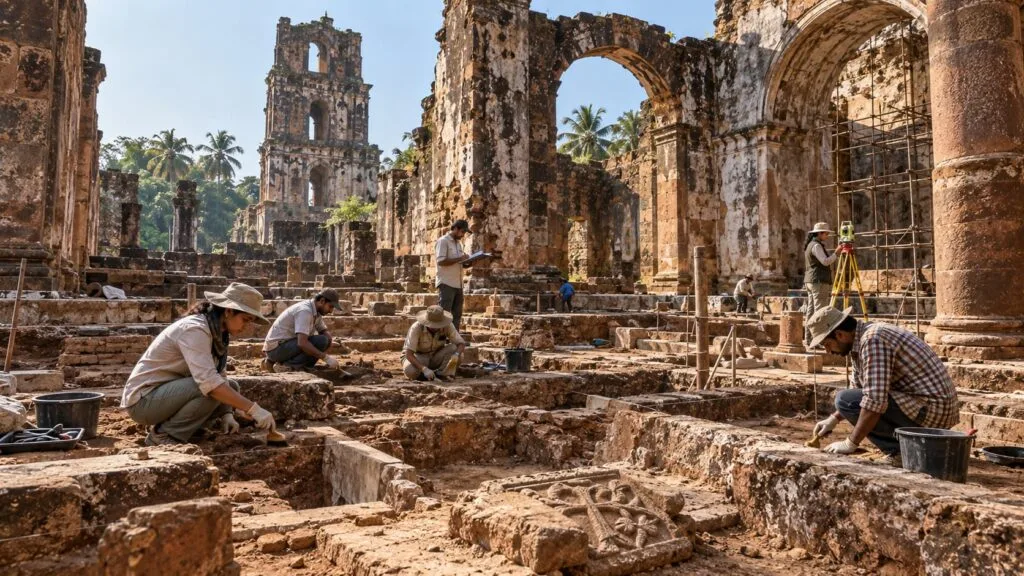
This is the point where Ketevan’s story starts looking less like a legend and more like an archaeological investigation.
Historical Portuguese documentation described where the relic was supposed to have been kept.
The researchers reconstructed the layout of the former convent using historical descriptions and information from local historians.
After topographical surveys, archaeologists identified the chapter chapel and the window described in the historical material. The investigation focused on the area where the relic box was expected to have been located.
Then they found something.
While clearing a collapsed wall, archaeologists discovered a long arm bone in the sediment.
It was designated QKT1.
Pieces of what appeared to be the collapsed stone relic box were also recovered.
Two additional bone specimens, QKT2 and QKT3, were found elsewhere in the area. The researchers believed those could instead have belonged to Augustinian friars associated with the site.
The discovery therefore wasn’t simply:
“Archaeologists found some old bones.”
They had found a bone at the location indicated by historical records for a lost relic.
But there was still a major problem.
What Did the Archaeologists Actually Find?
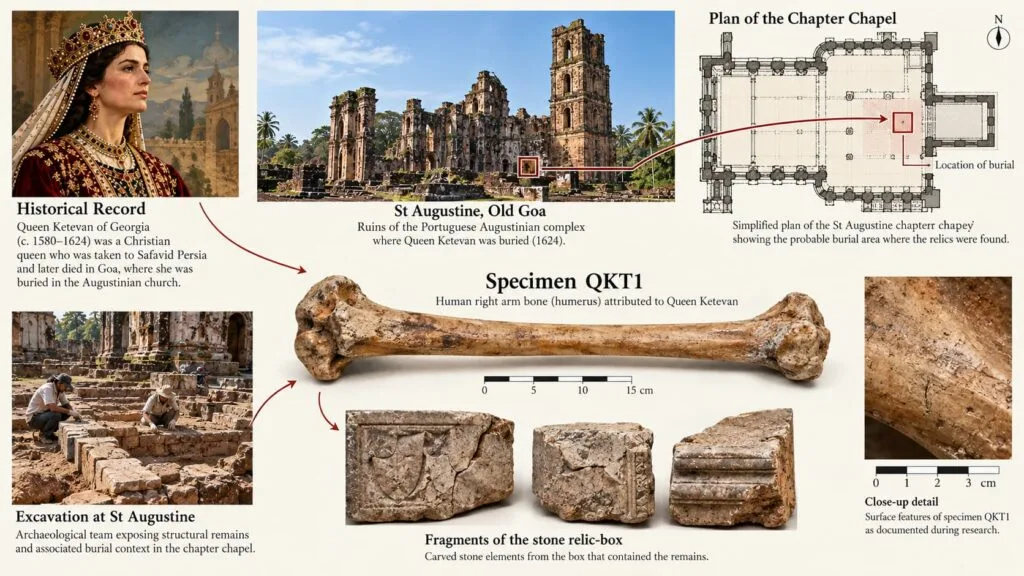
The archaeological evidence was suggestive, but it could not establish the person’s identity.
The researchers themselves explicitly stated that the archaeological and historical evidence was consistent with the remains being Ketevan’s, but that the identification could not be considered conclusive without direct confirmation of her identity.
That is why the next step was so important.
The team turned to ancient DNA.
Did DNA Prove the Bone Was Ketevan's?
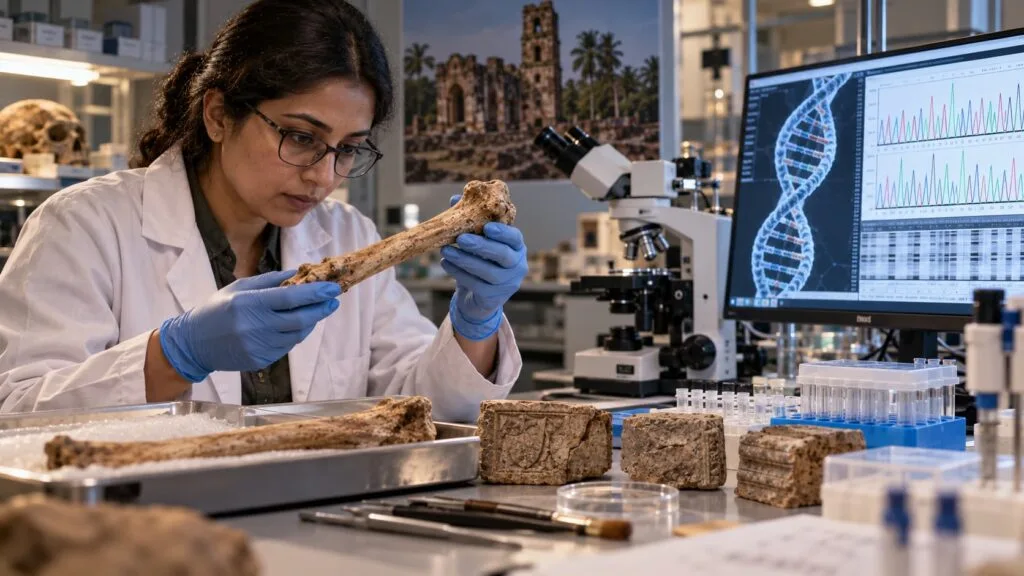
Not in the sense of a direct individual DNA match.
Researchers extracted mitochondrial DNA from the excavated remains.
The crucial specimen was QKT1.
The study reported that QKT1 carried mitochondrial haplogroup U1b. The researchers reported that this lineage was absent from their Indian comparison dataset but present in Georgia and surrounding regions. They therefore argued that the genetic result supported the archaeological and literary evidence connecting the bone to Ketevan.
The paper’s own conclusion is deliberately cautious:
The bone is probably that of Queen Ketevan.
That wording matters.
It does not mean researchers found Ketevan’s DNA and compared it with a verified DNA sample from Ketevan herself.
Instead, several independent clues pointed in the same direction.
What Does Haplogroup U1b Tell Us?
Mitochondrial DNA, or mtDNA, is inherited through the maternal line.
It can therefore help researchers compare ancient remains with populations and maternal genetic lineages.
In the Ketevan investigation, researchers identified U1b in QKT1 and compared the result with genetic information from modern populations.
The study reported that the relevant lineage was found in Georgia and surrounding regions but not in the Indian dataset used for comparison.
The authors described this as a unique mtDNA haplogroup U1b in their investigation and used the result to support the archaeological and literary identification.
The distinction is important:
The study did not establish that U1b is exclusively Georgian.
Nor does the absence of the lineage from the study’s Indian comparison dataset prove that nobody in India can carry it.
What the research actually established was narrower:
The particular genetic evidence from QKT1 was compatible with a Georgian origin and strengthened the identification already suggested by historical and archaeological evidence.
Why Scientists Still Say “Probably”
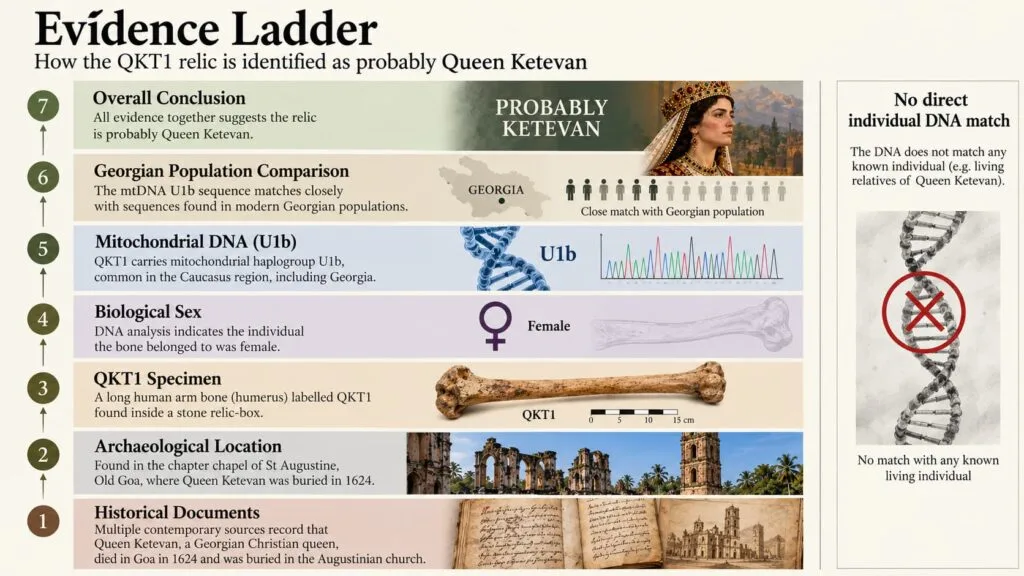
This is perhaps the most important part of the entire Ketevan story.
The evidence forms a chain:
Historical documents
↓
A relic was reportedly brought to Goa
↓
Historical descriptions indicated where it was kept
↓
Archaeologists reconstructed the relevant area
↓
QKT1 was recovered there
↓
QKT1 was a female bone
↓
Its mitochondrial DNA belonged to U1b
↓
The researchers found the lineage in Georgian and surrounding populations
↓
The genetic evidence supported the historical and archaeological evidence
That is a powerful convergence.
But it is not the same as possessing a verified DNA sample from Ketevan herself.
The original scientific paper therefore used cautious language and concluded that the bone probably belonged to the Georgian queen.
This is also why HypeHive should avoid the tempting headline:
“DNA Proves Ketevan’s Bones Were Found.”
A more accurate statement is:
“Ancient DNA strengthened the case that the Goa relic belonged to Ketevan.”
That difference is small in wording and enormous in historical accuracy.
What Happened to Ketevan's Relic After the Discovery?

The story did not end with the archaeological excavation.
The Government of India and Government of Georgia later formalized an agreement for India to gift a relic of St. Queen Ketevan to Georgia. The agreement records the 1627 transfer of remains to Goa and the 2005 excavation that uncovered remains subsequently scientifically identified and accepted as relics of Ketevan.
On 9 July 2021, India’s External Affairs Minister S. Jaishankar handed over part of the relic to the Georgian side during his visit to Georgia. India’s Ministry of External Affairs records the handover and identifies the relic as having been discovered at Goa’s St Augustine Church.
India’s official India–Georgia bilateral brief also lists the discovery of St. Ketevan’s relics at St. Augustine Church in Goa and the 2021 handover as part of the historical background of the two countries’ relationship.
So the journey that began in 17th-century Persia eventually became part of 21st-century India–Georgia cultural relations.
Why Ketevan's Story Still Matters

The ruins of St Augustine are now a heritage site in Old Goa, but they preserve something more unusual than architecture.
They preserve a physical trace of a connection between three very different historical worlds:
Georgia
where Ketevan was a queen,
Safavid Persia
where she was held captive and died,
and
Portuguese Goa
where part of her remains were carried and eventually rediscovered.
Goa Tourism itself identifies the St Augustine ruins as the archaeological site associated with the discovery of Queen Ketevan’s remains.
And the scientific investigation made the story even more unusual.
The 2014 paper described the work as the first ancient-DNA report from India, while using the genetic evidence alongside archaeological and literary evidence to investigate the identity of the relic.
The subject has also continued to attract attention.
A 2026 The Week feature revisited the Ketevan discovery while examining how ancient DNA is being used to investigate Indian history.
So Ketevan’s story is no longer only a medieval or early-modern religious story.
It has become a case study in how history, archaeology and genetics can be combined to investigate the past.
What We Know — and What Remains Uncertain
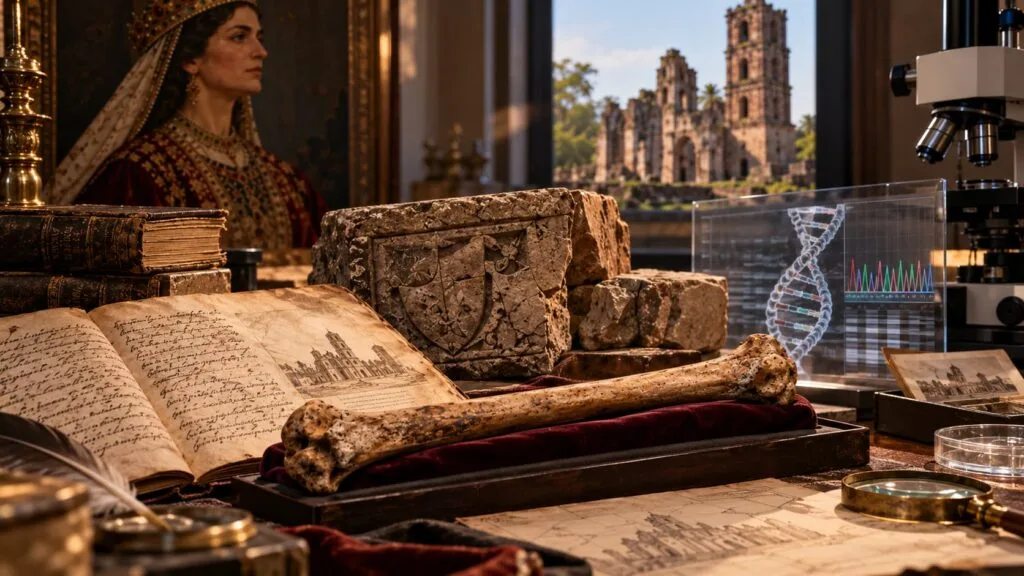
What is well documented
- Ketevan was a Georgian queen associated with Kakheti.
- She was held in Safavid Persia and died in Shiraz in 1624.
- Historical traditions connect Augustinian missionaries with the recovery of her remains.
- Part of the relic was brought to Goa in the 17th century.
- Archaeologists recovered QKT1 from the St Augustine complex.
- QKT1 produced mitochondrial-DNA evidence associated by the researchers with Georgian and surrounding populations.
- India handed part of the relic to Georgia in 2021.
What remains uncertain
- The exact date of Ketevan’s death is presented differently by different sources.
- The archaeological evidence alone could not conclusively establish the identity of QKT1.
- The DNA study did not have a direct reference DNA sample from Ketevan herself.
- The scientific conclusion is therefore probable identification, not an absolute individual DNA identification.
And that uncertainty is not a weakness in the story.
It is the story.
The Answer in One Paragraph
Ketevan the Martyr was a Georgian queen who died in Safavid Persia in 1624. Historical accounts say Augustinian friars recovered some of her remains and that part of the relic reached Goa in 1627. Centuries later, archaeologists excavating the ruins of the St Augustine complex found a long arm bone at the location indicated by historical records. Ancient-DNA analysis identified mitochondrial haplogroup U1b in the bone, a lineage the researchers associated with Georgia and surrounding regions. Together with the historical and archaeological evidence, the genetic findings led the researchers to conclude that the bone was probably Ketevan’s — although the study did not provide a direct individual DNA match.
Related HypeHive Stories
Ketevan fits naturally into HypeHive’s broader approach of following a historical mystery from evidence to evidence. For example, our earlier investigation into How Did Aurangzeb Die? similarly separates later stories about a historical figure’s death from what the surviving evidence can actually establish.
For the archaeological side of the investigation, Barbadgaon: The Lost Settlement Near Sir Creek and Lakkundi History: The Hidden City Being Rediscovered explore another recurring HypeHive question: what can archaeology tell us when the historical record is incomplete?
Sources & Further Reading
- Original scientific study — PubMed — Rai et al., Mitochondrion (2014).
- Full scientific article — ScienceDirect — archaeological and DNA methodology.
- India–Georgia relic agreement — Ministry of External Affairs — official record of the relic’s history and transfer.
- India–Georgia Bilateral Brief — MEA — modern diplomatic context.
- Ruins of the Church of St. Augustine — Goa Tourism — heritage and archaeological context.
- Queen Ketevan — Georgian Encyclopedia — Georgian historical reference.
- Ketevan in Pietro Della Valle’s letters — scholarly historical research.
- 2026 ancient-DNA feature — The Week — recent context.