
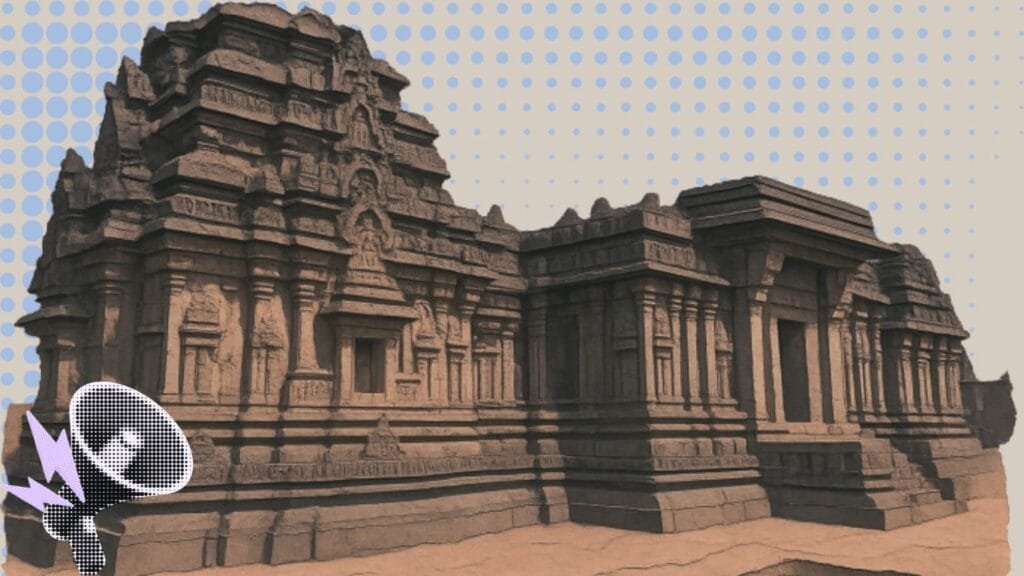
What if the village you see today is only the surface of a city that once mattered enormously to medieval India? That question sits at the heart of Lakkundi history, because archaeologists and researchers are now using LiDAR, remote sensing, Ground Penetrating Radar and other technologies to search for monuments that may have disappeared beneath vegetation, soil and centuries of change. In 2026, Karnataka’s Department of Archaeology, Museums and Heritage began working with the National Institute of Advanced Studies (NIAS), Bengaluru, on a six-month investigation designed to create a clearer picture of what lies across Lakkundi’s archaeological landscape.
And this is where the story becomes fascinating.
The scientists are not searching for an unknown civilization in some remote desert.
They are searching beneath and around a living village in Karnataka.
A village that already contains more than 50 ancient temples, around 101 stepwells and numerous inscriptions.
A village that was once known as Lokki-Gundi.
A place that was once a prominent city more than a thousand years ago.
And according to the historical tradition surrounding it, what we can see today may be only a fraction of what once existed.
So what happened to Lakkundi?
And perhaps the bigger question is:
How much of the medieval city is still waiting to be found?
Lakkundi History Begins With a City That No Longer Looks Like One
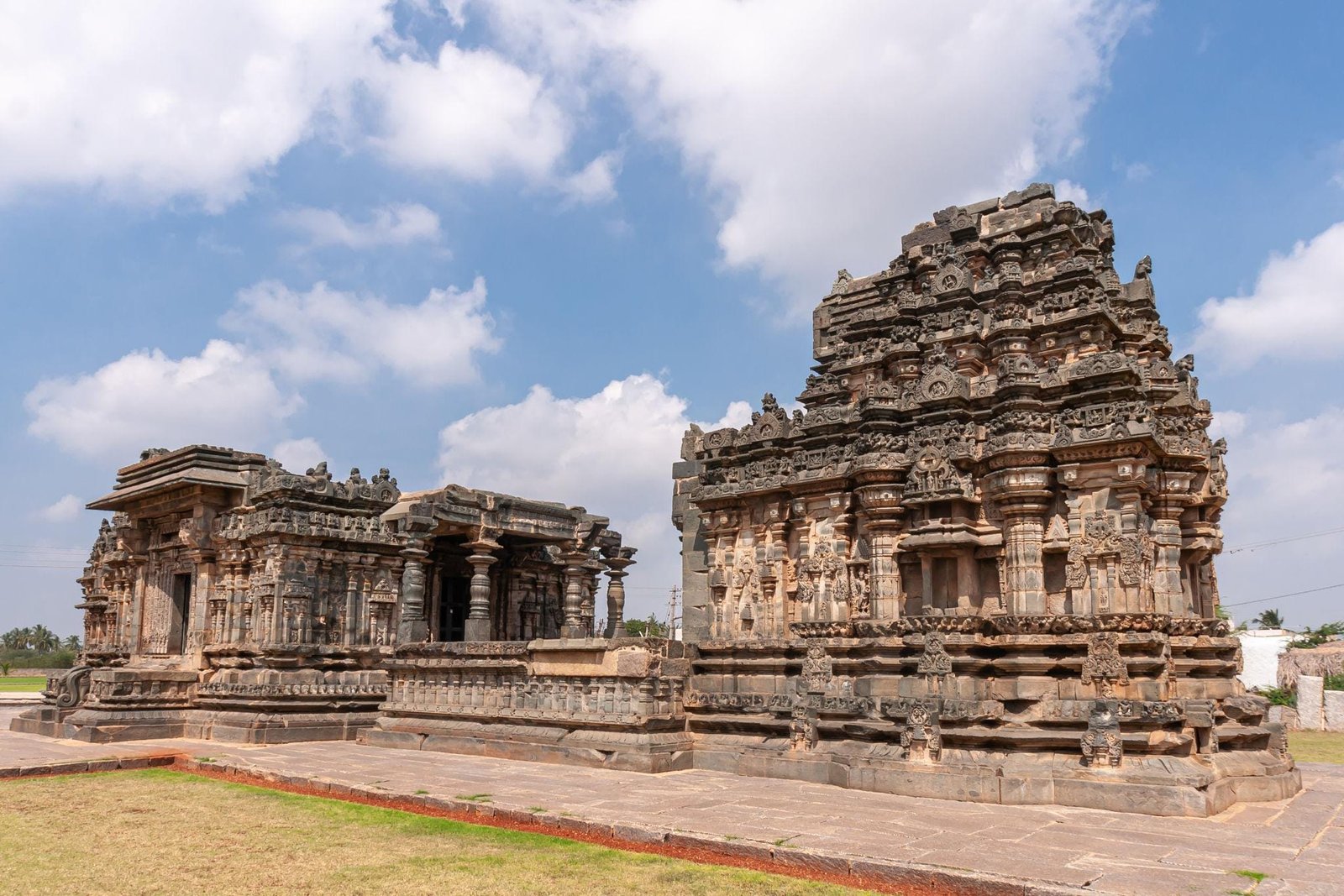
Today, Lakkundi is located about 11–12 kilometres southeast of Gadag in Karnataka.
It is easy to look at the settlement and imagine that its temples are simply remnants of a small historic village.
That would be misleading.
The surviving monuments are fragments of a much larger historical landscape.
Government records describe Lakkundi as a prominent city roughly a thousand years ago. Its inscriptions use the name Lokki Gundi, while the settlement became associated with several major dynasties that shaped the history of the Deccan.
This is one of the first things that makes Lakkundi history so interesting.
The modern settlement and the medieval city are not necessarily the same thing.
The roads have changed.
Buildings have disappeared.
Fields and houses occupy spaces that were once part of an urban landscape.
Some monuments survived because they were protected or reused.
Others may have been dismantled, buried, overgrown or incorporated into later structures.
And that is precisely why archaeology is now looking beyond the monuments that are immediately visible.
A Thousand Years Ago, Lakkundi Was Part of a Powerful Deccan World
To understand Lakkundi history, we have to travel back to the period when the Kalyana Chalukyas were becoming a major power in the Deccan.
The Kalyana Chalukyas, also known as the Western or Later Chalukyas, rose to prominence around the end of the 10th century after the weakening of Rashtrakuta power.
Their political influence spread across large parts of present-day Karnataka and neighbouring regions.
Lakkundi grew within this changing political and cultural environment.
Its monuments, inscriptions and architecture reveal a society in which religion, scholarship, commerce, water management and political power were deeply connected.
The settlement later experienced the influence of other dynasties, including the Kalachuris, Seunas and Hoysalas.
So Lakkundi history is not the history of one dynasty.
It is the history of a place repeatedly reshaped by different political powers.
That is important because every new dynasty could leave something behind.
A temple.
An inscription.
A new architectural style.
A repaired water structure.
A new religious institution.
Or even a completely different layer of settlement.
The ground beneath Lakkundi may therefore contain several chapters of history stacked on top of one another.
The Woman Who Left Her Mark on Lakkundi
Kings often dominate history books.
Lakkundi reminds us that they were not the only people shaping medieval India.
One of the most remarkable figures associated with Lakkundi history is Dāna Chintāmaṇi Attimabbe.
Attimabbe was a prominent patron of Jainism and literature during the Kalyana Chalukya period.
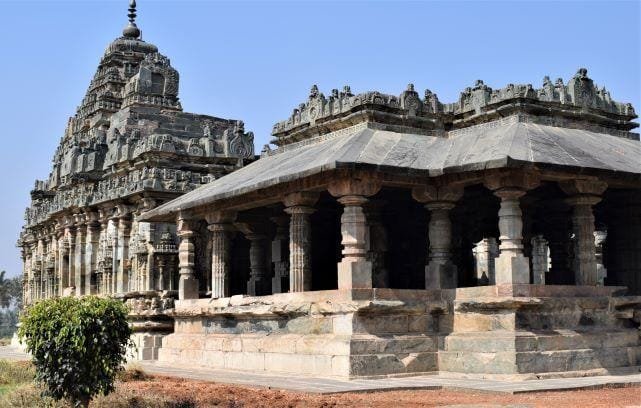
In 1007 CE, she established the Brahma Jinalaya, one of Lakkundi’s important Jain monuments.
She was also associated with the patronage of the celebrated Kannada poet Ranna.
Her story gives us a different way to look at the city.
Lakkundi was not simply a place where rulers ordered temples to be built.
It was a society in which wealthy patrons, religious communities, scholars and poets could influence the cultural landscape.
The stone monuments that remain today are therefore records of social history as much as architectural history.
And if archaeologists discover additional structures, inscriptions or foundations, they may reveal more people whose names never became famous outside the inscriptions they left behind.
Lakkundi Was More Than a City of Temples
One of the easiest mistakes when discussing Lakkundi history is to describe it simply as a temple town.
It was much more complicated.
Lakkundi was associated with learning, religion, commerce, water infrastructure and even coin production.
The Archaeological Survey tradition surrounding the site records its importance as a centre of learning, while historical evidence also points to its role in the monetary and economic life of the region.
Research and archaeological reporting have identified evidence of a mint associated with Lakkundi, including references to coins connected with names such as Lokkigadanya.
That detail changes our mental picture.
Imagine medieval Lakkundi not as a collection of isolated stone temples but as a functioning urban centre.
People lived there.
Merchants moved through it.
Religious communities operated there.
Students and scholars gathered there.
Craftsmen built increasingly sophisticated structures.
Water had to be stored and managed.
Money circulated.
And political power changed hands.
The temples were therefore only one visible part of a much bigger city.
Why Does Lakkundi Have 101 Stepwells?
If the temples tell us about religion and architecture, the stepwells tell another story.
Water.
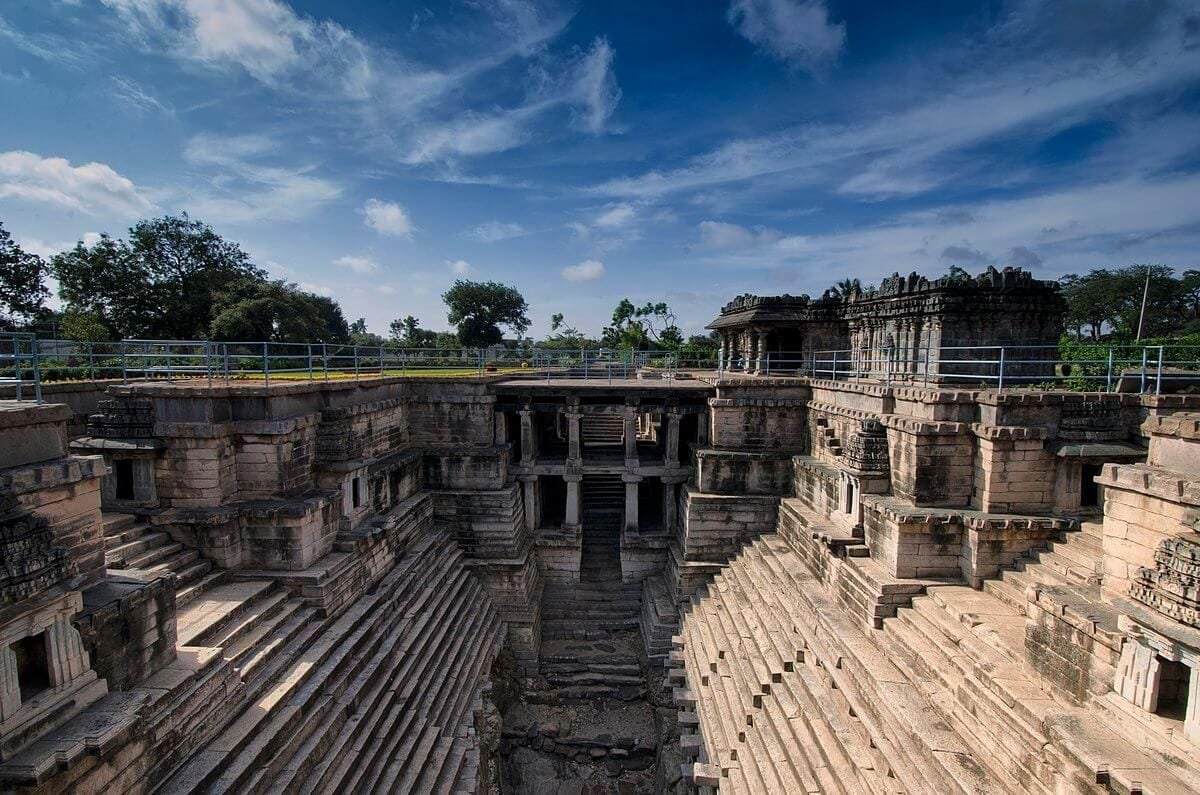
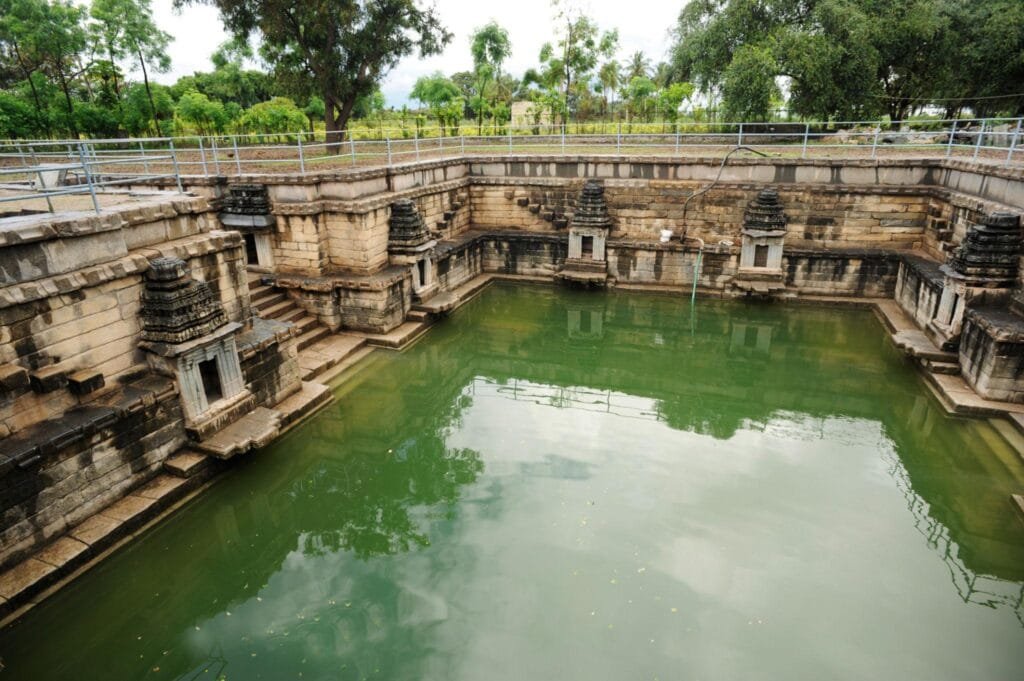
Karnataka’s government describes Lakkundi as having around 101 stepped wells, known as kalyani, alongside its ancient temples and inscriptions.
That number is extraordinary.
But it becomes more understandable when we consider the geography.
Lakkundi lies in the Deccan, where managing water has historically been a major challenge.
Stepwells were not merely decorative.
They could provide access to stored water while also becoming important social and religious spaces.
Some of Lakkundi’s stepwells contain carefully carved architectural elements and niches.
The structures demonstrate that water management could itself become an expression of art and engineering.
This is another reason Lakkundi history cannot be separated from geography.
The city developed within a landscape where survival, urban growth and water management were closely connected.
And if researchers discover additional buried wells, channels or reservoirs, they could potentially learn much more about how the medieval settlement functioned.
The Mystery of the 101 Temples
Now we reach the mystery driving much of today’s archaeological interest.
Local and historical traditions associate Lakkundi with 101 temples and 101 wells.
Yet the number of structures visible today is far smaller.
So where did the others go?
This question has been discussed for years.
Earlier excavations and surveys have already uncovered temple fragments, inscriptions, sculptural pieces and other remains. Recent excavation work near Kote Veerabhadreshwara Temple also identified an ancient temple fragment, a Shivalinga, sculptural remains and a fort-like wall.
But there is an important distinction.
We should not automatically assume that exactly 101 hidden temples are sitting underground waiting to be uncovered.
The figure is part of the historical and local tradition surrounding Lakkundi.
The purpose of the new investigation is precisely to establish what archaeological evidence actually survives.
That makes the story more exciting, not less.
Because the answer is still unknown.
Lakkundi History Is Written in Stone
Before satellites and laser scanners, historians had another technology.
Inscriptions.
Stone inscriptions can preserve names, dates, donations, religious affiliations, political events and details about institutions that might otherwise disappear from memory.
Lakkundi has accumulated a remarkable collection of inscriptions across centuries.
Some are associated with temples and Jain institutions.
Others record donations and public works.
Together, they provide fragments of the social and political world in which Lakkundi developed.
This is one reason historians care so much about the site.
A temple can tell us how people built.
An inscription can tell us why they built it, who paid for it, which ruler was involved and which community used it.
Put those pieces together and Lakkundi history begins to look less like a collection of monuments and more like a reconstruction of an entire society.
The Architecture of Lakkundi Was Ahead of Its Time
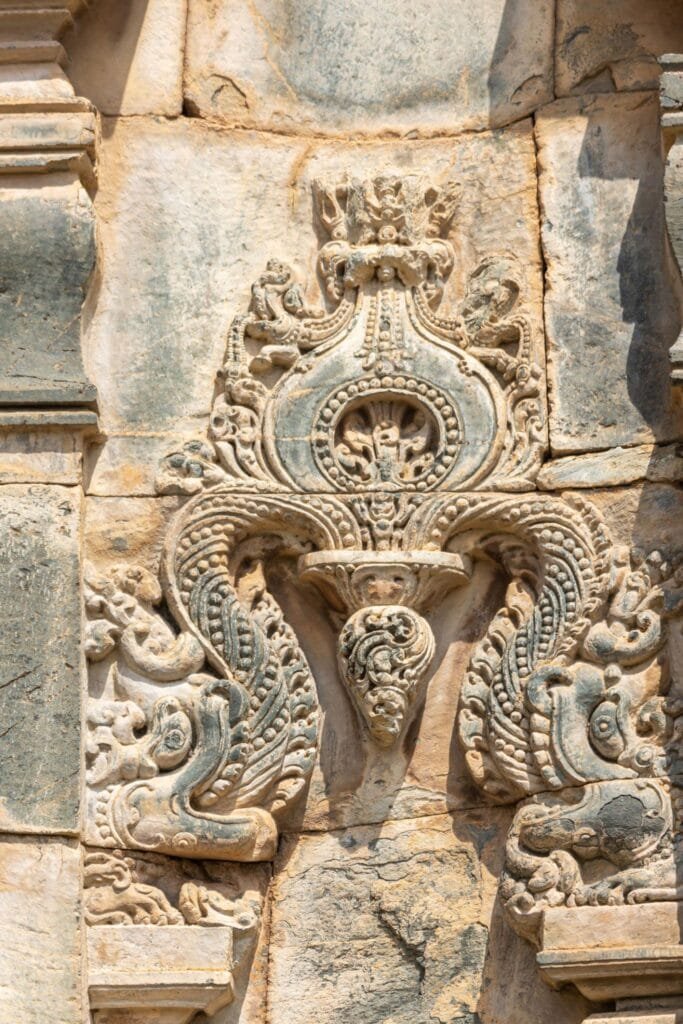
Walk through Lakkundi and another story appears in the stone itself.
The temples associated with the Kalyana Chalukyas are known for sophisticated craftsmanship and architectural experimentation.
The Government of Karnataka describes the architecture of the region as an important link between the earlier Chalukyan traditions of Badami and the later architectural developments associated with the Hoysalas.
The temples are often discussed in relation to the Vesara tradition, incorporating influences associated with Nagara, Dravida and Bhumija architectural forms.
One of the most celebrated monuments is the Kashi Vishwanatha Temple, known for its elaborate ornamentation and finely carved architectural details.
But there is a deeper lesson here.
Architecture does not evolve in isolation.
Ideas travel.
Craftsmen move.
Patrons commission new forms.
Religious communities interact.
Rulers borrow and adapt.
The architecture of Lakkundi is therefore evidence of a wider cultural network across medieval India.
When the City Changed Hands
Lakkundi did not remain permanently under Chalukyan control.
The settlement passed through different political phases, including the Kalachuris, Seunas and Hoysalas. Government and archaeological records also preserve evidence of later structures and changing religious and political landscapes.
The Hoysalas are particularly interesting.
Historical evidence associates Lakkundi with the reign of Hoysala ruler Vira Ballala II, who made it an important political centre.
This tells us something important about Lakkundi history.
The city did not simply rise under one dynasty and immediately disappear.
It continued to matter as political power shifted around it.
Its importance was repeatedly redefined.
And eventually, its role declined.
That decline is one of the biggest unanswered questions surrounding the site.
So What Happened to Lakkundi?
There is no single dramatic answer.
Cities rarely disappear overnight.
Political capitals move.
Trade routes change.
Economic centres shift.
New cities become more important.
Wars can disrupt settlements.
Religious institutions lose patronage.
Buildings are abandoned or reused.
Water systems deteriorate.
And eventually, nature begins reclaiming the spaces people once occupied.
That is probably a better way to understand Lakkundi history than imagining one event that suddenly destroyed the city.
The medieval Lakkundi may have gradually transformed.
Its temples survived because they were made of stone.
Its inscriptions survived because they were carved into durable surfaces.
Its wells survived because some continued to be useful.
But streets, houses, workshops, markets and ordinary buildings were far more vulnerable.
Those are precisely the things archaeology may now help reconstruct.
The Gold Discovery That Reignited Interest in Lakkundi
Then, in January 2026, something happened that seemed almost too appropriate for a city with such a remarkable past.
A 14-year-old boy named Prajwal Ritti reportedly discovered a pot containing gold ornaments and other artefacts while his family was working on the foundation of their house.
The family handed the material to the authorities.
The discovery weighed about 466 grams and attracted considerable public attention.
But the real significance was not simply the gold.
The discovery reminded people that Lakkundi’s archaeological past was not necessarily confined to museums and protected monuments.
It could literally be beneath people’s homes.
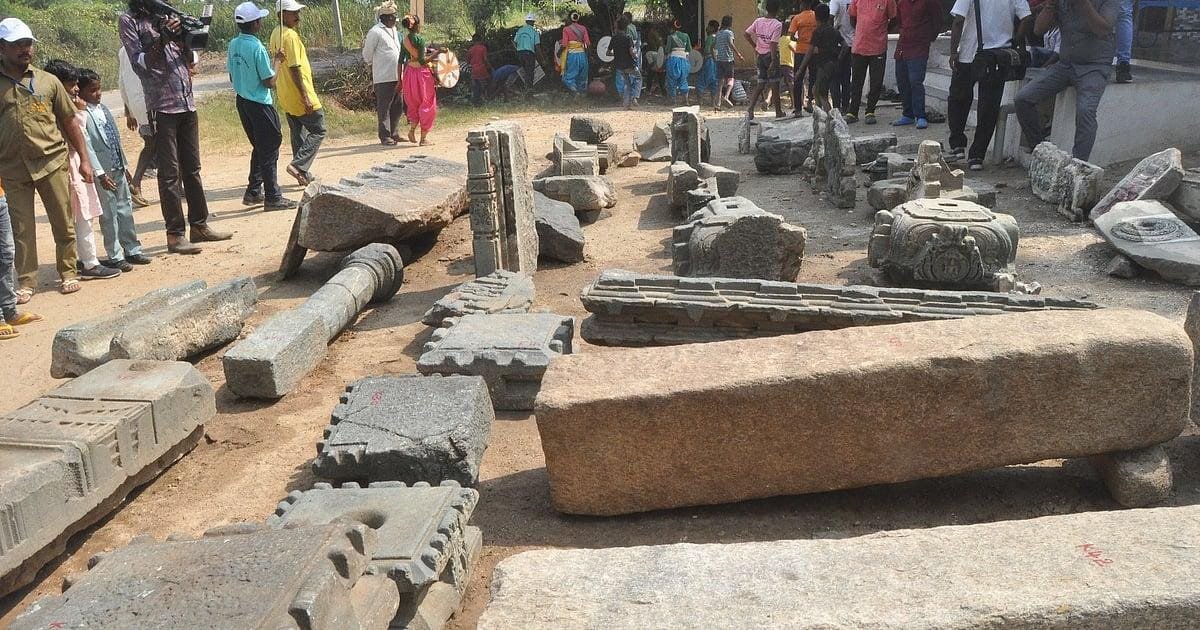
Around the same period, heritage officials and local residents were increasingly working to collect neglected inscriptions, sculptures and architectural fragments scattered throughout the settlement.
An awareness campaign reportedly resulted in teams collecting around 1,000 archaeological pieces from homes and other locations.
Suddenly, the idea of a “hidden Lakkundi” became much more tangible.
Now Scientists Are Going Looking Beneath the Surface
This is where the story comes back to Lakkundi history in 2026.
Karnataka’s Department of Archaeology, Museums and Heritage has entered into an agreement with the National Institute of Advanced Studies to investigate the archaeological landscape using modern scientific tools.
The project is expected to run for approximately six months.
And the toolbox is impressive.
LiDAR
Light Detection and Ranging, or LiDAR, uses laser pulses to measure surfaces and create highly detailed representations of terrain.
For archaeology, this can be useful when vegetation, soil or modern development hides subtle traces of older structures.
GIS
Geographic Information Systems can combine archaeological information with maps and spatial data.
This can help researchers understand how structures relate to one another and to the surrounding landscape.
Ground Penetrating Radar
GPR can help investigate underground features without immediately excavating them.
That can provide clues about buried walls, foundations and other archaeological anomalies.
Drones and Photogrammetry
Drones can capture detailed images of large areas, while photogrammetry can turn overlapping photographs into detailed three-dimensional representations.
Together, these technologies allow researchers to investigate a large archaeological landscape more efficiently than traditional surface surveys alone.
The Lakkundi project will also examine historical photographs and other existing information before identifying potential locations for future excavation.
For readers interested in how technologies like remote sensing evolved, this connects naturally with HypeHive’s earlier exploration of the history of remote sensing.
In Lakkundi, that technological history is no longer abstract.
It is being used to search for India’s physical history.
Why LiDAR Could Change What We Know About Lakkundi
Imagine standing in a field.
You see grass.
Perhaps a few stones.
Nothing that looks like a temple.
Now imagine that beneath that field are the foundations of a structure that collapsed 800 years ago.
The walls may be gone.
Trees may have grown over the remains.
Soil may have accumulated.
Modern activity may have changed the surface.
To the human eye, there may be almost nothing to see.
But the landscape can retain subtle signatures of what existed before.
That is where technologies such as LiDAR become powerful.
The goal is not to make history appear magically.
It is to identify patterns that tell archaeologists where they should look next.
The Lakkundi project therefore represents an important shift in archaeological investigation.
Instead of excavating blindly across a huge area, researchers can use digital mapping and non-invasive techniques to narrow down promising locations.
And that could make the next chapter of Lakkundi history very different from the previous ones.
What Could Archaeologists Find?
There are several possibilities.
They could find additional temple foundations.
They could identify buried stepwells.
They could map old roads or settlement boundaries.
They could discover evidence of houses and other ordinary structures.
They could identify water-management systems.
They could locate fortifications.
They could find inscriptions or sculptures that have been buried or reused.
Or they could discover that some popular assumptions about the old city were wrong.
That last possibility is just as important.
Archaeology is not supposed to prove a story simply because the story is attractive.
It is supposed to test the story against evidence.
That is why the current investigation matters.
If researchers discover more structures, Lakkundi history becomes richer.
If they discover fewer than expected, that is also valuable.
Either way, the archaeological record becomes clearer.
Could Lakkundi Become Karnataka's Next Major Heritage Destination?
There is another reason the current investigation matters.
The Karnataka government is preparing a Detailed Project Report connected with efforts to propose Lakkundi for inclusion on the UNESCO World Heritage tentative list.
That could potentially transform the settlement.
More visitors could mean:
- greater tourism revenue,
- more local employment,
- improved conservation,
- stronger archaeological research,
- and greater international recognition.
But heritage tourism also brings risks.
Too many visitors can damage fragile monuments.
Unplanned construction can threaten archaeological layers.
Commercial development can alter historic landscapes.
And local residents should not become secondary to the heritage being promoted around them.
The challenge will therefore be to preserve Lakkundi as a living historical landscape, not simply turn it into a collection of tourist attractions.
The Bigger Question: What Is Still Missing From India's History?
This may ultimately be the most important lesson from Lakkundi history.
India has thousands of known monuments.
But the visible monuments are not the complete historical record.
Cities change.
Buildings disappear.
Names change.
Roads move.
Rivers shift.
Communities migrate.
And entire neighbourhoods can vanish while a temple survives.
Modern archaeology gives us a chance to recover some of those missing pieces.
Lakkundi is particularly valuable because the clues are layered.
There are temples.
There are stepwells.
There are inscriptions.
There are archaeological fragments.
There are historical traditions.
There are later structures.
There are oral memories.
And now there is modern technology capable of examining the landscape in ways earlier generations could not.
That combination makes the site extraordinary.
Lakkundi Is Not Lost — It Is Incomplete
Perhaps calling Lakkundi a “lost city” is not entirely accurate.
The city never completely disappeared.
People continued living there.
Its temples remained.
Its stepwells survived.
Its inscriptions remained carved into stone.
Its name continued through generations.
What was lost was the complete picture.
And that is what today’s researchers are trying to recover.
The current investigation may reveal that the legendary 101 temples and 101 wells were more complicated than the tradition suggests.
It may reveal forgotten neighbourhoods.
It may uncover new inscriptions.
It may change our understanding of Chalukyan urban planning.
It may reveal how water, religion and commerce interacted.
Or it may simply show archaeologists where the surviving evidence ends.
Every one of those outcomes would add another piece to India’s past.
From Chalukyan Stones to Laser Scanners
There is something almost poetic about what is happening at Lakkundi.
More than a thousand years ago, craftsmen carved temples out of stone.
Scholars recorded donations in inscriptions.
Communities built stepwells to manage water.
Patrons supported temples, Jain institutions and literature.
Rulers used Lakkundi as an important centre of power.
Then centuries passed.
The city changed.
Some structures survived.
Others disappeared.
And now, in the 21st century, scientists are returning with lasers, radar, drones and digital maps.
They are asking the same basic question historians have asked for generations:
What was Lakkundi really like?
The difference is that today’s researchers have tools that the historians of a century ago could only have imagined.
And that is why this moment matters.
The technology is modern.
The questions are ancient.
The Future of Lakkundi History Is Being Written Now
The story of Lakkundi began long before modern Karnataka existed in its current form.
It passed through the worlds of the Chalukyas, Kalachuris, Seunas and Hoysalas.
It became a centre of religion, learning, architecture, commerce and water management.
People such as Attimabbe left their mark on its cultural history.
Its craftsmen produced monuments that still survive.
Its wells preserve evidence of sophisticated water architecture.
Its inscriptions preserve fragments of voices from centuries ago.
And yet, much remains unknown.
That is why the new investigation is so important.
The question is no longer simply what can we see at Lakkundi?
It is:
What can modern science reveal about what we cannot see?
If buried structures are identified, the archaeological map of the settlement could change.
If new inscriptions are discovered, historical interpretations could change.
If forgotten water systems are mapped, our understanding of medieval urban life could change.
And if the investigation helps establish the full extent of Lakkundi’s heritage, it could strengthen the case for protecting the site for generations to come.
For now, the ground is still keeping some of its secrets.
But for the first time, modern technology is giving researchers a better way to ask the ground to give them back.
Lakkundi was once a great city.
Perhaps we are only beginning to discover how great it really was.
Frequently Asked Questions About Lakkundi History
Lakkundi is famous for its medieval temples, ornate Chalukyan architecture, stepwells, Jain heritage and historical inscriptions. The Government of Karnataka describes more than 50 ancient temples and 101 stepped wells at the site.
What was Lakkundi called in ancient times?
Inscriptions refer to Lakkundi as Lokki Gundi. The modern name Lakkundi developed from this historical name.
Which dynasty is Lakkundi most famous for?
Lakkundi is particularly associated with the Kalyana Chalukyas, whose rule between the 10th and 12th centuries produced many of the site’s best-known monuments. However, its history also includes the Kalachuris, Seunas and Hoysalas.
What is the 101 temples and 101 wells story?
The tradition surrounding Lakkundi refers to 101 temples and 101 wells or stepwells. Archaeologists are investigating how much of this historical landscape survives and whether additional structures remain concealed.
Why is Lakkundi being surveyed with LiDAR?
LiDAR is being used as part of a wider archaeological investigation to identify possible concealed or buried structures. The project also includes GIS, remote sensing, GPR, drones and photogrammetry.
Who was Attimabbe?
Dāna Chintāmaṇi Attimabbe was a prominent patron of Jainism and literature during the Kalyana Chalukya period. She established the Brahma Jinalaya at Lakkundi in 1007 CE and was associated with the patronage of Kannada poet Ranna.
Is Lakkundi being considered for UNESCO recognition?
Yes. Karnataka is preparing a Detailed Project Report as part of efforts connected with proposing Lakkundi for inclusion on the UNESCO World Heritage tentative list.
Sources & Further Reading
For readers who want to go deeper, the strongest references for this article are the Government of Karnataka’s Gadag District heritage page, Karnataka Tourism material, and current reporting on the archaeological investigation.
HypeHive’s own History of Remote Sensing is also a particularly relevant internal read because the same technology story now intersects directly with Lakkundi’s archaeological investigation.
You can also connect this article to HypeHive’s broader “hidden history” theme through Top 10 Hidden Historical Events That Changed the World.
For the wider infrastructure-and-geography side of HypeHive, Ken–Betwa Link Project Explained provides another example of how modern India is reshaping landscapes that have much older histories.
