
Last updated: 10 November 2026
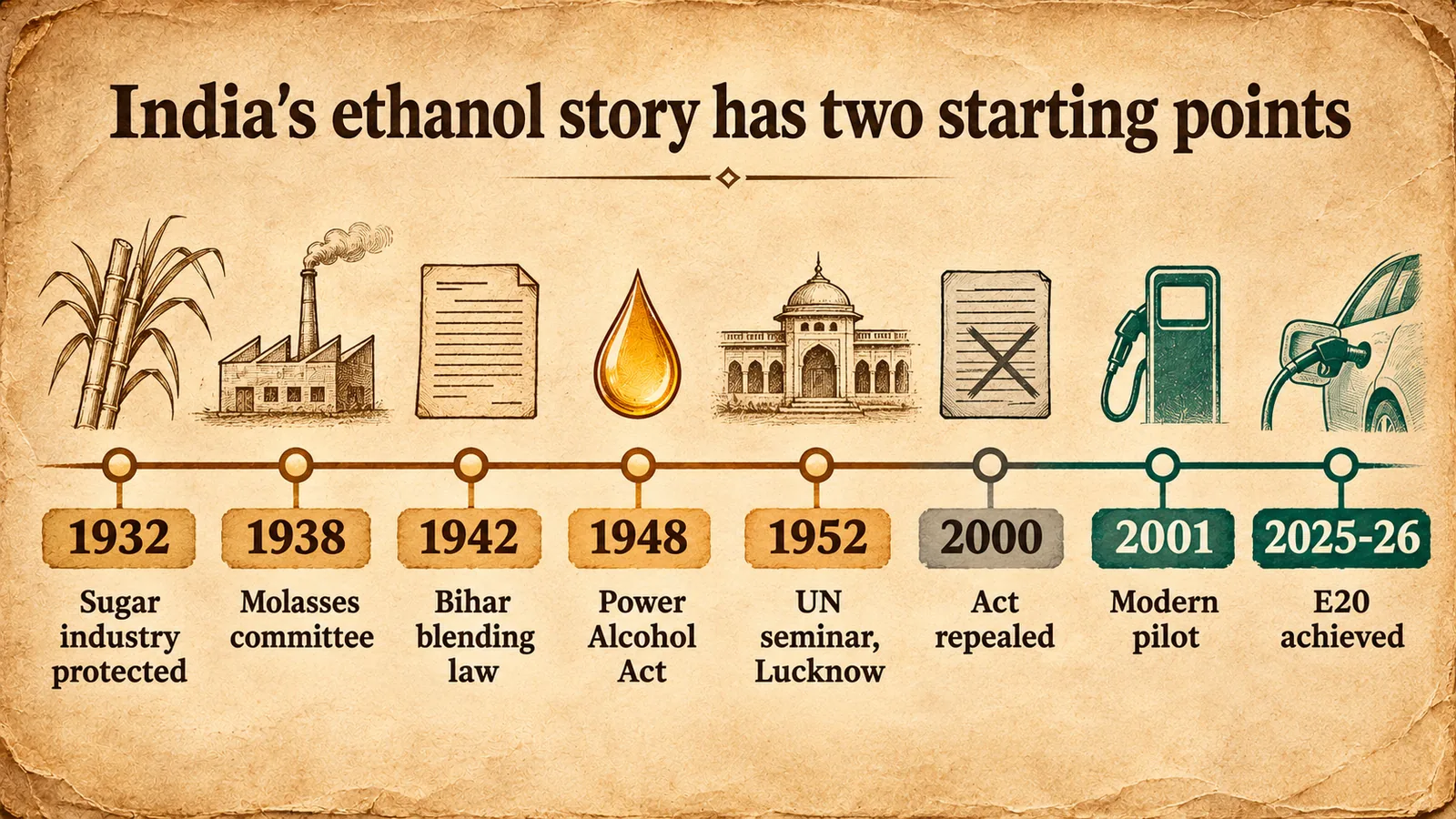
Short answer: Ethanol blending in India began in the 1940s, not 2001. Bihar’s 1942 Power Alcohol Act barred the sale of petrol without an admixture of power alcohol, and the Indian Power Alcohol Act, 1948 allowed 5–25% alcohol in motor fuel. The modern Ethanol Blended Petrol Programme began as a pilot in 2001 and averaged 20% blending in 2025–26.
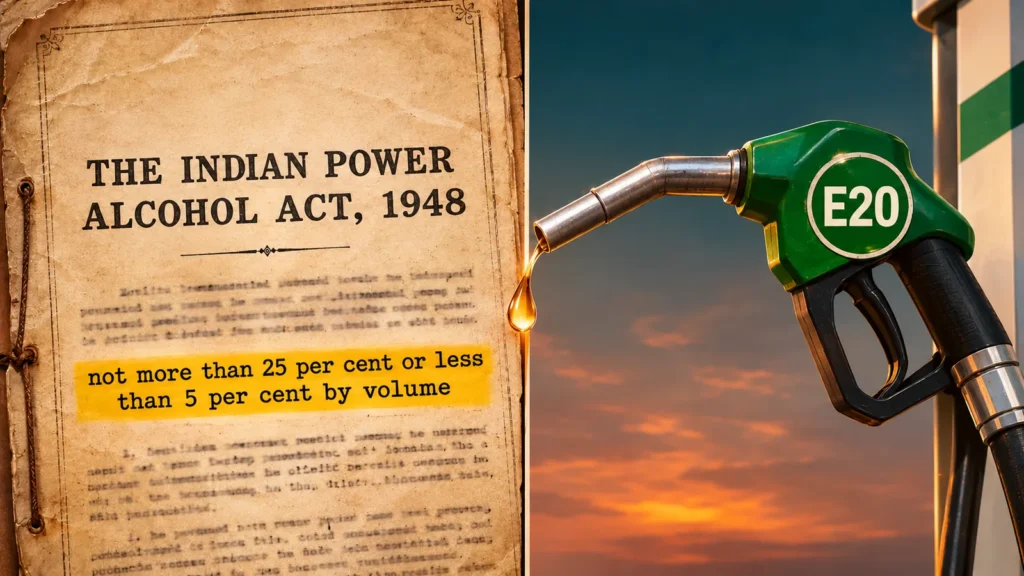
Ethanol blending started in India decades before the 2001 pilot project that politicians now argue over: in 1948, a national law already allowed petrol to carry up to 25 per cent alcohol. That law, the Indian Power Alcohol Act, stayed on the statute book for 52 years before Parliament repealed it in 2000. Almost nobody arguing about E20 today mentions it.
This month’s argument is about testing. On 6 November 2026, Karnataka’s government said tests on 63 petrol samples from seven districts had found ethanol content as high as 31.2 per cent, well above the 20 per cent blend sold as E20, and asked the Centre for an explanation, as Newslaundry reported. The state-run oil marketing companies rejected the finding. They said the third-party laboratories had skipped statutory sampling procedures, and that 893 samples from 27 states and union territories, 56 of them from Karnataka, met the national fuel standard IS 17021, according to Autocar Pro. As of 10 November, neither set of figures has been independently confirmed.
Under the testing fight sits an older quarrel over who started all this. An RTI-based report in Business Today traced E20’s roots to notifications issued under the Vajpayee government in 2001 and 2002. In July 2026, an IANS report carried by Telangana Today quoted the Petroleum Ministry as saying blending began well before the present government, under a headline crediting the UPA. The ministry’s own FAQ on the programme, dated 10 July 2026, asks whether ethanol is “a new fuel that India invented or rushed into”. Its answer points to Brazil and the United States and gives a timeline that starts in 2001.
Every one of those accounts starts too late. Between 1940 and 1948, Indian provinces and then the central government wrote petrol–alcohol blending into law. Their reasons were almost the ones given for E20 today: too much sugarcane by-product, too much imported fuel, and a fear of running dry in an emergency. This article follows that forgotten chain from the sugar boom of the 1930s to this month’s row, using the text of the laws themselves.
When did ethanol blending start in India?
Ethanol blending in India has two starting points. The modern Ethanol Blended Petrol (EBP) Programme began as a pilot in 2001. The legal history is about sixty years older: Bihar made blended petrol compulsory under a 1942 law, and the Indian Power Alcohol Act, 1948 set national rules for mixing alcohol into motor fuel.
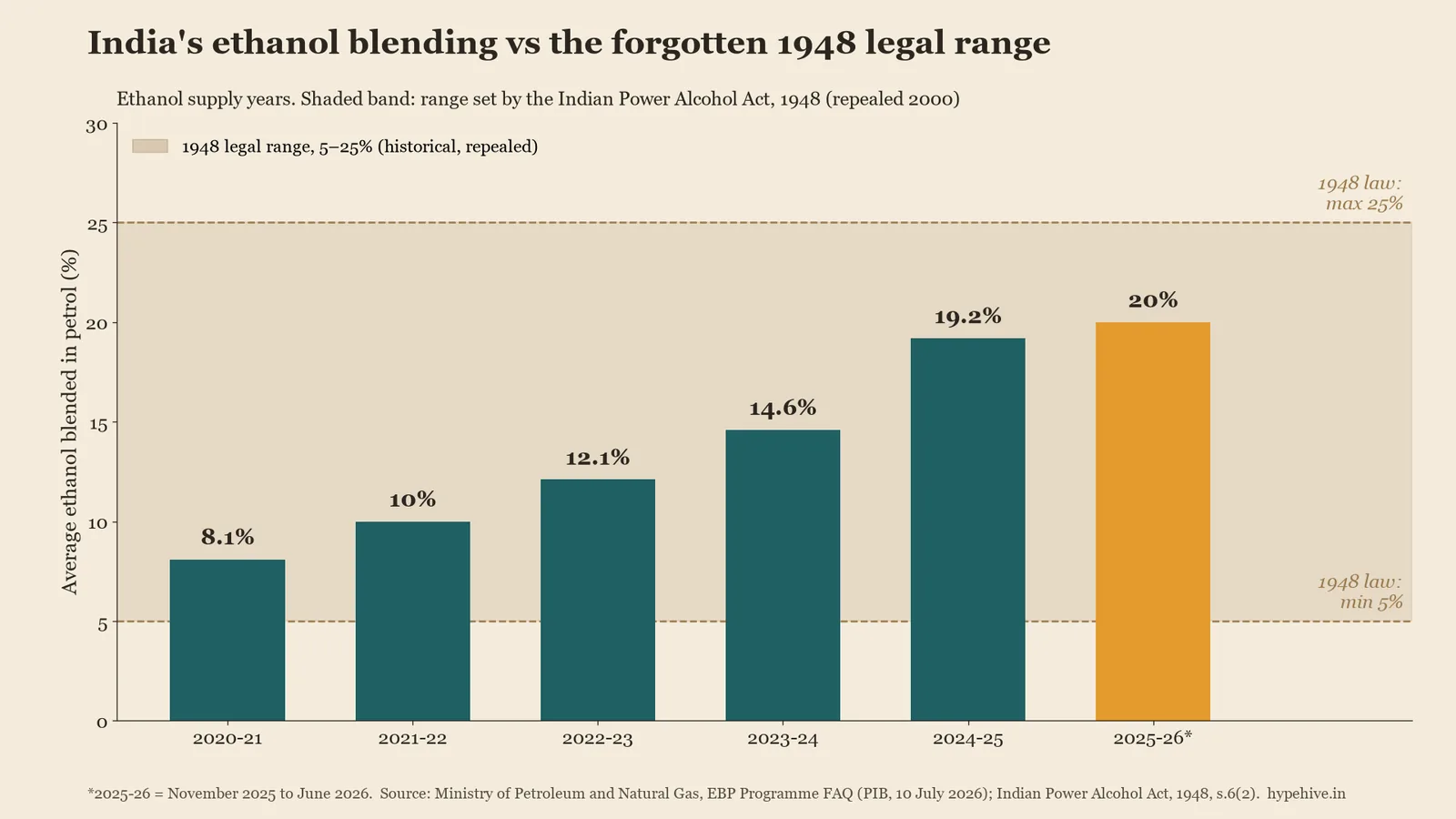
The modern timeline is well documented. According to the Petroleum Ministry’s FAQ, a pilot began in 2001, the programme was formally announced in 2004, E5 (5 per cent ethanol) reached several states in 2006, and a policy framework was notified in the Gazette of India in January 2013. Blending stayed near 1.5 per cent until 2014. It then rose to about 8.1 per cent in 2020–21, 10 per cent in 2021–22, 12.1 per cent in 2022–23, 14.6 per cent in 2023–24 and 19.2 per cent in 2024–25, before averaging 20 per cent between November 2025 and June 2026.
Even that modern record has a wrinkle. The Indian Economic Service’s Arthapedia dates the first mandate to 2003, when a 5 per cent blend was required in nine states and four union territories. The ministry’s FAQ names 2004 as the year of the formal announcement. Both can be true: an order was issued in 2003, and the programme was announced as a national scheme the following year.
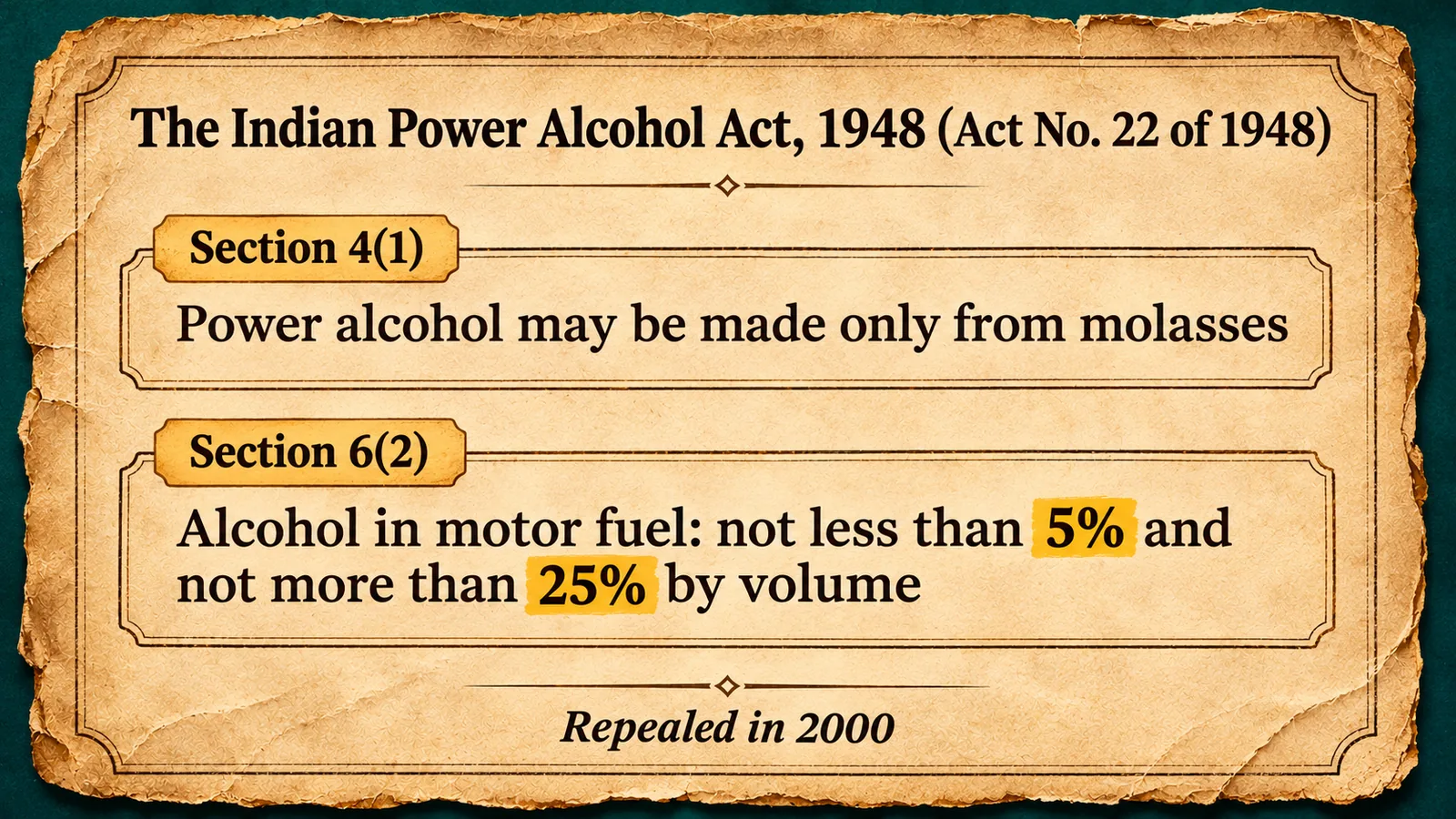
The older record is simpler to state, because it sits in the statute books. Section 3(1) of Bihar’s power alcohol law said that no petrol “shall be sold except with an admixture” of power alcohol supplied by the state government, according to the text of the Bihar Power Alcohol Act as re-enacted in 1948. Section 6(2) of the national 1948 Act set the share of alcohol in motor fuel at no more than 25 per cent and no less than 5 per cent by volume.
The sugar boom that left India with a molasses problem
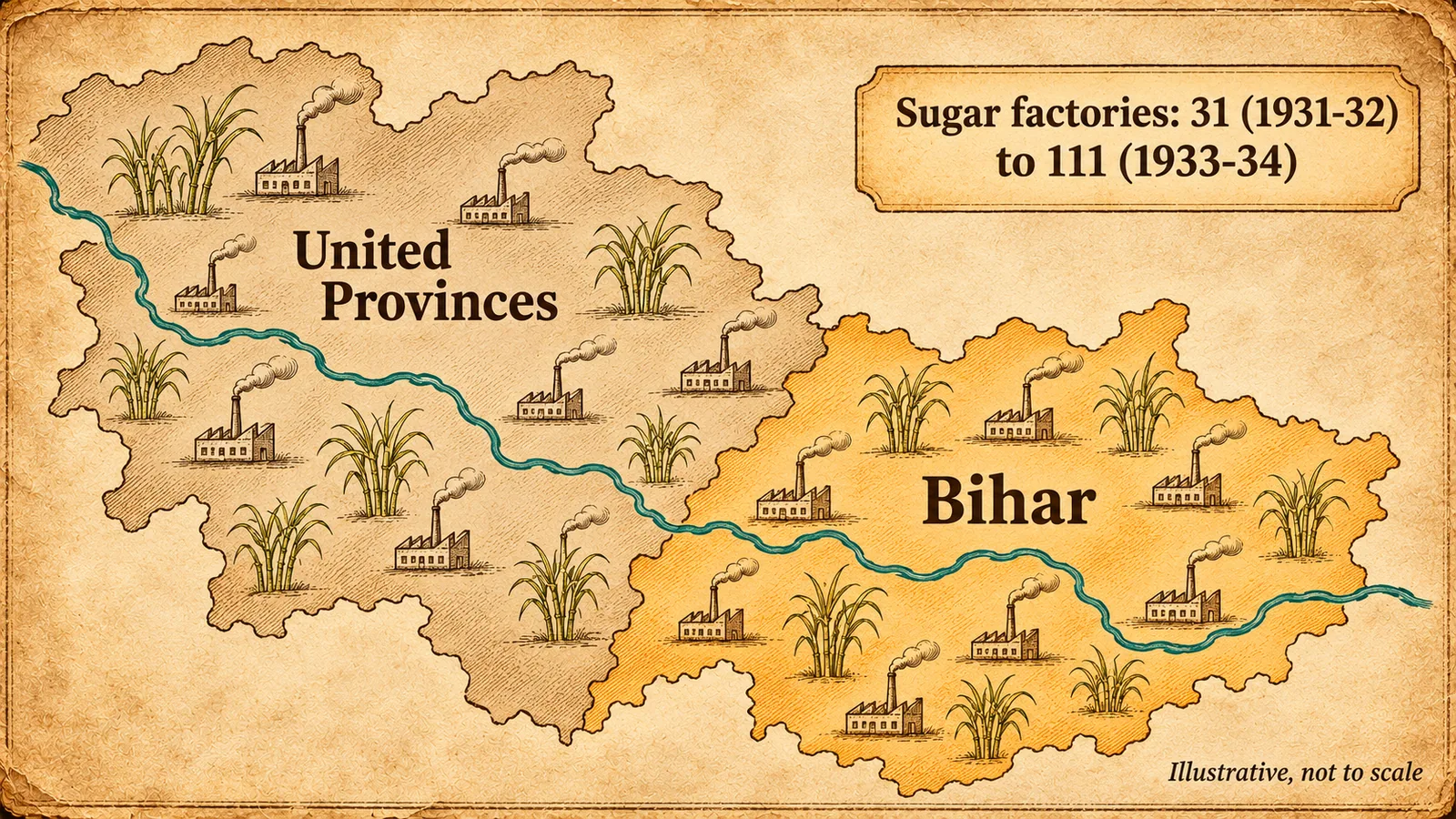
The history of ethanol blending in India starts with sugar. After the British Indian government gave the sugar industry tariff protection in 1932, mills multiplied across the United Provinces (today’s Uttar Pradesh) and Bihar. Every one of them produced molasses, a by-product that had few buyers.
The Sugar Industry (Protection) Act, 1932 raised duties on imported sugar to shelter Indian producers. The growth that followed was steep. The number of sugar factories rose from 31 in 1931–32 to 111 in 1933–34, according to figures summarised in the Supreme Court’s 1956 judgment in Ch. Tika Ramji v. State of Uttar Pradesh.
Molasses is the dark, syrupy residue left after sugar crystals are extracted from cane juice. It ferments easily, which makes it a natural raw material for alcohol. In the 1930s, much of it in north India was simply waste.
Officials in the two biggest sugar provinces saw an opportunity. In 1938, a Power Alcohol and Molasses Committee for the United Provinces and Bihar recommended that sugar mills convert molasses into alcohol rather than dump it, according to historian Bill Kovarik’s research on the global history of ethanol fuel. A 2023 report by Arcus Policy Research also cites the committee, drawing on Kovarik. The committee’s original report could not be located online for this article.
What is power alcohol?
Power alcohol is ethanol made to be burned as fuel, not drunk or used in factories. In Indian law it meant alcohol, made mainly from molasses, that was mixed with petrol to run engines.
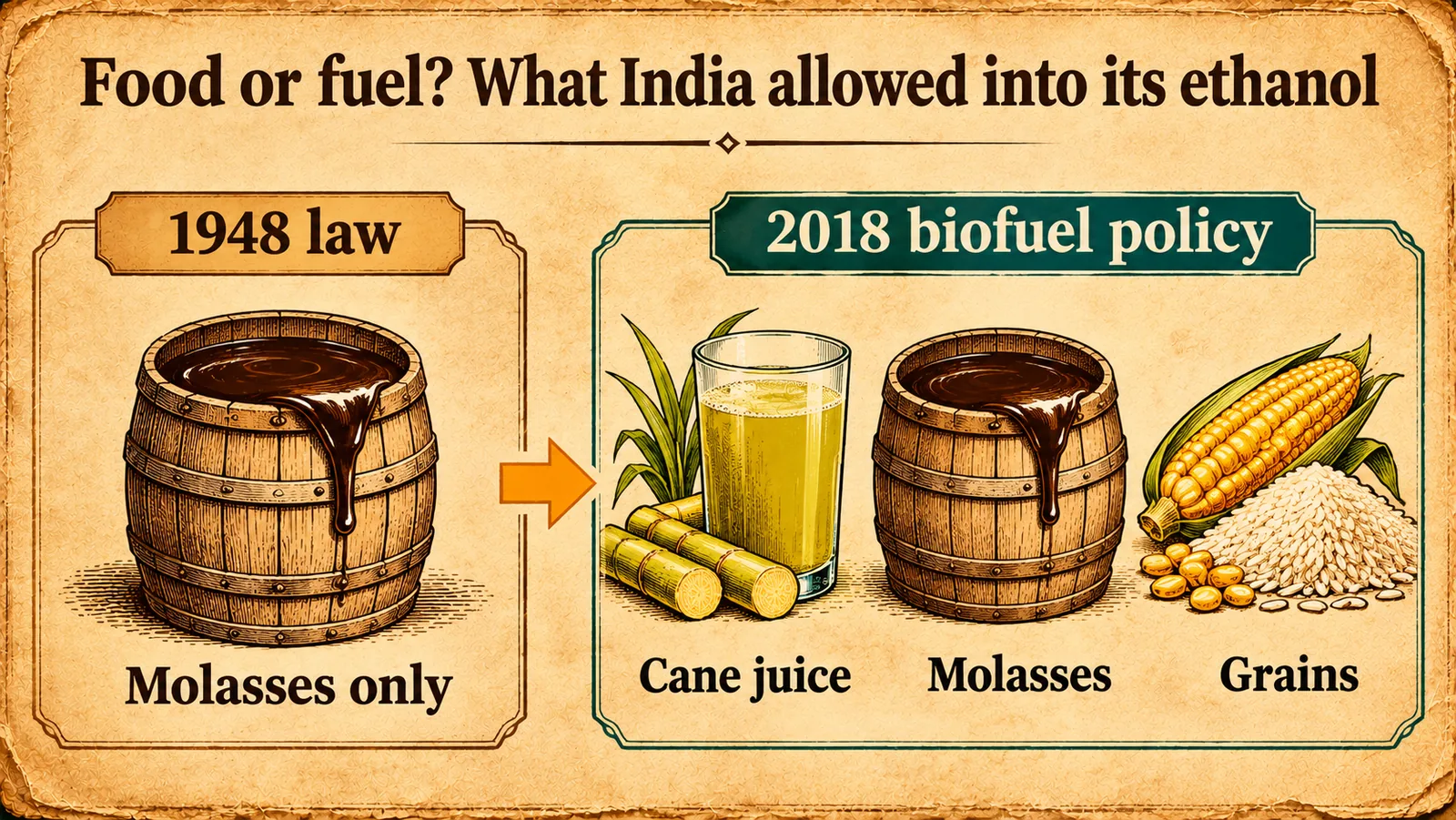
The 1948 Act limited power alcohol to molasses. Section 4(1) barred anyone from making it “from any substance other than molasses” unless the central government allowed another raw material, according to the text of the Act. Chemically, it is the same ethanol that goes into E20 petrol today.
War, governor’s rule and petrol sold “with an admixture”
India’s first blending mandates came during the Second World War, and at least one was made without an elected government. Bihar’s Power Alcohol Act of 1942 was enacted by the provincial Governor using emergency powers, after the elected Congress ministry had resigned in protest at India being taken into the war.
The Bihar law’s own preamble says the 1942 Act was made by the Governor of Bihar under a proclamation dated 3 November 1939. That proclamation came amid a constitutional crisis. In October and November 1939, Congress ministries in several provinces resigned because the Viceroy had declared India at war without consulting Indian leaders. On 7 November 1939, Britain’s House of Commons was told that Governors had “no option but to assume” the powers of government by proclamation under Section 93 of the Government of India Act, 1935, according to the Hansard record of that debate. Bihar’s blended-petrol mandate was written under that arrangement.
The United Provinces may have moved even earlier. According to Kovarik, the province passed a law in 1940 requiring 20 per cent power alcohol in petrol, and several other provinces followed. The original text of the UP law could not be located for this article, so the details rest on his account.
The war made the case for alcohol fuel urgent. Kovarik, citing a 1952 United Nations seminar report, writes that civilian transport in India had nearly stopped for lack of petrol by 1943, and that alcohol was used as an emergency fuel.
The Indian Power Alcohol Act, 1948: India’s first national ethanol law
The Indian Power Alcohol Act, 1948 (Act No. 22 of 1948) made ethanol blending national policy within a year of Independence. It put the power alcohol industry under central control, restricted its raw material to molasses, and required alcohol in motor fuel to make up 5 to 25 per cent of the mix by volume.
The Act’s preamble declared it “expedient in the public interest” that the power alcohol industry be developed under the control of the central government. Two published copies of the Act, on LatestLaws and Indian Kanoon, give the same 5–25 per cent range in Section 6(2). The two databases give different dates for when the Act took effect, so this article uses only the year.
Legal summaries of the Bill’s statement of objects describe three purposes: using molasses that would otherwise go to waste, bringing down the price of sugar, and reducing India’s dependence on imported petrol. They also describe the industry as a reserve for emergencies. The same summaries record that an expert panel had recommended making blending compulsory across the country. The full statement could not be retrieved for this article, so these aims are given as summarised, not quoted.
Bihar kept its own law running alongside the national one. In April 1948 the province re-enacted its 1942 law as Bihar Act 19 of 1948, keeping the rule that petrol could be sold only with power alcohol mixed in. Bihar’s version stayed on the books until it was repealed in 2006.
The 1948 ceiling of 25 per cent was higher than the 20 per cent sold as E20 today. That comparison is history, not law. The 1948 Act no longer exists, and its limits say nothing about whether this month’s Karnataka samples are within current standards.
How much alcohol actually reached India’s fuel tanks?
Very little. India used about 8 million litres of alcohol fuel in 1946 and about 9 million at the peak in 1948, according to figures from a 1952 UN seminar report cited by Kovarik. Around 20 million litres went into blends in 1951, against roughly a billion litres of petrol. That is about 2 per cent, a long way below the law’s 5 per cent floor.
Why the gap was so wide is not recorded in the sources found for this article. One plausible reading, offered here as interpretation, is that molasses supply depended on each cane harvest and that imported petrol became easier to obtain once the war ended. The records do not say how strictly the 1948 ratios were enforced, or where.
Food or fuel? The 1952 Lucknow seminar
India was arguing about food versus fuel in 1952. That October, the United Nations held a seminar on power alcohol in Lucknow, and India’s position was that grain and root crops should not be turned into fuel while the country was short of food.
The seminar met on 23 October 1952 and was organised by the UN Economic Commission for Asia and the Far East (ECAFE) and the UN Technical Assistance Administration. Its papers were later cited in the UN Food and Agriculture Organization’s forestry journal, Unasylva. According to Kovarik’s account, Kanaiyalal Maneklal (K.M.) Munshi, then Governor of Uttar Pradesh, opened the meeting, and Indian delegates said cereals and root crops could not be spared for alcohol.
The argument is back. India’s National Policy on Biofuels, 2018 widened the range of raw materials that can be used for ethanol, as the Petroleum Ministry itself has noted, and grain-based ethanol is now part of the supply. Sugarcane is also a thirsty crop, which ties ethanol to India’s long history of managing scarce water. The 1948 law answered the food-or-fuel question by allowing molasses only. Today’s policy answers it differently.
Why was the Power Alcohol Act repealed?
Parliament repealed the Indian Power Alcohol Act through the Indian Power Alcohol (Repeal) Act, 2000 (Act No. 32 of 2000), dated 25 August 2000. The repeal law has a single operative line: “The Indian Power Alcohol Act, 1948 is hereby repealed.”
The Bill’s statement of objects and reasons, as summarised in parliamentary records, said a review commission had found the 1948 Act “dysfunctional” and that it had “outlived its utility”. It also said the situation had changed because molasses was by then a raw material for the potable alcohol and alcohol-based chemical industries. In other words, the by-product that had been waste in 1938 had found paying customers. The full text of the statement could not be retrieved for this article.
The timing is striking, though it is interpretation rather than recorded fact. The national power alcohol law disappeared in August 2000. The ethanol pilot began in 2001 and is now described as the start of India’s ethanol story. The records reviewed here do not show whether officials in 2001 knew about the earlier law.
So who started ethanol blending in India?
No single government started ethanol blending in India. British-run provincial administrations required it in the early 1940s, independent India’s central legislature made it national law in 1948, and every government since 2001 has added a stage to the modern programme.
The documents support a sequence, not a single owner:
- 1938–1942: a UP–Bihar committee recommends power alcohol (according to Kovarik); the United Provinces reportedly legislates blending in 1940; Bihar’s Governor enacts a compulsory blending law in 1942.
- 1948: the Indian Power Alcohol Act sets a national 5–25 per cent range.
- 2001–2006: the modern pilot (2001), the first E5 mandate (2003, according to Arthapedia), the formal announcement (2004) and the wider E5 rollout (2006).
- 2013–2026: the Gazette framework (2013), the National Policy on Biofuels (2018), and E20 averaging 20 per cent by 2025–26.
What the evidence shows is the dates and the texts of the laws. “Our government started it” is a claim about credit, and on this record no government can make it alone. What remains unknown is how the 1940s laws worked in practice, because the original UP law, the 1938 committee report and the 1952 UN report were not available online for this article.
Why is ethanol added to petrol? The same reasons in 1948 and 2026
Ethanol is added to petrol in India for three reasons: to use surplus sugar-industry output, to cut the bill for imported fuel, and to have a domestic fuel supply in a crisis. Each of those reasons appears in some form in both the 1948 law and the 2026 policy.
| Reason | 1948 (as summarised from the Act’s objects) | 2026 (Petroleum Ministry FAQ) |
|---|---|---|
| Sugar-industry surplus | Use molasses that would otherwise be wasted | ₹1.66 lakh crore paid to farmers since 2014–15 |
| Fuel imports | Reduce dependence on imported petrol | ₹1.97 lakh crore saved in foreign exchange since 2014–15 |
| Emergency supply | An industry held in reserve for emergencies | Framed as strengthening energy security |
| Feedstock rule | Molasses only (Section 4(1)) | Cane juice, molasses and grains permitted |
India still imports most of the crude oil it uses. That is why the import argument has lasted, from wartime rationing to how India refines the crude it imports today.
India vs Brazil
Brazil is usually held up as the ethanol pioneer, and it did move first. Brazil required a 5 per cent blend in 1931 and launched its large-scale Proálcool (Proalcool) programme in 1975, according to ThePrint’s comparison of national blending policies. India’s provincial mandates of the early 1940s followed Brazil’s by about a decade, and its national law came in 1948, nearly thirty years before Proálcool. The difference is that Brazil kept going and India stopped.
What the forgotten history explains about the E20 row
The 1940s laws show that the hard questions in the E20 row are old ones: who decides how much alcohol goes into petrol, who supplies it, and who checks what reaches the pump. In 1942 a province controlled supply; in 1948 control moved to the Centre. In 2026 a state government is testing fuel sold under central standards.
Under Bihar’s 1942 law, the state government supplied the power alcohol that went into its petrol. The 1948 national Act moved control of the industry to the Centre. Today, fuel standards such as IS 17021 are set nationally, the oil marketing companies are central public-sector firms, and Karnataka is a state government challenging the product with its own tests. That pull between state and Centre over fuel is older than the Constitution.
Testing disputes about what is in everyday products are not new either. They belong to India’s long fight over what goes into what we buy. On the specific claim, the record as of 10 November 2026 is two contradictory sets of lab results: Karnataka’s figure of up to 31.2 per cent, and the oil companies’ 893 compliant samples. This article takes no position on which is correct.
What the history does settle is the frame. E20 is not a new experiment imposed on a country that had never tried it. It is the second attempt at a policy India first wrote into law during a world war, for sugar mills that had more molasses than they could sell. The first attempt faded quietly and was repealed in 2000. Whether the second one lasts depends on the same things that decided the first: how much cane and grain there is, what imported oil costs, and whether motorists trust what comes out of the nozzle.
Sources
- Indian Power Alcohol Act, 1948 (Act No. 22 of 1948) — LatestLaws
- Indian Power Alcohol Act, 1948 — Indian Kanoon
- Indian Power Alcohol (Repeal) Act, 2000 (Act No. 32 of 2000)
- Power Alcohol Act, 1948 (Bihar Act 19 of 1948), re-enacting the Bihar Power Alcohol Act, 1942
- Sugar Industry (Protection) Act, 1932
- Hansard, House of Commons, 7 November 1939: India (Government)
- Ministry of Petroleum and Natural Gas, Ethanol Blended Petrol Programme FAQ, 10 July 2026 (PIB)
- William Kovarik, “Ethanol’s First Century”
