
India’s relationship with water is far older than its modern dams, canals and pipelines. Water management in India has evolved for thousands of years, shaped by the monsoon, geography, agriculture, cities, kingdoms, technology and the simple fact that water is never distributed evenly across the subcontinent. From the reservoirs of the Indus Valley cities to today’s digital water databases and artificial intelligence, India has repeatedly reinvented the way it collects, stores, moves and shares water.
That long history matters even more today.
In September 2026, the Indian government placed water data, artificial intelligence, water-saving technologies and source sustainability at the centre of national discussions on water security. The National Departmental Summit on Water called for water-sector data to be brought together, systematically managed and analysed, with AI being considered for data collection and analysis.
At almost the same moment, another old problem returned to the headlines: the future of the Ganga water-sharing arrangement at Farakka. India is reviewing the treaty with Bangladesh as its 2026 expiry approaches, while concerns from Bihar have highlighted a fundamental question that has followed Indian water systems for centuries:
Who gets the water, where does it go, and who decides?
To understand India’s water future, it helps to go back to the beginning.
Why Water Has Always Mattered in India
India’s geography makes water management unusually complicated.
The country contains Himalayan rivers that receive snow and glacier melt, peninsular rivers dependent more heavily on seasonal rainfall, enormous groundwater reserves, arid regions, flood-prone plains, coastal areas and cities increasingly dependent on engineered water networks.
And above all of these sits the monsoon.
The monsoon does not simply determine whether India gets rain. It strongly influences agriculture, reservoirs, groundwater recharge, river flows and the seasonal availability of water.
That is why water management in India has never been only about finding water.
It has been about timing water.
Rain may arrive in enormous quantities during a few months, while many regions experience water stress during the dry season. A successful water system therefore has to capture excess water, store it, distribute it and protect it until it is needed.
That basic problem is thousands of years old.
The Beginning of Water Management in India
Long before modern India existed as a political entity, settlements had already developed sophisticated ways of dealing with water.
One of the clearest examples comes from the Harappan or Indus Valley Civilization.
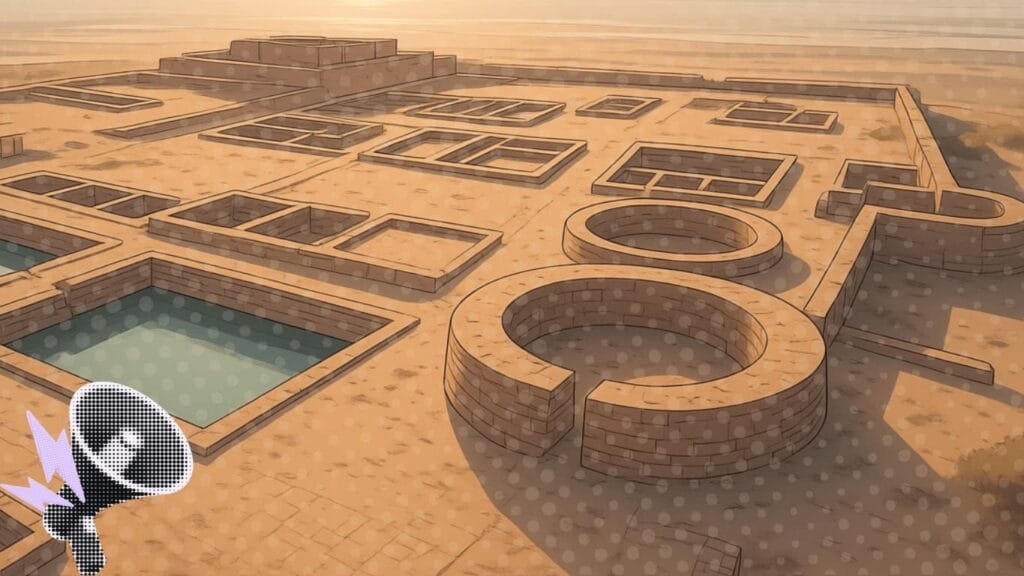
Cities such as Mohenjo-daro and Harappa are well known for their streets and drainage systems, but one of the most fascinating examples is Dholavira in present-day Gujarat.
Dholavira existed roughly between 3000 and 1500 BCE in an extremely dry environment. UNESCO describes its water infrastructure as a sophisticated system developed to help the settlement survive where water was scarce. Seasonal streams were channelled and stored through an extensive network of reservoirs and other structures.
This changes the way we should think about ancient India.
The earliest story of water management in India is not simply a story about wells.
It is a story about urban planning, storage, drainage and adaptation to local geography.
Dholavira’s builders faced a problem that still exists today: rainfall alone was not enough. Water had to be captured when available and retained for later use.
The technology was different.
The problem was remarkably familiar.
Dholavira: When a City Was Designed Around Water
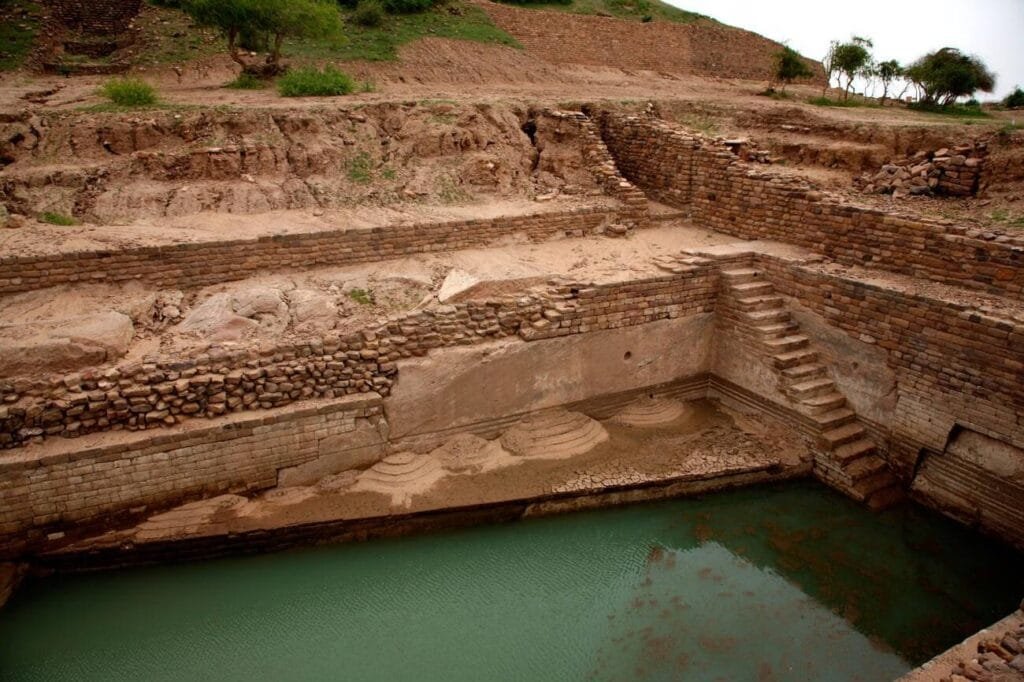
Dholavira is particularly important because it demonstrates that water infrastructure was not necessarily something added after a city was built.
Water influenced the city’s design itself.
The settlement’s reservoirs, channels and water structures were integrated into the urban environment. UNESCO identifies its water management system as evidence of the ingenuity of its inhabitants in adapting to a harsh environment.
That principle remains fundamental to modern water management in India.
A city cannot simply grow first and ask where its water will come from later.
Yet this is precisely the challenge facing many modern urban areas.
Population growth increases domestic demand. Industry requires reliable supplies. Agriculture competes for freshwater. Groundwater extraction can exceed natural recharge. Climate variability can make rainfall less predictable.
The ancient lesson is therefore surprisingly modern:
Water has to be part of planning from the beginning.
From Reservoirs to Wells: Water Management in India Becomes Local
As Indian settlements expanded and civilizations changed, communities developed thousands of local water systems.
Wells became particularly important because groundwater could provide water outside the monsoon season.
Tanks and reservoirs allowed communities to capture rainfall and runoff.
Canals moved water from rivers or reservoirs toward agricultural land.
In areas where groundwater was deeper or access was difficult, architecture itself became part of the solution.
This eventually produced one of India’s most distinctive forms of water infrastructure:
the stepwell.
Stepwells: Architecture Built Around Water
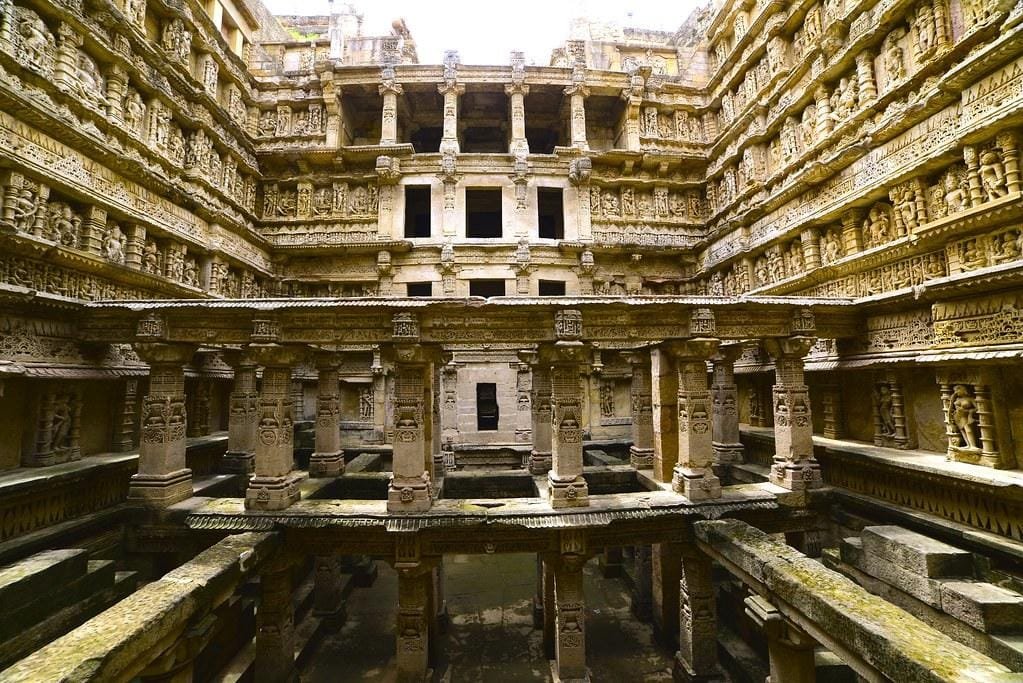
Stepwells are among the most visually striking examples of traditional water management in India.
Instead of simply digging vertically into the ground, builders constructed stairways descending toward the water table.
As the water level changed, people could descend further.
But stepwells were not merely holes in the ground.
Some became elaborate architectural spaces combining water access, shade, social activity and religious symbolism.
The famous Rani-ki-Vav at Patan in Gujarat provides an extraordinary example.
UNESCO describes it as a distinctive form of subterranean water architecture and identifies it as a water-resource and storage system associated with the stepwell tradition. Built in the 11th century, Rani-ki-Vav combined functional water infrastructure with monumental architecture.
The important point is that ancient water infrastructure was not necessarily crude.
It could involve careful engineering, structural stability, groundwater access, social use and architectural design simultaneously.
The Indian Water System Was Never Just One System
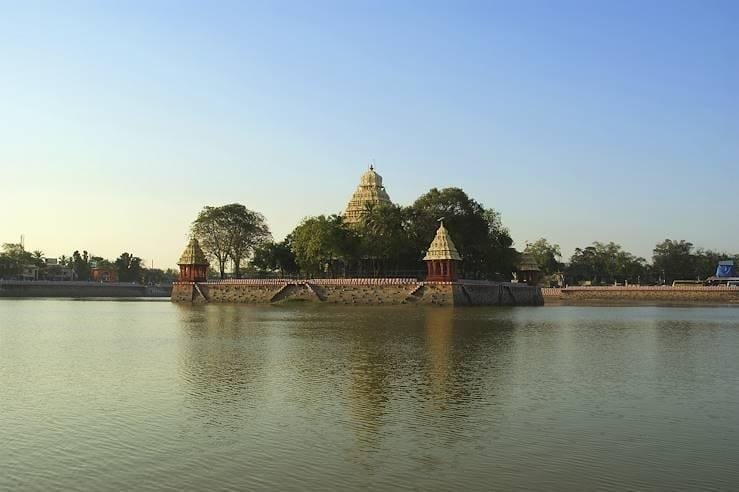
One mistake in discussions about water management in India is to imagine that there was one traditional Indian model.
There wasn’t.
A water system that worked in Rajasthan could be unsuitable in Kerala.
A reservoir system appropriate for a dry region might be unnecessary in a high-rainfall area.
Himalayan communities faced completely different challenges from communities in the Deccan Plateau.
This created a remarkable variety of solutions.
There were:
- stepwells
- village tanks
- ponds
- wells
- canals
- reservoirs
- diversion structures
- irrigation channels
- rainwater-harvesting systems
- mountain water channels
The common principle was adaptation.
Local geography determined engineering.
Water, Agriculture and the Rise of Irrigation
As agriculture became increasingly intensive, controlling water became directly connected to food production.
A farmer does not need water only when it rains.
Crops require water at particular stages of their growth.
That made irrigation one of the most important developments in water management in India.
Reservoirs could store seasonal rainfall.
Canals could distribute water.
Tanks could support agriculture in regions where rainfall was seasonal.
Over centuries, irrigation became connected with state power.
A ruler who could build and maintain irrigation infrastructure could influence agricultural productivity, taxation and settlement patterns.
Water was therefore never purely environmental.
It was also economic and political.
When Water Became a Question of State Power
As kingdoms expanded, large waterworks increasingly required organized labour, taxation and administration.
The construction of large tanks, canals and reservoirs could exceed the capacity of individual households.
This is one of the major turning points in water management in India.
Water infrastructure began moving between two models:
community-level management
and
large-scale state-supported engineering.
Neither completely replaced the other.
Instead, they existed alongside each other.
That tension remains visible today.
Modern India has enormous national and state water programmes, but successful water systems still depend heavily on local maintenance, groundwater recharge, community participation and local knowledge.
The Colonial Transformation of Water Management
The British colonial period introduced another major shift.
Irrigation became increasingly connected with large-scale engineering, revenue collection and agricultural expansion.
Canals and major irrigation works were developed across parts of the subcontinent.
The colonial state saw irrigation not simply as a local necessity but also as an economic and administrative instrument.
This period helped establish many of the institutional and engineering traditions that later influenced independent India’s approach to water.
But it also reinforced a particular idea:
larger infrastructure could solve larger water problems.
That philosophy became even more influential after independence.
The Dam-Building Era
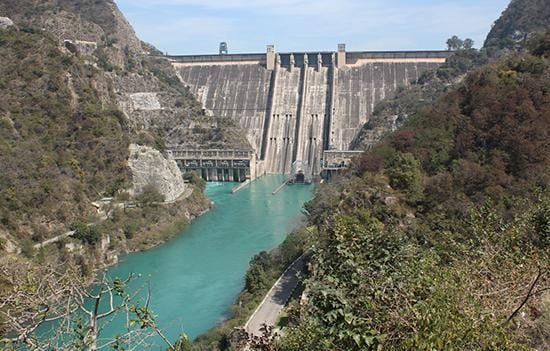
Independent India inherited a country facing food insecurity, poverty, uneven agricultural productivity and limited infrastructure.
Large dams came to represent modernisation.
They promised several benefits at once:
- irrigation
- hydropower
- flood management
- drinking water
- industrial development
- regional economic growth
The result was a dramatic expansion of large water infrastructure.
This period fundamentally reshaped water management in India.
Rivers increasingly became components of engineered systems.
Instead of allowing water to follow only its natural seasonal pathways, governments sought to store, divert and distribute it according to human requirements.
But large infrastructure also produced difficult questions.
Who was displaced?
Who benefited?
What happened downstream?
What were the environmental consequences?
How much water should remain in rivers?
These questions would become increasingly important as India’s development accelerated.
The Green Revolution Changed the Water Equation
Agricultural transformation created another enormous change.
High-yield crops, irrigation, fertilisers and improved agricultural technology dramatically increased food production in parts of India.
But agricultural success also increased dependence on reliable water.
In several regions, groundwater became an increasingly important source of irrigation.
This produced a paradox.
Groundwater is invisible.
A river can visibly shrink.
A reservoir can visibly fall.
But groundwater can be pumped year after year without the same immediate visual warning.
That made groundwater management one of the most difficult parts of modern water management in India.
Today, groundwater monitoring increasingly relies on digital instruments and networks. The Central Ground Water Board reports thousands of monitoring stations for groundwater levels and quality, alongside digital water-level recorders transmitting data electronically.
The technology has changed dramatically.
The underlying problem has not.
Rivers Became Political
Once water infrastructure became larger, rivers increasingly crossed administrative boundaries.
A river does not care where one state ends and another begins.
Governments do.
This created some of India’s most persistent water disputes.
The Cauvery, Krishna, Narmada and other river systems became subjects of negotiations, tribunals, court cases and political movements.
The issue is simple in theory but difficult in practice:
How should a limited and variable resource be shared between people living in different political territories?
That question brings us directly to today’s Farakka discussion.
Farakka and the Politics of the Ganga
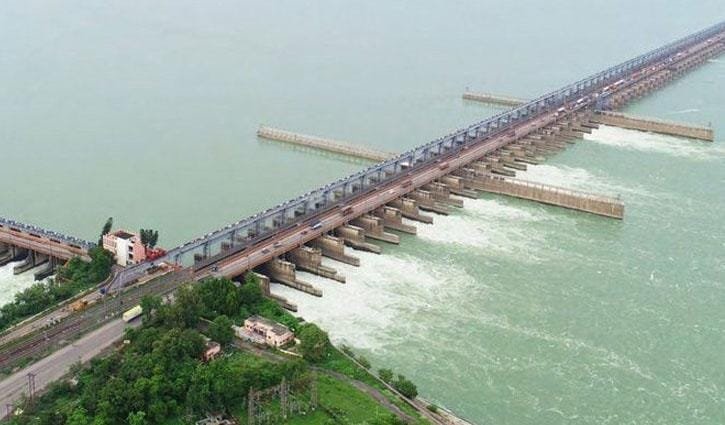
The Farakka Barrage was designed to influence the flow of the Ganga system and has long been connected with questions surrounding navigation, sedimentation and water availability.
India and Bangladesh eventually formalised a water-sharing arrangement in 1996.
The treaty established arrangements for sharing Ganga waters at Farakka during the dry season, using specified flow-based provisions. The agreement is due for renewal in 2026.
Today, Bihar’s concerns have added another dimension to the debate.
The Indian government has indicated that Bihar’s drinking-water and industrial requirements will be considered as the future of the arrangement is assessed.
This is a perfect illustration of why water management in India cannot be understood only as engineering.
It involves:
geography + agriculture + cities + states + neighbouring countries + diplomacy + ecology + economics.
Water eventually becomes politics because people depend on it.
River Linking: Can India Move Water Where It Is Needed?
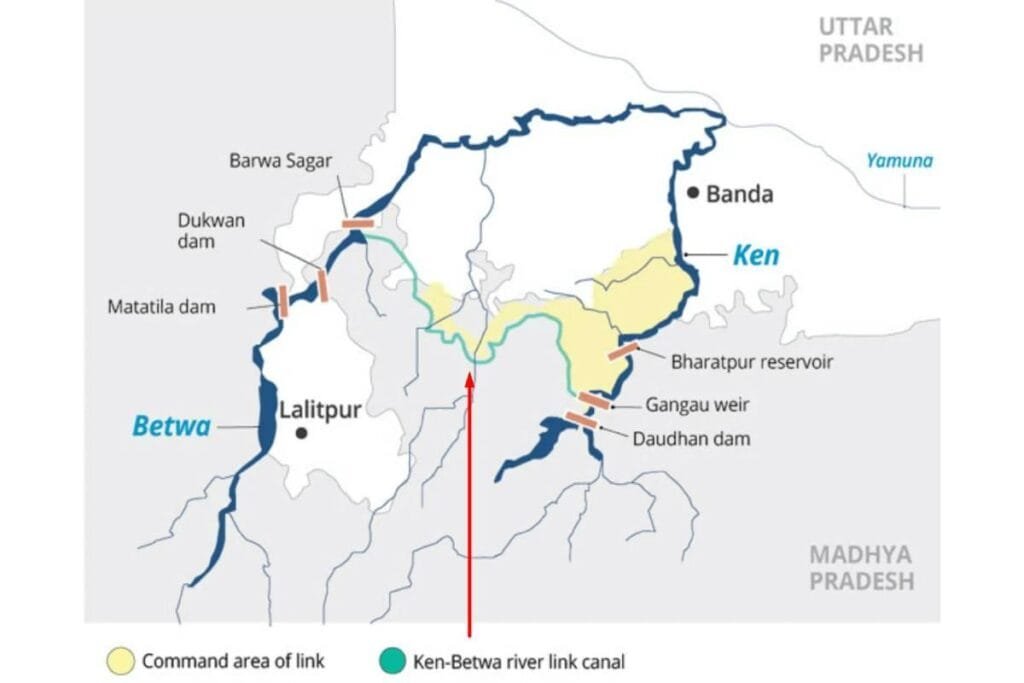
If rivers create both abundance and scarcity depending on location and season, one obvious question emerges:
Can water be transferred from water-surplus regions to water-deficit regions?
That idea lies behind India’s river-interlinking proposals.
The concept is not new, but it remains controversial because moving water is not simply a matter of connecting two lines on a map.
There are questions about:
- ecological flows
- rainfall variability
- displacement
- costs
- interstate cooperation
- downstream effects
- environmental change
- whether one region’s surplus really remains surplus under changing climate conditions
India’s Ken-Betwa Link Project is one of the most important contemporary examples.
Ken-Betwa Link Project Explained — HypeHive
Understanding the history of water management in India makes the river-linking debate easier to understand.
It is the latest chapter in a very old attempt to control where water goes.
From Dams to Pipelines: The Drinking-Water Revolution
Water management is not only about agriculture and rivers.
For ordinary households, the most important question is much simpler:
Can I turn on a tap and get safe water?
India’s modern drinking-water programmes increasingly focus on household connections, service delivery, water quality and long-term source sustainability.
The Jal Jeevan Mission, launched in 2019, was designed around providing rural households with functional tap connections while also incorporating source sustainability measures such as rainwater harvesting, recharge, reuse and greywater management.
By 2026, the programme’s digital systems had also become increasingly important.
The government reported that by August 2026, 75% of rural habitations had received Sujal Gaon IDs under the digital monitoring framework of Jal Jeevan Mission 2.0.
This represents another transformation in water management in India.
The question is no longer simply:
Where is the water?
It is increasingly:
Where is the water, what is its quality, how much is available, which infrastructure carries it, who is receiving it and whether the system is functioning?
India Enters the Digital Water Age
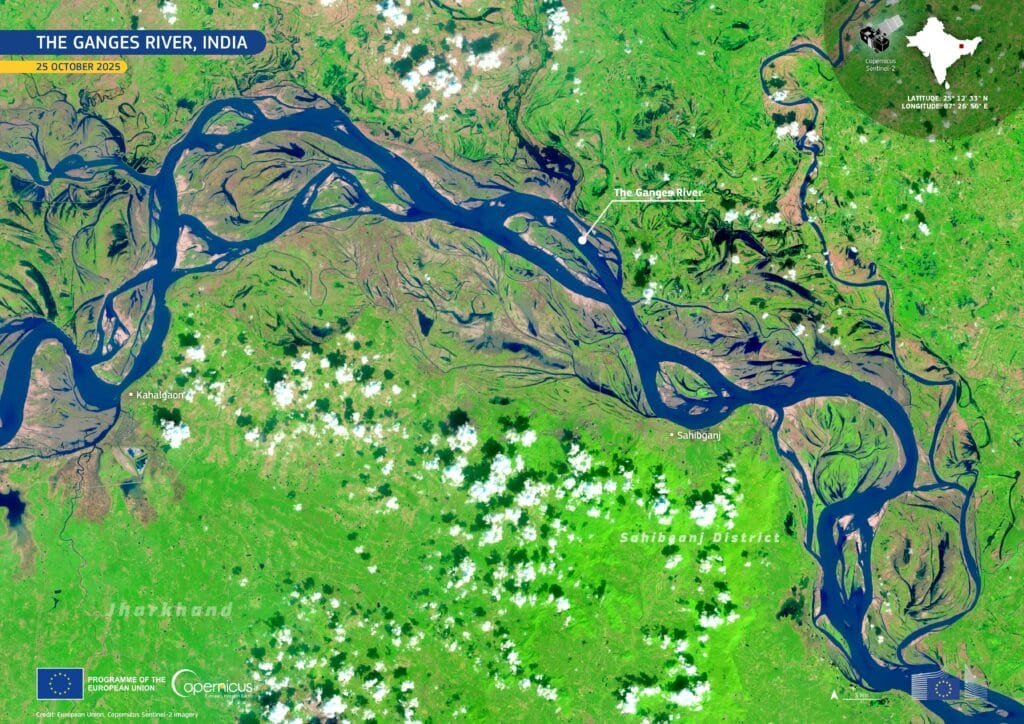
The next stage of water management in India is increasingly digital.
India now has national systems designed to collect, standardise and distribute water-related information.
The National Water Informatics Centre describes itself as a repository for nationwide water-resource data and supports standardised, GIS-based water information systems for integrated water-resource management.
This changes the nature of water planning.
A reservoir can have sensors.
A groundwater well can have a digital recorder.
Rainfall can be measured continuously.
River discharge can be monitored.
Satellite imagery can observe changes across huge areas.
Water infrastructure can receive digital identifiers.
Data can be brought together.
And then comes the next question:
What can we do with all that information?
The AI Era of Water Management in India
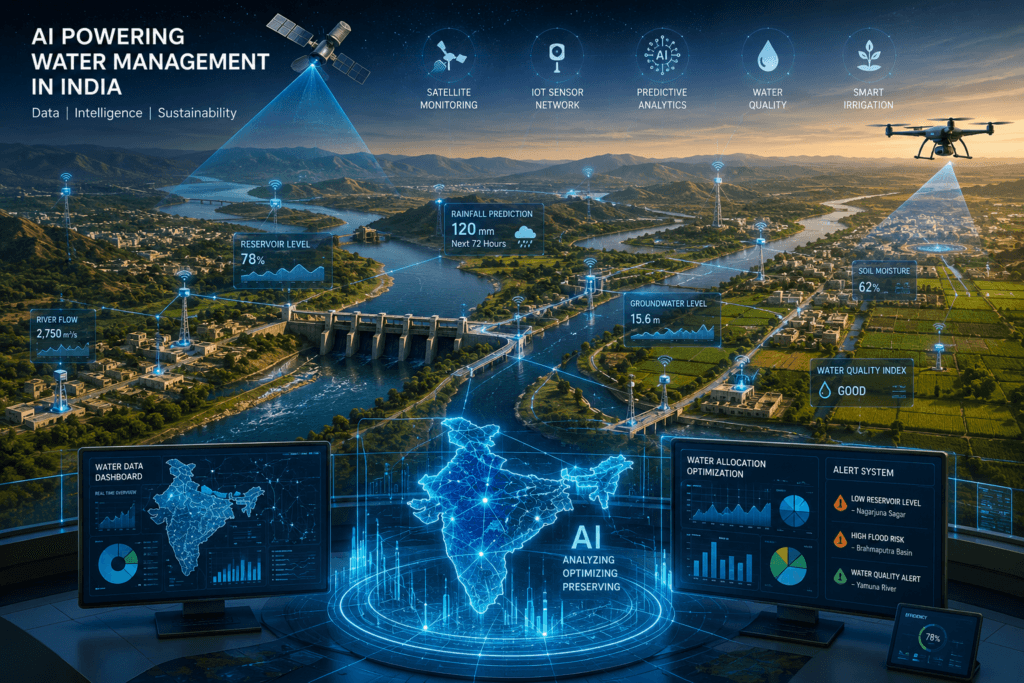
That is where the story returns to today’s headlines.
At the National Departmental Summit on Water in September 2026, the Prime Minister called for robust water-data governance and recommended using AI for water-data collection and analysis through uniform formats. He also called for anticipatory and integrated planning to address scarcity and greater use of treated water in agriculture and industry.
This could become one of the biggest changes in water management in India.
AI could potentially help analyse enormous quantities of information from:
- rainfall records
- river flows
- groundwater levels
- reservoir storage
- satellite imagery
- crop patterns
- urban consumption
- weather forecasts
- water-quality measurements
The goal is not to make AI magically create water.
It cannot.
Its value lies in helping humans make better decisions with information that would otherwise be too large or complex to analyse manually.
India’s National Water Data Portal already reflects this broader movement toward accessible and integrated water information.
But Can Technology Solve India's Water Problem?
Not by itself.
This is perhaps the most important lesson from the history of water management in India.
Technology has repeatedly changed the tools available to society.
It has not eliminated scarcity.
A stepwell could store water.
A dam could store vastly more.
A pipeline could transport it over long distances.
A sensor could measure it.
A satellite could observe it.
AI could analyse the resulting data.
But none of these technologies can change one basic reality:
Water is finite, while human demand can keep growing.
That means technology has to be combined with conservation, better planning, maintenance, groundwater recharge, efficient agriculture, wastewater treatment and responsible consumption.
What Ancient India Can Teach Modern Water Management
It would be easy to romanticise ancient water systems.
That would be a mistake.
A stepwell cannot replace a modern city’s entire water network.
An ancient reservoir cannot automatically solve today’s agricultural demand.
And historical societies faced their own failures, droughts and water conflicts.
But ancient systems do offer several useful principles.
1. Design around local geography
Dholavira adapted to an arid environment.
Different regions developed different systems.
Modern planning can learn from that principle.
2. Store water when it is available
Seasonal rainfall makes storage critical.
This remains true today.
3. Treat water as infrastructure
Ancient communities invested in structures that could survive for generations.
Modern infrastructure needs the same long-term thinking.
4. Connect communities with water systems
Water infrastructure cannot function indefinitely without people maintaining it.
Modern drinking-water programmes increasingly recognise this too. Jal Jeevan Mission documentation emphasises the role of local communities and people involved in operating and maintaining rural water systems.
5. Respect the difference between water and water infrastructure
Building a pipeline does not create water.
Building a dam does not create rainfall.
Digital monitoring does not increase groundwater recharge.
The infrastructure is only part of the system.
Water Management in India: What Comes Next?
India’s water story is now entering a fascinating stage.
For thousands of years, the basic challenge was to observe nature and adapt to it.
Then came increasingly powerful engineering.
Reservoirs grew.
Canals expanded.
Dams became symbols of development.
Groundwater pumping transformed agriculture.
Pipelines transformed drinking-water access.
Satellites and sensors transformed monitoring.
Now artificial intelligence is entering the system.
The direction is clear:
physical water infrastructure is being connected with digital infrastructure.
The National Water Data Portal’s emphasis on accessible and interoperable water data reflects this transition, while recent government initiatives have increasingly focused on data-driven governance and digital monitoring.
But the biggest challenge may not be technological.
It may be institutional.
India has thousands of rivers, millions of wells, enormous agricultural demand, rapidly growing cities and water systems crossing state and national borders.
No single ministry, technology or project can manage all of that alone.
The future of water management in India will therefore depend on cooperation between governments, scientists, engineers, farmers, industries, local communities and citizens.
The Bigger Story: India Has Never Stopped Reinventing Water
Look at the timeline.
Dholavira stored seasonal water.
Stepwells reached groundwater.
Tanks and reservoirs supported agriculture.
Canals moved water.
Colonial irrigation systems expanded large-scale distribution.
Dams transformed independent India’s development strategy.
Groundwater pumps changed agriculture.
Pipelines expanded household water access.
Satellites and sensors changed monitoring.
Digital platforms began connecting water information.
AI is now being considered for analysing that information.
The tools changed.
The fundamental question remained the same.
How does a society make sure that water is available when and where people need it?
That is the real story of water management in India.
Conclusion: From Stepwell to Algorithm
India’s water story did not begin with the first dam.
It did not begin with the Green Revolution.
It did not begin with Jal Jeevan Mission.
And it certainly did not begin with artificial intelligence.
It began with people looking at an uneven landscape and asking a remarkably simple question:
How do we survive when the water does not arrive when we need it?
Thousands of years ago, the answer could be a reservoir carved into the landscape or a staircase descending toward groundwater.
Today, it may involve a satellite, a sensor network, a national database and an AI model.
But the principle remains the same.
Technology can help India understand water better. It cannot make water infinite.
The most effective future may therefore not be a choice between ancient wisdom and modern technology.
It may be a combination of both.
India’s ancient water systems understood something modern infrastructure sometimes forgets: water is local, seasonal and deeply connected to the landscape and the people who depend on it.
Modern technology offers something those societies never had: the ability to observe water systems across an entire country in near real time and use enormous datasets to improve decisions.
The future of water management in India may ultimately depend on bringing those two ideas together.
The stepwell taught India how to store water.
The dam taught it how to engineer at scale.
The satellite taught it how to observe.
And AI may teach it how to connect the pieces.
The question now is whether India can turn that knowledge into water security that lasts for generations.
