
Last updated: 5 November 2026
Quick answer: Section 144 of the CrPC is now Section 163 of the Bharatiya Nagarik Suraksha Sanhita, 2023, in force since 1 July 2024. The power is the same: a magistrate can bar gatherings or acts in urgent cases, even without notice, for up to two months, which the state can extend to six. Its roots trace to the 1861 colonial Code.
Section 144 was not written for modern Delhi: its core words first appeared as Section 62 of British India’s Code of Criminal Procedure in 1861, four years after the 1857 uprising. Parliament gave the same power a new number in 2023, Section 163 of the Bharatiya Nagarik Suraksha Sanhita (BNSS), and in October 2026 it was once again the legal basis for barricades and detentions in central Delhi.
As of 5 November 2026, this much is on the record. The Supreme Court has directed Delhi Police to produce the prohibitory orders it issued under Section 163 ahead of a planned 10 October protest at Jantar Mantar against Chief Election Commissioner Gyanesh Kumar, LiveLaw reported. The court declined to re-examine whether Section 163 itself is constitutional, pointing to a 1961 judgment that upheld its predecessor, according to Bar & Bench. The protesters, as The Wire reported from the marches, want Kumar to resign over the Special Intensive Revision of voter rolls. The Election Commission has denied bias and says the exercise removes duplicate, dead and ineligible voters.
Two further developments are reported but not yet confirmed by an official document HypeHive has seen. Delhi Police have reportedly removed Jantar Mantar from the list of designated protest sites and named Ramlila Ground, Burari Ground and CBD Ground instead, ThePrint reported. And on 4 November, a headline in The Hindu said Delhi Police had told the Supreme Court that its 60-day prohibitory orders were passed “ex parte”, that is, without first hearing the people affected.
Most coverage asks whether this autumn’s orders were lawful. A different question explains more: why does Indian law let an official clear a street for two months at a time, and why does Delhi keep reaching for that power? The answer runs through six versions of one provision across 165 years, a farmers’ camp on the Boat Club lawns, and a 2018 Supreme Court judgment which found that the capital’s “permission” system had become a ban.
Is Section 144 a colonial law? Where it began in 1861
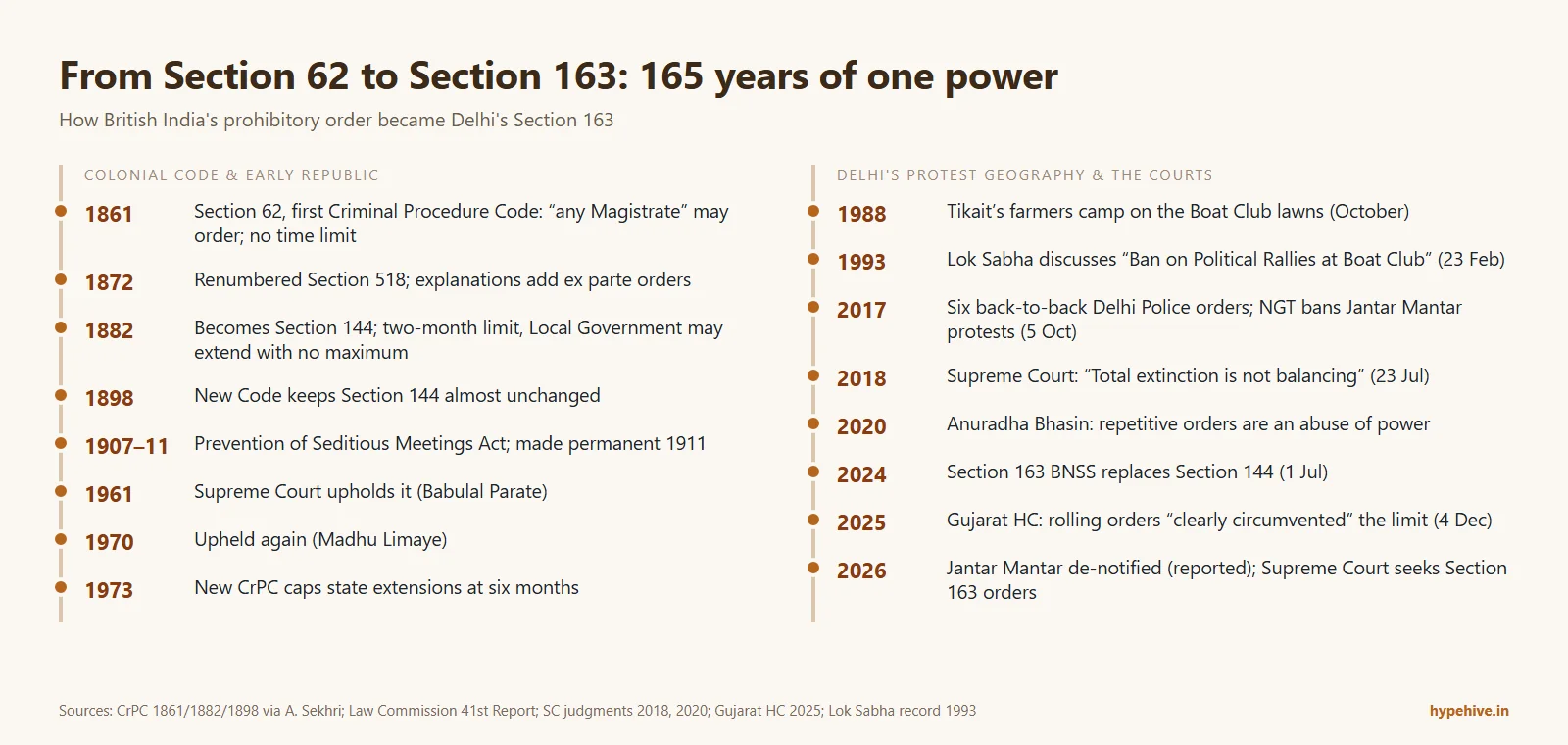
Yes. The power now in Section 163 BNSS descends directly from Section 62 of the Code of Criminal Procedure of 1861, a law of British India, and it took the number 144 in the colonial Code of 1882.
The 1861 Code came in the same burst of codification that produced the Indian Penal Code in 1860. Its Section 62, as reproduced by legal scholar Abhinav Sekhri in his history of the provision on The Proof of Guilt, made it “lawful for any Magistrate, by a written order” to direct a person to abstain from an act. The test was whether the magistrate considered the direction likely to prevent danger to human life, health or safety, or a riot or an affray.
Three features stand out. The power belonged to “any” magistrate, not only senior ones. It turned on an official’s opinion about what might happen, not on anything that had happened. And it carried no time limit at all. Sekhri notes that this substantive language reappears in today’s provision essentially unchanged.
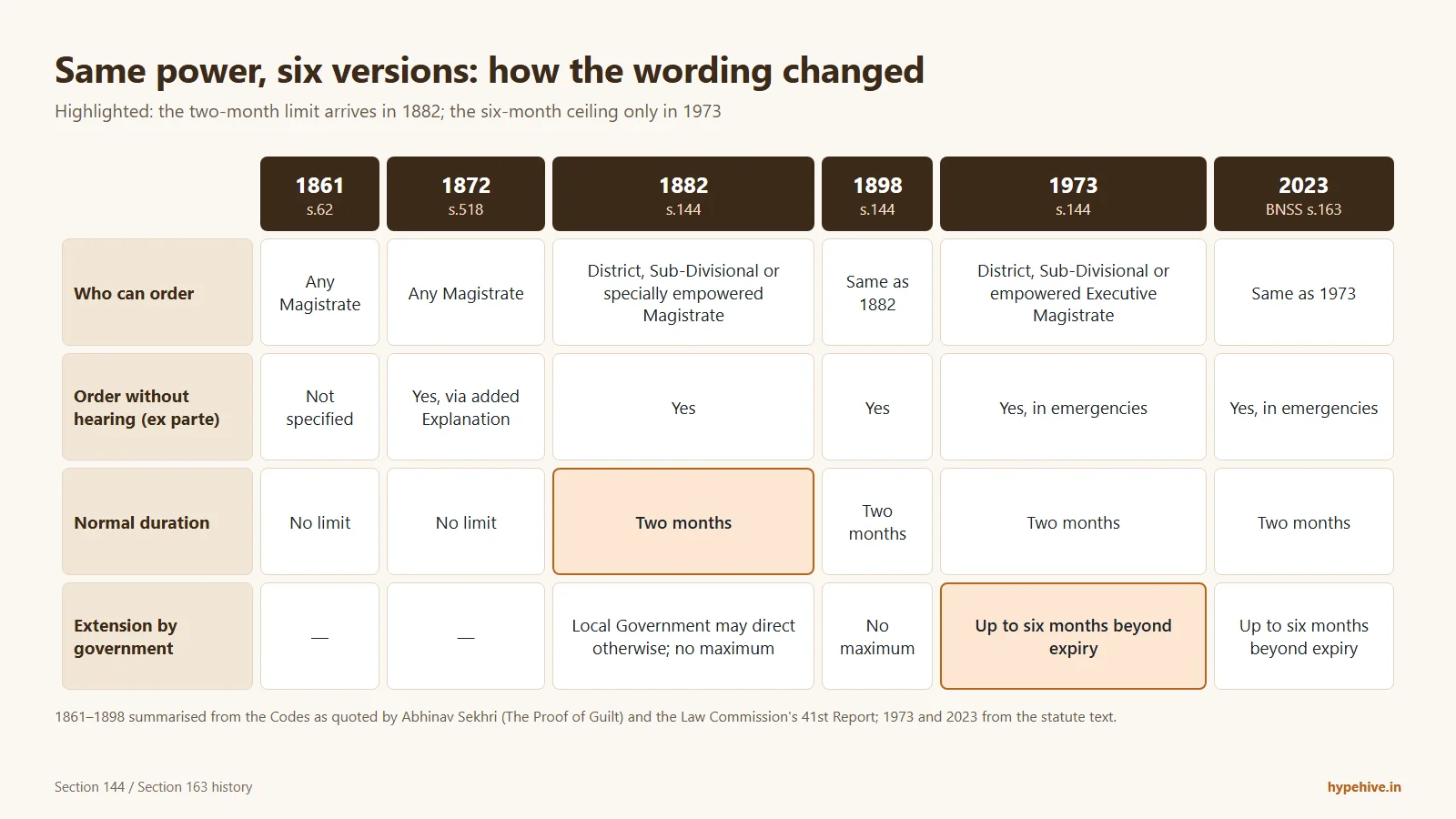
The 1872 Code moved the power to Section 518 and, by Sekhri’s reading, added explanations that included the ability to pass orders ex parte, without hearing the person affected first. That feature is still in Section 163 today.
One popular story online says Section 144 was “first used around 1861 in the State of Baroda by E.F. Deboo”. HypeHive could not trace it further back than a 2017 Governance Now article, which says only that this “is said to” have happened and cites no source. Baroda was a princely state, not British-ruled territory, so a British India code would not have applied there in the ordinary way. Until a primary record surfaces, the Baroda story should be treated as unverified.
1882: when it became “Section 144” and got its two-month limit
The number 144 and the two-month time limit both date from the colonial Code of Criminal Procedure of 1882. That Code also let the provincial government keep an order alive longer by notification in the official Gazette, with no maximum period.
The 1882 Code placed the power in a new chapter on temporary orders in urgent cases of nuisance. Its new clause read: “No order under this section shall remain in force for more than two months from the making thereof.” The same sentence, almost word for word, sits in Section 144(4) of the 1973 Code and in Section 163(4) of the BNSS.
The limit did not appear from nowhere. Sekhri points to Taramoni, a Calcutta High Court decision reported in 4 Calcutta Law Reports 309, which criticised magistrates’ orders of indefinite duration. The 1882 drafters answered with a cap, then left a door open: in cases of danger to life, health or safety, or a likely riot or affray, the Local Government could “otherwise direct”.
That open door survived the 1898 Code, which kept the 1882 text in almost identical terms. It even survived the first two decades of independence. When the Law Commission of India reviewed the 1898 Code in its 41st Report, it recorded that sub-section (6) let the State Government extend an order beyond two months, and said it was “not necessary to specify any maximum period”.
Here is the detail most explainers miss. The two-month rule that Delhi Police have repeatedly worked around was written by a colonial government in 1882. The ceiling that now stops a state government from extending an order indefinitely, six months beyond the original expiry, was added only in independent India’s Code of Criminal Procedure, 1973.
Who can impose Section 144?
Under the 1973 Code and now the BNSS, an executive magistrate can issue the order: a District Magistrate, a Sub-Divisional Magistrate, or another Executive Magistrate empowered by the state. In 1861 the power belonged to “any Magistrate”. In Delhi, the orders challenged before the Supreme Court in 2017 and 2026 were issued by Delhi Police.
How the Raj used it, and why it wanted more
After the 1905 Partition of Bengal, colonial officials used Section 144 to ban meetings they considered seditious. Some of them argued that it was too weak for the job, and the government passed the Prevention of Seditious Meetings Act in 1907.
This was the period when Vande Mataram became a political cry during the Swadeshi agitation. In a later part of his series, Sekhri describes the colonial administration “testing the limits” of Section 144 to stop political meetings. He draws on 1907 letters from Central Provinces officials, who complained that the section required no prior notice of meetings, targeted public disorder rather than speech, could be challenged in court, and was hard to enforce through prosecution.
Their answer was a special law. The Seditious Meetings Act began with a three-year life, was extended in 1910 and made permanent in 1911, while Indian members of the Legislative Council argued that ordinary law already sufficed. According to Sekhri, it was rarely used and stayed on the statute book until its repeal in 2018.
The court record from these years is less dramatic than popular accounts suggest. Surveying reported High Court decisions from 1901 to 1920, Sekhri found them dominated by land quarrels and disputes between rival groups, not political meetings. How heavily prohibitory orders weighed on the later mass movements, and on the freedom fighters who led them, including the women of India’s freedom struggle, is a question that still needs systematic archival counting rather than repetition.
Independence kept it, and the courts upheld it
Independent India kept Section 144 instead of discarding it. The Supreme Court upheld it in Babulal Parate v State of Maharashtra (1961) and again in Madhu Limaye (1970), and Parliament re-enacted it in the Code of Criminal Procedure, 1973.
The 1961 ruling still matters. In October 2026 the Supreme Court cited Babulal Parate when it declined to entertain a fresh challenge to the validity of Section 163, Bar & Bench reported, because the two provisions are materially the same.
Later courts added limits rather than removing the power. In Anuradha Bhasin v Union of India (10 January 2020), the case arising from the Jammu and Kashmir shutdown, the Supreme Court summarised the law in paragraph 140. The power may be used even where danger is only apprehended, but it “cannot be used to suppress legitimate expression of opinion or grievance or exercise of any democratic rights”. Orders must state their material facts so that courts can review them.
Read together, the record shows a power that independent India examined several times and chose to keep, with judicial conditions attached. That is an interpretation of the evidence, not a quotation from it, but it is hard to square with the idea that Section 144 is merely a forgotten colonial leftover.
From Boat Club to Jantar Mantar: how protest was moved
Until the early 1990s, Delhi’s largest protests gathered on the Boat Club lawns near Parliament. A Lok Sabha discussion on 23 February 1993 was titled “Ban on Political Rallies at Boat Club”, and Jantar Mantar, about two kilometres away, became the main sanctioned venue.
The most famous Boat Club protest came in October 1988, when farmers led by Mahendra Singh Tikait of the Bharatiya Kisan Union camped on the lawns between Vijay Chowk and India Gate for about a week, as The Caravan has recounted. The Caravan puts the crowd at “around half a million farmers” from western Uttar Pradesh, an estimate rather than a count, and says a protest planned for one day lasted about a week.
Why the Boat Club was closed is genuinely disputed:
- Scroll links the ban to security concerns after the demolition of the Babri Masjid in December 1992.
- Other explainers cite VVIP security and traffic disruption near the seat of government.
- Some reports trace it to Tikait-era farmer agitations, though they disagree on whether 1988 or a later dharna was decisive.
- A ThePrint photo archive says the Boat Club remained a major protest venue in the years after 1988, which argues against a simple “Tikait caused the ban” story.
HypeHive could not open the full text of the 1993 Lok Sabha record. The reasons the government gave in the House therefore remain to be confirmed. Petitioners told the Supreme Court in 2017 that Jantar Mantar had been the only permitted site “from 1993 till recently”; some later accounts date its formal designation to 2003.
The 60-day loop: how central Delhi stayed off-limits
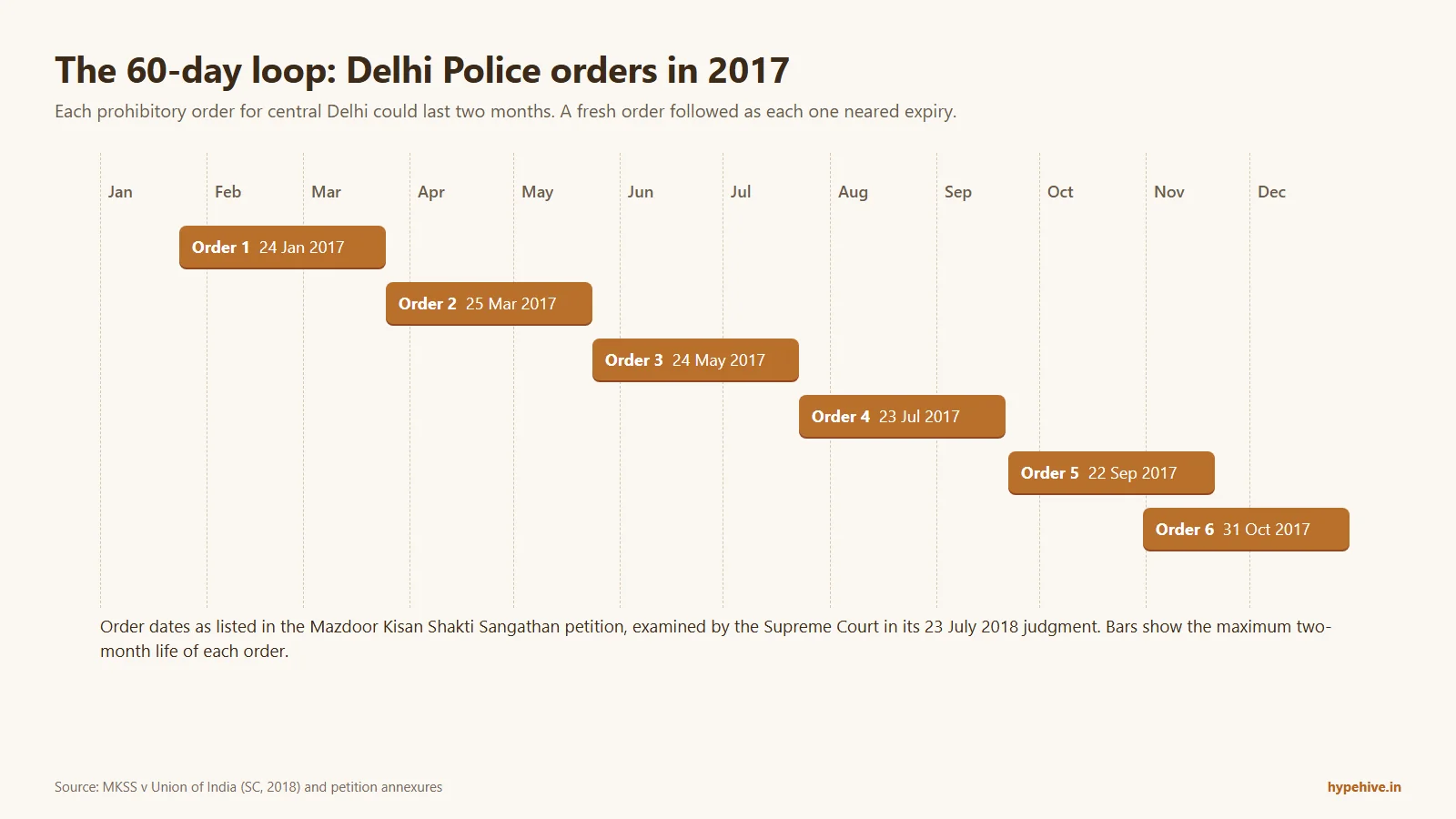
Because a Section 144 order lapses after two months unless the state government extends it, Delhi Police issued fresh, near-identical orders as each one expired. According to a 2017 petition later decided by the Supreme Court, there were six such orders for central Delhi that year alone.
The petition by the Mazdoor Kisan Shakti Sangathan, filed through founder member Aruna Roy, listed orders dated 24 January, 25 March, 24 May, 23 July, 22 September and 31 October 2017. Its summary of the practice was blunt: the police issue “fresh orders as soon as the previous order expires”.
The practice was not new. The same petition records that a 2010 challenge, Bano Bee v Union of India, brought by a member of a Bhopal gas victims’ group, was closed by the Delhi High Court on 31 May 2011. Delhi Police had filed an affidavit saying the continuous prohibition in New Delhi district had been discontinued. The petitioners said it came back.
On 23 July 2018, Justices A.K. Sikri and Ashok Bhushan decided Mazdoor Kisan Shakti Sangathan v Union of India. They recorded the police’s case: intelligence inputs, a heavy volume of permission requests, and violence at past protests. They also recorded the residents’ complaints of noise and nuisance that had led the National Green Tribunal to ban protests on Jantar Mantar Road on 5 October 2017.
The court then drew its line. The orders allowed gatherings with written permission, but in practice none were permitted, which made them a ban rather than regulation. “Total extinction is not balancing,” the judgment says at paragraph 61. It directed the Commissioner of Police to frame guidelines within two months for limited, regulated use of both Jantar Mantar and the Boat Club area.
Two later rulings sharpened the point. Anuradha Bhasin states at paragraph 140 that “repetitive orders under Section 144, Cr.P.C. would be an abuse of power”. On 4 December 2025, the Gujarat High Court quashed Ahmedabad’s prohibitory notifications in Navdeep Mathur v State of Gujarat. Justice M.R. Mengdey held that authorities had “clearly circumvented” the two-month limit by issuing notifications one after another without seeking a state extension, and that gazette publication alone was no longer enough notice to the public.
Section 144 vs Section 163 BNSS: what actually changed?
Very little. Section 163 of the Bharatiya Nagarik Suraksha Sanhita, in force since 1 July 2024, keeps the same urgent-case power, the same ex parte option, the same two-month limit and the same six-month state extension. The main change is the number.
| Feature | Section 144, CrPC 1973 | Section 163, BNSS 2023 |
|---|---|---|
| In force | Replaced from 1 July 2024 | From 1 July 2024 |
| Who can order | Executive magistrates empowered by the state | Executive magistrates empowered by the state |
| Order without hearing (ex parte) | Yes, in emergencies | Yes, in emergencies |
| Normal maximum | Two months | Two months |
| State extension | Up to six months beyond expiry | Up to six months beyond expiry |
| Validity tested by Supreme Court | Upheld (1961, 1970) | Fresh challenge not entertained (2026) |
Search data suggests many readers still look for “Section 144 BNSS”. That is a trap: Section 144 of the BNSS is a different provision. The prohibitory-order power now lives in Section 163.
Is Section 144 the same as curfew?
Not exactly. The Code does not define “curfew”. A prohibitory order can be narrow, such as banning gatherings of a certain size in one district, while a curfew asks people to stay indoors. In practice, authorities have often used the same Section 144 power to impose curfew-style restrictions, so the difference lies in how broad the order is.
What the evidence shows, and what we still don’t know
The documentary record supports three claims firmly: the power’s lineage runs unbroken from 1861 to 2023; the two-month limit dates from 1882 and the six-month ceiling from 1973; and Delhi Police used back-to-back orders in New Delhi district, which the Supreme Court in 2018 treated as a ban.
Interpretation is where views divide. Police and governments argue that preventive orders save lives in a crowded capital, and the 2018 judgment accepted that residents and offices near protest sites have rights too. Petitioners and civil-liberties lawyers argue that a power built for emergencies has become a standing rule. The courts have taken a middle path: the power stays, but blanket and repetitive use does not.
Several questions remain open. No public dataset HypeHive found counts how many prohibitory orders Delhi issues each year. The government’s stated reasons for the 1993 Boat Club ban sit in a Lok Sabha record that HypeHive has not yet read. The Baroda origin story remains unsourced. And whether the 2026 orders meet the standards set in 2018 and 2020 is now before the Supreme Court.
What 165 years of Section 144 tell us about the right to protest
Section 163 is not a new restriction on protest. It is the latest version of a colonial emergency power that independent India chose to keep, cap and renumber, and Delhi has repeatedly stretched it into something close to permanent.
That is the part of the story news coverage tends to miss. The fight over Jantar Mantar is usually told as a story about a place. The longer record shows it is also about a sentence written in 1882, “no order under this section shall remain in force for more than two months”, and about how officials and courts have treated that limit ever since. Each time protest has moved, from the Boat Club to Jantar Mantar and now possibly to grounds on the city’s edge, the same legal tool has done the moving.
The Constitution’s guarantee of the right to assemble peaceably sits on one side of the scale. Public order, and the residents who live beside protest sites, sit on the other. The Supreme Court’s 2018 phrase remains the best summary of how Indian law has tried to hold them together: balancing, not extinction.
Frequently asked questions
What is Section 144 called now?
Since 1 July 2024, the prohibitory-order power formerly in Section 144 of the CrPC is Section 163 of the Bharatiya Nagarik Suraksha Sanhita, 2023. Section 144 of the BNSS deals with a different subject.
Section 144 kya hai?
Dhara 144 (ab BNSS ki Dhara 163) ke tahat magistrate kisi ilaake mein bheed jutne ya kisi kaam par turant rok laga sakta hai, aam taur par do mahine tak. In English: it is an urgent order letting a magistrate ban gatherings or specific acts in an area, normally for up to two months.
How long can a Section 144 or Section 163 order last?
An order lapses after two months. The state government can extend it by notification for up to six months beyond that date, but only to prevent danger to life, health or safety, or a riot or affray.
Is Section 144 still applicable?
New orders are issued under Section 163 BNSS. Section 144 CrPC still appears in older orders and in court cases that began before 1 July 2024, and courts treat the two provisions as materially the same.
Sources
- Section 163, Bharatiya Nagarik Suraksha Sanhita, 2023
- Section 144, Code of Criminal Procedure, 1973
- Mazdoor Kisan Shakti Sangathan v Union of India (Supreme Court, 23 July 2018)
- Anuradha Bhasin v Union of India (Supreme Court, 10 January 2020)
- Navdeep Mathur v State of Gujarat (Gujarat High Court, 4 December 2025)
- Law Commission of India, 41st Report, chapter on Section 144
- Abhinav Sekhri, “Section 144 CrPC – Part II: Origins”, The Proof of Guilt
