
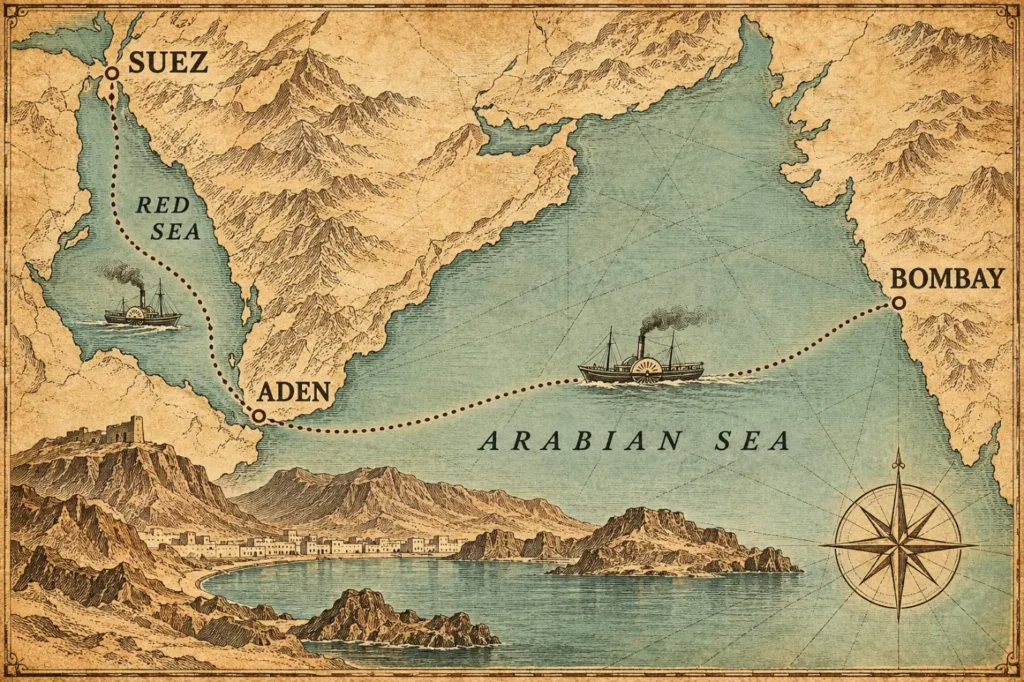
Aden, British India’s forgotten port in Arabia, was governed from Bombay for 93 years and from Delhi for five more, and it is the Yemeni city that Houthi fighters are now reported to be advancing on.
Last updated: 17 November 2026
On 15 November 2026, forces loyal to Yemen’s internationally recognised government said they were pulling back from positions near the Bab el-Mandeb strait to defend Aden, the government’s interim capital, Al Jazeera reported. The Houthis, the Iran-aligned movement that has held the capital Sanaa since 2014, say they are preparing to move on the city itself. Earlier in the month, four military sources told Reuters that Houthi fighters had come within about 80 km of Aden, the closest since 2015. That distance is a reported figure, not an official one, and Yemen’s front lines move quickly.
Most coverage stops at the map. The question underneath it is older: why is a port on the southern tip of Arabia worth this much? Part of the answer runs through India. Aden was captured by Bombay troops, run by Bombay officials, guarded by Indian soldiers and paid for in Indian rupees. It jailed an Indian revolutionary, stopped an Indian maharaja, welcomed Mahatma Gandhi and gave Dhirubhai Ambani his first job.
This article follows that thread from a stranded ship in 1837 to the fighting of November 2026. It is built on the India Office records held by the British Library and the UK National Archives, on British legislation and on Hansard, rather than on the web articles that copy one another. Several dates that circulate widely online turn out to be wrong, and they are corrected below.
Was Aden Part of India?
Yes. Aden, now in Yemen, was part of British India from January 1839 to 1 April 1937. Bombay governed it as the Aden Settlement until 1932; it then became a Chief Commissioner’s Province under the Viceroy. The Government of India Act 1935 separated it, and it became a British Crown Colony in 1937.
The UK National Archives catalogue for the India Office’s Aden records (IOR/R/20) sets out three phases: a Political Agency, later a Residency, under the Government of Bombay from 1839 to 1932; a Chief Commissionership under the Government of India from 1932 to 1937; and a Crown Colony under the Colonial Office from 1937 to 1963.
“Part of India” here means British India, the territory administered from Calcutta, Bombay and later Delhi. It does not mean the Republic of India, which came into being after 1947, and Aden’s Arab population was never consulted about any of these arrangements.
Why Britain Wanted Aden: Coal, Steam and the Road to Bombay
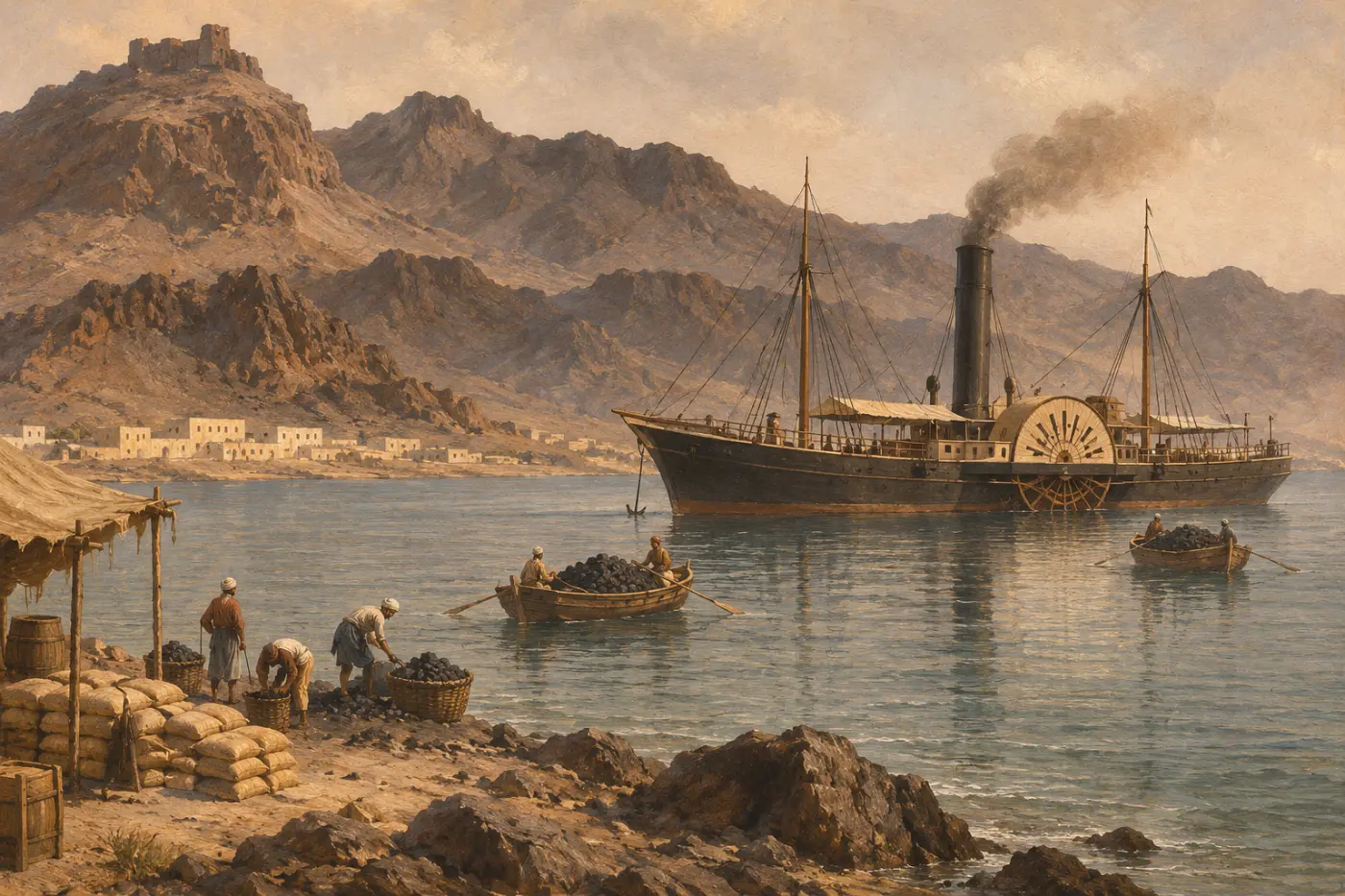
Britain took Aden because steamships needed coal. In the 1830s the East India Company was trying to run steamers between Bombay and Suez instead of sending everything around Africa, and those ships needed a safe refuelling stop near the mouth of the Red Sea.
The Company’s own naval history states the motive plainly. The History of the Indian Navy (1613–1863), now digitised by the British Library and the Qatar Digital Library, records that in May 1837 Commander Stafford Bettesworth Haines broke off his survey of the Arabian coast because he was needed “in connection with the acquisition of Aden as a coaling station”. Aden had a sheltered natural harbour at the entrance to the Red Sea. At the time it belonged to the Abdali Sultan of Lahej and had shrunk to a small, half-ruined town.

The Wreck of the Deria Dowlut (1837)
The pretext for taking Aden came from an Indian ship. The Deria Dowlut (also spelt Daria Dawlat or Duria Daulat), a Madras vessel sailing under British colours and belonging to a woman of the Nawab of the Carnatic’s family, went aground near Aden in early 1837. Its cargo was plundered and its passengers were mistreated.
The sources disagree on the details. The naval history dates the grounding to 4 January 1837 and describes the owner as a niece of the Nawab. A captain’s affidavit quoted by the Aden-based South24 Center places it on 20 February 1837. Some later writers argue that the grounding was deliberately arranged; that is an interpretation, not an established fact. What the records do not support is the date of 1838 given in some recent explainers.
Haines reached Aden on 28 December 1837 and went ashore in early January 1838 to demand compensation. According to the naval history, goods worth 7,808 dollars were returned and the Sultan signed a bill for the remaining 4,192 dollars. Haines also secured a written promise that Aden would be transferred to the Company. The Sultan’s family soon backed away from that promise.
The Capture of Aden, January 1839
When negotiations collapsed, Bombay sent troops. On 16 January 1839 a small expedition arrived in Aden’s Back Bay. It was made up of warships including HMS Volage, the Company’s Coote, Cruiser and Mahi, plus transports carrying the 24th Bombay Native Infantry and two artillery companies under Major Bailie.
That day Haines, signing as Political Agent, wrote to the naval commander, Captain Smith, that the Abdali chiefs had refused to honour their written promise to hand over Aden. In the same letter he asked that the lives of the town’s Jews and “Banians”, the Indian Hindu traders already living there, be spared. Indian merchants, in other words, were in Aden before the British flag was.
The squadron anchored in Front Bay on 18 January. Aden fell the next day, 19 January 1839, according to most histories, and is often described as the first territory Britain acquired in Queen Victoria’s reign.
Aden, British India’s Port in Arabia (1839–1932)
For its first 93 years under British rule, Aden was an outpost of the Bombay Presidency, the administration that also ran Bombay, Sind and much of western India. The port town was known as the Aden Settlement, and its chief officer reported to the Governor of Bombay.
India supplied almost everything that made the place work. India’s Ministry of External Affairs notes that a garrison of 2,000 Indian soldiers was stationed in Aden and the rupee was the official currency. Aden was made a free port around 1850, and its strategic and commercial value rose sharply after the Suez Canal opened in 1869, when it became a coaling station on the main shipping route between Europe and Asia.
The arrangement was clumsy from the start. The historian R. J. Gavin, in his 1975 study Aden Under British Rule, 1839–1967, judged that Aden’s history since 1839 “had been marked by administrative confusion and complication”. Before acting, the British Resident often needed approval from three masters: the Bombay Government, the Government of India and the Colonial Office in London.

Aden Settlement vs Aden Protectorate
The Aden Settlement and the Aden Protectorate were different territories. The Settlement was the port and its immediate surroundings, about 192 square kilometres under direct British rule. The Aden Protectorate was the far larger hinterland. It was a patchwork of sultanates and sheikhdoms bound to Britain by treaties meant to secure the port, and they kept their own rulers.
The difference matters for dates. In 1917, with Ottoman forces threatening Aden during the First World War, the Government of India handed military control of the Settlement to the War Office in London and the Protectorate’s affairs to the Foreign Office. India kept the civil administration of the town. That is why some sources say the Protectorate “left India” two decades before Aden did.
The Indians Who Built Aden
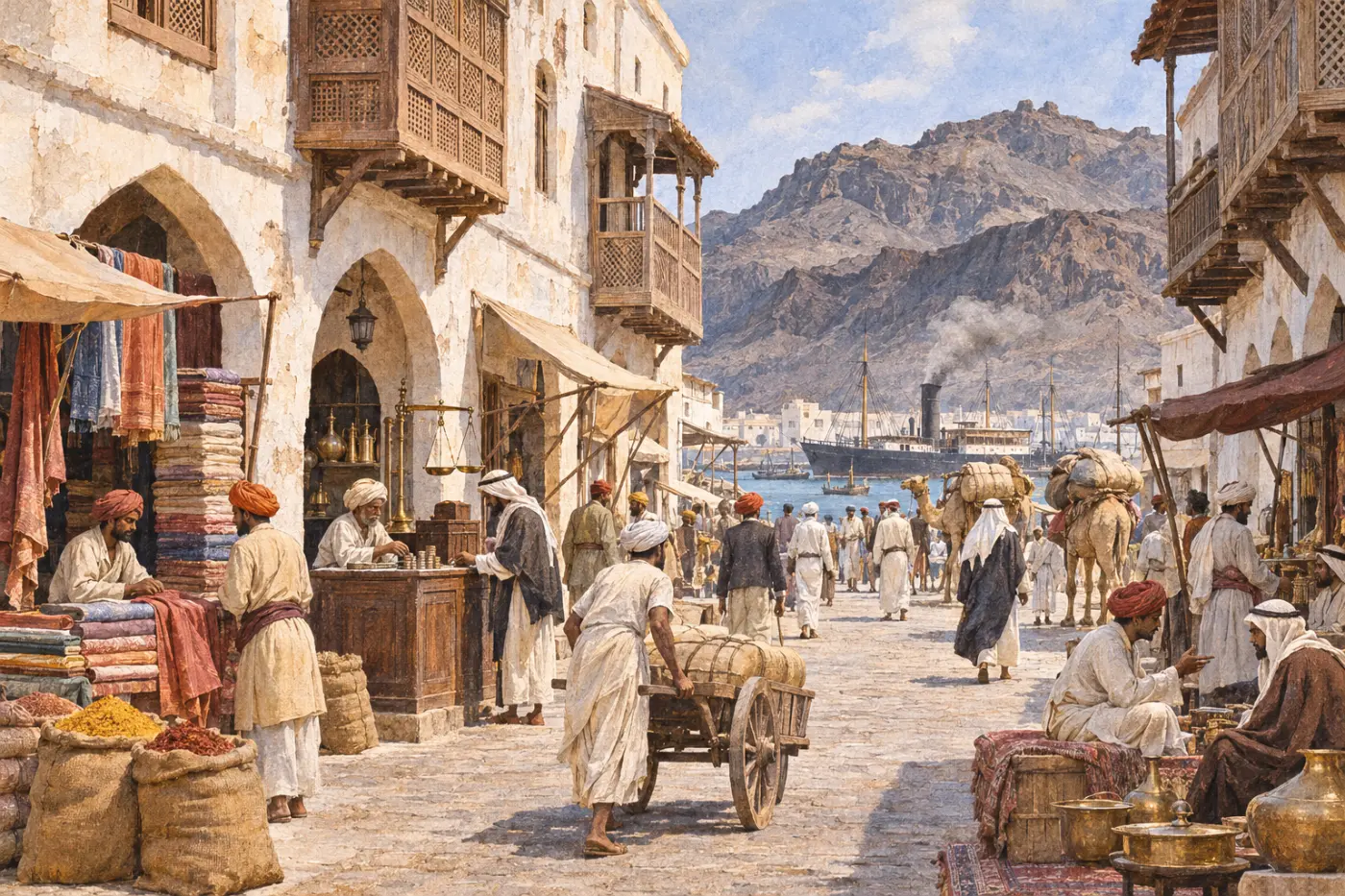
Aden’s commercial life ran largely on Indian merchants and Indian money. By one account, much of the town’s population came to speak Gujarati, Marathi and Hindi, and the shops, shipping agencies and moneylenders along its waterfront were run by families from Bombay, Gujarat and Kutch.
The most famous were the Parsi Adenwalas. According to Scroll, Cowasjee Dinshaw arrived from Bombay in 1845. He helped remodel the port for steamer traffic, and his family came to be called the “uncrowned kings of Aden”. Adenwala Road in Mumbai’s Matunga still carries the name.
A century later, Aden gave India its best-known business founder his start. As a teenager, around 1949–50 (accounts differ on the year), Dhirubhai Ambani left Gujarat for Aden and worked as a clerk for A. Besse & Co., a French trading house, and later at a petrol station. His eldest son, Mukesh Ambani, was born in Aden on 19 April 1957. Encyclopaedia Britannica records that the family moved to Bombay in 1958 because of Aden’s increasingly unstable politics. The trading contacts Dhirubhai built in Aden fed the business that eventually grew into Reliance’s Jamnagar refinery.
The Indian imprint outlasted British rule. Reporting on Aden’s colonial legacy in 2022, Al Jazeera found that thousands of Yemenis descend from Indians who came to work in the colony. It also noted that zurbian, Aden’s favourite dish, is a rice, potato and meat dish its reporter compared to biryani.
The Raj’s Checkpoint at the Edge of Arabia
Because Aden was legally Indian territory but far from India, the British used it as both a prison and a gate. Three episodes show how.
A revolutionary’s prison. Vasudev Balwant Phadke, a government clerk from the Konkan, raised an armed revolt against British rule in the Deccan in 1879, one of the first after 1857. He is remembered among India’s early freedom fighters. After his capture he was sentenced to transportation for life and sent to the jail at Aden, far from any supporters. He died there on 17 February 1883 after a long refusal of food.
A maharaja stopped at the gate. Duleep Singh, the last Maharaja of the Sikh Empire, was deposed after the British annexed Punjab in 1849 and lived for decades in exile in England. In 1886 he sailed for India to reclaim his heritage. He got only as far as Aden. In the House of Commons on 25 May 1886, a minister confirmed that the Maharajah had been arrested at Aden. Because Aden was British Indian soil, his arrest there was an arrest in India. According to the Encyclopaedia of Sikhism, he formally returned to the Sikh faith in Aden before being sent back to Europe.
Gandhi’s welcome. In early September 1931, Mahatma Gandhi’s ship, the SS Rajputana, stopped at Aden on the way to the Second Round Table Conference in London. The Gandhi Heritage Portal records that he received an address and a purse at a reception there. In reply, he said that a free India could be a great force of service to all mankind.
Why Did Aden Stop Being Part of British India?
Aden left British India on 1 April 1937, under the Government of India Act 1935. By the 1930s, India and London were quarrelling over who should pay Aden’s defence costs, and constitutional reform was turning British India into a federation in which an Arab port had no natural place.
The first step came on 1 April 1932, when Bombay gave up control and Aden became a Chief Commissioner’s Province run directly by the Viceroy of India. The status was meant to be temporary. According to the standard histories summarised on Wikipedia, Aden’s Indian merchants opposed a full transfer to London. They feared the Colonial Office would treat them as Indians had been treated in British East Africa.
Parliament settled the matter. Section 94 of the Government of India Act 1935 states in five words: “Aden shall cease to be part of India.” Section 288 let the King fix the date by Order in Council. When the Aden Colony Order was debated in the House of Lords on 21 July 1936, the government explained that it fixed 1 April 1937 as the appointed day and set up a standard Crown Colony. Sir Bernard Reilly, Aden’s last Chief Commissioner, became its first Governor.
What Currency Was Used in Aden?
Aden used the Indian rupee from the early years of British rule until 1951, when the East African shilling replaced it. That means Indian money stayed legal tender in Aden for 14 years after Aden left British India, and four years after India itself became independent.
When Aden became a colony in 1937, officials decided to keep the rupee. A history of Yemeni banknotes on al-bab.com explains that Aden later concluded it relied more on trade with Africa than with India, and in 1951 it joined the East African Currency Board. The shilling was in turn replaced by the South Arabian dinar in 1965, according to a summary of British currency in the Middle East. Readers curious about what those rupees and annas bought can try HypeHive’s old Indian money converter.
The legal tie was just as stubborn. The Indian Independence Act 1947, the British law that created India and Pakistan, contains a section titled simply “16 Aden”. It removed the powers over Aden still left in the 1935 Act and put Aden under the British Settlements Acts instead. Aden was not part of India in 1947, yet India’s independence law still had to tidy up after it.

When Did Aden Become Part of Yemen?
Aden became part of an independent Yemeni state on 30 November 1967, when British forces left and the People’s Republic of South Yemen was proclaimed. South Yemen merged with North Yemen in 1990 to form today’s Republic of Yemen.
The road there was violent. In 1963 the colony became the State of Aden inside a British-backed Federation of South Arabia, and an armed uprising followed. Al Jazeera’s 2022 report notes that hundreds of residents were killed in the British counterinsurgency. It also notes that the 1963–67 struggle, not the colonial era itself, is what Yemen officially remembers. The Ministry of External Affairs’ July 2026 brief on India–Yemen relations records the 1990 unification and estimates an Indian-origin diaspora of about 200,000 people in Yemen today.
Why Is Aden So Important in Yemen’s War Today?
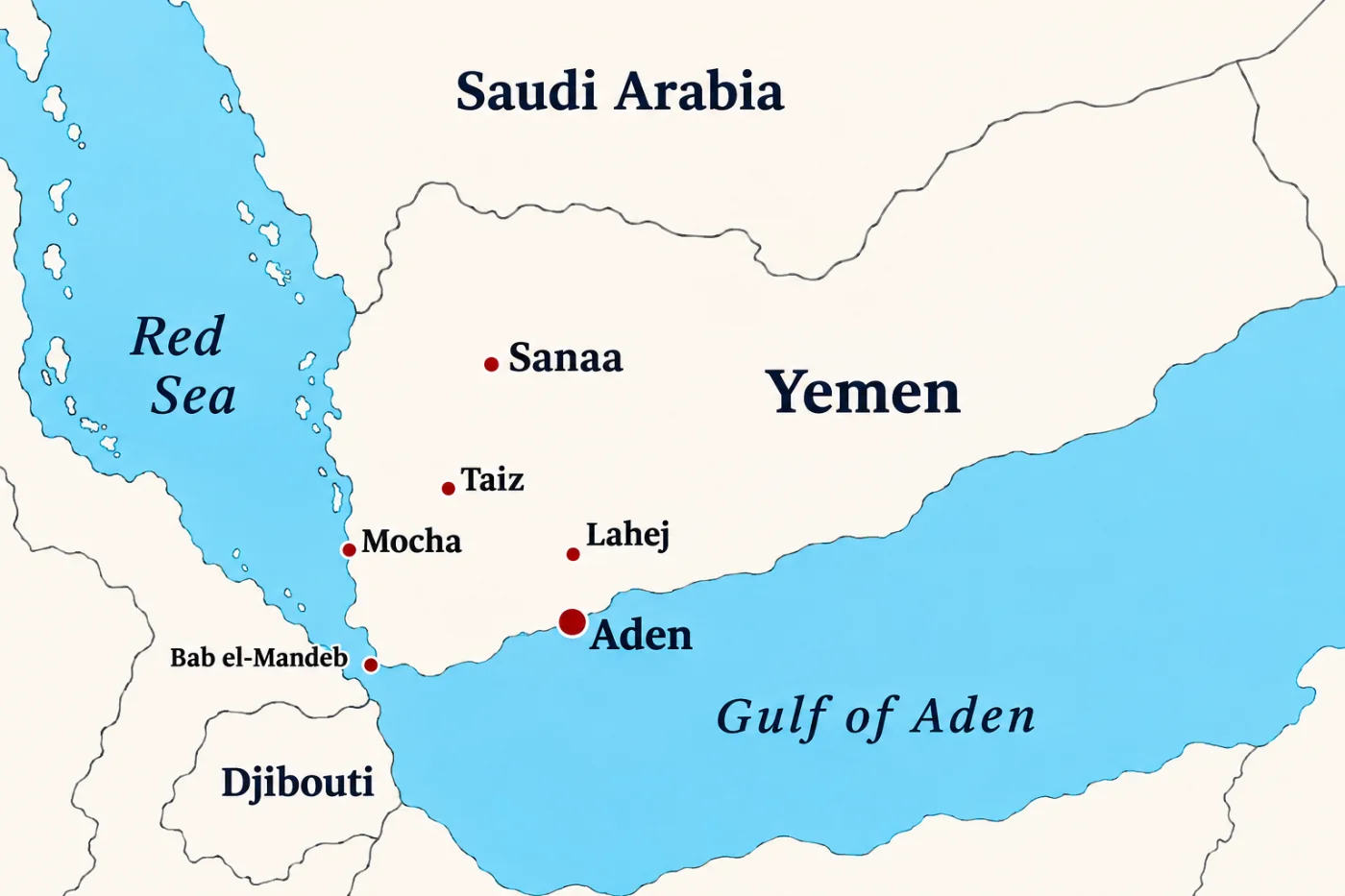
Aden matters today for the reason Britain wanted it in 1837: it sits at the southern approach to the Red Sea, beside the Bab el-Mandeb strait. Since the Houthis seized Sanaa in 2014, Aden has also been the base of Yemen’s internationally recognised government. Losing it would leave that government without its capital.
The stakes rose in September 2026, when the Houthis took control of Yemen’s Red Sea coast. That threatened the Bab el-Mandeb route, a key alternative while the Strait of Hormuz, guarded by islands such as Iran’s Qeshm Island, has been largely closed by the US–Iran war. The Houthis have also struck Saudi Arabia, reopening a conflict whose roots go back to the 1934 Saudi–Yemen war and border.
India’s interest is more than historical. Indian airlines suspended flights to several Saudi cities in November 2026 after Houthi attacks. Much of India’s trade with Europe passes through the Bab el-Mandeb. And the diaspora that the MEA counts in Yemen grew out of the Bombay-era migration described above.
What the Evidence Shows, and What We Still Don’t Know
The firmest parts of this story rest on law and official records. Aden’s administrative dates are fixed by the Government of India Act 1935, the Aden Colony Order debated in Hansard, and the India Office files catalogued by the UK National Archives. The rupee’s end in 1951, Phadke’s death in Aden, Duleep Singh’s arrest there and Gandhi’s 1931 stop are all documented in primary or official sources.
Other details are disputed. The Deria Dowlut‘s exact date and owner differ between sources, and the claim that its grounding was staged remains an interpretation. The precise day Aden fell is usually given as 19 January 1839, but the accounts are not fully consistent. Accounts also differ on whether Dhirubhai Ambani reached Aden in 1949 or 1950.
Interpretation also divides readers. To Indians, “Aden was part of India” can sound like a story of shared heritage. To many Yemenis, it was a period of foreign rule imposed on an Arab port without its consent, whichever capital the orders came from. Both views describe the same facts.
As for the present, the Houthi advance described above rests on government announcements, Houthi statements and anonymous military sources. As of 17 November 2026, Aden remained under government control, and how far the fighting will reach is unknown.
Aden and India: Timeline, 1837–2026
| Year | Event |
|---|---|
| 1837 | The Madras ship Deria Dowlut is stranded and plundered near Aden (exact date disputed) |
| 1839 | Bombay forces capture Aden (usually dated 19 January); the Aden Settlement is placed under the Bombay Presidency |
| c. 1850 | Aden becomes a free port |
| 1869 | The Suez Canal opens, raising Aden’s strategic value |
| 1883 | Vasudev Balwant Phadke dies in Aden jail (17 February) |
| 1886 | Maharaja Duleep Singh is arrested at Aden |
| 1917 | Military control passes to the War Office; Protectorate affairs to the Foreign Office |
| 1931 | Gandhi stops at Aden on his way to the Second Round Table Conference |
| 1932 | Aden becomes a Chief Commissioner’s Province under the Viceroy (1 April) |
| 1935 | Government of India Act: “Aden shall cease to be part of India” |
| 1937 | Aden becomes a British Crown Colony (1 April) |
| 1947 | The Indian Independence Act includes a section on Aden |
| 1951 | The East African shilling replaces the Indian rupee in Aden |
| 1957 | Mukesh Ambani is born in Aden (19 April) |
| 1967 | British withdrawal; People’s Republic of South Yemen proclaimed (30 November) |
| 1990 | North and South Yemen unite |
| 2014–15 | The Houthis take Sanaa; the government moves to Aden |
| Nov 2026 | Government forces redeploy to defend Aden as the Houthis advance (reported) |
Frequently Asked Questions
Aden is in which country?
Aden is a port city in Yemen, on the Gulf of Aden near the southern entrance to the Red Sea. It is currently the interim capital of Yemen’s internationally recognised government.
When did Aden separate from India?
Aden separated from British India on 1 April 1937, when it became a British Crown Colony under the Government of India Act 1935 and the Aden Colony Order 1936.
Who captured Aden in 1839?
Aden was captured in January 1839 by an East India Company expedition from Bombay, including the 24th Bombay Native Infantry under Major Bailie and a naval squadron led by Captain Smith of HMS Volage. Commander Stafford Bettesworth Haines of the Indian Navy was the Political Agent who negotiated, and later directed, the takeover.
Was Mukesh Ambani born in Aden?
Yes. Mukesh Ambani was born in Aden on 19 April 1957, while his father Dhirubhai Ambani was working there. The family moved to Bombay in 1958.
What currency did Aden use under British rule?
Aden used the Indian rupee until 1951, when the East African shilling replaced it. The shilling was replaced by the South Arabian dinar in 1965.
Is Aden controlled by the Houthis?
As of 17 November 2026, no. Aden is held by forces of Yemen’s internationally recognised government, but the Houthis have advanced towards the city and say they are preparing to attack it.
