
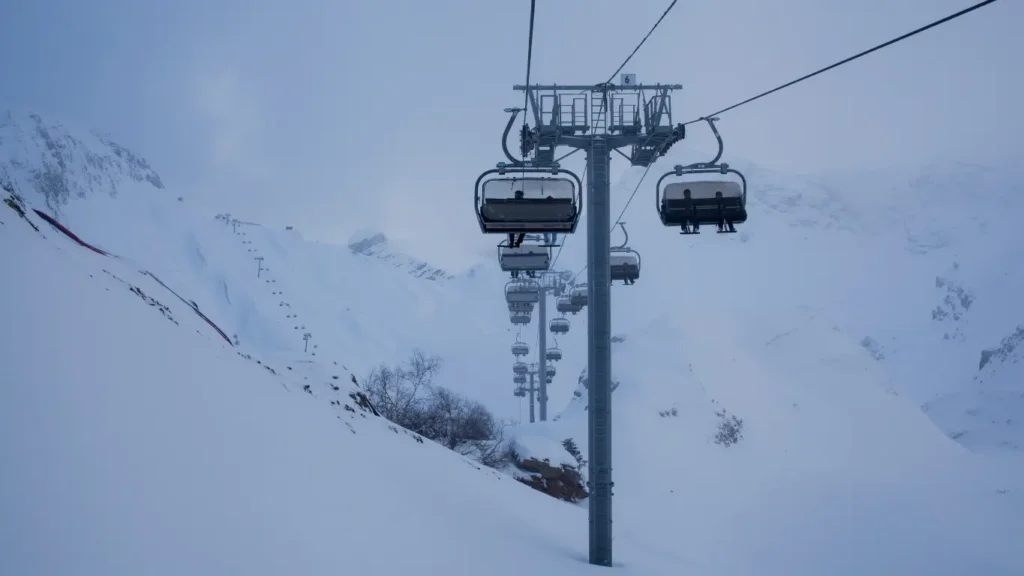
India’s mountains have always presented a strange transportation problem: the places that need connectivity the most are often the places where building roads and railways is hardest. The Parvatmala Project attempts to approach that problem differently—by taking transportation above the terrain rather than trying to carve every route through it.
Announced as the National Ropeways Development Programme – Parvatmala Pariyojana in the Union Budget 2022, the programme aims to develop ropeway infrastructure for difficult and congested areas. The government’s stated target is more than 250 ropeway projects covering around 1,200 km within five years, with the National Highways Logistics Management Limited (NHLML) playing a central implementation role.
But Parvatmala is more than a collection of cable cars.
It represents a different way of thinking about India’s infrastructure: when a railway cannot economically climb a mountain, and a road requires enormous excavation, bridges and tunnels, can a ropeway provide the missing link?
That question becomes particularly important in places such as Kedarnath and Hemkund Sahib, where millions of people travel through some of the most difficult terrain in the country.
What Is the Parvatmala Project?
The Parvatmala Project, officially known as the National Ropeways Development Programme – Parvatmala Pariyojana, is a Government of India initiative designed to expand ropeway-based transportation across India.
The programme was announced in the Union Budget 2022–23 with the objective of improving connectivity in difficult terrain and providing an alternative to conventional road transportation.
Unlike a conventional road or railway, a ropeway does not need to follow every contour of a mountain.
Its cabins can travel across valleys, steep slopes and other obstacles while requiring comparatively limited ground infrastructure.
This makes ropeways particularly interesting for:
- Mountainous regions
- Pilgrimage destinations
- Tourist areas
- Congested cities
- Difficult last-mile connections
- Remote communities
- Locations where conventional roads are expensive or technically difficult
The Ministry of Road Transport and Highways describes the programme as an effort to provide safe, economical, convenient and efficient ropeway infrastructure while improving first- and last-mile connectivity.
Why Does India Need Ropeways?
India has spent decades expanding its road and railway networks into difficult terrain.
But mountains impose a physical price on every kilometre of infrastructure.
A road climbing a steep Himalayan valley may require:
- Cutting into slopes
- Retaining walls
- Bridges
- Tunnels
- Drainage systems
- Slope stabilization
- Regular maintenance after landslides
Railways face an even more complicated problem because trains require relatively controlled gradients and curvature.
Ropeways approach the geography differently.
Instead of continuously modifying the ground to accommodate the transport system, the transport system crosses the difficult ground.
This is one reason the government considers ropeways suitable for difficult and environmentally sensitive terrain. An official government publication notes that ropeways can cross obstacles such as rivers, ravines, roads and buildings while requiring relatively little ground space.
That does not mean ropeways are automatically environmentally harmless. Towers, stations, construction access and maintenance infrastructure still have environmental consequences.
The important point is that the engineering footprint can be different from that of a road or railway.
How the Parvatmala Project Started
The idea did not appear from nowhere.
India had already experimented with ropeways in different forms for decades, particularly around tourist destinations, religious sites and industrial transportation.
What changed with Parvatmala was the attempt to create a national programme rather than treating every ropeway as an isolated local project.
In the 2022 Budget, the government announced the National Ropeways Development Programme through a public-private partnership approach. NHLML, a wholly owned SPV of the National Highways Authority of India, was given responsibility for implementing ropeway projects under the programme.
By January 2024, the government said that more than 200 projects worth about ₹1.25 lakh crore had been identified for the coming five years under Parvatmala.
The programme therefore evolved from a transportation concept into a much larger infrastructure pipeline.
Parvatmala Project and the Changing Meaning of Connectivity
There is an important distinction between building a road to a place and connecting a place to the transportation network.
A mountain village does not necessarily need a highway running through it.
A pilgrim destination does not necessarily need a railway station at the summit.
A tourist city does not necessarily need another road.
Sometimes the missing piece is simply a reliable connection between two points.
That is where ropeways can become useful.
For example, a ropeway can connect:
Railway station → city centre
or
Roadhead → pilgrimage site
or
Valley → mountain settlement
or
Parking area → tourist attraction
This is why Parvatmala is officially described not only as a mountain programme but also as a means of improving first- and last-mile connectivity and urban decongestion.
The Technology Behind the Parvatmala Project
A modern ropeway is much more than a cable with cabins hanging from it.
Different projects can use different technologies depending on:
- Distance
- Gradient
- Passenger demand
- Wind conditions
- Terrain
- Station requirements
- Safety requirements
Two technologies have become especially important in the major Uttarakhand projects.
Monocable Detachable Gondola
A monocable detachable gondola system uses a continuous cable that carries and propels the cabins.
The cabins can be detached from the main line at stations, allowing passengers to board and exit more comfortably.
The proposed Govindghat–Ghangaria section of the Hemkund Sahib project is planned around this technology.
Tricable Detachable Gondola — 3S
The 3S system uses three cables and is designed for higher capacity and improved stability.
It is particularly suitable for challenging environments where longer spans and strong wind resistance are important.
The proposed Sonprayag–Kedarnath ropeway is planned using Tri-cable Detachable Gondola technology with a design capacity of 1,800 passengers per hour per direction.
This illustrates an important feature of the Parvatmala Project:
The technology is being selected according to the geography and transportation demand rather than treating every ropeway as the same.
Sonprayag–Kedarnath Ropeway: The Most Closely Watched Parvatmala Project
Among all the projects associated with Parvatmala, few have attracted as much attention as the proposed Sonprayag–Kedarnath ropeway.
On 5 March 2025, the Union Cabinet approved the project.
Its key specifications are:
| Feature | Details |
|---|---|
| Route | Sonprayag–Kedarnath |
| Length | 12.9 km |
| Estimated capital cost | ₹4,081.28 crore |
| Technology | 3S Tri-cable Detachable Gondola |
| Capacity | 1,800 passengers/hour/direction |
| Design daily capacity | 18,000 passengers |
| Model | DBFOT under PPP |
| Proposed travel time | About 36 minutes |
These figures come from the Cabinet approval announced by the Press Information Bureau.
The difference between the current journey and the proposed ropeway is dramatic.
The traditional approach to Kedarnath involves a 16-km uphill trek from Gaurikund, while the proposed ropeway would connect Sonprayag with Kedarnath in roughly 36 minutes.
That does not mean the traditional pilgrimage disappears.
Instead, the ropeway could provide another way of reaching the shrine, particularly for elderly pilgrims, people with mobility difficulties and visitors unable to undertake the strenuous trek.
Why the Kedarnath Ropeway Matters
Kedarnath is not an ordinary tourist destination.
It is one of India’s most important pilgrimage centres and one of the twelve Jyotirlingas.
The site sits at an elevation of approximately 3,583 metres, and the pilgrimage season is restricted to part of the year because of the Himalayan climate. The government estimates around 20 lakh pilgrims visit Kedarnath during the season.
That creates a transportation problem.
Millions of visitors moving through a narrow mountain corridor put pressure on:
- Roads
- Parking
- Trekking routes
- Helicopter services
- Waste-management systems
- Medical facilities
- Emergency response
The ropeway is therefore not simply about saving travel time.
It is potentially about redistributing how people move through the pilgrimage landscape.
Govindghat–Hemkund Sahib Ropeway
The second major Uttarakhand project approved alongside the Kedarnath ropeway is the Govindghat–Hemkund Sahib ropeway.
The Cabinet approved the project on 5 March 2025.
Its main specifications are:
| Feature | Details |
|---|---|
| Route | Govindghat–Hemkund Sahib Ji |
| Length | 12.4 km |
| Estimated cost | ₹2,730.13 crore |
| Development model | DBFOT / PPP |
| Govindghat–Ghangaria | 10.55 km |
| Ghangaria–Hemkund Sahib | 1.85 km |
| Technology | MDG + 3S |
| Design capacity | 1,100 passengers/hour/direction |
| Design daily capacity | 11,000 passengers |
The government says the existing journey involves a challenging 21-km uphill trek from Govindghat, while the proposed ropeway is intended to provide all-weather last-mile connectivity.
The project is also significant because Ghangaria is the gateway to the Valley of Flowers, a UNESCO World Heritage site.
So one infrastructure project could influence both pilgrimage and tourism flows.
Why Uttarakhand Is Becoming a Major Testing Ground
Uttarakhand provides almost a perfect case study for understanding why India is interested in ropeways.
The state combines:
- Very steep terrain
- Fragile mountain ecosystems
- Major pilgrimage destinations
- Seasonal tourism
- Remote settlements
- Landslide-prone roads
- Heavy visitor concentration during short periods
Building conventional transportation infrastructure in such terrain is expensive and complicated.
That is why projects such as the Kedarnath and Hemkund ropeways are more than isolated tourist attractions.
They are experiments in how India can connect Himalayan destinations without relying entirely on roads.
This is also connected to a broader HypeHive theme: India’s mountain connectivity is being shaped simultaneously by roads, railways and aerial transport.
For example, our look at the Bilaspur–Manali–Leh railway project explores how railways are being considered for some of India’s most extreme terrain.
Meanwhile, the story of the Tanakpur–Bageshwar railway project shows that the dream of penetrating Uttarakhand’s mountains through modern transportation has much deeper roots.
Parvatmala is essentially another answer to the same geographical question.
Parvatmala Is Not Only About the Himalayas
It would be a mistake to think of the Parvatmala Project as simply the government’s “Himalayan ropeway scheme.”
Its scope is broader.
The official programme covers projects intended to improve connectivity in hilly regions as well as congested urban areas where conventional transport is saturated or unsuitable.
That explains why projects such as the Varanasi urban ropeway appear in the programme.
The Varanasi project connects the Cantt railway station area with Godowlia and was conceived as a way of reducing travel time and congestion while improving access to the city’s major attractions. The foundation stone was laid in March 2023.
So Parvatmala has two different faces:
Mountain connectivity
Moving people through difficult terrain.
Urban mobility
Moving people above congested streets.
The engineering principle is similar, but the transportation problem is completely different.
Major Parvatmala Projects
The programme has developed a large pipeline of projects at different stages.
According to the Ministry of Road Transport and Highways’ annual report, projects have included or progressed through stages involving:
- Varanasi
- Bijli Mahadev
- Dhosi Hill
- Mahakaleshwar Temple
- Sangam, Prayagraj
- Shankaracharya Temple
- Sonprayag–Kedarnath
- Govindghat–Hemkund Sahib
- Kamakhya Temple
- Tawang Monastery–P.T. Tso Lake
- Kathgodam–Hanuman Garhi Temple
- Ramtek Gad Temple
- Brahmagiri–Anjaneri
The government’s annual report records different stages for these projects, including construction, award, preferred-bidder selection, bidding and feasibility studies.
This is important because “Parvatmala project” does not refer to one physical ropeway.
It is an umbrella programme containing projects at different stages of development.
What Does DBFOT Mean?
A major part of the Parvatmala model is the use of DBFOT — Design, Build, Finance, Operate and Transfer.
Under this approach, a private-sector partner can be responsible for major parts of the project lifecycle.
In simple terms:
Design → Build → Finance → Operate → Transfer
This differs from a traditional government project where the government may directly finance construction and operate the resulting infrastructure.
For Parvatmala, the government has promoted public-private partnership models because ropeways need not only construction expertise but also long-term operational management.
The two major Uttarakhand ropeways approved in March 2025 were both planned under DBFOT in a PPP framework.
What Could Ropeways Change for Mountain Communities?
The most important question is not how fast a tourist can reach a temple.
It is:
What happens to the people who live there?
Better connectivity can potentially improve access to:
- Markets
- Schools
- Hospitals
- Employment
- Tourism
- Agricultural markets
- Emergency services
The government’s own Parvatmala material identifies improved mobility for people in difficult areas and better opportunities to sell products and produce as potential benefits of ropeway infrastructure.
But connectivity can also change communities in complicated ways.
More tourists can mean:
more income + more traffic + more waste + more commercial pressure.
Therefore, the success of Parvatmala should not be measured only by passenger numbers.
It should also be measured by whether local communities actually benefit.
Is the Parvatmala Project Environmentally Friendly?
This is where the discussion needs nuance.
Government documents describe ropeways as having advantages such as relatively limited ground occupation and lower environmental impact compared with some conventional infrastructure options.
But “lower impact” does not mean “zero impact.”
A ropeway still requires:
- Towers
- Stations
- Construction roads
- Foundations
- Power systems
- Maintenance infrastructure
- Land access
- Construction activity
And in the Himalayas, even relatively small interventions can matter.
The real environmental question is therefore not:
“Are ropeways green?”
It is:
“Is a particular ropeway less damaging than the realistic alternatives for that particular terrain and level of demand?”
That is a much more useful question.
The Safety Question
Mountain transportation is also a safety challenge.
Roads can be affected by:
- Landslides
- Rockfalls
- Floods
- Snow
- Heavy rainfall
Ropeways face their own hazards, including:
- High winds
- Ice
- Mechanical failures
- Evacuation challenges
- Power failures
- Structural problems
That means ropeway safety depends heavily on engineering standards, inspection, redundancy, emergency systems and trained operators.
The proposed Kedarnath project is designed around a 3S system, which is intended for high-capacity operation in demanding environments.
But technology alone cannot eliminate risk.
Mountain infrastructure must be designed around the mountain itself.
Parvatmala and India's Bigger Infrastructure Story
There is a fascinating historical pattern behind all of this.
For centuries, mountain communities have adapted their lives around geography.
Paths followed valleys.
Trade routes crossed passes.
Pilgrims walked steep trails.
Colonial engineers later attempted roads and railways.
Independent India expanded highways, bridges and tunnels.
Now the country is increasingly looking upward.
Ropeways represent a shift from:
“How do we cut a path through the mountain?”
to:
“How do we cross the mountain without completely reshaping it?”
That does not make ropeways universally superior.
But it adds another tool to India’s infrastructure toolbox.
The same broader transformation can be seen in other projects HypeHive has examined, including the history of remote sensing, where increasingly advanced technologies have changed how humans understand terrain from above.
Today, infrastructure planners can combine satellite imagery, GIS, surveying, drones and modern engineering to understand difficult landscapes before construction begins.
The mountain is no longer something engineers simply encounter after arriving at the site.
Increasingly, it is something they can model before they build.
The Challenges Facing the Parvatmala Project
Despite its potential, Parvatmala faces several challenges.
1. Difficult Terrain
Building towers and stations in mountains is itself complicated.
2. Environmental Clearances
Many proposed routes pass through ecologically sensitive areas, making environmental assessment critical.
3. Construction Costs
A ropeway may require less ground infrastructure than a road in certain locations, but sophisticated ropeway systems can still cost thousands of crores.
The approved Kedarnath project alone has a capital cost of ₹4,081.28 crore.
4. Seasonal Demand
Pilgrimage and tourism demand can be highly seasonal.
A system designed for huge peak-season crowds must still remain financially and operationally viable outside those periods.
5. Local Participation
Infrastructure can transform local economies. Without careful planning, however, local communities may receive fewer benefits than outside operators and large tourism businesses.
6. Construction and Maintenance
A ropeway is not finished when the cabins begin moving.
Long-term inspections, maintenance, emergency preparedness and component replacement are essential.
What Is the Current Status of the Parvatmala Project?
The most important thing to understand is that there is no single “Parvatmala construction status.”
Different projects are at different stages.
The Ministry’s annual report records projects under construction, awarded projects, preferred-bidder stages, bidding and feasibility studies.
The two major Uttarakhand projects have moved beyond the early conceptual stage because the Union Cabinet approved them in March 2025.
At the same time, approval does not mean that the entire ropeway is immediately operational.
There are still stages involving:
- Detailed design
- Financing
- Contract implementation
- Land and site requirements
- Environmental and statutory approvals
- Construction
- Testing
- Commissioning
This distinction is important when reading headlines about Parvatmala.
Approved ≠ under construction ≠ operational.
How Much Will Parvatmala Change Travel in India?
If the programme is implemented successfully, the impact could be substantial.
Consider the difference between a difficult mountain journey taking several hours and a ropeway journey taking less than an hour.
The proposed Sonprayag–Kedarnath system illustrates this dramatically:
Existing uphill journey: roughly 8–9 hours
Proposed ropeway journey: about 36 minutes.
That is not simply a reduction in travel time.
It changes:
- How many people can travel
- Who can make the journey
- How tourism businesses operate
- How emergency services can respond
- How pilgrimage seasons function
- How local economies interact with visitors
In other words, the ropeway becomes part of the geography of the destination.
Parvatmala Project: The Future of Mountain Connectivity?
India will probably not replace roads and railways with ropeways.
That would make little sense.
Roads will remain essential for villages, goods, emergency vehicles and ordinary transportation.
Railways will remain critical for mass transportation across suitable corridors.
Air travel will remain important for speed.
Ropeways occupy another space.
They are particularly useful where the challenge is:
short-to-medium distance + steep terrain + high passenger demand + difficult ground conditions.
That makes them a complementary technology.
The real future may therefore be a multi-layered transport network:
Railway → Road → Ropeway → Pedestrian destination
rather than one mode trying to do everything.
The Bigger Question: Can Infrastructure Adapt to Geography?
This is perhaps the most important lesson from the Parvatmala Project.
Infrastructure has traditionally been designed around the assumption that geography must eventually accommodate the infrastructure.
Mountains challenge that assumption.
A highway requires a corridor.
A railway requires controlled gradients.
An airport requires enormous flat space.
A ropeway can cross a valley without requiring a continuous road or railway surface beneath it.
That doesn’t make ropeways a miracle technology.
It simply means they provide another answer to an old Indian problem:
How do you connect places that geography naturally keeps apart?
From the colonial-era railway ambitions in Uttarakhand to today’s Himalayan tunnels, highways and ropeways, India’s infrastructure story has always been a negotiation between engineering ambition and physical geography.
The Parvatmala Project is the latest chapter in that story.
Frequently Asked Questions
What is the Parvatmala Project?
The Parvatmala Project, officially the National Ropeways Development Programme – Parvatmala Pariyojana, is a Government of India programme designed to develop ropeway infrastructure for difficult terrain, last-mile connectivity and congested urban areas.
When was Parvatmala launched?
The National Ropeways Development Programme was announced in the Union Budget 2022–23.
Who implements the Parvatmala Project?
The programme is implemented through the Ministry of Road Transport and Highways, with National Highways Logistics Management Limited (NHLML) playing a central role in ropeway development.
How many ropeway projects are planned under Parvatmala?
The government announced a target of more than 250 ropeway projects covering approximately 1,200 km within five years.
What is the Kedarnath ropeway project?
The Sonprayag–Kedarnath ropeway is a proposed 12.9-km ropeway approved by the Union Cabinet in March 2025 at a capital cost of ₹4,081.28 crore. It is planned to use 3S technology.
How long will the Kedarnath ropeway journey take?
The government says the proposed ropeway could reduce the one-way journey from approximately 8–9 hours to about 36 minutes.
What is the Hemkund Sahib ropeway project?
The Govindghat–Hemkund Sahib ropeway is a proposed 12.4-km project approved at a cost of ₹2,730.13 crore. It combines monocable and tricable detachable gondola technologies across different sections.
Is Parvatmala only for Uttarakhand?
No. The programme covers projects across India, including mountain states and urban locations. The government has identified projects in multiple states and Union Territories.
Are ropeways better than roads?
Not universally. Ropeways can have advantages in steep or congested terrain, but roads remain essential for many forms of transportation. The best solution depends on geography, passenger demand, environmental conditions and economics.
Is the Parvatmala Project environmentally friendly?
Ropeways can have a smaller ground footprint than some conventional infrastructure, but they still require towers, stations, construction activity and maintenance infrastructure. Environmental impact therefore needs to be assessed project by project.
Conclusion: India Is Learning to Travel Above the Mountain
The Parvatmala Project is ultimately an experiment in adapting transportation to India’s geography.
For decades, the answer to difficult terrain was usually another road, another bridge or another tunnel.
Ropeways offer a different possibility.
They can rise above valleys, cross steep slopes and connect destinations where conventional transport can become extremely expensive or difficult.
The proposed Sonprayag–Kedarnath and Govindghat–Hemkund Sahib ropeways are the clearest examples of how ambitious this approach has become.
But the success of Parvatmala should not be judged merely by kilometres of cable installed.
The real test will be whether these systems can deliver safe mobility, reliable connectivity, economic opportunity and responsible development without overwhelming the landscapes and communities they are meant to serve.
India’s mountains have always forced engineers to think differently.
The Parvatmala Project may be the next stage of that long conversation between geography and human ambition.