The 2009 Water Law That Moved Delhi’s Smog Season

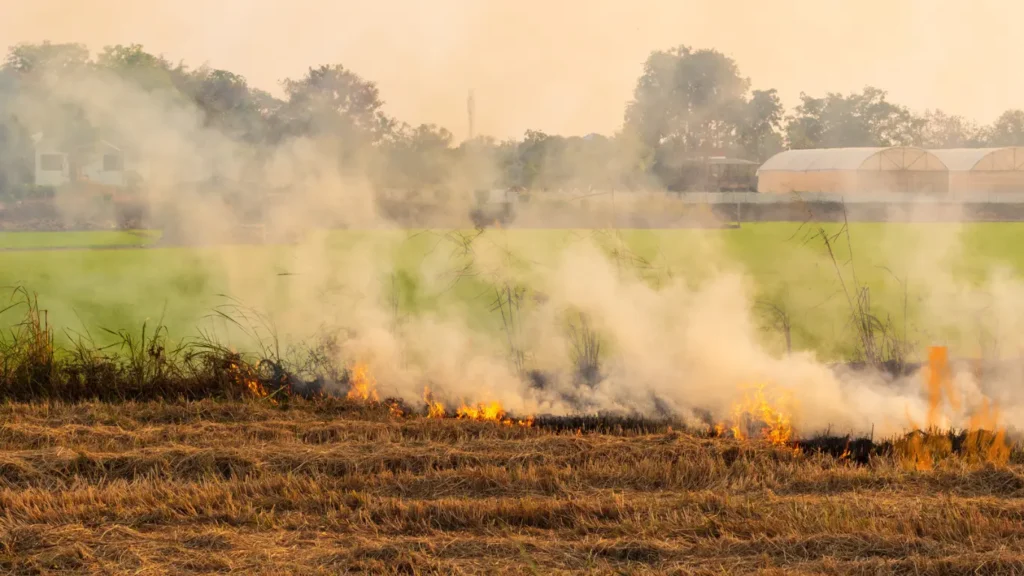
Why Delhi Air Pollution Rises in October - Rice residue burning in a harvested field near Sangrur, Punjab

Delhi’s air worsens in October because the monsoon withdraws, winds weaken and cold air traps pollution near the ground, just as paddy-residue fires peak in Punjab and Haryana. A 2009 Punjab groundwater law delayed paddy transplanting, pushing harvest and stubble burning later into this window, though scientists disagree on how much that timing shift matters.

Delhi’s air pollution rises in October because three things arrive in the same few weeks: still winter air, Diwali smoke, and the paddy-residue fires of Punjab and Haryana, whose timing a little-known 2009 water law helped shift.

On 23 October 2026, Delhi’s air quality fell into the “very poor” band across several hotspots, with Graded Response Action Plan (GRAP) curbs in force, according to local reporting that morning. The coverage that follows every year is predictable: AQI readings, satellite images of farm fires, and Delhi and Punjab blaming each other.

A simpler question rarely gets asked. Why do those fires burn in late October and early November, the exact weeks when Delhi’s air can least absorb smoke? Part of the answer lies in a short law the Punjab legislature passed in April 2009, to save groundwater rather than air. By the end of this article you will know what that law says, what two research teams found when they measured its effect, and why the map of the smoke is now moving south.

Why Delhi Air Pollution Rises in October

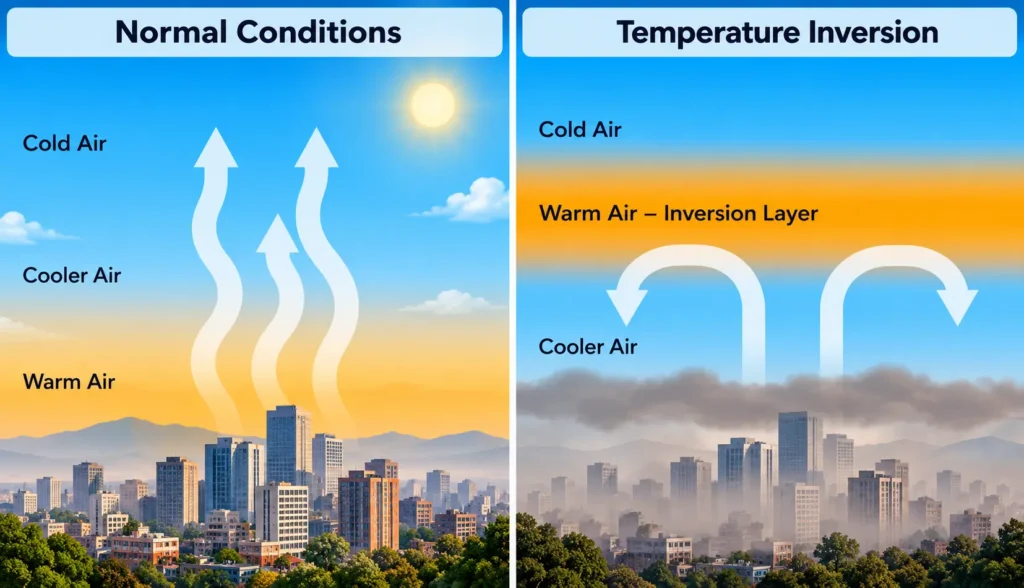
After the monsoon withdraws, weaker ventilation and winter atmospheric conditions can allow pollution to accumulate. Credit: HypeHive, original diagram.

Delhi’s air deteriorates from late October because the weather stops clearing it. Once the monsoon withdraws, winds slow, temperatures drop, and a layer of cold air near the ground holds whatever the region emits: vehicle exhaust, construction and road dust, industrial smoke, and smoke from fields hundreds of kilometres away.

That seasonal switch is the reason October behaves differently from August. For a refresher on how the monsoon shapes India’s seasons, the short version is that the rain and wind which scrub the air for four months disappear almost at once.

The Centre for Research on Energy and Clean Air (CREA), an independent research organisation, found that Delhi’s worst air usually falls between the last week of October and mid-November. CREA’s analysis attributes 15 to 20 days of that deterioration to stubble burning, layered on top of Diwali fireworks and the city’s year-round sources.

How much of Delhi’s smog comes from farm fires is genuinely contested, because the share swings with the wind and the number of fires. In one November season, figures cited by Scroll put stubble smoke at around 7% of Delhi’s pollution on a day with 1,797 fires and around 48% on a day with 5,450 fires. Traffic and dust never switch off. Farm smoke is the part that spikes.

Which brings the real question into focus: why does that spike arrive in the stillest weeks of the year?

How Punjab Became a Rice State

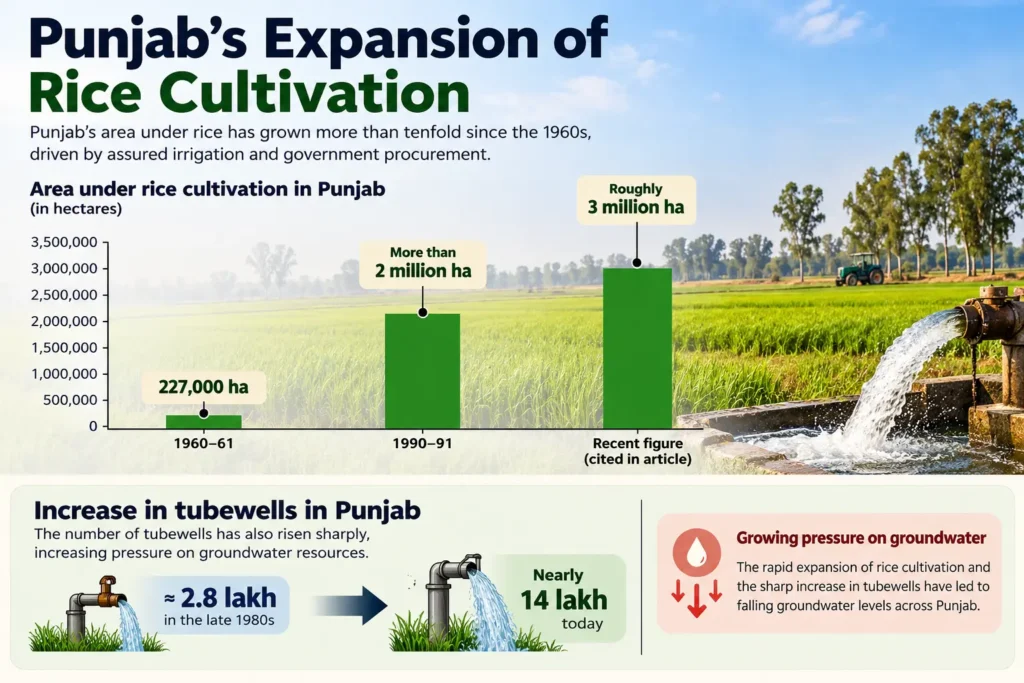
Punjab’s rice area expanded dramatically alongside dependence on irrigation; figures shown are historical estimates cited in the article. Credit: HypeHive, based on the sources cited in the article.

Punjab grows rice on a massive scale because national food policy pushed it there, not because the crop suits a dry, hot summer. In 1960-61 the state had about 227,000 hectares under rice. By 1990-91 the figure had crossed 2 million hectares, according to data compiled by H.S. Sidhu of Guru Nanak Dev University. Punjab Agricultural University (PAU), Ludhiana, now puts paddy area at roughly 3 million hectares.

Growing a flooded crop through Punjab’s summer means pumping groundwater. The state had about 2.8 lakh agricultural tubewells in the late 1980s and has nearly 14 lakh today, and since January 1997 it has given farmers electricity for those pumps free of charge, The Tribune reported. When power costs nothing, pumping costs nothing to the farmer.

The aquifer paid instead. PAU’s figures show the average fall in the water table rising from about 25 cm a year in the 1990s to 50–60 cm a year between 2008 and 2017. For a country with India’s long history of managing water through tanks, stepwells and canals, Punjab’s model of drawing down groundwater every summer was a sharp break.

Machines supplied the second ingredient. Combine harvesters spread across Punjab from the 1980s, agricultural experts told Scroll. They cut and thresh the grain in one pass but leave long stalks standing in the field. Those stalks are the stubble.

The Punjab Preservation of Subsoil Water Act 2009, Explained

The Punjab Preservation of Subsoil Water Act, 2009 (Punjab Act No. 6 of 2009) is a short law that bars farmers from sowing paddy nurseries and transplanting paddy too early in summer. Its aim was to move rice’s thirstiest weeks away from the hottest, highest-evaporation part of the year and closer to the monsoon rains.

The Governor of Punjab gave assent on 2 April 2009, and the Act was published in the state gazette on 28 April 2009, coming into force immediately, as the gazette copy on India Code shows. Haryana passed a near-identical law, the Haryana Preservation of Sub-Soil Water Act, the same year, according to Business Today.

What the law actually says

Section 3 sets two rules. No farmer may sow a paddy nursery before 10 May. And no farmer may transplant paddy before “such date, as may be notified”. The Act itself names no transplanting date.

That blank matters more than anything else in the law. Because the date sits in a government notification, it can be moved by an order each season, without going back to the legislature. A 2010 paper by researchers Bharat R. Sharma, G.K. Ambili and B.S. Sidhu described the original rule as a mandatory delay in transplanting beyond 10 June.

The law has teeth on paper. Section 7 sets a penalty of ₹10,000 per hectare for every month, or part of a month, that a violation continues, in addition to recovering the cost of destroying the illegally planted crop. Research plots of PAU and waterlogged areas, defined as land where the water table lies less than one metre below the surface, are exempt.

The squeeze between paddy and wheat
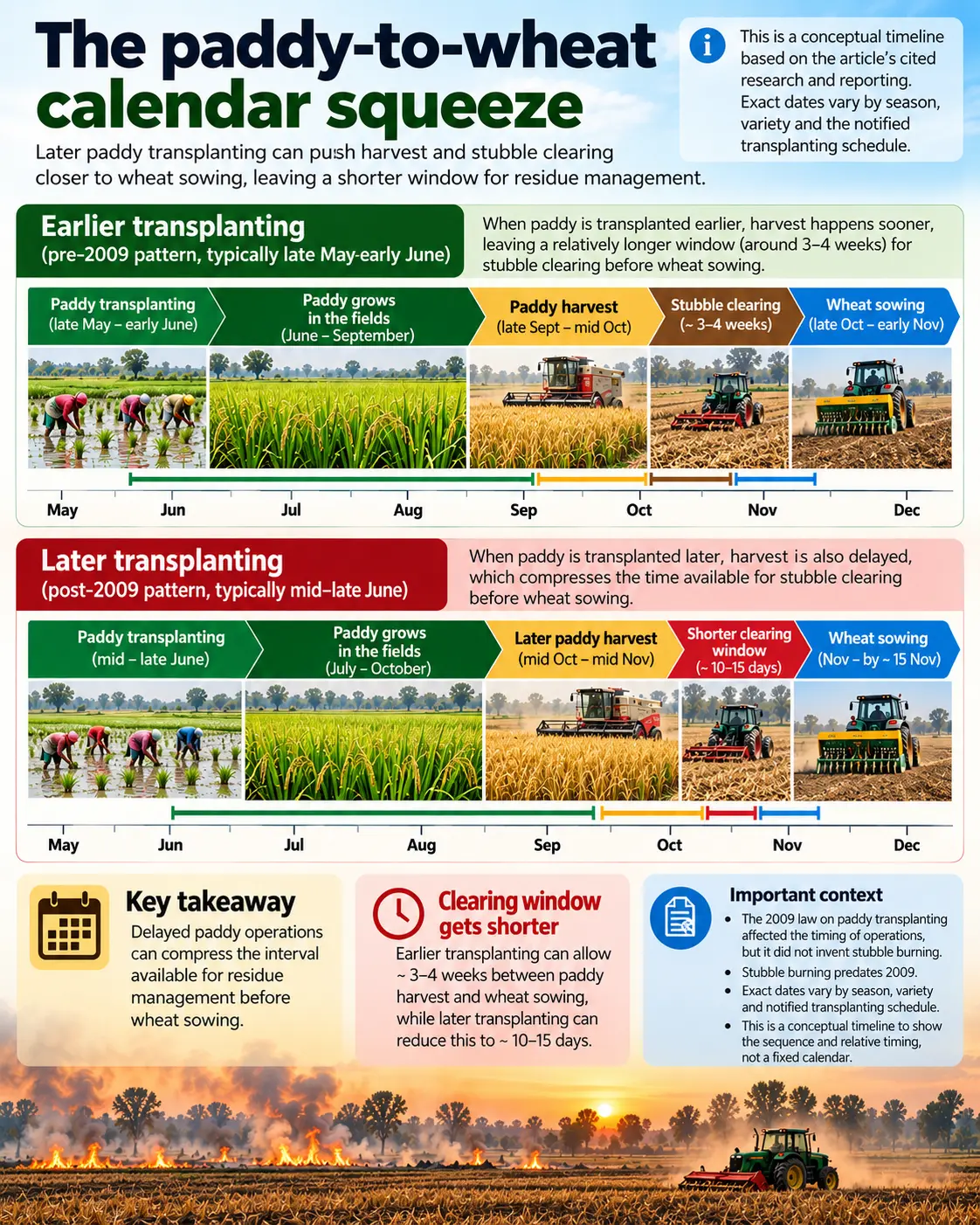
Timeline showing how later paddy transplanting can push harvest and stubble clearing closer to wheat sowing

Transplant later and you harvest later. Wheat, Punjab’s winter crop, still has to go in on time, and farmers usually sow it within seven to ten days of the paddy harvest, agricultural experts told Scroll. Clearing two to three feet of standing stubble from a field in that window takes machinery, labour or money. A matchstick takes a minute.

None of this means the 2009 Act invented stubble burning. Farmers in Punjab say they were burning paddy residue long before 2009, and the Business Today report records that claim. What the Act changed was when the burning happens.
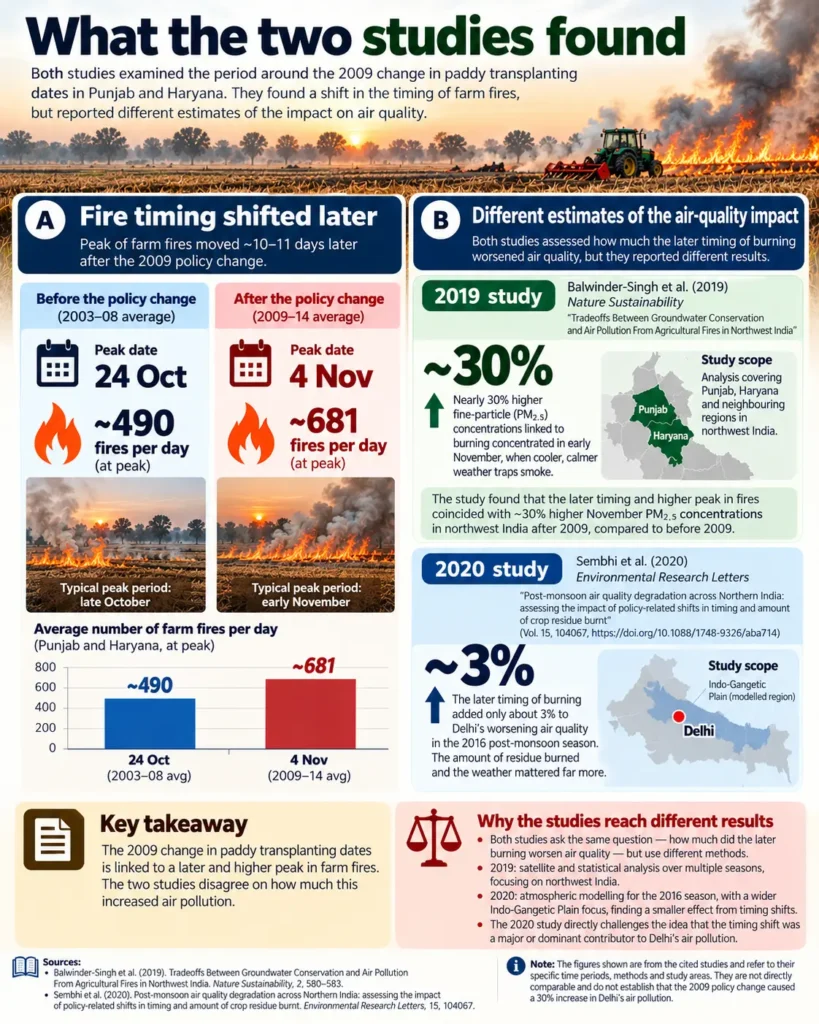
When Did the Smoke Move? What the Studies Found

Two studies found a shift in fire timing but differed on its air-quality consequences. Credit: HypeHive, based on Balwinder-Singh et al. (2019) and Sembhi et al. (2020).

Researchers agree that the 2009 groundwater laws pushed Punjab and Haryana’s fire season later. They disagree on how much that shift worsened Delhi’s air, and the disagreement is the most important thing a reader should know about this story.

The first study, published in Nature Sustainability in 2019 by Balwinder-Singh and Amit Srivastava of the International Maize and Wheat Improvement Center (CIMMYT), Andrew McDonald of Cornell University and Bruno Gerard of CIMMYT, measured the shift directly. In the six seasons before the laws, an average of 86% of rice area in Punjab and Haryana was planted by 28 June. Afterwards, less than 40% was. The peak day for farm fires moved from 24 October, at about 490 fires a day, to 4 November, at about 681. Cornell’s summary of the study reports that the authors linked the shift to almost 30% higher fine particulate concentrations in November across the region.

The second study, published in Environmental Research Letters in 2020 by a UK–Indian team led by H. Sembhi, reached a more cautious conclusion. It found that burning had shifted by about 10 days after the 2009 policy, but that in 2016 this timing shift made only a small contribution, about 3%, to worse air over Delhi. The team concluded that post-monsoon air quality is far more sensitive to the weather and to how much residue is burned than to when it is burned. It also warned that delaying the fires further could have worsened air by 30% in Ludhiana and 4.4% in Delhi.

StudyShift in burningEffect on air reportedMain conclusion
Balwinder-Singh et al., Nature Sustainability (2019)Peak fire day 24 Oct → 4 NovAlmost 30% higher November fine particulates, regionallyWater conservation traded off against air quality
Sembhi et al., Environmental Research Letters (2020)About 10 days laterAbout 3% worse over Delhi in 2016Weather and the amount burned matter far more than timing

The two findings are less contradictory than they look. Both confirm the shift. They differ on region, year and method, and on whether timing or volume is the bigger lever. The fairest reading is this: a law written to save Punjab’s water moved its farm fires into the weeks when north India’s weather is least able to disperse smoke, but whether a given November turns hazardous for Delhi depends more on the wind and on how much straw is burned. None of the popular explainers reviewed for this article set these two studies side by side, and the policy argument changes once you do.

The Date That Keeps Moving

Because the 2009 Act left the transplanting date to government notification, Punjab has changed it repeatedly, and every change drags the harvest and the fires with it. The tug-of-war is between groundwater, which favours a later date, and harvest moisture, power demand and farmer pressure, which favour an earlier one.

  • 2009: transplanting held back to after 10 June under the new law.
  • 2014: the date was later moved to 15 June, according to a Punjab farmers’ group quoted by The Tribune.
  • 2019: a 20 June date, set on the recommendation of the Punjab Pollution Control Board and PAU, was brought forward to 13 June after farmer groups complained of high moisture in late-harvested grain. The change was challenged before the National Green Tribunal, PTI reported, which took the view that earlier transplanting would help air quality, even as a committee report argued the 20 June date would save groundwater without adding to stubble pollution.
  • 2025: Chief Minister Bhagwant Mann’s government moved to zone-wise transplanting from 1, 5 and 9 June, citing power demand and the October moisture problem at procurement, India TV reported.

The 2025 decision drew warnings from agricultural experts that an earlier date could pull farmers back towards long-duration paddy varieties and worsen both groundwater depletion and stubble burning, The Tribune reported. It also squeezed the other end of the calendar: with less time between the wheat harvest and paddy planting, Punjab recorded 6,244 wheat-residue fires by mid-May 2025, with a sharp jump in the second week of the month, the paper reported separately.

Is Punjab Still the Problem? The 2026 Shift

Punjab’s paddy fires have fallen sharply, yet Delhi’s autumn air has not cleaned up, which shows how far the problem now reaches beyond one state and one source.

Between 15 September and 6 October 2026, satellites tracked by the Consortium for Research on Agroecosystem Monitoring and Modelling from Space (CREAMS) at the Indian Agricultural Research Institute counted 88 paddy-burning events in Punjab, the state’s lowest for that period in seven years. Madhya Pradesh recorded 118, its highest ever for the same period, Down To Earth reported. Across the whole 2025 season, Madhya Pradesh accounted for 17,067 of 33,028 incidents in six states, more than half. Punjab logged 5,114.

Two caveats apply. These are early-season counts, and the peak normally comes in late October and early November. Satellite detection also misses fires under cloud cover. Even so, the direction is clear, and the 23 October “very poor” reading arrived while Punjab’s fire count stayed low. Delhi’s own traffic, dust and industry, and its winter weather, were doing much of the damage on their own.

Frequently Asked Questions

Why was stubble burning banned, and why hasn’t it stopped?

Stubble burning is penalised because its smoke adds to severe air pollution across north India. Since November 2024, farmers can be charged environmental compensation of up to ₹5,000 per incident for holdings under 2 acres, ₹10,000 for 2–5 acres and ₹30,000 above 5 acres, under rules of the Commission for Air Quality Management (CAQM), LiveLaw reported. The rates were doubled after the Supreme Court criticised governments for imposing nominal fines. Burning persists because the window between paddy and wheat is short and straw management costs money that a match does not.

How much does stubble burning contribute to Delhi pollution?

It depends on the day. Estimates range from single digits to nearly half of Delhi’s pollution at the peak of the fire season, depending on fire counts and wind direction. Over the year as a whole, local sources such as transport, dust and industry carry most of the load.

What is the Punjab Preservation of Subsoil Water Act 2009?

The Punjab Preservation of Subsoil Water Act, 2009 is a state law that bans sowing paddy nurseries before 10 May and transplanting paddy before a date the government notifies each season. It was passed to slow groundwater depletion and carries a penalty of ₹10,000 per hectare per month for violations.

When is paddy transplanted in Punjab now?

In 2025, Punjab allowed zone-wise transplanting from 1, 5 and 9 June, depending on the district. Because the date is set by notification, it can change every year, so farmers should check the Punjab Agriculture Department’s notice for the current season.

One Law, Two Crises

The 2009 Act was a reasonable answer to a real emergency: an aquifer falling every year under a crop the country had asked Punjab to grow. It treated water and air as separate problems, and the smoke over Delhi each November is part of the price of that separation.

Much is still uncertain. No published study isolates the Act’s effect on Delhi’s air in the seasons since 2020. It is also unclear how much water the law has actually saved: a 2020 PAU master’s thesis found groundwater continued to fall in high-rice areas after the Act. And the 2026 figures suggest the fire map is shifting towards Madhya Pradesh and Uttar Pradesh, where the 2009 Punjab law has no reach.

What the history makes plain is that Delhi’s October smog is not just a farmer problem or a weather problem. It is the visible end of a chain that runs from the Green Revolution through free power, a blank date in a short state law and, now, fields far beyond Punjab. India is making other large bets on water, from river-linking projects like the Ken–Betwa link onward. The lesson of 2009 is to count the air in the same ledger.

Picture of Himanshu Pant

Himanshu Pant

Himanshu Pant is the founder and editor of HypeHive. He holds a BA in Political Science and History and an MA in English, and writes on Indian and world history, connecting current events to their historical roots using primary and scholarly sources.
Scroll to Top