
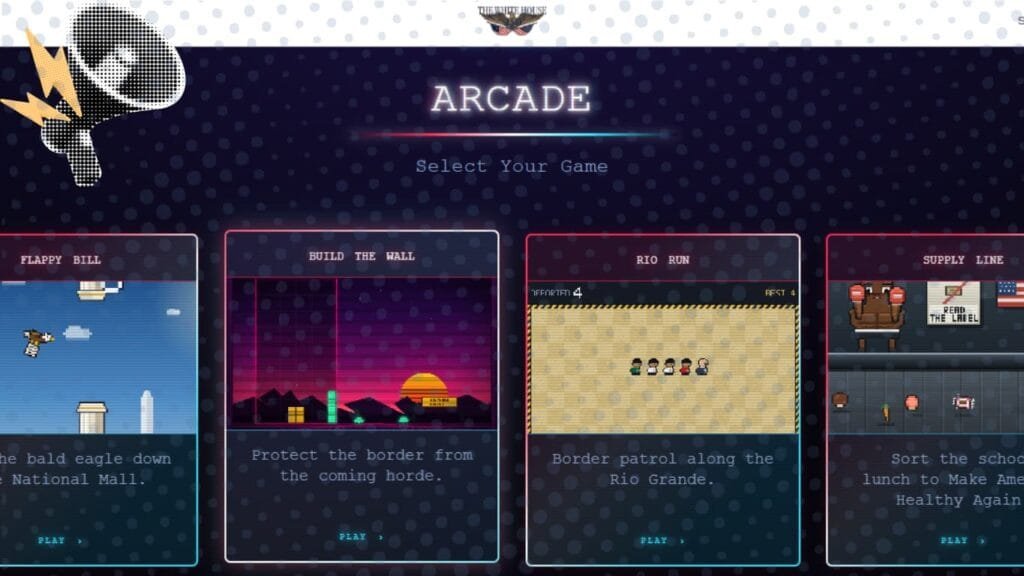
Government video games have entered an unexpected new chapter. In September 2026, the White House added an online arcade to its official website, offering five simple browser games built around themes from President Donald Trump’s political agenda. The games include Flappy Bill, Build the Wall, Rio Run, Supply Line and Trump Savings Tycoon.
At first glance, it looks like an internet oddity: a government website filled with pixel graphics, retro sound effects and games resembling classics such as Tetris, Snake and Flappy Bird.
But the strange part isn’t that the White House made games.
The strange part is that governments have been using games as communication tools for decades.
Long before Arcade.gov appeared, the U.S. military had already discovered that a video game could do something a poster, television advertisement or recruitment brochure could not.
It could make the audience participate in the message.
That story begins in the early 2000s with a game called America’s Army.
And once you follow that trail—from military recruitment to political campaigns, from shopping malls to esports, and finally to the White House—you discover that the 2026 arcade is not as unprecedented as it first appears.
It is the latest stage in the history of government video games.
What are government video games?
Government video games are interactive games created, commissioned or used by government institutions to communicate information, recruit people, educate audiences, simulate situations or promote particular policies and ideas.
They are different from ordinary commercial games that happen to contain political themes.
The distinction is about who is using the game and why.
A commercial game might explore war, immigration or elections because those subjects make compelling stories.
A government-backed game can have a much more specific objective.
It may want you to:
- understand a policy
- learn about an institution
- consider military service
- practice a real-world skill
- simulate a government process
- or associate an institution with particular values
That makes games an unusual communication medium.
A speech asks you to listen.
A poster asks you to look.
A television advertisement asks you to watch.
A game asks you to act.
That difference is the key to understanding why governments became interested in gaming.
The White House Arcade: Why did it launch in 2026?

On September 3, 2026, the White House unveiled Arcade, a dedicated gaming section on its official website. The White House promoted the launch through its own video channels and social media, framing the arcade as a new way to communicate the administration’s record.
The official arcade currently lists five playable titles:
| Game | Basic gameplay | Political theme |
|---|---|---|
| Flappy Bill | Guide a bald eagle through obstacles | Legislation and Trump Accounts |
| Build the Wall | Stack falling pieces | Border security |
| Rio Run | Patrol along the Rio Grande | Border enforcement |
| Supply Line | Sort school-lunch items | “Make America Healthy Again” |
| Trump Savings Tycoon | Collect items associated with savings | Trump Accounts |
The White House describes the games in straightforward policy terms. Build the Wall is presented as protecting the border, Rio Run as border patrol, and Supply Line as sorting school lunches according to the administration’s stated health priorities.
The games are deliberately simple.
That is important.
They don’t require a gaming PC.
They don’t require an account.
They don’t require someone to understand a complicated story.
The barrier to entry is essentially:
click → play → understand the political reference.
That makes Arcade.gov a particularly direct form of digital political communication.
Why the White House chose old-school video games
There is another interesting decision hidden in the arcade.
The White House didn’t invent complicated new game mechanics.
Instead, it borrowed familiar ones.
Build the Wall resembles the falling-block structure of Tetris.
Rio Run draws on the basic logic of Snake.
Flappy Bill resembles the simple obstacle-avoidance gameplay popularized by Flappy Bird.
That means the political message does not have to teach the player how to play.
The player already understands the language.
Stack the blocks.
Avoid the obstacles.
Move around the map.
The game mechanics are familiar enough that the political message becomes the new part.
This is an important characteristic of modern government video games:
The government doesn’t need to teach people how to play the game. It can use a gaming language people already know.
The result is something closer to a political meme that happens to be playable.
But the White House wasn't the first government to discover games
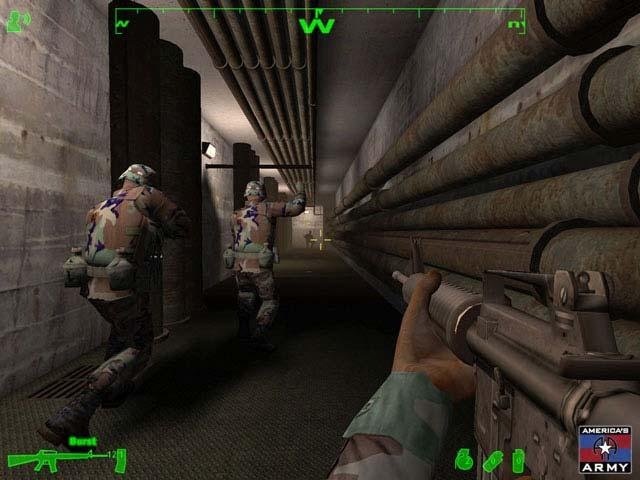
To understand how we got here, go back to 2002.
The United States Army launched America’s Army on July 4, 2002.
It was a free online first-person shooter.
And it wasn’t secretly funded or accidentally political.
The Army openly described its purpose.
The game was designed to use entertainment technology to educate potential recruits and the general public about the Army and to communicate Army values. The U.S. Army later described it as a way to give players insight into soldiers’ lives through a virtual environment.
That makes America’s Army one of the most important examples in the history of government video games.
The Army had identified a problem:
Young people were already spending enormous amounts of time playing first-person shooters.
So why not communicate with them through the medium they were already using?
The logic was remarkably simple.
Instead of saying:
“Come learn about the Army.”
The Army effectively said:
“Come play the Army.”
America's Army changed the recruitment model
The significance of America’s Army wasn’t just that the U.S. military made a game.
It was that the game was designed around participation.
The player entered a simulated military environment.
They completed training.
They learned procedures.
They received virtual achievements.
They progressed through the game.
The Army’s own account explains that the project was conceived specifically as a way to reach young Americans through entertainment technology and communicate aspects of Army life and values.
This created a fundamentally different relationship between the institution and its audience.
Traditional recruitment advertising says:
Here is who we are.
A game says:
Try doing what we do.
That distinction would become increasingly important as gaming grew.
The surprising scale of America's Army
America’s Army wasn’t a tiny experiment that disappeared after a few months.
It became a major online game.
The Army described the original title as a runaway internet success, and later versions continued the project.
The game also became a subject of academic interest because it represented a new type of government communication.
Researchers began examining the phenomenon using terms such as “propagame” to describe games designed to communicate ideological or political messages.
That distinction is useful.
Not every political game is propaganda.
A game can simply explore politics.
But a game can also be deliberately designed to persuade.
Academic research into political gaming has examined how games can encode political rhetoric not only through dialogue or images, but through gameplay itself.
That is the critical difference.
A political poster tells you what to think.
A game can make you perform a simplified version of the argument.
The Army didn't stop with a computer screen
The next step in the history of government video games was even stranger.
The military began experimenting with physical gaming environments.
Instead of waiting for young people to encounter a recruitment advertisement, the Army created spaces where gaming itself could become the entry point.
One of the best-known examples was the Virtual Army Experience, an immersive simulation environment designed to bring aspects of military experience to public events.
The idea was straightforward:
Let people experience military technology and simulation.
Then:
let them interact with military personnel.
And potentially:
turn that interaction into recruitment.
Academic research into military gaming and recruitment documents the Virtual Army Experience as part of the Army’s broader attempt to use immersive gaming as a recruitment and communication tool.
The boundary between entertainment and recruitment was becoming increasingly thin.
Then the Army put gaming inside a shopping mall

This may be the strangest chapter in the story.
In 2008, the U.S. Army opened the Army Experience Center in Philadelphia.
It was not a traditional military recruitment office.
It was designed as an interactive gaming and recruitment environment.
Visitors could encounter military-themed simulations alongside commercial gaming technology.
The strategy was based on a powerful idea:
Don’t ask young people to walk into a recruitment office. Give them a place they already want to enter.
The Army Experience Center became controversial precisely because of that approach.
Critics argued that the environment blurred entertainment and recruitment, particularly in its appeal to younger visitors.
But from a communication perspective, the experiment revealed something important.
Gaming could function as a social gateway.
The game brought the audience in.
The institution came afterward.
That model would eventually become much larger than military recruitment.
Government video games became part of a bigger political ecosystem
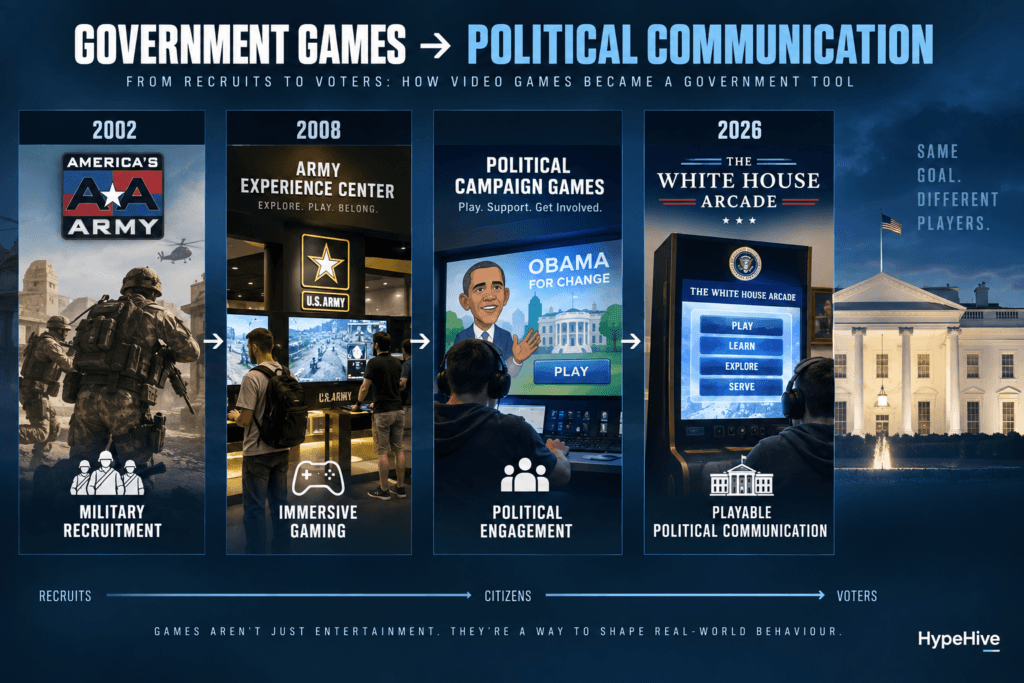
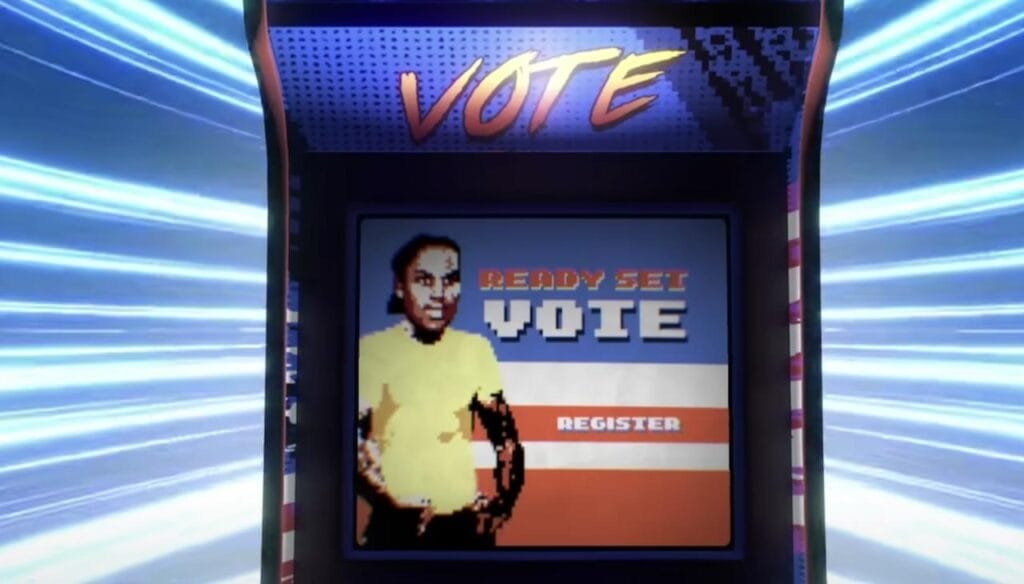
The 2000s were also the period when political campaigns began experimenting with games.
Campaigns discovered that games could be distributed online just like videos, advertisements and social-media content.
Researchers studying political campaigning games found that political games were used as alternative forms of voter contact and could encode political rhetoric directly into gameplay.
The idea was no longer limited to:
“Join the Army.”
It expanded toward:
“Support this candidate.”
“Understand this issue.”
“See the world through this political frame.”
And this wasn’t uniquely American.
Academic research has documented political games across different countries and political systems, including games associated with campaigns, protests and state messaging.
The medium was becoming global.
Some governments used games for something darker
This is where the story needs nuance.
Governments and political movements have used games for very different purposes.
Some have been educational.
Some have been recruitment tools.
Some have been political campaigning.
Others have been much closer to explicit propaganda.
Academic research on Chinese “propagames,” for example, has examined games designed to support political narratives and ideological legitimacy. Researchers have studied how such games can use fictional worlds, collective memory and emotional engagement to communicate political messages.
Other research has examined propaganda techniques in games connected to geopolitical conflicts, including repetition, emotional framing, demonization of opponents and the presentation of selective historical narratives.
This gives us an important distinction:
Political game
A game containing political ideas.
Political campaign game
A game created to support a political campaign or movement.
Government game
A game created or used by a government institution.
Propagame
A term used in academic discussions for games designed to communicate ideological or propagandistic messages.
The categories can overlap.
But they are not automatically the same thing.
So, are the White House games propaganda?
This is where the answer needs to be careful.
The White House Arcade is clearly political communication.
The games are built around specific administration priorities.
The White House itself presents them as part of its effort to communicate what the administration considers its accomplishments.
But calling every government game “propaganda” would erase important distinctions.
A recruitment game can contain propaganda elements.
An educational simulation can be government-produced without being propaganda.
A political game can persuade without being state propaganda.
The more useful question is:
What does the game ask the player to do, and what worldview is built into those actions?
That is where games become particularly interesting.
The secret weapon of government video games: gameplay
Imagine two political messages.
The first says:
“The government has strengthened border security.”
The second gives you a game in which:
You build the border wall.
The first asks you to believe a statement.
The second asks you to perform an action.
That doesn’t mean the player will automatically accept the political message.
Games can be mocked.
Games can be criticized.
Players can reject the assumptions built into them.
But gameplay changes the relationship between the audience and the message.
Researchers studying political games have argued that games can enact political rhetoric through their mechanics, rather than merely presenting political statements through text.
That is why government video games deserve to be studied differently from posters or television commercials.
The argument can exist inside the rules.
Why Arcade.gov feels different from America's Army
There is a crucial distinction between the two.
America’s Army was fundamentally tied to military recruitment and public education about the Army.
Arcade.gov is openly tied to the political agenda of a sitting administration.
The first essentially asks:
Could you imagine yourself in the Army?
The second asks:
Can we turn our political agenda into something you can play?
The technological sophistication has actually moved backward.
America’s Army was a full multiplayer shooter.
The White House games are deliberately tiny.
But their distribution is radically different.
In 2002, you had to download a game.
In 2026, the government can put a playable political message directly on its homepage.
No installation.
No store.
No publisher.
No gaming platform.
Just:
whitehouse.gov → Arcade → Play.
That is a remarkable change in distribution.
The White House also understands internet culture
There is another reason the 2026 arcade is different.
The White House didn’t present the games like conventional government educational software.
The launch used retro graphics, gaming references and parody versions of recognizable console-era imagery.
The White House itself promoted Arcade.gov through short-form video and gaming-themed content.
That matters because the product isn’t only the game.
The meme is part of the product.
A screenshot can circulate.
A gameplay clip can circulate.
Someone can share the game ironically.
Someone can criticize it.
Someone can stream it.
Someone can turn it into another meme.
In other words:
The game is designed for a media ecosystem in which people don’t just consume political content—they remix it.
That is very different from the political communication environment of 2002.
And then there is the Tetris problem

The most visible controversy surrounding Arcade.gov has also highlighted another dimension: intellectual property.
Build the Wall uses a falling-block mechanic strongly associated with Tetris.
The Tetris Company said it was not involved with the White House game and objected to the apparent use of its intellectual property or branding association. AP reported that the company emphasized that the original Tetris game was created by Soviet computer scientist Alexey Pajitnov and that the company had not authorized the White House project.
That creates an almost perfect historical collision:
Soviet-born game
↓
global commercial franchise
↓
American political website
↓
border-wall political message
↓
2026 internet controversy
A game created in the Soviet Union decades ago has become part of an American political communication experiment.
That alone is a story worth telling.
From Soviet computers to the White House
The original Tetris was created by Alexey Pajitnov in the Soviet Union in 1984.
Its history is already extraordinary.
A simple puzzle game created on Soviet computer hardware eventually became one of the most recognizable games in the world.
Decades later, its familiar gameplay language has become so culturally recognizable that someone can reproduce the basic concept and most people immediately understand the mechanic.
That is exactly what makes retro gaming useful for political communication.
The audience already knows the rules.
You don’t have to explain what falling blocks mean.
You just change what the blocks represent.
And suddenly:
a game mechanic becomes a political metaphor.
What happens when politics becomes a game?
This is the real historical question behind Arcade.gov.
For centuries, governments have tried to communicate through whatever medium reached the largest audience.
First came monuments.
Then pamphlets.
Then newspapers.
Then radio.
Then cinema.
Then television.
Then websites.
Then social media.
And now governments can build interactive political experiences.
The medium keeps changing.
The fundamental objective doesn’t.
Reach people.
Get attention.
Communicate an idea.
Build an emotional connection.
And, sometimes, persuade.
What changes with gaming is the final step:
the audience participates.
The history of government video games is really the history of participation
That may be the biggest lesson from the story.
America’s Army asked players to experience military life.
The Virtual Army Experience asked visitors to experience military simulation.
Political games asked voters to interact with campaign messages.
Propagames ask players to inhabit ideological narratives.
And Arcade.gov asks visitors to play through simplified versions of current political priorities.
Different governments.
Different eras.
Different objectives.
But one technological evolution connects them:
From watching the message to playing the message.
That is a much more interesting story than five pixel-art games appearing on a government website.
What government video games tell us about the future
The White House Arcade may disappear from the news cycle within weeks.
The games themselves may become forgotten internet curiosities.
But the underlying experiment is unlikely to disappear.
Government communication is moving toward increasingly interactive formats.
Virtual reality.
Simulations.
Gamified education.
Interactive maps.
AI-generated experiences.
Digital twins.
Games.
The technology keeps making the same question more relevant:
If you can make someone experience an idea instead of merely hearing it, what happens to political communication?
That question extends far beyond the White House.
It applies to militaries.
Schools.
Public-health campaigns.
Museums.
Political campaigns.
Governments.
And eventually, perhaps, almost every institution trying to explain something complicated to a generation raised inside interactive media.
Frequently Asked Questions About Government Video Games
What are government video games?
Government video games are games created, funded or used by government institutions for purposes such as education, recruitment, simulation, public communication or political messaging. America’s Army is one of the best-known U.S. examples.
What is the White House Arcade?
The White House Arcade is a section of the official White House website launched in September 2026 containing five browser-based games tied to themes from the Trump administration’s agenda.
What games are on the White House Arcade?
The current arcade lists Flappy Bill, Build the Wall, Rio Run, Supply Line and Trump Savings Tycoon, with another title listed as coming soon.
What was America’s Army?
America’s Army was a free online first-person shooter launched by the U.S. Army in 2002. The Army described it as an entertainment-based way to educate potential recruits and the public about Army life and values.
Were government video games used before the White House Arcade?
Yes. The U.S. military had already used games and immersive simulations for recruitment and public communication years before Arcade.gov. Political campaigns and governments in other countries have also used games to communicate political ideas.
Are government video games propaganda?
Not automatically. A government-produced game can be educational, promotional, recruitment-oriented or political. Some games can function as propaganda, but the term depends on the game’s purpose, content and persuasive methods.
Why are games useful for political communication?
Games allow audiences to interact with a message instead of simply reading or watching it. Political research has found that games can communicate rhetoric through their rules and mechanics as well as through conventional text and imagery.
From America's Army to Arcade.gov
The White House Arcade looks new because the technology is new.
The idea isn’t.
More than two decades ago, the U.S. Army discovered that a video game could turn a young person from a spectator into a participant.
The military experimented with games, simulations and physical gaming environments.
Political campaigns experimented with interactive persuasion.
Governments around the world explored games as vehicles for ideology, recruitment and public messaging.
And now, in 2026, the White House has placed that concept directly on its official website.
The technology has changed.
The graphics have changed.
The audience has changed.
But the underlying idea remains remarkably simple:
If people are already playing, why merely talk to them when you can make the message playable?
That is why the White House Arcade is more than a collection of strange retro games.
It is another chapter in the history of government video games—a history that began when governments realized that the most powerful message might not be the one people read.
It might be the one they play.
Explore more HypeHive history
The story also connects naturally with HypeHive’s broader coverage of hidden history and gaming:
- Biggest Video Game Leaks in History — useful for readers interested in how gaming culture has evolved beyond entertainment.
- Top 10 Hidden Historical Events That Changed the World — a natural next read for the article’s hidden-history theme.
- Domains of AI: A Complete Guide — relevant to the article’s discussion of how interactive technology is changing communication.
- Best World History Books — useful for readers who want to go deeper into the historical context.
For primary evidence, readers can also explore the White House Arcade and the U.S. Army’s historical material on America’s Army.
